From Desolation to Restoration (Jeremiah 33:1-13)

While Jeremiah was still locked up in jail, a second Message from God was given to him:

“This is God’s Message, the God who made earth, made it livable and lasting, known everywhere as God: ‘Call to me and I will answer you. I’ll tell you marvelous and wondrous things that you could never figure out on your own.’

“This is what God, the God of Israel, has to say about what’s going on in this city, about the homes of both people and kings that have been demolished, about all the ravages of war and the killing by the Chaldeans, and about the streets littered with the dead bodies of those killed because of my raging anger—about all that’s happened because the evil actions in this city have turned my stomach in disgust.

“But now take another look. I’m going to give this city a thorough renovation, working a true healing inside and out. I’m going to show them life whole, life brimming with blessings. I’ll restore everything that was lost to Judah and Jerusalem. I’ll build everything back as good as new. I’ll scrub them clean from the dirt they’ve done against me. I’ll forgive everything they’ve done wrong, forgive all their rebellions. And Jerusalem will be a center of joy and praise and glory for all the countries on earth. They’ll get reports on all the good I’m doing for her. They’ll be in awe of the blessings I am pouring on her.

“Yes, God’s Message: ‘You’re going to look at this place, these empty and desolate towns of Judah and streets of Jerusalem, and say, “A wasteland. Unlivable. Not even a dog could live here.” But the time is coming when you’re going to hear laughter and celebration, marriage festivities, people exclaiming, “Thank God-of-the-Angel-Armies. He’s so good! His love never quits,” as they bring thank offerings into God’s Temple. I’ll restore everything that was lost in this land. I’ll make everything as good as new.’ I, God, say so.

“God-of-the-Angel-Armies says: ‘This coming desolation, unfit for even a stray dog, is once again going to become a pasture for shepherds who care for their flocks. You’ll see flocks everywhere—in the mountains around the towns of the Shephelah and Negev, all over the territory of Benjamin, around Jerusalem and the towns of Judah—flocks under the care of shepherds who keep track of each sheep.’ God says so. (The Message)

The prophecy of Jeremiah is a large and rather difficult biblical book to read – not because it’s hard to understand, but for the continual words of divine judgment. Jerusalem, the center of the world and the jewel of Judaism, would be destroyed by a pagan army.

This was a very unpopular message in the city of Jerusalem. It was the sort of message which landed Jeremiah in prison, more than once. No one, in any age, wants to hear a steady stream of how their society will be crushed by enemies they despise.

Yet, consistent with all the prophetic books of the Old Testament, judgment and destruction never have the last word. There are rhythms of grace and restoration that move imperceptibly underneath the black crud of worldly injustice. And those movements will eventually create a wave of renewal which can wash away the apathy, anger, and avarice around us.

We, as readers examining the prophecy a millennia and half later, may fail to notice that God’s judgment is no spur of the moment thing. The destruction of Jerusalem by the Babylonians was centuries in the making.

The patience and continual wooing of the Lord for the people to return to fidelity of worship and practice of justice is what dominates the prophecy – and not some capricious deity who spontaneously flares in anger and scorches the earth.

All we have is now. This present moment is the one we are living. So, instead of worrying about the future – either of getting to heaven, or of avoiding hell – we are to love and serve the Lord in the now, and love our neighbor, in this present time we have to do it.

God will take care of the future. We can trust God to do what is right, just, and fair for ourselves and everyone else.

For the Christian, the gospel of Jesus Christ is a life to be lived, not just a set of rules or rituals to observe or doctrines to believe.

Every spiritual person since the dawn of time has struggled with the temptation to bifurcate the inner and outer self. That is a path of disintegration. It ends in destruction.

Jeremiah’s prophecy is an acknowledgment and naming of doing outward religious practices, while possessing an inward disposition which is very far from God.

The people were practicing “rabbit’s foot” religion, that is, believing that as long as they kept certain observances in place, then that would inoculate them from any harm – and they could do whatever they wanted.

Indeed, their hearts became hardened to the voice of the Lord and the cries of the oppressed. Yet, judgment never has the final say; grace and mercy do.

As bad as things may get, our circumstances are never too deep for God to turn them around. Restoration and renewal are divine specialties. And if a heart becomes so hard as to be petrified, the Lord is able to replace the heart of stone for a heart of flesh.

A dry and inhabitable soul can turn to a lush garden. A desolate life can be transformed to a habitation of justice, righteousness, and peace. The ire and irk of God can change to divine blessing and holy joy.

All spiritual restoration begins with silence… humility… repentance… return….

Renewal is a process, not an event. It is slow and tedious, pedantic and pedestrian. Restoration takes time. It is living one day at a time, putting one foot in front of the other, making daily choices of trust and faith which eventually add up to a beautiful life.

And along the way, the steadfast love of God never fails – always there, always supportive. Like earthly gravity, heavenly love is constant, continually keeping us grounded, even when we don’t acknowledge or understand it.

So, may today, and every day, be for you a walk of faith, trusting in the restorative presence of God to heal and transform pain and hopelessness to peace and well-being. May all desolate souls be restored. Amen.

Psalm 80:1-2, 8-19 – Longing for Restoration

Shepherd of Israel, listen!
    You, the one who leads Joseph as if he were a sheep.
    You, who are enthroned upon the winged heavenly creatures.
Show yourself before Ephraim, Benjamin, and Manasseh!
    Wake up your power!
Come to save us!…

You brought a vine out of Egypt.
    You drove out the nations and planted it.
You cleared the ground for it;
    then it planted its roots deep, filling the land.
The mountains were covered by its shade;
    the mighty cedars were covered by its branches.
It sent its branches all the way to the sea;
    its shoots went all the way to the Euphrates River.
So why have you now torn down its walls
    so that all who come along can pluck its fruit,
    so that any boar from the forest can tear it up,
    so that the bugs can feed on it?

Please come back, God of heavenly forces!
    Look down from heaven and perceive it!
Attend to this vine,
    this root that you planted with your strong hand,
    this son whom you secured as your very own.
It is burned with fire. It is chopped down.
    They die at the rebuke coming from you.
Let your hand be with the one on your right side—
    with the one whom you secured as your own—
    then we will not turn away from you!
Revive us so that we can call on your name.
    Restore us, Lord God of heavenly forces!
    Make your face shine so that we can be saved! (Common English Bible)

Let us continually keep in mind that the psalms are quite Jewish. Yes, I often refer to the psalms as the Church’s Prayer Book and unabashedly see them through Christian eyes. Yet, the psalter, at its core, are prayers and songs of the Jewish experience.

The deep longings and yearnings of the Jewish people within a constant stream of hardship, difficulty, and persecution give voice to all humanity. In other words, the bearing of the Jewish soul as the people of God is the crying out on behalf of us all.

The Jews know a thing or two about lament. Today’s psalm is a lament, a prayer, a longing for God to come and restore Israel. It is a cry for the Lord to no longer look upon them with anger. The people knew, in their exposed vulnerability, they needed God. They longed for their God to come and save them and to bring a revitalized nation.

Amid awful circumstances and emotional pain, it can be hard to focus with any sort of concentrated prayer. 

The Jews also help us here because they crafted and arranged the psalms in such a way as to enable and foster recall and memory. So, where many of us Gentiles can be rather more like pagans babbling on in our distress, the Jewish psalms offer us the ability of short, succinct, and staccato prayers. Early Christians called them “breath prayers.” 

Throughout the day we can utter “Stir up your power, O God; come to save us.”  The intention of saying it repeatedly in a day is not to get God’s attention – because we already have it. No, the purpose is to connect us with Divine resources for deliverance; to be in constant touch and continual communion with the One who can ultimately restore, renew, revitalize, and reform the world with justice and righteousness. 

Repeated short prayers offer us the opportunity to express our longing for the flourishing of the earth and its inhabitants, as well as to enjoy walking with God in the garden of fellowship, peace, and goodwill.

To pray is to be restored.

Restoration is a beautiful thing. I rarely watch makeover shows on television, but if I notice a program where an old house, seemingly better suited for the wrecking ball, getting restored to its original charm and beauty, I am hooked. 

We as people seem to resonate deeply with things being repaired and rejuvenated to looking brand new again.

Again, the Jewish people go before us, through the psalms, with the vision to see the old become new. Whereas some may get lost in the drab discouragement of a gray and dreary environment, forgetting the original shine of how things once were, Asaph, the consummate Jewish song leader, guided the people in remembering how God’s people enjoyed the covenant and the promises of God. 

Yet, over time, the relationship was not maintained and cared for; the people gradually slid into disrepair, much like a once grand old house, now merely a haunt for critters and birds. Centuries of neglecting prayer and worship brought a situation where it seemed the only recourse was to do away with the people and begin again.

I certainly do not want to be on the bad end of God’s anger. I would much rather learn my lesson from the Jewish experience and enjoy Divine favor.

I also long to see this old fallen world restored to her original beauty. So, we must come to God – not once – but again and again, over, and over. Like the hammer of perseverance, pounding nail after nail, so we must offer our prayers morning, noon, and night, day after day, crying out to God with the great cry of the Jewish people:  “Restore us, O God; let your face shine, that we may be saved!”

Merciful God of all nations bring restoration to our lives, our families, our faith communities, our workplaces, our human institutions, our neighborhoods, and our shared world. Send your Holy Spirit so that we might enjoy seasons of blessing again.  Restore, renew, revive, and rejuvenate our disordered love. May your face shine upon us once again through the mighty name of Jesus. Amen.

2 Chronicles 15:1-15 – Revive Us Again

The Spirit of God came on Azariah son of Oded. He went out to meet Asa and said to him, “Listen to me, Asa and all Judah and Benjamin. The Lord is with you when you are with him. If you seek him, he will be found by you, but if you forsake him, he will forsake you. For a long time, Israel was without the true God, without a priest to teach and without the law. 

But in their distress they turned to the Lord, the God of Israel, and sought him, and he was found by them. In those days it was not safe to travel about, for all the inhabitants of the lands were in great turmoil. One nation was being crushed by another and one city by another, because God was troubling them with every kind of distress. But as for you, be strong and do not give up, for your work will be rewarded.”

When Asa heard these words and the prophecy of Azariah son of Oded the prophet, he took courage. He removed the detestable idols from the whole land of Judah and Benjamin and from the towns he had captured in the hills of Ephraim. He repaired the altar of the Lord that was in front of the portico of the Lord’s temple.

Then he assembled all Judah and Benjamin and the people from Ephraim, Manasseh and Simeon who had settled among them, for large numbers had come over to him from Israel when they saw that the Lord his God was with him.

They assembled at Jerusalem in the third month of the fifteenth year of Asa’s reign. At that time, they sacrificed to the Lord seven hundred head of cattle and seven thousand sheep and goats from the plunder they had brought back. They entered into a covenant to seek the Lord, the God of their ancestors, with all their heart and soul. All who would not seek the Lord, the God of Israel, were to be put to death, whether small or great, man or woman. They took an oath to the Lord with loud acclamation, with shouting and with trumpets and horns. All Judah rejoiced about the oath because they had sworn it wholeheartedly. They sought God eagerly, and he was found by them. So, the Lord gave them rest on every side. (New International Version)

God’s people had drifted. Times of seeking the Lord became few and far between – until it rarely happened, at all. They were spiritually dry with seemingly no hope. How did they get to the point of being so far from God that they needed a spiritual revival?

After God brought Israel out of hundreds of years of slavery in Egypt, they were led to the Promised Land with Moses as leader. Moses died, and his young protégé Joshua took over and led Israel in her military campaigns to take the land that God had promised them. 

God kept the divine promises. However, although Israel had geographically taken the land, they did not completely dislodge all the peoples living there, as God had told them to do. God’s people only partially obeyed. They were content to be in the land without dealing with all the remaining people.

Israel and Judah’s relationship to the land also serves as a metaphor for the church and her faith. Israel saw the land as a possession, as something to have, rather than as something to be used and developed for the glory of God. 

If and when God’s people, in any age, look upon their faith as merely a possession, instead of a dynamic relationship between themselves and the Lord, then the beginnings of spiritual rigor mortis begin to settle in. 

We get a haunting narrative in the book of Judges, after the people took the land, and Joshua died: 

“After that whole generation had been gathered to their ancestors, another generation grew up who knew neither the Lord nor what he had done for Israel… They forsook the Lord, the God of their ancestors, who had brought them out of Egypt. They followed and worshiped various gods of the peoples around them. They aroused the Lord’s anger.” (Judges 2:10-12)

The land became something not to lose, instead of something God wanted to use to grow them into faithful people.

The day God’s people took the land was the day they rejoiced in victory, and also the day their faith began to die. The Old Testament is a long drawn out story of a disobedient and obstinate people who continually forsake their God and live like the nations for whom they did not overcome. 

The Lord, ever the longsuffering and patient God, went century after century sending prophets to call them back to a living faith. Yet, with each passing year, they’d die a little bit more.

The promise, however, was always there: Seek God, and you will find him. Whenever the people were reminded of that reality and took it to heart by going after the Lord, there was revival in the land.

Restore us, Lord God Almighty;
    make your face shine on us,
    that we may be saved.

Psalm 80:19, NIV

God’s people, in every age, must look upon faith as a wonderful opportunity to spiritually engage the world – to explore all the dimensions of knowing God. That requires putting unhealthy stuff aside and taking up healthy practices. The word for that action is “repentance.” And the result is revival, or new life.

For the Christian, if the goal is to just keep some semblance of looking like a real follower of Jesus, then there is probably some inner distress which no one sees. If we become more afraid of making mistakes than we are of missing God-given opportunities, then the time is ripe for a revival. 

God does not send us to safe places to do easy things; the Lord sends prophets to remind us of our true calling, to revive us again.

The need for resurrection presupposes that there is death. Praying for revival, renewal, and reawakening means that something needs life. With God, nothing is impossible – even the deadest and driest of people and situations.

God specializes in both giving and restoring life. The Lord does more than help; God finds us and changes us. reanimates us from spiritual rigor mortis to lively resurrection through breathing on us. Jesus came to his disciples after the resurrection and said:

“Peace be with you! As the Father has sent me, I am sending you.” And with that he breathed on them and said, “Receive the Holy Spirit. ” (John 20:21-22, NIV)

Faith is more than a possession; it is also a gift to be used to glorify God in loving one another and loving the world as Jesus did.

You live where you live because God wants you to bring life to your neighborhood. 

Who will pray for your neighbors, if not you? 

Who will be concerned for our communities, if not us? 

You work at your workplace because God wants to bring life to it.

Who will make a difference at your workplace, if not you? 

You are in your family, your school, or your church because God wants to bring life to all those spaces and places.

Who will bring a vigorous spiritual life everywhere they are, if not you? 

We are to seek the Lord. It isn’t a game of hide-and-seek. It is an act of faith, believing that God can and will be found by those who seek after him. And wherever God is found, there you will find abundant life.

Perhaps, just maybe, what is needed is some heartfelt, sustained, and focused prayer to God.

Ask and it will be given to you.

Seek and you will find.

Knock and the door will be opened to you. 

For everyone who asks receives; the one who seeks finds; and to the one who knocks, the door will be opened. (Matthew 7:7-8)

Revive us again, fill each heart with thy love.
May each soul be rekindled with fire from above.

Hallelujah! Thine the glory, hallelujah! Amen!
Hallelujah! Thine the glory, revive us again. – W.P. Mackay, 1863

Leviticus 25:1-19 – Your Well-Being Is a Priority to God

And the Lord spoke to Moses on Mount Sinai, saying, “Speak to the children of Israel, and say to them: ‘When you come into the land which I give you, then the land shall keep a sabbath to the Lord. Six years you shall sow your field, and six years you shall prune your vineyard, and gather its fruit; but in the seventh year there shall be a sabbath of solemn rest for the land, a sabbath to the Lord. You shall neither sow your field nor prune your vineyard. What grows of its own accord of your harvest you shall not reap, nor gather the grapes of your untended vine, for it is a year of rest for the land. And the sabbath produce of the land shall be food for you: for you, your male and female servants, your hired man, and the stranger who dwells with you, for your livestock and the beasts that are in your land—all its produce shall be for food.

‘And you shall count seven sabbaths of years for yourself, seven times seven years; and the time of the seven sabbaths of years shall be to you forty-nine years. Then you shall cause the trumpet of the Jubilee to sound on the tenth day of the seventh month; on the Day of Atonement, you shall make the trumpet to sound throughout all your land. And you shall consecrate the fiftieth year and proclaim liberty throughout all the land to all its inhabitants. It shall be a Jubilee for you; and each of you shall return to his possession, and each of you shall return to his family. That fiftieth year shall be a Jubilee to you; in it you shall neither sow nor reap what grows of its own accord, nor gather the grapes of your untended vine. For it is the Jubilee; it shall be holy to you; you shall eat its produce from the field.

‘In this Year of Jubilee, each of you shall return to his possession. And if you sell anything to your neighbor or buy from your neighbor’s hand, you shall not oppress one another. According to the number of years after the Jubilee you shall buy from your neighbor, and according to the number of years of crops he shall sell to you. According to the multitude of years you shall increase its price, and according to the fewer number of years you shall diminish its price; for he sells to you according to the number of the years of the crops. Therefore, you shall not oppress one another, but you shall fear your God; for I am the Lord your God.

‘So, you shall observe My statutes, keep My judgments, and perform them; and you will dwell in the land in safety. Then the land will yield its fruit, and you will eat your fill, and dwell there in safety. (New King James Version)

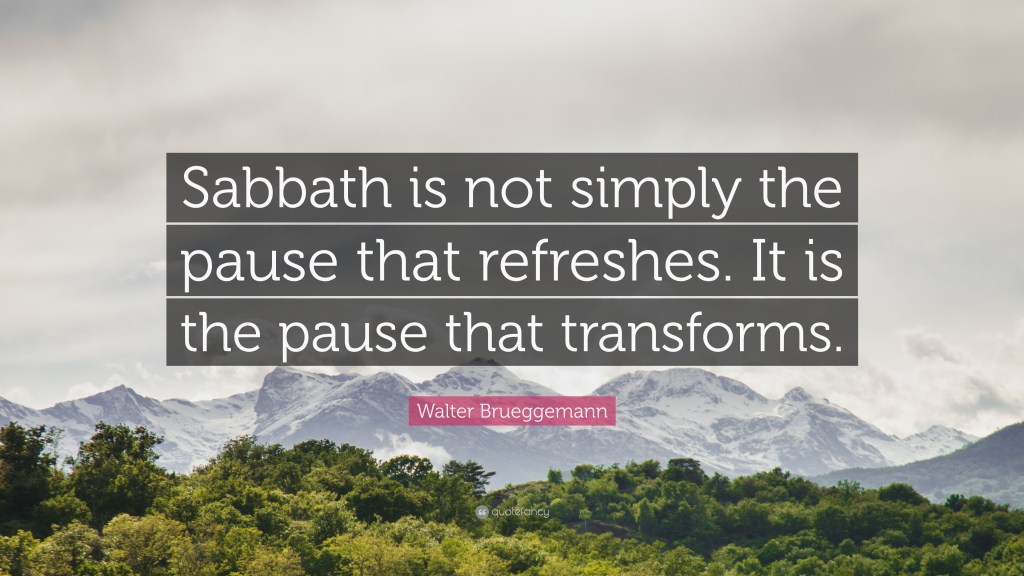
Our continual well-being and rest are not optional; it is absolutely essential.

If a car is driven day-after-day and never gets an oil change, the engine will eventually seize and die. And if a person insists on driving their life every day with continual work, and never practices a Sabbath rest, that person will inevitably burn-out and die an early death. 

In this busy world, far too many persons are putting the pedal-to-the-metal with no thought to the consequences, and no plan for any kind of Sabbath rest. Many people throughout the modern world are slowly draining their souls, causing themselves physical harm, and are on the precipice of emotional and spiritual death.

Perhaps you raise a Mr. Spock eyebrow and wonder if I am being too dramatic. Yet, if we are to take today’s Old Testament lesson seriously, we will see that all of life is to be governed by a healthy rhythm of life which benefits both the individual and the community.

Yes, I fully understand that neither the contemporary person nor the Christian is currently living under ancient Israelite law. However, every single law in the Old Testament is grounded in the character of God. 

This means that, although we may not be obliged to hold the detailed specifics of the seven years system and a year of Jubilee, we are still beholden to observe a Sabbath rhythm of rest because God rested. And we ignore this built-in rhythm to our own peril.

Sometimes I watch the news, see all the upset people at one another and think, “Dude, you really need to sit down, relax, and have a sandwich. Just take a breath, man!” I sometimes wonder if God looks down from heaven at all the world’s conflicts and sees the people involved as a bunch of toddlers who simply need a snack and a nap.

Just as God loves, we are to love. As God is holy, so we are to be holy. And the same holds true for a Sabbath rest. Just as God rested from all the work of creating the world, so we, too, are to rest from our work. Laboring 24/7 will only give us regrets, not results.

If I haven’t been explicit enough, I will say it plainly: We are commanded by God to rest.

It is high time we begin building into our weekly planners, smartphone calendars, and long-range goals, a deliberate and purposeful inclusion of Sabbath rest. 

That means not just doing this biblical rest thing once-in-a-while, that is, if I can fit it in somewhere. A complete Sabbath rest entails making it a real actual event on a regular basis in our life, on our calendars. No excuses, no fudging of appointments, and no lame *sigh* about how busy we are. 

Set aside time today to build a Sabbath into your schedule for the rest of the year, and maybe beyond. I’m not saying this is at all easy; in fact, it is terribly hard for me to get this practice into my own life. 

Because I am a church pastor, hospital chaplain, husband, father, and grandfather, my times of scheduling meetings, events, and visits looks more like a Sudoku puzzle than a calendar. Engrafting some serious biblical rest into my life sometimes feels like hacking through a jungle, looking frenetically for some time.

But, without that rest, I am much less the person I need to be for all the people and responsibilities I care for. The people in my life deserve better than that. They don’t need my leftovers. And I suspect the people in your life want you to rest, too, because you matter to them.

Creator God, you formed the earth in six days and then rested on the seventh. Help me not to put Sabbath on some wish list of things to do someday but enable me to practice it with courage and without apology, through the name of Jesus, I live and pray. Amen.