Revelation 11:15 – He Will Reign Forever

The seventh angel sounded his trumpet, and there were loud voices in heaven, which said:

“The kingdom of the world has become
    the kingdom of our Lord and of his Messiah,
    and he will reign for ever and ever.” (New International Version)

I am so looking forward to that day!

As an ordained Minister, I have done my share of weddings over the years. Working with engaged couples anticipating marriage is both exciting and awkward. It is, in some ways, a difficult time for the betrothed because they are committed to one another in a manner different from just dating. But they are not yet in a marriage relationship. 

The same is true for the Church. She is betrothed to the Lord Jesus. They are both quite committed to each other. But the marriage hasn’t yet happened. There is still this engagement period. We’re ready for permanent unending marital bliss.

The kingdom of God has been inaugurated, but not yet consummated. That’s a fancy way of saying that God’s rule and reign has come to this earth, but its fulfillment has not yet occurred. 

This present time we are now experiencing between the two advents of Christ – his incarnation and his coming again – is a weird and awkward time of engagement. We’re trying to figure out how to live in the world but not of it. 

Yet, there is a time coming at the consummation of the ages, at the end of time, when Christ will return to take his bride. Then, the Church will celebrate in a great wedding feast, the marriage supper of the Lamb. From then on, the kingdom of the world becomes the kingdom of our Lord, and he will reign forever and ever.

Just as marriage is designed for permanence, so our union with Jesus will last forever. His gracious and benevolent reign shall never end. Christ’s rule will be complete and extend over all the earth. 

Until then, however, believers must patiently persevere with fidelity to our Lord Jesus, who loved us and gave himself up for us.

Slow and steady is better than nothing at all.

We keep going, despite all obstacles, adversity, difficulty, and discouragement – without comparing ourselves to others or making everything a competition.

Let us throw off everything that hinders and the sin that so easily entangles. And let us run with perseverance the race marked out for us, fixing our eyes on Jesus, the pioneer and perfecter of faith. For the joy set before him he endured the cross, scorning its shame, and sat down at the right hand of the throne of God. Consider him who endured such opposition from sinners, so that you will not grow weary and lose heart. (Hebrews 12:1-3, NIV)

Persevering to the end is the goal, not being perfect all the time. Perfection is the sure road to depression and feeling defeated. Endurance, however, is able to focus on the small efforts of each day to get where it wants to go.

Even though we anticipate our eternal life, that very life has already begun, right now. So, we can live with confidence, knowing the Lord is with us.

Be strong and courageous; do not be frightened or dismayed, for the Lord your God is with you wherever you go. (Joshua 1:9, NRSV)

Perseverance can only happen with physical, mental, emotional, as well as spiritual health. We compromise our ability to keep going and remain encouraged with a lack of self-care.

We need to pay attention to our bodies because they are the vehicles by which we do the will of God.

We must attend to our minds because that is where we do battle with the enemy.

We have got to become comfortable with talking about feelings because we are emotional creatures, created by a God with deep feeling and emotion.

And we are to be disciplined with spiritual practices, just as we are with anything which requires our attention.

Exercise daily in God—no spiritual flabbiness, please! Workouts in the gymnasium are useful, but a disciplined life in God is far more so, making you fit both today and forever. You can count on this. Take it to heart. This is why we’ve thrown ourselves into this venture so totally. We’re banking on the living God, Savior of all men and women, especially believers. (1 Timothy 4:8-10, MSG)

In those times we are confused or just don’t know what the heck to do, we turn to the Lord.

With all your heart
you must trust the Lord
    and not your own judgment.
Always let him lead you,
and he will clear the road
    for you to follow. (Proverbs 3:5-6, CEV)

Keep moving. The Lord will direct you. The kingdom is coming in all its fullness.

Gracious heavenly Father, may we never lose the way through our self-will, and so end up in the far countries of the soul. May we never abandon the struggle, but endure to the end, and so be saved. May we never drop out of the race, but continually press forward to the goal of our high calling.

May we never choose the cheap and temporary things and let go the precious things that last forever. May we never take the easy way, and so leave the right way. May we never forget that sweat is the price of all things, and that without the cross, there cannot be the crown.

So, almighty and everlasting God, keep us and strengthen us by your grace so that no disobedience and no weakness and no failure may stop us from entering into the blessedness which awaits those who are faithful in all the changes and chances of life, through Jesus Christ our Lord. Amen.

Psalm 122 – A Spiritual Journey

I was glad when they said to me,
“Let’s go to the house of the Lord.”
Our feet are standing inside your gates, Jerusalem.
Jerusalem is built to be a city
where the people are united.
All of the Lord’s tribes go to that city
because it is a law in Israel
to give thanks to the name of the Lord.
The court of justice sits there.
It consists of princes who are
David’s descendants.

Pray for the peace of Jerusalem:
“May those who love you prosper.
May there be peace inside your walls
and prosperity in your palaces.”
For the sake of my relatives and friends, let me say,
“May it go well for you!”
For the sake of the house of the Lord our God,
I will seek what is good for you. (God’s Word Translation)

The spiritual life is a pilgrimage—a journey of constant growth, sacrifice, and faith in what we cannot see. As both pilgrims and disciples, we continually move and learn.

The biblical psalms of ascent (Psalms 120-134) were sung by worshipers as they made the journey to Jerusalem for the annual feasts, and up the temple mount to unite together in worship.

Many pilgrims spent hours and/or days walking to the holy city. In the great anticipation of collective worship, the people quoted and sang the several psalms of ascent together. They enjoyed the journey.

I once spent some time reading the journals of several medieval Christian pilgrims who went to various holy sites in Europe, and some who even made the trek all the way to Jerusalem – on foot. Early in their journals, they mostly wrote about the anticipation of reaching their destination. These pilgrims went into great detail about the hospitality they encountered, and friends made along the way.

I was struck, however, with the profound lack of space and detail devoted to visiting the actual holy site – especially when they returned home and reflected on their experiences. The vast majority of pilgrims had the journey itself as their most memorable time.

Of course, we all can worship individually and personally anywhere and anyplace. Yet, if we want to have worship experiences which truly shape our spiritual lives, then we will need to have plenty of corporate encounters with fellow pilgrims on the same path as us.

Within today’s psalm, we are told that part of Israel’s decree in approaching the Lord is to give thanks. The Jewish pilgrims were to have an attitude of gratitude when they came to Jerusalem and the house of God. Each pilgrimage to Jerusalem was to have a marked expression of thanksgiving to God for giving them a place to worship and a land to dwell within.

I cannot help but wonder if attending church services would be much more appreciated and impactful if we took the mental and emotional posture of gratitude when approaching worship. 

Within some church buildings and sacred spaces there is a flight of stairs that one must ascend to reach the sanctuary. Slowly going up the stairs, we can give thanks for one thing in each step. Even if you attend a church with a zero entry, you can still give thanks to God while walking from the parking lot to the building. 

The point is that the worship of God needs some thought and intent behind it. Simply showing up and flopping down in a seat – almost daring the worship leaders and/or pastor to bless them – is far from the imagination the psalmist had for approaching a sovereign God.

Pilgrimage is about more than a long walk. It’s about the soul in community with others and God.

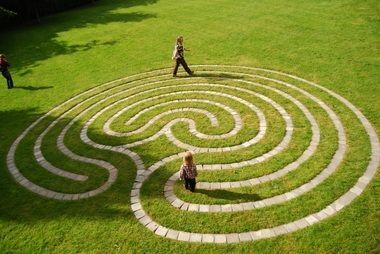
One way of being a pilgrim close to home is through walking a Labyrinth – an ancient practice of the Church meant for spiritual centering, contemplation, and prayer.

Entering the serpentine path of a Labyrinth, one walks slowly while quieting the mind and focusing on a spiritual question or prayer. A Labyrinth is not a maze. It has only one winding path to the center and back out. 

The wisdom of the Labyrinth is that it reflects the way life actually is – that our lives are not about the destination but about the long circuitous journey. The Christian life is consistently described in the New Testament as a road or a way. We walk with Jesus.

Labyrinths can be found within some church buildings, on church grounds, in hospitals, or park spaces. There are also “finger” Labyrinths. Rather than physically walking, the pilgrim can slowly trace the path on a paper or small Labyrinth object with a finger. 

You might also get creative and make your own homemade Labyrinth within a space of your home or out in the yard. labyrinthsociety.org has free printable Labyrinths, as well as a virtual Labyrinth walk.

The Labyrinth is not meant to be a race to the center; it only “works” if we move at a pace which enables us to meditatively pray, paying attention to what God is doing within us. Generally, there are four stages to the walk:

  • Releasing on the way toward the center – letting go of all that weighs us down in the Christian life.  “Let’s throw off any extra baggage, get rid of the sin that trips us up, and fix our eyes on Jesus, faith’s pioneer and perfecter.” (Hebrews 12:1-2, CEB)
  • Receiving in the center – accepting the love God has for you. Jesus said, “Ask and you will receive, so that your joy may be complete.” (John 16:24, NRSV)
  • Returning through following the path back out – integrating what you have received for the life of the world. “I will give them a heart to know me, God. They will be my people and I will be their God, for they will have returned to me with all their hearts.” (Jeremiah 24:7, MSG)
  • Responding to the love of God through gratitude – thus finding joy, even in the most troubling of circumstances. “O give thanks to the Lord, for he is good; his steadfast love endures forever!” (Psalm 118:1, NRSV)

The penitent heart will resonate deeply with the psalms as worship liturgy. This is because liturgical practices impress the spirit and bring spiritual freedom.

Walking together in a common spiritual journey is like going through a gate into a new reality and rejoicing with all the other redeemed pilgrims who are walking the road to Jerusalem.

Lord Jesus Christ, you call me to follow you, and I choose to walk with you. Open the eyes of my heart to see my life in a new way. With each step I take, help me to be open to change. As I walk this pilgrimage, give me the grace to journey deliberately and patiently. Amen.

Everyone Can Juggle

“Say, what?” you may protest. “I can’t juggle. I can’t learn that. I’m not coordinated, not rhythmic, not graceful, not _____.” (fill in the blank with your own negative)

I’m not buying it. I insist everyone can juggle, without exception. Yes, even the elderly, the young, those with severely arthritic hands and no hands, at all, can juggle. This is no mind game. It’s not playing with words.

Everyone can juggle because there is a juggler inside of every person.

God is Creator. People are creatures, created in the image and likeness of God. God is a juggler. And so are you and me.

It comes down to what kind of story we are telling ourselves.

For example, if there is a narrative rolling around in your head that you are stupid, even though you may be very intelligent, you will live up to the story of being unintelligent. The life you live will be as an incompetent nincompoop.

So, what is the story you are telling yourself about yourself?

Juggling takes practice. I can teach anyone to juggle in three minutes, or less. After that, it’s all about doing it – lots and lots of repetition and practice. It takes time, patience, and tenacity – the very qualities required to do just about anything.

Which you have done multiple times in your life, already. Sometimes we all need to remember when we did something well, when we committed to the time and effort of accomplishing an important task or project.

There is nothing glamorous about learning to juggle, and certainly not about becoming proficient at it. It is tedious, pedantic, and at times, frustrating work. It takes an overarching, “Why?”

If I want to juggle because it looks cool, and I’d like to impress friends, then I likely will not stick with it. If I believe it can be done in a relatively short amount of time, then I’ll probably become discouraged and drop out.

Yet, if I discover I really like to juggle, and I want to do it, that in the doing of this new thing I am finding out some things about myself I didn’t know before – or even that when I juggle, even imperfectly, I learn something about God – well, then, this is a “why” which has sustaining power.

Yes, indeed, everyone can juggle. There is a juggler inside each and every one of us. The real issue is whether we actually believe that is true, and whether we really have a solid internal reason for doing so.

So, let’s come back to that weird part about what I said above – that even people without an ability to lift their arms (or with no arms, at all) can juggle. It has to do with our definition of juggling. Here is the straight up dictionary definition of the words, “juggle,” “juggling,” and “juggler:”

To keep (several objects, as balls, plates, tenpins, or knives, etc.) in continuous motion in the air simultaneously by tossing and catching.

To perform feats of manual or bodily dexterity, as tossing up and keeping in continuous motion a number of balls, plates, knives, etc.

A person who performs juggling feats, as with balls or knives, etc.

One little word makes the difference here: etcetera. (etc.)

I’m actually not going to answer my own question or make explicit my point. I’ll let you fill it in yourself because I am confident you can do so. You are creative.

You’ll figure it out.

What we all really need is just enough direction to get our creative abilities going, without so much instruction that it becomes controlling (like a boss looking over your shoulder and just barking orders when you screw up).

Developing a skill or a craft is different than becoming a professional or doing a job. The real work is both internal and most often out of the limelight. It’s a commitment to a process, more than it is a means to an end goal. A process cannot be rushed; there must not be shortcuts. And, unless we learn to enjoy the process, we end up doing shoddy work.

The construction of a person’s soul is a lifelong project.

It requires becoming aware of one’s deep inward spirituality. Solitude, silence, and stillness are imperative to forming the soul.

I am a Christian. As such, I want to know Christ better. For that to happen, I need to pay attention to and care for my soul.

Throughout the history of Christianity, much attention has been given to the care of souls. Early church fathers (and mothers) such as Gregory the Great (540-604, C.E.) took great pains to describe ministerial work as offering moral and spiritual guidance to both the churched and unchurched, both Christian and non-Christian.

In 1656, Puritan preacher Richard Baxter wrote a book, The Reformed Pastor, which set the standard of pastoral care for generations. Baxter elaborated on seven functions of crafting souls (stated in my own words):

  1. Helping others connect with their spiritual selves;
  2. Giving sage spiritual direction;
  3. Building up people with careful and encouraging words;
  4. Attending to church, family, and group dynamics;
  5. Providing special focus to the needy, the sick, and the dying;
  6. Holding people accountable for their words and actions;
  7. Setting proper spiritual boundaries to keep harmful words and actions at bay within the community.

There is nothing sexy about any of these functions. It is humble nitty-gritty work which typically goes unnoticed by many because it is a slow process over time.

As a Christian who is concerned for the construction of souls, I take my cues from the Christian Bible. There are many references to “one another” in the New Testament which highlight the spiritual dynamics and proper environment needed for souls to thrive. Just a few of the most mentioned are: 

  • Encouragement
  • Mutual edification
  • Love
  • Forgiveness
  • Hospitality

Within the New Testament Gospels of Jesus, Christ modeled a life of spiritual practice which include healing, teaching, guiding, and mending damaged and broken souls. These were all a part of his mission to bring God’s benevolent kingdom to earth.

Like a proper garden, we need to continually tend to our soul, which requires the consistent spiritual farming of daily Scripture reading and prayer, practicing Sabbath rests, silence and solitude, fasting, and giving.

Our souls need careful shepherding. We are to be vigilant toward attending to our spiritual selves, as well as the souls of others – not because we must, but because we are willing.

You can do this. After all, you are a juggler!

Hebrews 2:1-9 – Pay Attention

We must pay the most careful attention, therefore, to what we have heard, so that we do not drift away. For since the message spoken through angels was binding, and every violation and disobedience received its just punishment, how shall we escape if we ignore so great a salvation? This salvation, which was first announced by the Lord, was confirmed to us by those who heard him. God also testified to it by signs, wonders and various miracles, and by gifts of the Holy Spirit distributed according to his will.

It is not to angels that he has subjected the world to come, about which we are speaking. But there is a place where someone has testified:

“What is mankind that you are mindful of them,
    a son of man that you care for him?
You made them a little lower than the angels;
    you crowned them with glory and honor
    and put everything under their feet.”

In putting everything under them, God left nothing that is not subject to them. Yet at present we do not see everything subject to them. But we do see Jesus, who was made lower than the angels for a little while, now crowned with glory and honor because he suffered death, so that by the grace of God he might taste death for everyone. (New International Version)

In my line of work as a hospital chaplain on a behavioral health unit, I frequently deal with patients who have brain disorders. Many of them, including many in my own family, have Attention Deficit Disorder (A.D.D.). Many people believe this to be a disadvantage.

Yet, I have noticed that since their brain chemistry doesn’t have a good filter for sifting all the stimuli they hear each day, many A.D.D. folks are quite intentional about picking out the voice they want to hear and engaging with it. Whereas others might take this for granted, the patients in my life know the value of creating the skills to pay attention.

The ability to pay attention and listen is necessary for a successful and sustainable Christian life.

The consequence of not developing such competency is that we will drift away – our minds will wander and allow other competing voices to overwhelm the singular voice of Jesus. Taking salvation for granted may subversively set us up for spiritual failure.

Whenever we think we already know about Christ’s person and work, we neglect to really pay attention. Bad idea.

Assuming we are paying attention is not the same thing as actually doing it. Assumptions create a slow drift away from truth. Therefore, we need continual reminders of Christ’s redemptive events. 

We must avoid the precarious position of being lost in a sea of competing voices.

We need an intentional plan for paying attention – without assuming we will be focused. Here are a few ways of daily mindfulness so that we will not become S.A.D.D. (Spiritual Attention Deficit Disorder):

  • Read Holy Scripture each day with a combination of standing and sitting, reading silently and out loud.
  • Hold a cross or other Christian reminder in your hand and feel free to fidget with it.
  • Journal your thoughts in a notebook.
  • Set a consistent time and place for spiritual reading and prayer.
  • Use different translations and versions of the Bible to read.
  • Go outside occasionally and pray while walking.
  • Focus on your breathing, and consider using breath prayers (i.e., Breathe out: “Speak Lord.” Breathe in: “I am listening.”)
  • Drink some coffee, tea, or something soothing, and picture the comfort of Christ coming into your life.
  • Be aware of distractions and acknowledge them without judging yourself.
  • Observe the Christian Year and the Daily Lectionary.

While some might argue that observing Lectionaries, the Church Calendar, Christian seasons, and worship liturgies are vain repetition, I insist otherwise: We are in grave danger of not paying attention to what we have heard, lest we drift away from it. 

Like a beach-goer on the lake drifting on her flotation device far out from shore, we can be unaware of how far we have strayed from our spiritual moorings.  If the passion and death of Jesus can only get a shoulder shrug and a “meh” out of us, there is a real problem.

Forming habits of worship, fellowship, service, and piety are essential to deliberately maintaining attention to Jesus. Perhaps if we all felt S.A.D.D. we would be more intentional about grafting reminders and practices into our lives.

Ignorance does not come from a lack of education; it comes from a failure to pay attention to the most important things in life.

God pays attention to us in a special way, different from all other creation. As the only creatures for whom the image and likeness of God resides, we have an innate sense of connection with the divine. Paying attention to things, especially to what Christ has secured for us through the cross, reflects the God who is continually observing humanity.

May your contemplation of Christ and his redemptive events of incarnation, holy life, teaching, death, resurrection, and ascension be always fresh and continually meaningful.

God, as You speak through scriptures, whispers, dreams, circumstances, nature, and people in our lives, help us to pay attention to Your voice. May we hear You in the many ways You communicate. May we pay attention to the important and the urgent and may we choose wisely. May we live attentively today.