Leviticus 25:1-19 – Your Well-Being Is a Priority to God

And the Lord spoke to Moses on Mount Sinai, saying, “Speak to the children of Israel, and say to them: ‘When you come into the land which I give you, then the land shall keep a sabbath to the Lord. Six years you shall sow your field, and six years you shall prune your vineyard, and gather its fruit; but in the seventh year there shall be a sabbath of solemn rest for the land, a sabbath to the Lord. You shall neither sow your field nor prune your vineyard. What grows of its own accord of your harvest you shall not reap, nor gather the grapes of your untended vine, for it is a year of rest for the land. And the sabbath produce of the land shall be food for you: for you, your male and female servants, your hired man, and the stranger who dwells with you, for your livestock and the beasts that are in your land—all its produce shall be for food.

‘And you shall count seven sabbaths of years for yourself, seven times seven years; and the time of the seven sabbaths of years shall be to you forty-nine years. Then you shall cause the trumpet of the Jubilee to sound on the tenth day of the seventh month; on the Day of Atonement, you shall make the trumpet to sound throughout all your land. And you shall consecrate the fiftieth year and proclaim liberty throughout all the land to all its inhabitants. It shall be a Jubilee for you; and each of you shall return to his possession, and each of you shall return to his family. That fiftieth year shall be a Jubilee to you; in it you shall neither sow nor reap what grows of its own accord, nor gather the grapes of your untended vine. For it is the Jubilee; it shall be holy to you; you shall eat its produce from the field.

‘In this Year of Jubilee, each of you shall return to his possession. And if you sell anything to your neighbor or buy from your neighbor’s hand, you shall not oppress one another. According to the number of years after the Jubilee you shall buy from your neighbor, and according to the number of years of crops he shall sell to you. According to the multitude of years you shall increase its price, and according to the fewer number of years you shall diminish its price; for he sells to you according to the number of the years of the crops. Therefore, you shall not oppress one another, but you shall fear your God; for I am the Lord your God.

‘So, you shall observe My statutes, keep My judgments, and perform them; and you will dwell in the land in safety. Then the land will yield its fruit, and you will eat your fill, and dwell there in safety. (New King James Version)

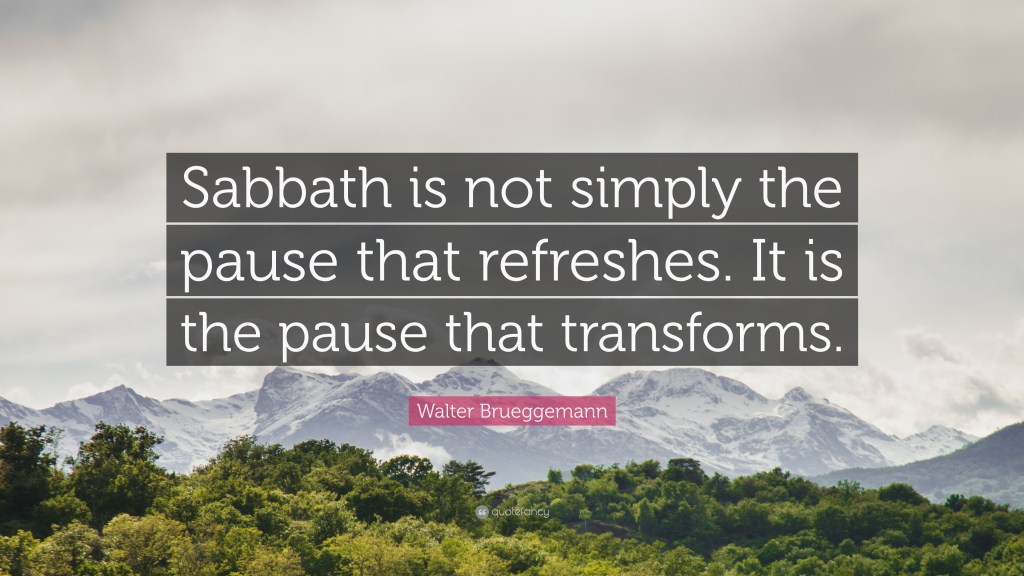
Our continual well-being and rest are not optional; it is absolutely essential.

If a car is driven day-after-day and never gets an oil change, the engine will eventually seize and die. And if a person insists on driving their life every day with continual work, and never practices a Sabbath rest, that person will inevitably burn-out and die an early death. 

In this busy world, far too many persons are putting the pedal-to-the-metal with no thought to the consequences, and no plan for any kind of Sabbath rest. Many people throughout the modern world are slowly draining their souls, causing themselves physical harm, and are on the precipice of emotional and spiritual death.

Perhaps you raise a Mr. Spock eyebrow and wonder if I am being too dramatic. Yet, if we are to take today’s Old Testament lesson seriously, we will see that all of life is to be governed by a healthy rhythm of life which benefits both the individual and the community.

Yes, I fully understand that neither the contemporary person nor the Christian is currently living under ancient Israelite law. However, every single law in the Old Testament is grounded in the character of God. 

This means that, although we may not be obliged to hold the detailed specifics of the seven years system and a year of Jubilee, we are still beholden to observe a Sabbath rhythm of rest because God rested. And we ignore this built-in rhythm to our own peril.

Sometimes I watch the news, see all the upset people at one another and think, “Dude, you really need to sit down, relax, and have a sandwich. Just take a breath, man!” I sometimes wonder if God looks down from heaven at all the world’s conflicts and sees the people involved as a bunch of toddlers who simply need a snack and a nap.

Just as God loves, we are to love. As God is holy, so we are to be holy. And the same holds true for a Sabbath rest. Just as God rested from all the work of creating the world, so we, too, are to rest from our work. Laboring 24/7 will only give us regrets, not results.

If I haven’t been explicit enough, I will say it plainly: We are commanded by God to rest.

It is high time we begin building into our weekly planners, smartphone calendars, and long-range goals, a deliberate and purposeful inclusion of Sabbath rest. 

That means not just doing this biblical rest thing once-in-a-while, that is, if I can fit it in somewhere. A complete Sabbath rest entails making it a real actual event on a regular basis in our life, on our calendars. No excuses, no fudging of appointments, and no lame *sigh* about how busy we are. 

Set aside time today to build a Sabbath into your schedule for the rest of the year, and maybe beyond. I’m not saying this is at all easy; in fact, it is terribly hard for me to get this practice into my own life. 

Because I am a church pastor, hospital chaplain, husband, father, and grandfather, my times of scheduling meetings, events, and visits looks more like a Sudoku puzzle than a calendar. Engrafting some serious biblical rest into my life sometimes feels like hacking through a jungle, looking frenetically for some time.

But, without that rest, I am much less the person I need to be for all the people and responsibilities I care for. The people in my life deserve better than that. They don’t need my leftovers. And I suspect the people in your life want you to rest, too, because you matter to them.

Creator God, you formed the earth in six days and then rested on the seventh. Help me not to put Sabbath on some wish list of things to do someday but enable me to practice it with courage and without apology, through the name of Jesus, I live and pray. Amen.

Luke 11:33-36 – Life Goals

Photo by Taryn Elliott on Pexels.com

“No one lights a lamp and puts it in a place where it will be hidden, or under a bowl. Instead, they put it on its stand, so that those who come in may see the light. Your eye is the lamp of your body. When your eyes are healthy, your whole body also is full of light. But when they are unhealthy, your body also is full of darkness. See to it, then, that the light within you is not darkness. Therefore, if your whole body is full of light, and no part of it dark, it will be just as full of light as when a lamp shines its light on you.” (New International Version)

We don’t typically frame our words in a phrase like, “Your eye is the lamp of the body.” The idea of healthy or unhealthy eyes as determining how well we are doing might seem weird or awkward to us. We need to keep in mind that Jesus the Jew communicated in distinctly Jewish ways. Speech was often expressed in metaphors and word pictures. 

The word “body” serves as a way of saying “life” and the word “eye” represents our contemporary word “goal.” So, then, let’s restate the verse: “Your goals determine the direction of your life. When your goals are good, your entire life is healthy, but when your goals are bad, it messes up your life.”

Our goals, whether stated or unstated, set the focus and direction of our lives. If the orientation of our lives is the pursuit of selfish gain and temporary satisfaction, then we will move in that direction, and it will not end well. However, if our goals are toward God and the accomplishment of God’s will, then we will be light for the world. It’s all a matter of focus and where we set our attention.

But more than anything else, put God’s work first and do what he wants. Then the other things will be yours as well.

Jesus (Matthew 6:33, CEV)

In our goal setting, we are to be careful, deliberate, and sensitive to the ways of Jesus. That means Christians will focus on the kind of people they want to be, that is, like Jesus Christ. Instead of simply making big resolutions, we can implement small decisions, practiced every day, which will help us grow spiritually.

For example, if we have some besetting sin which tends to dog us, we might try to summon the willpower and energy to take it on. On some days, that works. On most days, it doesn’t. That’s because if we maintain the same daily habits that led to being ensnared in sin, we’ll continually be looking for that unusual burst of energy to overcome that sin.

We need a new system of living. If we imagine our lives as a house, and a room in your house needs a complete restoration and makeover, it won’t do to enthusiastically rearrange the furniture. It’s a superficial goal which doesn’t address the systemic change of habits needed to thoroughly reform that area of your life.

And if we try and change our results, our sinful actions, chronic failure is likely in our future. What we really need to change are the systems that cause those results. When we solve problems at the results level, it’s only a temporary fix.

In order to have some permanent improvement, we need to solve problems at the systems level. That’s why problems like racism, poverty, hunger, and a thousand other issues will never be truly solved unless there is a complete transformation of the systems which keep people locked into those tragic situations.

We need some good healthy biblical goals. And we equally need a reformation of habits to actually realize those worthy goals.

Our goals need not be big and audacious; they just need to be consistent with living the Christian life according to the words and ways of Jesus. That means choosing one thing and ruthlessly eliminating everything else. We don’t really need more time to accomplish the will of God; we simply need to decide that we are following Jesus. Spiritual growth and maturity happen not with more but with less.

Jesus said, “I am the true grapevine, and my Father is the gardener. He cuts off every branch of mine that doesn’t produce fruit, and he prunes the branches that do bear fruit so they will produce even more.” (John 15:1-2, NLT)

Proper goals bring us into the light. And when we establish a routine rule of daily life – small practices of faith done every day – then our light can shine in the darkness of the world.

Loving Lord Jesus, help me to set my life’s gaze on the living and doing of your teaching. Enable me to set godly and worthy goals and grant me the power to see them realized through your Holy Spirit.  Amen.

1 Timothy 4:6-16 – Build Your Faith Muscle

If you point these things out to the brothers and sisters, you will be a good minister of Christ Jesus, nourished on the truths of the faith and of the good teaching that you have followed. Have nothing to do with godless myths and old wives’ tales; rather, train yourself to be godly. For physical training is of some value, but godliness has value for all things, holding promise for both the present life and the life to come. This is a trustworthy saying that deserves full acceptance. That is why we labor and strive, because we have put our hope in the living God, who is the Savior of all people, and especially of those who believe.

Command and teach these things. Don’t let anyone look down on you because you are young, but set an example for the believers in speech, in conduct, in love, in faith and in purity. Until I come, devote yourself to the public reading of Scripture, to preaching and to teaching. Do not neglect your gift, which was given you through prophecy when the body of elders laid their hands on you.

Be diligent in these matters; give yourself wholly to them, so that everyone may see your progress. Watch your life and doctrine closely. Persevere in them, because if you do, you will save both yourself and your hearers. (New International Version)

There are several metaphors throughout the New Testament illustrating the nature of the Christian life and Christian community.

God’s people are the temple of the Holy Spirit, the house where the Lord dwells; the Body of Christ, a group working together and strengthening one another in faith; the army of the Lord, advancing with the shared purpose of proclaiming good news and extending God’s benevolent rule – just to name a few.

All the metaphors are embedded with the need for training, for spiritual disciplines and practices which strengthen faith and promote spiritual health.

Just as an army of recruits needs intense basic training and ongoing discipline; and just as the body needs hourly movement and daily exercise of its muscles; so, Christian communities require spiritual development with a variety of forms and functions to elicit and establish a solid godly life.

The curriculum in the school of faith, the liturgy within the spiritual temple, the boot camp for the Lord’s soldier, and the sets and repetitions for Christ’s Body are reading and listening to Scripture with a life rhythm of personal and corporate integrity, confident faith, steadfast love, encouraging words, and virtuous behavior.

If we dedicate ourselves to these things, there will be no room for entertaining wacky stories which have no basis in truth. Instead, there will be lush spiritual growth, teachable spirits, humble service, supportive beliefs, compassionate ministry, and open fellowship.

The high values of our faith need to be both used and guarded. Our treasured possessions, whatever they may be, are handled appropriately and carefully – being kept in a secure place when not used – and being used with care when out.

Our faith, our life and doctrine, is both a precious possession, as well as a necessary muscle to do the will of God. Like our own physical muscles, faith needs to be stretched, exercised, rested, and supplied with plenty of protein and necessary nutrients. Overtaxed muscles will fatigue and can be damaged through too much exertion. And underused muscles will wither and atrophy, unable to handle even the smallest of strain when we need them.

So, it is best to have proper spiritual hygiene and exercise through a regimen of tried and true practices designed to improve and maintain healthy faith. If you want to build your faith, consider the following 10 ways:

  1. Increase your amount of reading. There is no substitute for daily repetitions of reading the Bible. Supporting a growing faith will require more voluminous reading.
  2. Focus on listening to the biblical text. Reading is only as good as our listening skills. For the Christian, paying attention to the Holy Spirit’s gentle whispers is a must.
  3. Decrease your media time. For all the good stuff out there, a lot of media information is based in myth, half-truths, and opinions masked as facts – not to mention all the hack and huckster preachers.
  4. Pray more. In fact, pray continually.
  5. Practice gratitude – not complaining. Need I say more?
  6. Snack on good spiritual reading. Consuming a good book before bed keeps the faith muscle fed longer.
  7. Rest! When God created and instituted seven days, the first day was a day of rest; the workdays came after. Don’t flip-flop the divine order.
  8. Supplement with good spiritual conversation. Half-baked theological ideas come from remaining in one’s own cave-like head. Consultation, collaboration, and fellowship help create a rich and full faith.
  9. Don’t overtrain. Good idea: Read the Bible in a year. Bad idea: Read the Bible in a month. Good idea: Digest the contents of ecumenical Creeds and church Confessions. Bad idea: Stuff a bunch of knowledge down your gullet without any love to wash it down. Savor the meal. Don’t be a pig.
  10. Don’t lift too heavy for your faith muscle. The ancient desert fathers spent years developing their faith and could do incredible feats of spiritual strength. Christianity isn’t a competition of keeping up with the Francis of Assisi’s and Martin Luther’s of history. Use the measure of faith given to you and focus on those small daily decisions of trust.

Christianity is a marathon, not a 100-meter sprint. We persevere to the end, not flame out after taxing ourselves with expectations and responsibilities God never gave us.

Be safe. Be strong. Be smart. Be spiritual. We are all in this together.

Gracious God, fill your Church with truth, the truth with peace, and the peace with love. Where our faith is weak, make it strong; where it is misguided and in error, correct and direct it; where it is amiss, reform it; where it is in want, provide for it; where it is divided, reunite it, for the sake of Jesus Christ your Son our Savior. Amen.

Luke 15:1-7 – Lost and Found

Tax collectors and sinners were all crowding around to listen to Jesus. So, the Pharisees and the teachers of the Law of Moses started grumbling, “This man is friendly with sinners. He even eats with them.”

Then Jesus told them this story:

If any of you has a hundred sheep, and one of them gets lost, what will you do? Won’t you leave the ninety-nine in the field and go look for the lost sheep until you find it? And when you find it, you will be so glad that you will put it on your shoulder and carry it home. Then you will call in your friends and neighbors and say, “Let’s celebrate! I’ve found my lost sheep.”

Jesus said, “In the same way there is more happiness in heaven because of one sinner who turns to God than over ninety-nine good people who don’t need to.” (Contemporary English Version)

Lost people matter to God… a lot!

From God’s perspective, it really doesn’t matter why a sheep has strayed from the flock. That stuff only matters to us. It seems many folks only believe a person is worth going out and looking for after we have properly deemed them worthy of pursuing.

“They made their bed; now they need to sleep in it,” “You reap what you sow,” and “They don’t want to be found,” are all human contrived justifications for letting a strayed sheep remain in the wilderness, vulnerable to the wolves.

The mercy of God makes no distinctions between a person who purposely leaves and squanders their resources, and one who accidentally wanders off because of hardship which wasn’t their fault. Lost is lost. Mercy is mercy, period.

Lost people matter so much to God that one lost soul is worth sending out the hounds of heaven to find them. And, once found, becomes the ground for a big celestial party! 

Please note this simple observation of today’s Gospel reading: If there is rejoicing in the presence of angels in heaven over one sinner who repents, then who is doing the rejoicing?  God!  God is crazy giddy with joy over one lost person being found. 

Celebration is a spiritual discipline.

Yes, indeed, it is. Celebration is an important activity for the Church and for believers everywhere. Just as pursuing lost people is a spiritual practice and a skill to be developed, so celebration is a spiritual discipline which needs time, attention, and resources.

But the religious insider might doth protest, why care about this, especially the celebration? Aren’t we being faithful already, and properly focusing on Scripture, sacrament, worship, and prayer? Isn’t this just all a waste of our limited time, energy, and assets?

Short answer: We celebrate because God celebrates.

God throws the best parties, filled with plenty of joy and recognition of persons restored to fellowship.

As people created in the image and likeness of God, we are hardwired for celebration. If God can go uncorked with joy and celebration, I’m going to say with confidence that open unabashed blowouts rejoicing over people’s transformation and new life is welcome and expected.

Folks baptized in pickle juice can join the grumbling of all the high mucky-muck dudes who smugly look down on the marginal persons among us. Hopefully, the party-poopers won’t be heard because of all the noise at God’s party.

This parable of Jesus is meant to give us a glimpse of God’s own heart. 

God would do anything to find a lost person, to restore and reconcile a person to relational connection. God would go dumpster diving and wade through the stinky nasty garbage to find that one lost valuable person.

Why should reaching out to marginal people with the grace and love of Jesus Christ be a high priority? 

Because restoring lost people is a high priority for God. 

God has placed the highest of priorities on recovering those who are spiritually lost and wandering around life without a purpose or a place to call home. Such people matter so much that God sent the Son, Jesus, to this earth. 

Christ went to the greatest lengths possible through enduring a cruel death on a cross in order to reconcile a broken lost relationship between people and God.

I still remember what it felt like to be separated from God and estranged from the church – it was lonely and sad, like being in a deep black hole with no way of getting out and no one around to help. 

But God, with immense mercy, sent spiritual commandos to extract me from my captivity of the soul. So, my greatest desire is to live my life basking in the grace shown to me, grateful for new mercies which come every day, and giving that same grace to others – especially those considered as the lost, the least, and the lonely in society.

In leaving the ninety-nine and going after the one sheep, God gave preferential attention to the lost. So, because of this, I ask a sincere and probing question which I believe needs to be asked: Can you live with that? 

My own answer is: “I sure can, because I was once that lone lost sheep!”

Jesus, you are the Good Shepherd. Thank you for going after me when I was lost. Help me remember that you will often leave my pasture to go after others. I’ll be willing and happy to go with you when you do. Let’s also take the Spirit with us.  Amen.