The Power of Deliverance (Exodus 14:10-31, 15:20-21)

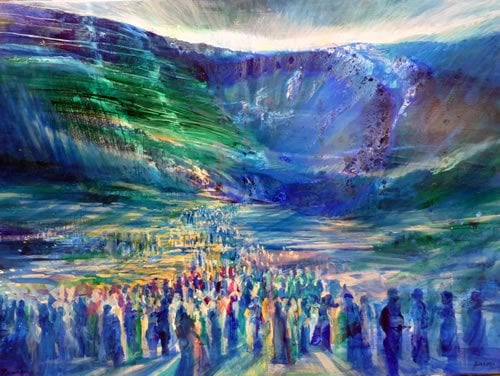
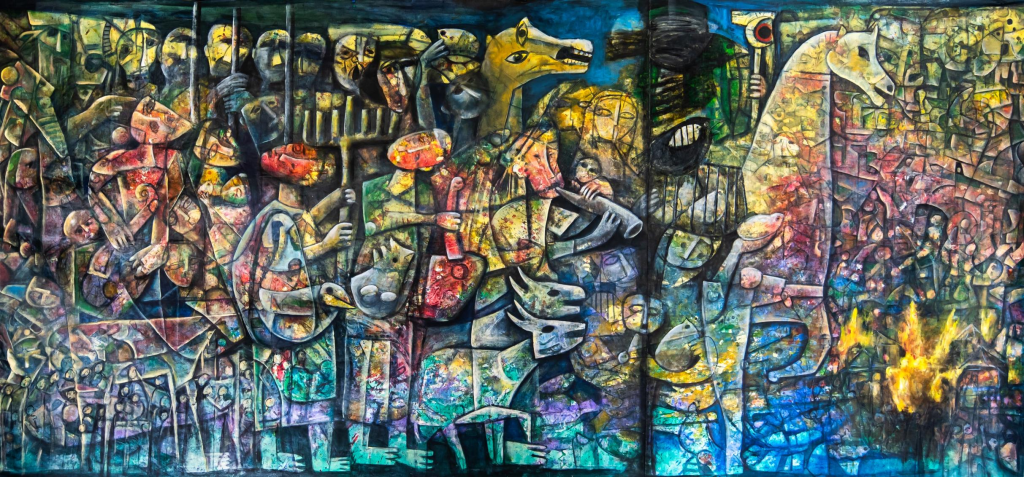
The Parting of the Sea, by Yoram Ranaan

As Pharaoh approached, the Israelites looked up and saw that the Egyptians were coming after them. Terrified, the Israelites cried out to the Lord. They said to Moses, “Did you bring us out into the desert to die because there were no graves in Egypt? Look what you’ve done by bringing us out of Egypt! Didn’t we tell you in Egypt, ‘Leave us alone! Let us go on serving the Egyptians’? It would have been better for us to serve the Egyptians than to die in the desert!”

Moses answered the people, “Don’t be afraid! Stand still, and see what the Lord will do to save you today. You will never see these Egyptians again. The Lord is fighting for you! So be still!”

Then the Lord said to Moses, “Why are you crying out to me? Tell the Israelites to start moving. Raise your staff, stretch out your hand over the sea, and divide the water. Then the Israelites will go through the sea on dry ground. I am making the Egyptians so stubborn that they will follow the Israelites. I will receive honor because of what I will do to Pharaoh, his entire army, his chariots, and cavalry. The Egyptians will know that I am the Lord when I am honored for what I did to Pharaoh, his chariots, and his cavalry.”

The Messenger of God, who had been in front of the Israelites, moved behind them. So the column of smoke moved from in front of the Israelites and stood behind them between the Egyptian camp and the Israelite camp. The column of smoke was there when darkness came, and it lit up the night. Neither side came near the other all night long.

Then Moses stretched out his hand over the sea. All that night the Lord pushed back the sea with a strong east wind and turned the sea into dry ground. The water divided, and the Israelites went through the middle of the sea on dry ground. The water stood like a wall on their right and on their left.

The Egyptians pursued them, and all Pharaoh’s horses, chariots, and cavalry followed them into the sea. Just before dawn, the Lord looked down from the column of fire and smoke and threw the Egyptian camp into a panic. He made the wheels of their chariots come off so that they could hardly move. Then the Egyptians shouted, “Let’s get out of here! The Lord is fighting for Israel! He’s against us!”

Then the Lord said to Moses, “Stretch out your hand over the sea so that the water will flow back over the Egyptians, their chariots, and their cavalry.”

Moses stretched his hand over the sea, and at daybreak the water returned to its usual place. The Egyptians tried to escape, but the Lord swept them into the sea. The water flowed back and covered Pharaoh’s entire army, as well as the chariots and the cavalry that had followed Israel into the sea. Not one of them survived.

Meanwhile, the Israelites had gone through the sea on dry ground while the water stood like a wall on their right and on their left. That day the Lord saved Israel from the Egyptians, and Israel saw the Egyptians lying dead on the seashore. When the Israelites saw the great power the Lord had used against the Egyptians, they feared the Lord and believed in him and in his servant Moses….

Then the prophet Miriam, Aaron’s sister, took a tambourine in her hand. All the women, dancing with tambourines, followed her. Miriam sang to them:

“Sing to the Lord.
He has won a glorious victory.
He has thrown horses and their riders into the sea.” (God’s Word Translation)

Things can change quickly.

One day, you’re living in slavery, and the next, you’re free. One minute, you’re celebrating freedom, then the next minute, you’re backed into a corner, and it looks like the end – only to be dramatically delivered from calamity.

One day (Holy Saturday) the disciples were lower than a snake’s belly in a wagon wheel rut; the next day (Easter Sunday) they’re wondrously slack-jawed with hopes higher than the sky.

Today’s Old Testament reading impresses on us the necessity of trusting God one day at a time, one minute at a time. Circumstances will change; God’s basic character will not change. Therefore, we have the continual opportunity of exercising our faith, and practicing trust in the Lord, by living into a new reality.

In this Christian season of Eastertide (spanning the next 50 days until the Day of Pentecost) we discover resurrection power in putting to death old unhealthy practices and adopting new healthy life-giving habits. Eastertide’s intentional focus is to recognize and celebrate the resurrection of the Lord Jesus Christ, and so, to exult in our own new life in him.

Revisiting both Christ’s resurrection, and the Red Sea deliverance, helps to remind us God’s invisible power to save is stronger and greater than any visible powers on this earth. Both of these deliverance stories keep us focused on the hope of individual renewal, corporate revitalization, and worldwide revival.

Eastertide is the season to engage in some renewal practices. The following are a few ideas for living into our deliverance from God:

  • Pray for revival of spirituality. Christ brings salvation and life, so praying to God for revival is a deliberate way of connecting with God.
  • Pay attention to words. Gossip, back-biting, slander, and other sins of the tongue kill people. Instead, consider how to use your speech for encouragement, love, mercy, forgiveness, and building up one another. This promotes growth, health, and life.
  • Proclaim resurrection. I believe the church is meant to be the hope of the world because Christ is the risen Lord. Graciously proclaim the resurrected Christ and how the spiritual life makes a difference in life.
  • Put yourself out there. Start the new ministry you always believed would make a difference. Take a risk. You’ve been given eternal life, so can you really fail?
  • Promote daily habits of spiritual health and life. Develop a realistic and workable plan for yourself when it comes to basic spiritual practices of Scripture reading, prayer, worship, etc. And stick to it by involving others.

There will always be people in our lives who try and pull us from what’s most important, even persons who want to keep the status quo to the point of seeking to destroy us. Be ready. Keep Eastertide in front of you; God has raised us to new life.

Allow Christ’s resurrection take root in your heart to such an extent that life itself informs all your thinking, speaking, feeling, and acting. The victory is won. So, sing to the Lord!

Let It Out (Isaiah 51:1-16)

If you want to do right
and obey the Lord,
    follow Abraham’s example.
He was the rock from which
    you were chipped.
God chose Abraham and Sarah
    to be your ancestors.
The Lord blessed Abraham,
and from that one man
    came many descendants.

Though Zion is in ruins,
    the Lord will bring comfort,
and the city will be as lovely
as the garden of Eden
    that he provided.
Then Zion will celebrate;
it will be thankful
    and sing joyful songs.

The Lord says:
You are my people and nation!
    So pay attention to me.
My teaching will cause justice
to shine like a light
    for every nation.
Those who live across the sea
are eagerly waiting
    for me to rescue them.
I am strong and ready;
soon I will come to save
    and to rule all nations.

Look closely at the sky!
    Stare at the earth.
The sky will vanish like smoke;
the earth will wear out
    like clothes.
Everyone on this earth
    will die like flies.
But my victory will last;
my saving power never ends.

If you want to do right
    and obey my teaching
with all your heart,
    then pay close attention.
Don’t be discouraged
when others insult you
    and say hurtful things.
They will be eaten away
    like a moth-eaten coat.
But my victory will last;
my saving power
    will never end.

Wake up! Do something, Lord.
    Be strong and ready.
Wake up! Do what you did
    for our people long ago.
Didn’t you chop up
    Rahab the monster?
Didn’t you dry up the deep sea
and make a road for your people
    to follow safely across?
Now those you have rescued
will return to Jerusalem,
    singing on their way.
They will be crowned
    with great happiness,
never again to be burdened
    with sadness and sorrow.

I am the Lord, the one
    who encourages you.
Why are you afraid
    of mere humans?
They dry up and die like grass.

I spread out the heavens
and laid foundations
    for the earth.
But you have forgotten me,
    your Lord and Creator.
All day long you were afraid
of those who were angry
    and hoped to oppress you.
Where are they now?

Everyone crying out in pain
    will be quickly set free;
they will be rescued
from the power of death
    and never go hungry.
I will help them
    because I am your God,
the Lord All-Powerful,
    who makes the ocean roar.

I have told you what to say,
and I will keep you safe
    in the palm of my hand.
I spread out the heavens
and laid foundations
    for the earth.
Now I say, “Jerusalem,
    your people are mine.” (Contemporary English Version)

“There will always be fear; do it anyway. Let your courage inspire the world around you.”

Steve Maraboli

Courageous, brave, bold, and strong – it seems most people do not characterize themselves this way. I suppose it makes some kind of sense in our minds as to why this is: Every one of us can readily recall a time or several events in which we wilted with fear; did not speak up; or were not assertive. 

The many conversations we will never have that take place in our heads are testament to our supposed withdrawal in the face of adversity. In other words, we have far too many discussions with ourselves of how something should have gone and way too many brave retorts for someone whom we really have no intention of saying those words toward.

If this all sounds like the convoluted musings of a wimpy kid, that’s not far off the mark. Getting bullied, even as adults, may easily cause us to wilt, or to take it, or to simply find a way to avoid the bully. With some folks, we even create elaborate internal reasons why it’s our fault someone is upset with us. In such times, bravery and courage seem a long way from our true selves.

Faced with a daunting task at work, at home, or at school, we may wonder if we really have the internal stuff to pull it off.  We feel that maybe someone else would be better suited to do it. When given an unwanted medical diagnosis, it might feel as if it is way above our emotional pay grade. It’s not only the added hard situations of life that make us look fearful; it is the crippling losses that can leave us feeling anything but strong and brave.

Yet, what if I told you that you are, indeed, brave, strong, and confident? 

What if I insisted that courage resides within you, even if you yourself cannot see it right now? 

And, what if I told you that bravery isn’t something you must go on a quest to find, but that it’s been in you all along? 

You only need to let it out. You must release the words and resilience already given to you by the One who holds you in the hollow of his hand.

You intuitively know I’m on to something here. After all, the most common exhortation and assurance in the entirety of Holy Scripture is to not be afraid because God is with us.

“Be strong and courageous. Do not be afraid or terrified because of them, for the Lord your God goes with you; he will never leave you nor forsake you.”

Deuteronomy 31:6, NIV

“God has said, ‘Never will I leave you;
    never will I forsake you.” So we say with confidence, ‘The Lord is my helper; I will not be afraid.
    What can mere mortals do to me?’” (Hebrews 13:5-6, NIV)

Believe it, or not, the Bible tells us 365 times to not be afraid. Maybe that’s not a coincidence that we can quote a verse every day of the year about our own fearfulness in the face of so much of life’s cruel junk.

Yet, the tack I want you to take in the great litany of fear we daily face is that bravery is not something that is so much commanded as it is a calling forth of something which is already within you.

Now, before you go thinking I’m some strange spiritual huckster, hear me out. From the beginning of the world, God created by calling forth from within himself. What I mean is this: God did not simply command everything into being; instead, God said, “Let there be…”  Thus, letting out what was already there within God’s very Being.

I also find it interesting that when it comes to fear and bravery God does not so much command us to be courageous, as calls us to draw from the great reservoir within. The Lord has already created us strong, as creatures in the divine image. We just need to get in touch with what is already there. 

“Do not let your hearts be troubled,” said Jesus to his disciples because he knew his followers had it in them to walk in his way without fear. (John 14:6, NRSV)

“Let not your heart faint, and be not fearful,” said God to the prophet Jeremiah in the face of a terrible destruction that was about to unfold against Jerusalem because the Lord knew that Jeremiah could face what was going to happen. (Jeremiah 51:46, ESV)

Christians can act with boldness because Jesus is the pioneer of our salvation. He is the One who enables us to draw from the deep well of courage:

“So then, since we have a great High Priest who has entered heaven, Jesus the Son of God, let us hold firmly to what we believe. This High Priest of ours understands our weaknesses, for he faced all of the same testing we do, yet he did not sin. So let us come boldly to the throne of our gracious God. There we will receive his mercy, and we will find grace to help us when we need it most.” (Hebrews 4:14-16, NLT)

When I say that you are brave, you are strong, you are good – those are not words meant to make you believe something which may or may not be true, as if I were trying to convince you to take some panacea to feel better. No, I say it because it is true. 

You really can face the immense mountain in front of you and climb it. You can actually surmount the adversity you are in the middle of – not because of some words I say, but because you were created for courage.

So, how do you let out the bravery and let the boldness shine? 

That seems to be the million dollar question. I’m going to go out on a limb here and say that you already know the answer to this. Yes, you possess the answers to your own questions. You have all the knowledge you need to face your problems.  The real question is:

Will you let your bravery come out to play, or will you keep it hidden beneath layers of insecurity?

It’s a whole lot easier to let me tell you what to do than to draw from what you already know deep down how to handle that troublesome something. 

So, I’m not going to give you a simple three-step process out of fear and into courage because you already have been endowed with the process. 

This certainly isn’t a sexy way to end a blog post, but it just might be the most effective and lasting.

Exiled (Jeremiah 52:12-30)

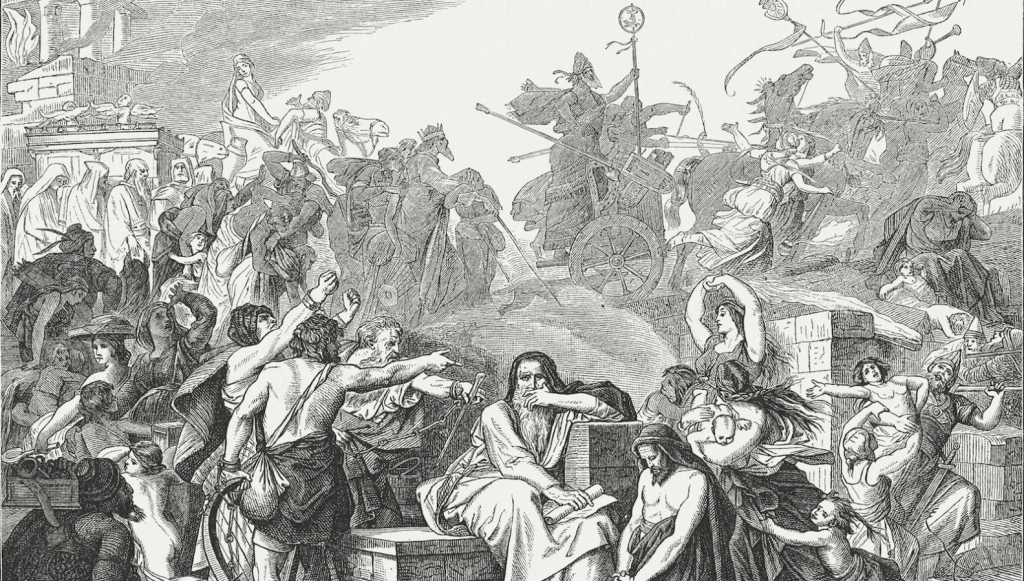
The Babylonian Exile by Jewish-German painter Eduard Bendemann (1811-1889)

In the nineteenth year of Nebuchadnezzar king of Babylon on the seventh day of the fifth month, Nebuzaradan, the king of Babylon’s chief deputy, arrived in Jerusalem. He burned the Temple of God to the ground, went on to the royal palace, and then finished off the city. He burned the whole place down. He put the Babylonian troops he had with him to work knocking down the city walls. Finally, he rounded up everyone left in the city, including those who had earlier deserted to the king of Babylon, and took them off into exile. He left a few poor dirt farmers behind to tend the vineyards and what was left of the fields.

The Babylonians broke up the bronze pillars, the bronze washstands, and the huge bronze basin (the Sea) that were in the Temple of God and hauled the bronze off to Babylon. They also took the various bronze-crafted liturgical accessories, as well as the gold and silver censers and sprinkling bowls, used in the services of Temple worship. The king’s deputy didn’t miss a thing. He took every scrap of precious metal he could find.

The amount of bronze they got from the two pillars, the Sea, the twelve bronze bulls that supported the Sea, and the ten washstands that Solomon had made for the Temple of God was enormous. They couldn’t weigh it all! Each pillar stood twenty-seven feet high with a circumference of eighteen feet. The pillars were hollow, the bronze a little less than an inch thick. Each pillar was topped with an ornate capital of bronze pomegranates and filigree, which added another seven and a half feet to its height. There were ninety-six pomegranates evenly spaced—in all, a hundred pomegranates worked into the filigree.

The king’s deputy took a number of special prisoners: Seraiah the chief priest, Zephaniah the associate priest, three wardens, the chief remaining army officer, seven of the king’s counselors who happened to be in the city, the chief recruiting officer for the army, and sixty men of standing from among the people who were still there. Nebuzaradan the king’s deputy marched them all off to the king of Babylon at Riblah. And there at Riblah, in the land of Hamath, the king of Babylon killed the lot of them in cold blood.

Judah went into exile, orphaned from her land.

3,023 men of Judah were taken into exile by Nebuchadnezzar in the seventh year of his reign.

832 from Jerusalem were taken in the eighteenth year of his reign.

745 men from Judah were taken off by Nebuzaradan, the king’s chief deputy, in Nebuchadnezzar’s twenty-third year.

The total number of exiles was 4,600. (The Message)

The Babylonian Exile by Fahri Aldin, 2017

Eventually, God’s words and decrees happen. It may take minutes. It might take centuries. But it will happen.

God promised destruction. It happened. The temple, the city walls, and the houses of Jerusalem were destroyed.

God decreed deportation of the people. It happened. Thousands of Jews were uprooted and moved to Babylon.

God foretold depression. It happened. The social and economic system of Judah collapsed.

God said there would be an occupation of Gentiles. It happened. The occupying force seized and confiscated the holy temple articles. They violated that which was sacred to Judah.

God repeatedly told the people that there would be a reckoning for the years of social injustice and religious infidelity. It happened. There was not just a deportation of persons; there were waves of removal.

The long prophecy of Jeremiah began with a proclamation of exile. It moved toward that exile. And then, in the end, the exile became reality.

Surely, it must have seemed to the citizens of Jerusalem that the end of the world was at hand. Their very identity as God’s people, as they had understood it for centuries, was now obliterated. Who are they now?

The Jewish exile changed forever their understanding of themselves and of God because they needed to reimagine what being the people of God really means without a place and without a temple.

God is both subject and object of all Holy Scripture, including the book of Jeremiah. Perhaps neglected in all the talk of exile is that the Lord was also cast-off, put away, and exiled. And rather than this being bad news, it becomes the good news that divine presence was right alongside the exiles.

In our darkest times, in the worst of circumstances, when all seems hopeless – there is a God who shows such solidarity with us that he is crucified and put to death so that we might live.

The Lord does not stand afar off from us but is beside us, even within us.

The sheer violation and agony of Good Friday and the depressive silence of Holy Saturday are the means of demonstrating the power of resurrection and new life.

We may be deported, depressed, and destroyed – exiled to a place we do not know and do not want to be. Yet, that is not the end of the story.

Exile is temporary. Mercy is forever. There cannot be a resurrection without a death. There must be suffering before there is glory.

Love wins. Every time.

God is Love. Thus, there is always hope….

Ephesians 3:14-21 – A Prayer for Every Believer

A mosaic of the Apostle Paul in St Isaac’s Cathedral, St. Petersburg, Russia

For this reason, I fall on my knees before the Father, from whom every family in heaven and on earth receives its true name. I ask God from the wealth of his glory to give you power through his Spirit to be strong in your inner selves, and I pray that Christ will make his home in your hearts through faith. I pray that you may have your roots and foundation in love, so that you, together with all God’s people, may have the power to understand how broad and long, how high and deep, is Christ’s love. Yes, may you come to know his love—although it can never be fully known—and so be completely filled with the very nature of God.

To him who by means of his power working in us is able to do so much more than we can ever ask for, or even think of: to God be the glory in the church and in Christ Jesus for all time, forever and ever! Amen. (Good News Translation)

In Jesus Christ, the believer has been given incredible blessings – adoption into God’s family and belonging with God, redemption through Christ’s cross and experiencing freedom from the power of sin, and intimacy and help by means of God’s own Spirit.

Today’s New Testament lesson is a prayer of the Apostle Paul for the Church. After three chapters of describing who we are and what we have in Christ as Christians, he goes to prayer, asking that the new life we have in Christ will be pressed firmly into our heads and our hearts so that this reality of spiritual blessings will be practically realized for the believer.

Here’s a quick remedial grammar lesson: a “verb” expresses an action between two things; a “participle” or “participial phrase” is a word or group of words which help describe the action of the verb.

There are two main verbs Paul uses: “I ask (pray)” for God “to give.” The participles all explain or modify the action of pray and give. In other words, the following actions are what Paul deeply desires that God will do for us as believers in Jesus….

To Become Mighty Through the Spirit

God grants us all the blessings of being in Christ. We are delivered from sin, death, and hell so that we will live into God’s purposes for this new life of freedom.

We live into the Christian life, on a practical level, as our faith is strengthened, and our inner person becomes powerful. This is the Spirit’s work in us – to strengthen our spiritual spine so that we can bear and carry our cross in this life, despite whatever the adversity or difficulty.

We are not alone. The Spirit is with us always. God is present. The believer is never promised that life will be a bowl of cherries and that being a Christian is all rainbows and unicorns. However, the believer is assured that God will be with us through the trouble – which is why we need a strong and robust faith.

You set a table for me
    right in front of my enemies. (Psalm 23:5, CEB)

To Dwell In Christ Through Faith

The “heart” in the New Testament is a reference not to the physical muscle in our chest but the seat or center of our inner person.

Paul’s prayer is that God gives or plants the seeds of the gospel in the hearts of people. Those good seeds then take root and become anchored firmly in the soul. They grow and mature, producing a harvest of love.

Not only do those roots grow down and deep, but they also grow out and connect with all other believers everywhere.

To Grasp God’s Love in Christ Through the Spirit

Enjoying this mystical union with Christ and connection with Christians, we come to experientially grasp together the vast dimensions of God’s love for us. God’s love is a multiverse of blessing. In fact, an eternity in heaven will never reach the bottom or top of the God who is Love itself.

When God our Savior made his kindness and love for humanity appear, he saved us, but not because of anything we had done to gain his approval. Instead, because of his mercy he saved us through the washing in which the Holy Spirit gives us new birth and renewal. God poured a generous amount of the Spirit on us through Jesus Christ our Savior. (Titus 3:4-6, GW)

To be filled with all the fullness of Love, is to be filled thoroughly with God – because God is Love.

My dear friends, we must love each other. Love comes from God, and when we love each other, it shows we have been given new life. We are now God’s children, and we know him. God is love, and anyone who doesn’t love others has never known him. (1 John 4:7-8, CEV)

Conclusion

Prayer is a gift. Like a little child bursting into her daddy’s office at work and crawling up on his lap, so we have the wondrous privilege of coming to God without hindrance and asking for whatever we need and want.

And what God wants and enjoys hearing, is us asking for spiritual strength, faith, and love. Because it is these things which create a thriving inner person who blesses others.

May it be so, to the glory of God, for the edification of the Church, and in the proclamation of the gospel. Amen.