Increase Our Faith? (Luke 17:5-10)

The apostles said to the Lord, “Increase our faith!” The Lord replied, “If you had faith the size of a mustard seed, you could say to this mulberry tree, ‘Be uprooted and planted in the sea,’ and it would obey you.

“Who among you would say to your slave who has just come in from plowing or tending sheep in the field, ‘Come here at once and take your place at the table’? Would you not rather say to him, ‘Prepare supper for me; put on your apron and serve me while I eat and drink; later you may eat and drink’? Do you thank the slave for doing what was commanded? So you also, when you have done all that you were ordered to do, say, ‘We are worthless slaves; we have done only what we ought to have done!’ ” (New Revised Standard Version)

Here’s a simple observation of today’s Gospel text: Because Christ’s apostles said to the Lord, “Increase our faith!” they were acknowledging that they did not have enough faith.

But is that really true? Did the apostles – or do any of us – lack the faith we need to live the sort of life Jesus wants us to live?

I know that I sometimes feel like I have such little faith that it prevents me from being the person I want to be, and to do the good things I want to do. Yet, if I’m honest with myself, I truly don’t lack for anything in living out my faith. For God has already given me what I need.

God is good, all the time. Divine resources are always present. The Spirit dwells within us.

I’m reminded of Peter’s encouragement:

His divine power has given us everything we need for a godly life through our knowledge of him who called us by his own glory and goodness. (2 Peter 1:3, NIV)

Jesus gave his disciples a hard answer to their request for faith. Perhaps hearing a bit of exasperation in the Lord’s voice, Christ communicated to them that they already have all the faith they need.

It’s never about the amount of faith. That’s because we already have enough faith. It doesn’t take much faith to radically change things. It’s much more an issue of accessing the faith which has already been provided for us.

Indeed, even if we have faith the size of a tiny little mustard seed, we could command a tree to be uprooted and throw itself into the sea. (Matthew 17:20; Mark 11:20-25)

Therefore, the apparently weakest of people in the world actually have the power to move mountains and uproot trees.

For example, when a sinful woman poured out expensive ointment on Jesus and applied it with her hair, Christ responded with a resounding “Your faith has saved you.” (Luke 7:50)

Furthermore, when a blind beggar longed to see again…

When a Samaritan leper looked for healing…

When a woman reached out and touched a tassel of the Lord’s garment…

When and a Gentile Roman Centurion came to Jesus on behalf of his ailing servant…

Christ affirmed the existing faith which was present with them – and each one of them therefore experienced the healing they so expected to realize. (Luke 3:48; 7:9; 18:42; 17:19)

In God’s economy, there is no distinction between basic trust in God and the faith that uproots trees. There is absolutely no need to try and manipulate spiritual forces in order to access a special kind of supernatural power. That’s what the pagans of old were always trying to do with their religion.

Getting a right or particular formula for a healing or a miracle is the stuff of other religions, not Christianity. For the Christian, something else is going on with faith.

What is impossible for us is possible with God. The issue with faith is where it is placed, and not with how much or how little you have. Any amount of faith that is directed to Jesus is more than enough. Even a mustard-seed-sized faith.

When participating in the sacrament of communion, you may wonder why a quarter-sized communion wafer is supposed to feed you anything. But this is communicating something important about our faith: Even a tiny portion of bread can fill and satiate the Christian’s need for spiritual sustenance.

A little bit of Jesus goes a very long way, no matter how many are gathered around the Table.

Having faith involves possessing thoughts, feelings, and actions which are thoroughly transformed by God. In other words, it involves being a “slave” of God, being a person who is devoted to engaging in God’s purposes for this world.

Whenever we engage in our work as servants of God, there’s no need for medals and accolades; we are simply doing what is expected of us. Our faith is quite enough to sustain us in doing our normal work in the world. Nothing added or unique is needed.

So, how do we access the faith needed to live the Christian life, in order to please God and bless the world? We do the work which is expected of us.

Then, we will find and see that the faith is there to do and to say what is needed. We need not wait for it; the faith is already there. But we will have to act if we want to see faith in action.

God of all ages, you have revealed your grace to us in the Savior, Jesus Christ our Lord. As we actively live into your mercy, strengthen us to do justice, to love mercy, and to walk humbly with You. May we accomplish Your divine will and live by the faith You have so graciously provided for us; through Christ, who lights the way to everlasting life. Amen.

Pray with Persistence (Luke 11:1-13)

He [Jesus] was praying in a certain place, and after he had finished, one of his disciples said to him, “Lord, teach us to pray, as John taught his disciples.” So he said to them, “When you pray, say:

Father, may your name be revered as holy.
    May your kingdom come.
    Give us each day our daily bread.
    And forgive us our sins,
        for we ourselves forgive everyone indebted to us.
    And do not bring us to the time of trial.”

And he said to them, “Suppose one of you has a friend, and you go to him at midnight and say to him, ‘Friend, lend me three loaves of bread, for a friend of mine has arrived, and I have nothing to set before him.’ And he answers from within, ‘Do not bother me; the door has already been locked, and my children are with me in bed; I cannot get up and give you anything.’ I tell you, even though he will not get up and give him anything out of friendship, at least because of his persistence he will get up and give him whatever he needs.

“So I say to you, Ask, and it will be given to you; search, and you will find; knock, and the door will be opened for you. For everyone who asks receives, and everyone who searches finds, and for everyone who knocks, the door will be opened. Is there anyone among you who, if your child asked for a fish, would give a snake instead of a fish? Or if the child asked for an egg, would give a scorpion? If you, then, who are evil, know how to give good gifts to your children, how much more will the heavenly Father give the Holy Spirit to those who ask him!” (New Revised Standard Version)

If we desire to see the power of prayer become a reality in our lives, we will have to avoid drive-by prayers in favor of sustained and focused prayers taught to us from the Lord Jesus.

Prayer empowered Jesus in his earthly ministry. His disciples saw this, and wanted it, too. So, Christ encouraged them in what to pray, and to keep persistently praying, despite the circumstances.

We are instructed by Jesus to approach the heavenly Father just as he himself did – in a straightforward and intimate manner. The content of our prayers ought to encompass the following five petitions:

  • Let God’s name be made holy. In other words, we are to let the Lord’s name be seen by others as holy within us in our daily lives. This is a petition for God to establish divine sovereignty and holiness in the heart of the believer. When this happens, the name of God is exalted and set apart as holy before a watching world.
  • Let God’s kingdom come. This is a prayer that asks for the reign of God to extend over the entire earth in a very practical way – to have God’s rule draw near to everyone and everything, including ourselves.
  • Let us have our daily bread. That is, pray that God will give us everything we need for life and godliness in this present evil age, including physical sustenance, mental acuity, emotional intelligence, and spiritual food. None of us lives by bread alone, but by every word that proceeds from the mouth of God.
  • Let forgiveness come. Sin is a reality. Therefore, every one of us needs forgiveness; and everyone needs to forgive others. Forgiveness is powerful; it releases us to freedom. And thus, we have the power to release others through the act of forgiving the egregious sins of others. The failure to do this is why the kingdom of God is so disestablished in this world.
  • Let us not become victims of the cosmic conflict. There is a continual struggle of unseen powers on this earth that no human is armed to deal with. Apart from God’s intervention, humanity gets caught in the crosshairs of the conflict. We are to pray that this trial does not overcome us.

These prayers are to be consistently and persistently prayed every day. Christ wants us to keep asking, seeking, and knocking.

Jesus, in his teaching ministry on earth, often used the lesser-to-greater argument in getting his point across. And that is precisely what he was doing with his disciples in today’s Gospel lesson by instructing them about the nature and motivation of prayer.

The lesser-to-greater argument implies a comparison of values. It’s grounded on a common sense and logical convention that if this lesser thing is true, then, of course, how much more is this greater thing!

If something less likely to happen is true, then something more likely to happen will probably be true as well. The technical phrase for this is an argument a fortiori – a Latin term meaning, “for a still stronger reason.”

Jesus wanted his followers to understand that prayer has value because God is a loving Father, not a begrudging friend. Whereas the friend in the story was badgered just so the person could get some real necessities, God needs no badgering to generously give good gifts that may or may not be considered as necessities by us.

Jesus desired to highlight that prayer has veracity because of whom those prayers are directed.

In the ancient world, it was common understanding you needed to get the local gods attention if you wanted something. Which is why, for example, in the prophet Elijah’s showdown with the prophets of Baal, that Baal’s worshipers were yelling, gesticulating, and even cutting themselves for hours. They fully expected to put a lot of work into getting Baal’s attention, maybe even needing to convince him of intervening in their ancient version of a wild West shootout.

In contrast to four-hundred prophets of Baal, a single prophet of the Lord utters one simple prayer, then fire comes rushing down from heaven. Much like the person who badgered the friend for bread, the prophets pestered Baal for hours. (1 Kings 18)

In Christ’s story, it all comes down to who really cares. The friend? Not enough to jump out of bed right away and meet a need. Baal? Not so much. God? Now we’re talking.

We typically don’t ask, seek, or knock, if we believe we will not get a response – or if it will take a lot of energy, time, and effort we don’t have. Yet, if we are confident of being heard and our requests taken seriously with care, then we are likely to have a habit of asking, seeking, and knocking.

If a friend begrudgingly gives to you because of persistent knocking, how much more will God graciously, generously, and with gaiety give you goodness when you ask?

Because God is good, God gives. The largess of the Lord is willing and ready to dispense grace from an infinite storehouse of mercy.

This is why Jesus encouraged people to not pray like those who don’t know God, babbling on because they think they’ll be heard because of the sheer volume of words. (Matthew 6:7-8)

Two misconceptions of prayer existed in Christ’s day (and today); they come from non-Christian sources:

  1. There must be a lot of prayer before prayer “works.” Although I believe repetition is important for forming good habits, praying the same prayers over and over again so as to be heard betrays an ignorance of God, not to mention an actual lack of faith. Many ancient religions were based in learning how to manipulate the spiritual forces out there to get what we need. It’s kind of like a divine version of hustling for love in all the wrong places. Christians need to know they don’t need to have thousands of people praying in order to get God’s attention to answer prayer.
  2. I must convince God of the need to answer my prayer. God is not a reluctant listener. The reason the Lord already knows what we need before we ask is because God has been paying close attention to us well before we got around to asking, seeking, and knocking on the divine door. God’s ear is already inclined to hear us – expectantly and anxiously awaiting our petitions. This is a tremendously freeing idea, that I can come to God openly and honestly, without drudgery, and without wondering if I am heard, or not.

May we be encouraged to pray, to truly connect with God, because the Lord is available without appointment, and is waiting for us to ask with bended ear.

Eternal God, by whose power we are created and by whose love we are redeemed: Guide and strengthen us by your Spirit so that we may give ourselves to your service and live today and every day in love to one another and to you, through Jesus Christ our Lord, in the strength of the Holy Spirit. Amen.

Against Exorbitant Wealth (Amos 3:9-4:5)

Proclaim to the strongholds in Ashdod
    and to the strongholds in the land of Egypt,
and say, “Assemble yourselves on Mount Samaria,
    and see what great tumults are within it
    and what oppressions are in its midst.”
They do not know how to do right, says the Lord,
    those who store up violence and robbery in their strongholds.
Therefore thus says the Lord God:
An adversary shall surround the land
    and strip you of your defense,
    and your strongholds shall be plundered.

Thus says the Lord: As the shepherd rescues from the mouth of the lion two legs or a piece of an ear, so shall the people of Israel who live in Samaria be rescued, with the corner of a couch and part of a bed.

Hear and testify against the house of Jacob,
    says the Lord God, the God of hosts:
On the day I punish Israel for its transgressions,
    I will punish the altars of Bethel,
and the horns of the altar shall be cut off
    and fall to the ground.
I will tear down the winter house as well as the summer house,
    and the houses of ivory shall perish,
and the great houses shall come to an end,
            says the Lord.

Hear this word, you cows of Bashan
    who are on Mount Samaria,
who oppress the poor, who crush the needy,
    who say to their husbands, “Bring something to drink!”
The Lord God has sworn by his holiness:
    The time is surely coming upon you
when they shall take you away with hooks,
    even the last of you with fishhooks.
Through breaches in the wall you shall leave,
    each one straight ahead,
    and you shall be flung out into Harmon,
            says the Lord.
Come to Bethel—and transgress;
    to Gilgal—and multiply transgression;
bring your sacrifices every morning,
    your tithes every three days;
bring a thank offering of leavened bread
    and proclaim freewill offerings, publish them;
    for so you love to do, O people of Israel!
            says the Lord God. (New Revised Standard Version)

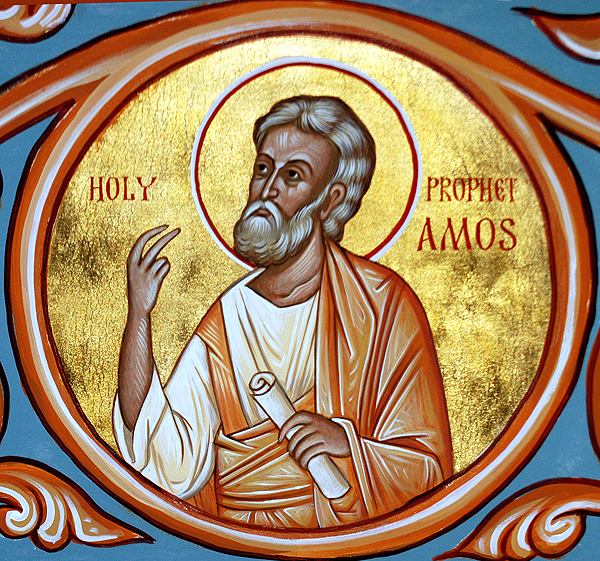
Orthodox icon of the prophet Amos

The prophet Amos sought to leave no stone unturned in exposing the transgressions of God’s wayward people. He went after social injustice; personal sins; religious idolatry; and all aspects of life in which the nation practiced self-indulgent hoarding of wealth and power.

Whenever people become focused on earthly power and control, they fall out of the realm of living in God’s power. If there is ever a personal or corporate sense of losing spiritual power, the problem is never with the Lord. The more one amasses worldly power and authority, the less effective they are with spiritual power.

It is possible for a nation or a church to have great political strength, yet in reality be powerless. Impressive constructed human strongholds are totally defenseless before the all-powerful God of the universe.

It’s always been curious to me why folks who claim the name of Christ, or who make grand confessions of faith, can then turn around and be enamored with obtaining wealth, real estate, resources of all sorts, and high-level positions. Such persons don’t deserve worldly power. It’s like putting a gold ring in a pig’s snout.

Persons with lots of worldly wealth and power will eventually find that their acquisitions fail them. And if their religion is powerless, everything in their life will lack power – no matter how it looks, or what spin they put on their situation.

Ignoring grace and mercy, compassion and kindness, to the poor and needy is a surefire way of experiencing divine condemnation. Treating one’s society and social relationships as mere pawns to get what I want is a prescription for alienation from God.

Whether someone believes in an almighty God, or not, oppressing and gaslighting others breaks down a society, and compromises basic law and order. Being concerned only with one’s constituents, and turning away from the common good of all, brings about injustice for the many.

But the ones in charge simply don’t care – which is why it raises the ire of a holy God. Any person who demeans meekness and gentleness, and clearly evidences a profound lack of humility, you can be sure that person is up to no good – despite any “good” words they might say.

Violence and robbery are the tools of those who care nothing for what their actions do to others. Justifying the rounding up of people into detention centers and robbing them of their lives and livelihood doesn’t fool God.

Those who go after unjust gain through any means possible will find that there is a boomerang effect to their actions. Their violent and unjust ways will turn back on them. They themselves shall be destroyed, and not the powerless and vulnerable.

In ancient Israel at the time of Amos, it was the Gentile nations who would rise up and be their judge. Pagan nations who thought nothing of despising and abusing others were the very ones to stand up and judge Israel. That’s how bad it was, even though there was wild prosperity, exorbitant wealth, and loads of power, that is, only among the upper class.

Living below the level of grace means showing no dignity or respect to one’s fellow humanity. It is unthinkable that such persons could or would ever exercise power in a democratic form of government. Just because they were elected and appointed to office, doesn’t mean they’ll act as civil servants.

Those in power who act only in self-interest will find themselves on the bad side of a holy God:

“Why would God withdraw from such a people? Because there was nothing in their lives corresponding to a heart concern for spiritual things; their character-reference could be written without mentioning God, or prayer, or holiness; their legacy to the future was wholly a testimony to a life lived for the body. And these claimed to be the people of God!” J.A. Motyer

Unchecked covetousness is actually a form of war against the poor. And any worship disconnected from righteousness and justice is an affront to both the needy among us, and God.

Wealth and power, in and of themselves, are neither good nor bad; they just are. But what we do with them is of vital concern. However, exorbitant riches and a lust for power, in and of themselves, are egregious sins.

In Holy Scripture, the poor are never chastised for their poverty and neediness. But the rich are continually exhorted and warned against for any sort of failing to care for the lower classes of people. (Matthew 25:14-30; Luke 12:13-21; 16:19-31)

The psalmist has a reality check for us:

Don’t be overly impressed when someone becomes rich,
    their house swelling to fantastic proportions,
    because when they die, they won’t take any of it with them.
    Their fantastic things won’t accompany them down under.
Though they consider themselves blessed during their lives,
    and even thank you when you deal well with them,
    they too will join the ancestors who’ve gone ahead;
    they too will never see the light again.
Wealthy people? They just don’t understand;
    they’re just like the animals
    that pass away. (Psalm 49:16-20, CEB)

The Teacher gives us some practical wisdom:

If you love money and wealth, you will never be satisfied with what you have. This doesn’t make a bit of sense. (Ecclesiastes 5:10, CEV)

Whoever becomes wealthy through unfair loans and interest collects them for the one who is kind to the poor. (Proverbs 28:8, GW)

And the Lord Jesus said:

“No one can serve two masters. Either you will hate the one and love the other, or you will be devoted to the one and despise the other. You cannot serve both God and money.” (Matthew 6:24, NIV)

“God blesses you who are poor,
    for the Kingdom of God is yours.” (Luke 6:20, NLT)

As for me, I’ll choose to take my cues from Jesus and the prophets, and not from those with earthly influence, riches, and power. How about you?

Almighty God, everything we possess – our time, abilities, resources, money, and material possessions – are gifts from You, and belong to You. Enable me to be a good steward of all that you have provided for me, so that I may be a blessing to the poor and needy; through Jesus Christ my Lord, in the strength of the Holy Spirit. Amen.

Day of Pentecost (John 14:8-17, 25-27)

Philip said to him, “Lord, show us the Father, and we will be satisfied.” Jesus said to him, “Have I been with you all this time, Philip, and you still do not know me? Whoever has seen me has seen the Father. How can you say, ‘Show us the Father’? Do you not believe that I am in the Father and the Father is in me? The words that I say to you I do not speak on my own, but the Father who dwells in me does his works. 

“Believe me that I am in the Father and the Father is in me, but if you do not, then believe because of the works themselves. Very truly, I tell you, the one who believes in me will also do the works that I do and, in fact, will do greater works than these, because I am going to the Father. I will do whatever you ask in my name, so that the Father may be glorified in the Son. If in my name you ask me for anything, I will do it.

“If you love me, you will keep my commandments. And I will ask the Father, and he will give you another Advocate, to be with you forever. This is the Spirit of truth, whom the world cannot receive because it neither sees him nor knows him. You know him because he abides with you, and he will be in you….

“I have said these things to you while I am still with you. But the Advocate, the Holy Spirit, whom the Father will send in my name, will teach you everything and remind you of all that I have said to you. Peace I leave with you; my peace I give to you. I do not give to you as the world gives. Do not let your hearts be troubled, and do not let them be afraid.” (New Revised Standard Version)

The Christian observance of Pentecost is much more than a date on the calendar or a cognitive belief about the Holy Spirit. Pentecost is a powerful reality for believers to be aware of and to live into.

The symbols used to communicate this reality are the elements of wind and fire. They each have incredible potential for both help and harm, life and death. Tornadoes and wildfires bring awful destruction, whereas flame and wind power are necessary elements for life.

There is power in the Spirit. The Spirit of God dismantles and rearranges our lives to make something different or new altogether.

When the Spirit gets involved, nothing is the same again.

The Spirit upsets the status quo, brings energy and ability, heals broken lives, and establishes a truly egalitarian society. The New Testament knows the Christian as one given wholly to the Spirit in order to accomplish the will of God on this earth.

Therefore, this time of the year is hugely significant. Christians attune themselves to Holy Time because it is the age of the Spirit, the blessed opportunity of Pentecostal life and power. 

Jesus promised us an Advocate, the Spirit, and the era of the Spirit is here. We enjoy the very same Holy Spirit as our spiritual ancestors in the faith. This gives us great confidence and security knowing that the Spirit’s enablement, guidance, and power is available to us.

Pentecost flings every single believer into a congregational whole, the church, and lets us know that we are not to be rugged individualists acting alone, but are part of the Body of Christ.   

The Spirit uses us to forge spiritual bonds of kinship, fellowship, and solidarity.  Pentecost throws disparate people together in a unified whole, made up of every kind of language, nationality, ethnicity, gender, and race. We all use the gifts of the Spirit given to us for the benefit of building up one another.

Pentecost and the presence of the Spirit opens up the greatest of possibility in seeing our true selves emerge, and experiencing what is false melt away.

For most of us, we eventually discover that our egos are much thicker and predominant than we realized. And that ego gets in the way of bringing our authentic selves to the world. The Spirit comes along with fire to purify us, and then blows a mighty wind to drive the false self away.

Such true spiritual power helps us discern that issues of power in this world are difficult to deal with because things are not as they appear to be. Operating in the ego, far too many of us puff up ourselves to try and merely appear strong. People who present themselves as large and in charge end up hiding their vulnerabilities and insecurities in favor of keeping up appearances.

Jesus openly talked of real spiritual power, and promised to give the Spirit for our benefit. And Christ laid bear himself, stretching his arms out on a cross in a display of humiliation and degradation – all for us and our deliverance from false power and pesky egos.

If we go looking for earthly power and rely upon worldly power structures, we will likely be as confused as Philip and the other disciples of Jesus. But if we adopt the inner spiritual power provided for us, we find real effective strength which brings us the peace of Christ in any and all circumstances.

Life in the Spirit – spiritual life – happens within the depths of the soul. And it happens when we give up all pretense to alternative power sources, and participate with the Holy Spirit in allowing God to melt all that is false with spiritual fire and blow it all away with spiritual wind.

Pentecost was and is a watershed event. It’s effects are lasting, right up to the present time. Rather than settling for power-substitutes, we can imbibe ourselves of real spiritual power.

Living God, you have created all that is. Send forth your Spirit to renew and restore us, so that we may proclaim your good news in ways and words that everyone will understand and believe. Amen.