Have Some Spiritual Discernment (Deuteronomy 13:1-5)

Prophet, by Théophile Alexandre Steinlen, 1902

Prophets or interpreters of dreams may promise a miracle or a wonder, in order to lead you to worship and serve gods that you have not worshiped before. Even if what they promise comes true, do not pay any attention to them. The Lord your God is using them to test you, to see if you love the Lord with all your heart. Follow the Lord and honor him; obey him and keep his commands; worship him and be faithful to him. 

But put to death any interpreters of dreams or prophets that tell you to rebel against the Lord, who rescued you from Egypt, where you were slaves. Such people are evil and are trying to lead you away from the life that the Lord has commanded you to live. They must be put to death, in order to rid yourselves of this evil. (Good News Translation)

It’s a foolish notion that a servant of God can have a moonlighting gig with another god. A shortsighted philosophy believes that worshiping God on the Sabbath allows one to then do whatever they want on the other six days. And a downright deadly act is to become enamored with a miracle and then follow the miracle worker who did it, even though they want nothing to do with devotion to the Lord.

It only takes one bad apple to spoil the whole bushel basket of them. Just one rotten egg in a six egg omelet will ruin the entire thing. And one bad prophet amongst the people will end up destroying the congregation. Evil isn’t something to dabble with; instead, wickedness is something to rid yourself of altogether.

“If your right eye causes you to stumble, gouge it out and throw it away. It is better for you to lose one part of your body than for your whole body to be thrown into hell. And if your right hand causes you to stumble, cut it off and throw it away. It is better for you to lose one part of your body than for your whole body to go into hell.” Jesus (Matthew 5:29-30, NIV)

Jesus declared that believers must take decisive, drastic, and radical action against idolatry. Serving other gods, along with the one true God, requires an amputation. The biblical text of both Testaments leaves us no room to believe that it’s okay to dabble in things that the Lord condemns. And if we think we are not hurting anybody to hold onto such a thought, we very much need to think again.

True prophets and preachers don’t lead people into idolatry, no matter how spectacular their omens, wonders, or miraculous signs. False prophets and preachers exist only to test the sincerity of a believer’s love for the Lord. Israel was to take decisive and radical measures to rid themselves of false gods. Failing to do so would certainly lead to idolatry.

These are the regulations and the case laws that you must carefully keep in the fertile land the Lord, your ancestors’ God, has given to you to possess for as long as you live on that land:

You must completely destroy every place where the nations that you are displacing worshipped their gods—whether on high mountains or hills or under leafy green trees. Rip down their altars and shatter their sacred stones. Burn their sacred poles with fire. Hack their gods’ idols into pieces. Wipe out their names from that place.

Don’t act like they did toward the Lord your God! (Deuteronomy 12:1-4, CEB)

Believers of every era need to learn that the occurrence of supernatural manifestations, and/or wild success in ministry, does not automatically authenticate the prophet or preacher.

Theology always takes precedence over miraculous signs and wonders. A growing church doesn’t necessarily mean that God’s favor rests upon it, anymore than a declining church signals God’s displeasure. This is why we are to never add to or take away from God’s Word to people. (Deuteronomy 12:32)

“It is the nature of false prophets to create a conscience where there is none, and to cause conscience to disappear where it does exist.”

Martin Luther

If Christians are ever invited to disobey and rebel against the words and ways of Jesus, they are to refuse the offer. This, of course, requires actually knowing God’s Word and handling the worship of God and the interpretation of God’s Word with great care, humility, and wisdom.

There are many times that false preachers are quite sincere, believing that they are proclaimers of truth, when they are really leading others astray. We are always to be students of Holy Scripture, consistently discerning the difference between truth and error, right and wrong. Let us be careful to avoid the situation of the believers in the New Testament book of Hebrews:

In fact, though by this time you ought to be teachers, you need someone to teach you the elementary truths of God’s word all over again. You need milk, not solid food! Anyone who lives on milk, being still an infant, is not acquainted with the teaching about righteousness. But solid food is for the mature, who by constant use have trained themselves to distinguish good from evil. (Hebrews 5:12-14, NIV)

Let’s be people who take the time and effort to grow in the grace and knowledge of the Lord Jesus; and be patient and humble enough to learn over time what truly pleases the Lord.

Blessed God, give your servant a discerning heart to govern, lead, and teach your people, so that we may all be able to distinguish between right and wrong, doing your divine will and obeying your divine commands, to the glory of Jesus Christ, in the power of the Holy Spirit. Amen.


“Follow Me” (John 1:43-51)

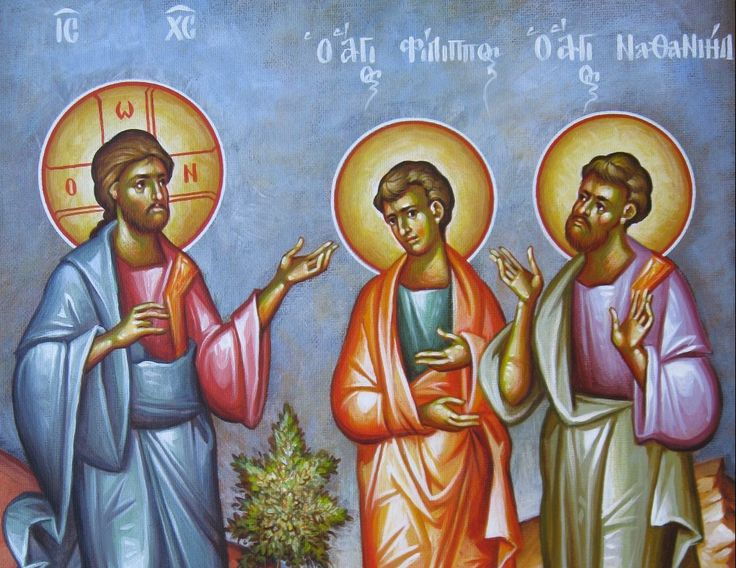
The next day Jesus decided to go to Galilee. He found Philip and said to him, “Come, follow me.” Philip was from Bethsaida, Andrew and Peter’s hometown.

Philip went to look for Nathanael and told him, “We have found the very person Moses and the prophets wrote about! His name is Jesus, the son of Joseph from Nazareth.”

“Nazareth!” exclaimed Nathanael. “Can anything good come from Nazareth?”

“Come and see for yourself,” Philip replied.

As they approached, Jesus said, “Now here is a genuine son of Israel—a man of complete integrity.”

“How do you know about me?” Nathanael asked.

Jesus replied, “I could see you under the fig tree before Philip found you.”

Then Nathanael exclaimed, “Rabbi, you are the Son of God—the King of Israel!”

Jesus asked him, “Do you believe this just because I told you I had seen you under the fig tree? You will see greater things than this.” Then he said, “I tell you the truth, you will all see heaven open and the angels of God going up and down on the Son of Man, the one who is the stairway between heaven and earth.” (New Living Translation)

I describe myself as a follower of Jesus. I have been for decades. I found, and continue to find, in Jesus Christ a compelling person full of grace, truth, and love.

But my early life was not characterized with knowing Christ. I certainly learned about Jesus, that this ancient guy lived an altruistic life, got tortured and killed on a cross, and that Christians believe in his resurrection from death. However, back then it was more like some strange history lesson. The information made no difference to me.

That is, until I heard a voice – not an audible one that others could hear. Yet, it was just a real as any daily conversation with another person. I heard the call of Jesus. The Ancient of Days showed up.

I know with every epistemic fiber in my being that it wasn’t an undigested bit of beef, a blot of mustard, a crumb of cheese, a fragment of an underdone potato. I am sure beyond certainty that there was more of an empty grave than gravy about my experience of the risen Christ.

I experienced the call of Jesus to “follow me.” And that is really, at its simplest, the call which continually goes out to all humanity. It is a gracious and merciful call. It isn’t a summons to experience a cataclysmic event of total belief in one fell swoop. Rather, it’s a call to believe that is much more an unfolding awareness of the deep spirituality and connection with the divine within.

Important to that faith process is another call to “come and see.” Whereas there are some Christian traditions which focus solely on a singular one-time experience of saving faith in Christ, the Gospel of John displays a drama of faith with multiple layers which people move through.

There is no egalitarian zap in which God grants total and immediate understanding. Instead, faith is an ever-increasing process. It is appropriate and biblical to say that our salvation has happened, is happening, and will happen. We follow, we come and see, and we keep following, keep coming, keep seeing more and more.

Like a muscle, our faith grows, develops, stretches, and strengthens over time. To use another metaphor, we ascend a stairway to heaven, one step at a time, day after day, following Jesus and ascending to spiritual maturity.

Orthodox icon of Christ calling Philip and Nathanael

Methinks this is likely part of what Jesus was getting at with Nathaniel in today’s Gospel lesson. Nathaniel would have quickly picked up on the reference Jesus was making, way back to the first book of Genesis. The Jewish patriarch, Jacob, had an experience of seeing the angels of God on some celestial stairway, ascending and descending. It was an encounter of God’s presence with Jacob, assuring him of divine intervention into the muck of humanity. (Genesis 28:10-17)

Jesus connected that ancient portrait to himself so that Nathaniel would understand, would believe, that God has again broken into this world with a special divine presence. To look at Jesus and follow him, is to see and follow God.

Christ Jesus is the ultimate example and embodiment of God with us. Throughout John’s Gospel, Jesus presents himself as:

  • Living water – connecting to Jacob’s well (John 4:5-14)
  • The Temple of God – the place where the Lord dwells in all divine fullness (John 2:18-22)
  • Bread from heaven – linking the giving of manna to the Israelites in the desert (Exodus 16:4-7; John 6:1-59)
  • The good shepherd – fulfilling divine Old Testament imperatives of caring for people (Ezekiel 34:11-16; John 10:1-30)

In all these ways, and more, Jesus intentionally connects himself as fulfilling God’s ancient promises to people.

In whichever way we need to hear the call to follow, Jesus accommodates to us. For some, Christ comes knocking on the front door. For others, he enters the side door, or slips into the backdoor of our lives.

And, if we will come and see, Jesus will also accommodate us by being the authority over us, the teacher to us, or the friend beside us. The Lord Jesus shall shepherd us and woo us to the flock for guidance and protection.

However it may be that Jesus comes to you, it most likely will be in ways you aren’t expecting. Surely, nothing good can come from Nazareth! Yet, it did. Can anything good come from Calcutta, India, or Juarez, Mexico, or Hoboken, New Jersey, or Milwaukee, Wisconsin, or even from a small rural area that doesn’t show up on a map? Yes, it can. Because with Jesus, God has entered this world, and, as it turns out, the Lord’s presence is everywhere.

Follow me. Come and see. Two of the simplest exhortations ever uttered. Yet, two of the most gracious phrases ever said, with profound implications for us beyond what we can fathom or imagine.

Guide us waking O Lord, and guard us sleeping; that awake we may watch with Christ and asleep we may rest in peace. May the shape of each day be formed by the pedantic following of my Lord; and may I come and see the wonders you have done, are doing, and will do. Almighty and merciful God – Father, Son and Holy Spirit – bless us and keep us. Amen.

Real Life (1 Thessalonians 3:6-13)

But Timothy has just now come to us from you and has brought good news about your faith and love. He has told us that you always have pleasant memories of us and that you long to see us, just as we also long to see you. Therefore, brothers and sisters, in all our distress and persecution we were encouraged about you because of your faith. 

For now we really live since you are standing firm in the Lord. How can we thank God enough for you in return for all the joy we have in the presence of our God because of you? Night and day we pray most earnestly that we may see you again and supply what is lacking in your faith.

Now may our God and Father himself and our Lord Jesus clear the way for us to come to you. May the Lord make your love increase and overflow for each other and for everyone else, just as ours does for you. May he strengthen your hearts so that you will be blameless and holy in the presence of our God and Father when our Lord Jesus comes with all his holy ones. (New International Version)

What does it mean to really live? Everyone has their own conceptions of what the good life is. But to live life to the full, to really live in sync with how life actually is (and is supposed to be) brings us true satisfaction, contentment, and meaning.

In the radical individualism of the West, it may seem foreign or strange to us that the Apostle Paul’s life was very much bound up in the lives of others – in the churches he established and with the believers who had come to faith in Christ. For Paul, to really live was to see spiritual growth and development in the places where he ministered.

The thing that really got Paul excited, what really melted his butter, was leading others to Christ, forming them into churches, and watching them carry out their missional mandate by doing the same things that he did with them. I can relate to Paul’s joy and satisfaction over Christian discipleship.

There’s nothing quite like mentoring others in the faith, helping them mature in that faith, and sending them out to live according to the model of faith that you’ve demonstrated for them. To see the Word of God take root in individuals and communities of people is like no other sort of joy and contentment.

In the midst of discouraging circumstances of persecution and distressing situations of opposition, it was gratifying, encouraging, and motivating for Paul to hear a good spiritual report from his protégé Timothy about the Thessalonian church’s faith.

Whether we acknowledge it or not, or like it or not, every one of us is inextricably connected to the other. And that is especially true in families, and in the family of God. The Thessalonian believers’ steadfast commitment to Christ and the Christian faith was a crucial and important dimension of Paul’s own persevering faith.

The Apostle had been on the front lines of faith – taking the good news of grace and forgiveness in Christ to the nations. To have his churches endure through all their own troubles and challenges is a great boon to Paul. They each derive confidence and inspiration from the other. Everyone’s faith is confirmed and strengthened when everyone is striving to live for Christ.

All the believers in Christ were really living because they stood firm in the Lord and were immovable in their faith commitments. Assurance and reassurance comes not in isolation, but through the interdependence and interaction with others who share the same values.

Parents don’t really live, unless they see their children living a life of abundant joy and satisfaction. And it’s the same with spiritual mothers and fathers; they truly live when their spiritual children are walking in faith and patience with the Lord.

This is why Paul was grateful and could not thank God enough for the Thessalonians’ life of faith. God’s powerful and gracious work in the church brought out all kinds of thanksgiving. With that sort of dynamic happening, Paul could face any tribulation with the confidence and trust needed to keep going.

Prayer is the logical response to a healthy spiritual and relational dynamic of faith. The greater the good relations, the greater the desire to come and keep imparting needed teaching and encouragement for the Christian life. In other words, spiritual growth begets spiritual growth.

The best way the Thessalonian converts and all the churches become rooted in faith is by God helping them to have their love increase and overflow for each other, and for everyone else. What’s more, God intends that the love Christians have for one another be a model and a witness to and for the world.

Christian community is the place we learn to love. As we practice again and again how to love one another in the church, we then take this love into the world in loving even our enemies. For if we are to follow our model and leader, Jesus Christ, then we will infuse each word and every action with the love of God in Christ – which is the light that draws others into a healthy spiritual and relational dynamic.

We must pray, as Paul did, for love to increase amongst us, so that our hearts are strengthened with genuine purity and holiness of life. For unless love grows and flowers, selfish desires will increase and turn our love inward to the point of taking love away from God and the world.

It is imperative that we have a genuinely loving stance toward each other as believers, and toward others in the world. Apart from this love – given graciously to us through the cross and resurrection of Christ – there is little hope for anything bad in this old fallen world to ever be better.

The bottom line is that churches wither and die because they lose sight of love; Christians lose faith and go their own way because they forget about love; and believers throughout the world continue on because loving prayers, loving ways, and loving words come their way, despite difficulty and hardship they face.

So, let us love one another as Christ loved us. For this is the way our faith is strengthened and our hope is kindled to keep enduring until Jesus returns to this earth and makes all things new and right. This is real life.

May almighty God give you grace to persevere with joy, so that the work of love begun in you may be completed, through Jesus Christ our Lord. Amen.

Paul the Missionary (Acts 13:1-12)

Elymas the sorcerer is struck blind by Paul, before Sergius Paulus. painting by Raphael (1483-1520)

Now in the church at Antioch there were prophets and teachers: Barnabas, Simeon called Niger, Lucius of Cyrene, Manaen (who had been brought up with Herod the tetrarch) and Saul. While they were worshiping the Lord and fasting, the Holy Spirit said, “Set apart for me Barnabas and Saul for the work to which I have called them.” So after they had fasted and prayed, they placed their hands on them and sent them off.

The two of them, sent on their way by the Holy Spirit, went down to Seleucia and sailed from there to Cyprus. When they arrived at Salamis, they proclaimed the word of God in the Jewish synagogues. John was with them as their helper.

They traveled through the whole island until they came to Paphos. There they met a Jewish sorcerer and false prophet named Bar-Jesus, who was an attendant of the proconsul, Sergius Paulus. The proconsul, an intelligent man, sent for Barnabas and Saul because he wanted to hear the word of God. But Elymas the sorcerer (for that is what his name means) opposed them and tried to turn the proconsul from the faith. Then Saul, who was also called Paul, filled with the Holy Spirit, looked straight at Elymas and said, “You are a child of the devil and an enemy of everything that is right! You are full of all kinds of deceit and trickery. Will you never stop perverting the right ways of the Lord? Now the hand of the Lord is against you. You are going to be blind for a time, not even able to see the light of the sun.”

Immediately mist and darkness came over him, and he groped about, seeking someone to lead him by the hand. When the proconsul saw what had happened, he believed, for he was amazed at the teaching about the Lord. (New International Version)

Most, if not every, follower of Jesus wants to hear the voice of God’s Spirit. Yet, many don’t. Why? Because they have not yet put themselves in a position to listen and learn.

We can only hear if we are attentive. We cannot hear if we are distracted doing other things.

The Antioch Church heard the Holy Spirit speak to them because they deliberately arranged their Christian lives so that they could learn God’s Word and clearly hear God’s voice. Notice what helped them:

  1. A diversity of leaders. The Church purposely had Christians from various backgrounds, races, ethnicities, and cultures, including Barnabas, a Jewish Levite from the island of Cyprus; Simeon, a Black man from sub-Saharan Africa; Lucius, a Roman from North Africa; and Manaen, an upper class Jew from Judea. They knew that the Spirit’s voice was not limited to one particular group of people, and could come to anyone.
  2. Worship and fasting. Together, the prophets and teachers worshipped the Lord and committed themselves to the spiritual practice of fasting. They knew that focusing on God by abstaining from food for a time, and using that time for prayer, would help them be ready to hear and respond to the Spirit.

As a result, the Church heard the Holy Spirit’s instructions for them to send Barnabas and Saul [Paul] as missionaries to the Gentiles. The Christians obeyed God, blessed the team, and sent them off to do their work.

It was the missionaries practice to find the Jewish synagogues wherever they went. There they would proclaim the good news of God’s grace in Jesus Christ as the fulfillment of divine promises to the people. Early on, Barnabas and Paul encountered Elymas, an esoteric individual who had the ear of the Roman authority in Paphos, a city in Cyprus.

Elymas was, frankly, a spiritual pest who kept interfering with Paul’s ministry to the Roman official. Paul, having many gifts of the Spirit, saw exactly who Elymas was – a windbag who deceived and cheated people for his own advantage.

Paul got down to it with Elymas, bluntly informing him that he has finally come up against God himself, and his trickery is over. Paul declared that Elymas was about to go blind for a good long time. And sure enough, the supposed magician was plunged immediately into a shadowy mist; he stumbled around, begging people to take his hand and show him the way.

It was only fitting that a person who promoted dark ways and crooked paths should be subject to that darkness and have to grope around for a time.

When the Roman official saw what happened, he became a believer on the spot, full of enthusiasm over what Barnabas and Paul were saying about Jesus.

So began years of ministry for the Apostle Paul, missionary to the Gentiles. There never seemed to be a dull moment with him around, making gracious waves of good news for those coming to God; and a tsunami of judgment for people, like Elymas, who were stuck in their selfish ways.

Paul, like Jesus, demonstrated his authority over the forces of darkness. He thus proved himself in Christian mission. The conversion experience and the commissioning of Paul became real and complete at the beginning of this missionary journey.

It is from this point on that the former Saul is now consistently referred to as Paul – signifying his change of status as a person who once opposed Christ to one who is dedicated to serving Christ and making him known throughout the Roman Empire.

Years of mature learning, spiritual growth, and discovering Jesus went into Saul’s life before he then became the missionary Paul. Although Paul was an extremely gifted person with a large intellect, he still needed to go through what we all must go through in the Christian life – put the time and effort into spiritual growth and maturity needed within the church, in order to go out and change the world with the good news of Jesus.

Gracious and almighty God, you have given pastors and teachers to equip us to do your work and to build up the church, the Body of Christ. Help us all together to realize unity in the faith, and knowledge of your Son, so that we will be spiritually mature in Christ, in whose name we are bold to pray. Amen.