The Light of the World (John 8:12-19)

The Light of the World, by the Jyoti Art Ashram

Again Jesus spoke to them, saying, “I am the light of the world. Whoever follows me will never walk in darkness but will have the light of life.” 

Then the Pharisees said to him, “You are testifying on your own behalf; your testimony is not valid.” 

Jesus answered, “Even if I testify on my own behalf, my testimony is valid because I know where I have come from and where I am going, but you do not know where I come from or where I am going. You judge by human standards; I judge no one. Yet even if I do judge, my judgment is valid, for it is not I alone who judge but I and the Father who sent me. In your law it is written that the testimony of two witnesses is valid. I testify on my own behalf, and the Father who sent me testifies on my behalf.” 

Then they said to him, “Where is your Father?”

Jesus answered, “You know neither me nor my Father. If you knew me, you would know my Father also.” (New Revised Standard Version)

In this season of Christmastide, I am reminded that my own joy over the birth of Jesus as the incarnation of God upon this earth, is not shared by everyone. Where I see good news, there are others who feel threatened. As I bask in glorious light, some prefer to remain in the shadows.

Not everyone, of course, buys into this distinctively Christian way of seeing things – which is why it’s important for all Christians and Churches everywhere to be characterized by the Light and not by the darkness.

Humanity is a strange alchemy of both light and dark, hopefulness and hopelessness, awareness and ignorance, love and hate. We must acknowledge the light, bring it out, and let it shine.

Hiding the light only gives the dark forces of this world an opportunity to hold a sinister and shadowy grip of guilt and shame on the people of this world.

I find that most people want truth and authenticity. They want to discover, know, and be told the truth from a genuine place of care and attention.

There are, however, those few persons who only want what they want, and don’t care much about truth and authenticity, that is, unless they can use it as leverage for their personal agenda.

Jesus Christ, Light of the World, by William Holman Hunt (1827-1910)

One of the reasons I like Jesus so much, is that he lived and spoke truth from a good place, and actually worked to better the human condition in its most awful situation.

It doesn’t take a biblical scholar to see that most of the religious leaders, especially the Pharisees, rejected the words of Jesus. They brought up a legitimate legal issue (after all, they were the experts in the Mosaic law) of Jesus bearing witness to himself. How could Jesus possibly be Messiah without the proper testimony of two or three witnesses to his messiahship?

Put another way, why should anyone believe anything Jesus was saying? What stamp of authenticity is upon his ministry? The Pharisees wanted legal evidence, so they confronted Jesus. Most of all, they wanted to expose him as an illegal.

Christ’s response to the religious leaders was consistent with most all of his responses, whenever he was queried about his authenticity. And those responses rarely made sense to most of the people hearing it – largely because they were jerks to begin with.

What I’m getting at is that whenever our hearts are oriented toward humility, gentleness, empathy, good relations, mercy, and peacemaking, then Jesus makes a whole lot of sense.

But whenever the heart is full of shadows and darkness, the person is then driven by unconscious forces which never consciously understand what in the world Jesus is saying to them.

A well-oriented heart is a gift obtained from God. A disoriented heart and a fragmented mind are the result of arrogant pride and selfish agendas.

Therefore, what Jesus said makes perfect sense when he stated that, because of his divine connection, anything and everything he says and does is true, no matter what the issue is.

The problem with the Pharisees speaking with Jesus is that they were not familiar with the two witnesses which he provided for them. Since they didn’t know the Father, the Father’s witness meant nothing to the religious leaders.

Notice that in the banter between Jesus and the Pharisees, Christ seemed to understand that he was not going to convince the unconvinced.

That’s one of the reasons Christ spoke in parables and answered questions other than what people asked of him. Jesus was not going to waste his time with folks who already had their minds made up.

“Do not give what is holy to dogs, and do not throw your pearls before swine, or they will trample them under foot and turn and maul you.”

Jesus (Matthew 7:6, NRSV)

Jesus wants people to make right judgments, instead of ignoring all of the epistemic knowledge which is available to them. If you desire the real deal, and want the truth, then open yourself to the means of authenticating it.

Why do you see the speck in your neighbor’s eye but do not notice the log in your own eye? Or how can you say to your neighbor, ‘Let me take the speck out of your eye,’ while the log is in your own eye? You hypocrite, first take the log out of your own eye, and then you will see clearly to take the speck out of your neighbor’s eye. (Matthew 7:3-5, NRSV)

It’s hard to see the light whenever there is a problem with your eyesight. Jesus claims to be the Light of the World. In order to test that claim, you’d better first have your eyes examined.

For those with the eyes to see, the Light illumines the way. Trust the Light. Take it where it leads you.

Almighty God, whose Son our Savior Jesus Christ is the light of the world: Grant that your people, illumined by Word and Sacrament, may shine with the radiance of Christ’s glory. May you bless us with the brightness of Christ’s glory! And, may you enable us to keep seeking the light of Christ. Amen.

Dealing with Hate (Genesis 37:5-11)

One night Joseph had a dream, and when he told his brothers about it, they hated him more than ever. “Listen to this dream,” he said. “We were out in the field, tying up bundles of grain. Suddenly my bundle stood up, and your bundles all gathered around and bowed low before mine!”

His brothers responded, “So you think you will be our king, do you? Do you actually think you will reign over us?” And they hated him all the more because of his dreams and the way he talked about them.

Soon Joseph had another dream, and again he told his brothers about it. “Listen, I have had another dream,” he said. “The sun, moon, and eleven stars bowed low before me!”

This time he told the dream to his father as well as to his brothers, but his father scolded him. “What kind of dream is that?” he asked. “Will your mother and I and your brothers actually come and bow to the ground before you?” But while his brothers were jealous of Joseph, his father wondered what the dreams meant. (New Living Translation)

We need to talk about hate, and it’s wicked stepsisters jealousy and disrespect.

In the ancient world, the oldest son was usually the one favored by parents. The eldest child would typically grow up to lead the family and inherit the largest share of the family resources. Joseph and Benjamin were two sons born to Jacob and Jacob’s favored wife, Rachel (Genesis 30:22-24). They were the youngest of Jacob’s twelve sons.

Jacob loved Joseph more than any other of his children (Genesis 37:3). To make things even more complicated, Jacob made his affection for the seventeen-year-old Joseph very public by giving Joseph a special long multi-colored robe. Not surprisingly, the other brothers hated him. 

“Joseph’s Dreams” by Susan Govatos

From the brothers’ perspective, Joseph added insult to injury by sharing a dream of his, implying that all of them would one day bow down to him. Dreams were significant in the ancient world; they were understood to be one way the divine realm could communicate with humans. But all this only made Joseph’s brothers hate him more than they already did.

Unfortunately, as the story unfolds further into Genesis, Joseph’s brothers take their sibling rivalry to a diabolical level. And it’s all fueled by their hatred and jealousy.

We all can relate to feelings of hatred and jealousy toward another. They can overwhelm us. So, what do we do when these big emotions come upon us?

  1. Consider your thoughts. If you find that you’ve been engaging in an all-or-nothing thought or a generalization, consider what a more balanced thought might be. Instead of saying, “He’s a total jerk,” consider instead, “I don’t like what he did to me” as an alternative. This approach typically makes the difference between health and sickness. A peaceful heart leads to a healthy body; jealousy is like cancer in the bones. (Proverbs 14:30, NLT)
  2. Pause for a moment and be curious about whether what you’re telling yourself about the other person or group is accurate. Crowds came from the villages around Jerusalem, bringing their sick and those possessed by evil spirits, and they were all healed. The high priest and his officials, who were Sadducees, were filled with jealousy. They arrested the apostles and put them in the public jail. (Acts 5:15-18, NLT)
  3. Lead with empathy and compassion if you feel hatred toward a person or group. Empathy is the ability to understand and share the feelings of another. Compassion is engaging in an act of kindness. If you come upon your enemy’s ox or donkey that has strayed away, take it back to its owner. If you see that the donkey of someone who hates you has collapsed under its load, do not walk by. Instead, stop and help. (Exodus 23:4-5, NLT) “But to you who are willing to listen, I say, love your enemies! Do good to those who hate you. Bless those who curse you. Pray for those who hurt you.” (Luke 6:27-28, NLT)
  4. Talk to God instead of bottling up your feelings. Many people believe that ignoring their emotions will make them disappear, but in reality, it’s quite the opposite. Rather than going away, unaddressed emotions build up and intensify over time. Praying to the Lord and crying out to God are therapeutic. Rescue me from the mud; don’t let me sink any deeper! Save me from those who hate me, and pull me from these deep waters. (Psalm 69:14, NLT)
  5. Receive God’s love and kindness. We cannot give that which we have not first received. Once we, too, were foolish and disobedient. We were misled and became slaves to many lusts and pleasures. Our lives were full of evil and envy, and we hated each other. But when God our Savior revealed his kindness and love, he saved us, not because of the righteous things we had done, but because of his mercy. He washed away our sins, giving us a new birth and new life through the Holy Spirit. (Titus 3:3-5, NLT)

If we spend a disproportionate amount of time hating someone in our heart, have difficulty focusing on other things because of jealousy, or consider disrespecting another to the point of violence, then we need help; we cannot handle this alone.

Seeking help to resolve hatred doesn’t mean that there’s mental illness going on. Everyone experiences hatred at some point in their lives. Allowing God and others to help is a rational, responsible, and courageous act.

Almighty God, from whom all thoughts of truth and peace proceed: kindle, we pray, in the hearts of all, the true love of peace and guide us with your pure and peaceable wisdom, so that your kingdom may go forward on this earth, filled with the knowledge of your love; through Jesus Christ your Son our Lord, who is alive and reigns with you, in the unity of the Holy Spirit, one God, now and forever. Amen.

Mercy Will Happen (Isaiah 60:17-22)

I will exchange your bronze for gold,
    your iron for silver,
your wood for bronze,
    and your stones for iron.
I will make peace your leader
    and righteousness your ruler.
Violence will disappear from your land;
    the desolation and destruction of war will end.
Salvation will surround you like city walls,
    and praise will be on the lips of all who enter there.

“No longer will you need the sun to shine by day,
    nor the moon to give its light by night,
for the Lord your God will be your everlasting light,
    and your God will be your glory.
Your sun will never set;
    your moon will not go down.
For the Lord will be your everlasting light.
    Your days of mourning will come to an end.
All your people will be righteous.
    They will possess their land forever,
for I will plant them there with my own hands
    in order to bring myself glory.
The smallest family will become a thousand people,
    and the tiniest group will become a mighty nation.
    At the right time, I, the Lord, will make it happen.” (New Living Translation)

The people of ancient times typically had a love/hate relationship with prophets. After all, the Lord’s messengers gave verbal punches to the gut with bad news of judgment. But they also were bearers of good news, as well. They were able to hold both judgment and grace together.

It is good to always keep in mind that, despite human foibles, grace exists and is the grand operating force in God’s big world. Good news turns to great news when there is a realization that judgment is deserved, yet it won’t have the last word.

God’s grace prevails in the end. God has a tenacious resolve to work out good for people, not ill. Although the Lord dispenses judgment, sometimes with a firm hand, there is an unflagging commitment to divine love which shines through the darkest of times.

God expertly knows how to make a reversal in people’s situations from hopeless despair to incredible fortune (and vice versa). The Lord truly has plans of goodness and well-being for humanity. Humiliation and powerlessness will give way to exaltation and empowerment. Peace will eventually overcome both the human heart and human institutions.

Deliverance from the ills which plague both body and soul comes from the God who specializes in penetrating the blackest darkness with overwhelming light – and it’s more than personal well-being. Isaiah’s prophecy communicates a cosmic vision of peace which thoroughly works its way in all the shadowy places of the world. It’s a vision of a new world and new life.

Because of God’s merciful action in a broken and bruised world, we can make some bold and hopeful theological claims for God’s people:

  • God’s good grace and steadfast love are the superior forces in the church and the world. Because grace and love are pure gifts from the Lord, they are not dependent upon whether we deserve them, or not. The sheer fact that we need them is what prompts God to give generously and unsparingly. A new heaven and new earth are coming. Sin and death are not permanent.

Then I saw a new heaven and a new earth; for the first heaven and the first earth had passed away. (Revelation 21:1, NRSV)

  • God is the center of every good thing that was, is, and is coming. God’s world runs on God’s providence and power, and not on human agency. God is in control. All the Lord’s good promises shall not fail but will be realized. For the Christian, those promises are ultimately fulfilled in the person and work of Jesus Christ. When circumstances are at their worst, faith is at its best.

In everything we have won more than a victory because of Christ who loves us. I am sure that nothing can separate us from God’s love—not life or death, not angels or spirits, not the present or the future, and not powers above or powers below. Nothing in all creation can separate us from God’s love for us in Christ Jesus our Lord! (Romans 8:37-39, CEV)

  • God’s promises extend well beyond the “spiritual” to all of life. God’s peace will work its way into the fabric of the whole world, not only individual hearts. God’s benevolent kingdom and ethical will shall be done on earth as it is always done in heaven. Just as every human institution and all creation have been profoundly touched by sin, so everything will be touched by grace and renewed. Our prayers are to encompass this grand scope of God’s renewing vision for the world.

May your Kingdom come soon. May your will be done on earth, as it is in heaven. (Matthew 6:11, NLT)

God’s plans are more than good and gracious; they are cosmic in their scope and include an expansive realm of peace which is so incredible that the Lord’s glory will overwhelm all darkness and shall shine forever.

Human sin might seem as though it is so pervasive as to win the day, yet it will not always be this way. God’s light will penetrate, overcome, and dispel guilt, shame, and disobedience. And it has already begun…

Almighty God give us a new vision of you, of your love, of your grace and power; and then, give us a new vision of what you would have us do as your people, and an awareness that in the strength of your Spirit we can do it to your glory, through Jesus Christ our Lord. Amen.

Matthew 2:1-12 – Epiphany of the Lord

The Three Wise Men by He Qi

In the time of King Herod, after Jesus was born in Bethlehem of Judea, wise men from the East came to Jerusalem, asking, “Where is the child who has been born king of the Jews? For we observed his star at its rising and have come to pay him homage.” When King Herod heard this, he was frightened, and all Jerusalem with him; and calling together all the chief priests and scribes of the people, he inquired of them where the Messiah was to be born. They told him, “In Bethlehem of Judea; for so it has been written by the prophet:

‘And you, Bethlehem, in the land of Judah,
    are by no means least among the rulers of Judah;
for from you shall come a ruler
    who is to shepherd my people Israel.’”

Then Herod secretly called for the wise men and learned from them the exact time when the star had appeared. Then he sent them to Bethlehem, saying, “Go and search diligently for the child; and when you have found him, bring me word so that I may also go and pay him homage.” When they had heard the king, they set out; and there, ahead of them, went the star that they had seen at its rising, until it stopped over the place where the child was. When they saw that the star had stopped, they were overwhelmed with joy. On entering the house, they saw the child with Mary his mother; and they knelt down and paid him homage. Then, opening their treasure chests, they offered him gifts of gold, frankincense, and myrrh. And having been warned in a dream not to return to Herod, they left for their own country by another road. (New Revised Standard Version)

“Truth, by which the world is held together, has sprung from the earth, in order to be carried in a woman’s arms.”

St. Augustine

Each year on January 6 in the Church Calendar, after the twelve days of Christmas, is the celebration of Epiphany. Christ’s coming to this earth as a child and becoming like us is much more than a baby in a manger.  Epiphany helps to bring a vision and understanding of God’s glory to all kinds of people of the world.

Epiphany means “manifestation” or “appearance.”

The event associated with this season is the visit of the Magi to Jesus. The season of Epiphany has a special emphasis on the teaching and healing ministry of Jesus. The great celebration and focus of these weeks is that salvation is not limited to Israel but extends to the Gentiles, as well.

Every season in the Christian Year has its unique angle of grace. With Epiphany, we see that one of the most scandalous truths of Christianity is that God graces common ordinary people who seem far from God with the gift of Jesus. 

God grants repentance that leads to life for all kinds of people no matter their race, ethnicity, gender, class, or background. It is a wondrous and astounding spiritual truth that God’s gracious concern is not limited to a certain type of person or a particular group of people.

Grace is and ought to be the guiding factor in how we interact with people. 

Losing sight of grace leads to being critical and defensive. Like King Herod of old, a graceless person becomes enamored with earthly power and control. But embracing grace leads to the humility of seeing the image of God in people quite different from ourselves. 

Like the Apostle Peter, who learned in a vision to bring the gospel to non-Jews, old legalisms begin to wear away so that people from all walks of life can have access to Jesus and his gracious saving and healing ministry. (Acts 10-11:18)

Grace brings down barriers and causes us to do away with unnecessary distinctions between others. Our appropriate response to such a grace is to glorify God for his marvelous and amazing work.

It is a merciful reality that the Magi, or Wise Men, pagan astrologers, were directed to the Messiah. A light was provided to lead them to Jesus. Apart from God’s care and intervention they would have remained in darkness. 

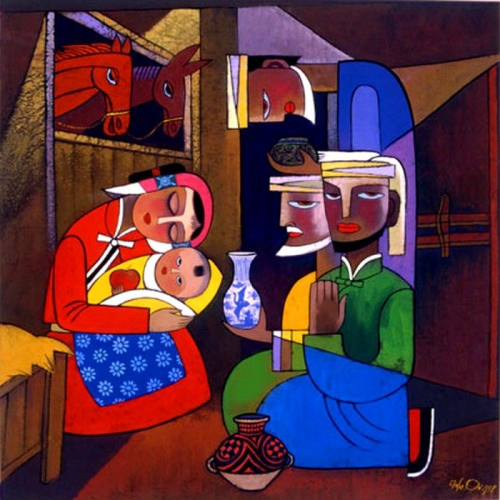
Adoration of the Magi by He Qi

It is still true for people today. This old broken world is wrapped in darkness. All kinds of people have no light at the end of the tunnel of their lives for hope and new life. The gospel of Jesus Christ brings that light to those unable to see. Jesus, in his teaching ministry, exhorted his followers not to hide their light but to let it shine for all to see. (Matthew 5:14-16)

Sometimes, maybe oftentimes, the best way to bring resolution to our own troubles and problems is through helping others make sense of their lives through the gracious light of Christ. Then, they can see an appearance, an epiphany, of what their lives could be in the gracious rule of the kingdom of God. 

As we celebrate Epiphany and journey with Jesus through his earthly upbringing and into his gracious ministry to people, let us keep vigilance to not let our light grow dim. Instead, let us hunger and thirst after Christ’s righteousness so that our joy is full, and our light is bright.

God of mercy, Lord of all, you have gifted the Church through the goodness of your grace to be your hands and do your work, to be your voice and share your words, to bring healing to broken lives. You have graciously gifted your people with the blessings of your Spirit, the power to transform lives and make all things new.

Now may our hearts receive, our mouths proclaim, our hands prepare for compassionate service so that the love we have may overflow into the hearts of others. May they receive your grace, your renewing Spirit, and your love, through Jesus Christ our Savior. Amen.