Are Your Ears Being Tickled? (2 Timothy 3:14-4:5)

But as for you, continue in what you have learned and firmly believed, knowing from whom you learned it and how from childhood you have known sacred writings that are able to instruct you for salvation through faith in Christ Jesus. All scripture is inspired by God and is useful for teaching, for reproof, for correction, and for training in righteousness, so that the person of God may be proficient, equipped for every good work.

In the presence of God and of Christ Jesus, who is to judge the living and the dead, and in view of his appearing and his kingdom, I solemnly urge you: proclaim the message; be persistent whether the time is favorable or unfavorable; convince, rebuke, and encourage with the utmost patience in teaching. For the time is coming when people will not put up with sound teaching, but, having their ears tickled, they will accumulate for themselves teachers to suit their own desires and will turn away from listening to the truth and wander away to myths. As for you, be sober in everything, endure suffering, do the work of an evangelist, carry out your ministry fully. (New Revised Standard Version)

It’s only human in wanting to hear only those things we like to hear. Rarely do any of us purposely seek to listen to another voice which is contrary to our likings. This may be why we exist in such a polarized world; we simply have no intention of listening to any sort of opposing view on anything.

We put our fingers in our ears to stop hearing things we don’t want to hear; and conversely, we surround ourselves only with people who tell us what we want to hear.

The Apostle Paul would say that we like our ears tickled.

One of the hardest things to hear is that sometimes we need to hear hard things.

There is no spiritual growth, and no Christian maturity, apart from the willingness to hear what we need to hear, rather than to always hear what we want to hear. All of us need to keep developing our listening skills.

I would argue that one of the reasons there are umpteen Protestant denominations in this world is that groups of people don’t really want to listen to one another. We’d much rather insulate ourselves; label ourselves as right; and declare that everyone else is worldly and wrong, or an antichrist and a terrorist.

But that sort of thinking will not do for the Apostle Paul. It’s one of the reasons he took the time to write to his young protégé Timothy.

Paul’s letter to Timothy is filled with exhortations and warnings about making sure the church is ethical with their words; avoids useless and profane speech; holds to sound biblical talk; and stays away from speaking erroneously about apostolic teaching.

In other words, church folk must keep their life, their doctrine, and their speech in line with the words and ways of Jesus – even when we encounter hard words from our Lord and his apostles.

Listening to what we need to hear, instead of always what we want to hear, is a significant way of maturing in the Christian life.

We choose to listen to hard things, and things we don’t necessarily want to hear in order to connect with God and others; and to compassionately understand what they’re saying to us.

We need not be at the mercy of our own reactivity. Knee jerk reactions only breed ignorance, not spiritual growth.

Since listening is a skill to develop, that means we need a lot of practice doing it. We can begin by listening to Scripture; embracing the sort of faith which it advocates; and following the examples of godly persons, like the Apostle Paul.

In Timothy’s case, faith was learned and nurtured through the examples of his mother Eunice and grandmother Lois (2 Timothy 1:5). Their compassionate and beloved way of life displayed an embodied source of sound teaching.

There was a whole lot more going on with the godly examples than catechism classes and Sunday School lessons. Their teaching effected a deep and enduring desire to follow the example of godly living.

Every believer needs helpful examples and models, whether they are family or not. The truly Christian person is one who allows the inspiration of Holy Scripture to manifest itself in their life in profoundly powerful ways which brings transformation, not just information.

And whenever these godly persons are together, making up a Christian community, then there is wise discernment in carefully listening to what is right, true, good, and just. Gossip is jettisoned. Lack of evidence is not ever entertained. Rather, encouragement and spiritual nurture take hold.

Christians with the inspired text in the very marrow of their souls faithfully call out deviations and departures from godly scriptural speech. They hold to righteousness and embrace the good. They love mercy and exhibit humility in all things.

Holy Scripture was not a collection of facts for Timothy, but was engrafted into his mind and heart so that what came out of him was faith, hope, and love. Christians like Paul and Timothy had a well-rounded spirituality which was attuned to following Jesus and nurturing the faith of others.

Paul lovingly and confidently exhorted Timothy (and his congregation) to go diligently after Scripture, so that it could do its work within them. They were to speak out the gospel of grace, no matter the situation.

Believers are to liberally use apostolic teaching to convince, rebuke, and encourage each other toward the righteousness of God.

Everyone is to work together in practicing holiness, proclaiming grace, and promoting a way of life rooted in the life of Christ.

Everyone is to avoid flocking to leaders who only tell them what they want to hear. They are to instead flock toward humble and wise leadership who possess time-tested teaching – not pithy slogans and promotions of hate.

Reliable true-blue teaching understands perseverance, long-suffering, honesty, and fidelity to Christ’s words. The truth is stated plainly, and thinks of others. There’s no get-down-and-dirty pride; no posturing nor slick salesmanship.

Timothy cared nothing about getting as many social media followers as he could. And he wasn’t so insecure as to want everyone in his congregation to like him. But neither was he calloused by forcing his way on everyone. Paul taught him better than that.

Paul’s instruction took hold with Timothy by cultivating a genuine spiritual growth that is organic and patient, rooted in love, that can always hearken back to the faithfulness of Christ and the apostles.

It is profoundly sad to me how many persons have left the church. And yet, I understand why. There are too many pastors and elders and deacons who are driven by their own selfish desires for power, control, money, and personal followers. That stuff is a sure prescription for people to get hurt and disillusioned with Christianity, let alone the church.

The Apostle Paul wanted to see leadership which reflects the grace by which he himself had been saved. Furthermore, Paul was devoted to being a mentor in helping others like Timothy and Titus to live in ways which exhibit the grace and mercy of Christ.

A hard teaching is really only hard wherever there exists a hard heart. We all need ever-expanding and softening hearts which are receptive to the voice of Holy Scripture.

What’s more, we need non-itchy ears which listen to the voice of God and the voice of hurting people who need the gospel of grace.

We need godly leadership who knows the difference between truth and being a jerk.

Where are you in your own faith walk?

O God, Spirit of righteousness, you temper judgment with mercy. Help us to live out the covenant which is written on our hearts so that when Christ returns we may be found worthy to receive your gracious presence. Amen.

Learn To Do Good (Isaiah 1:1, 10-20)

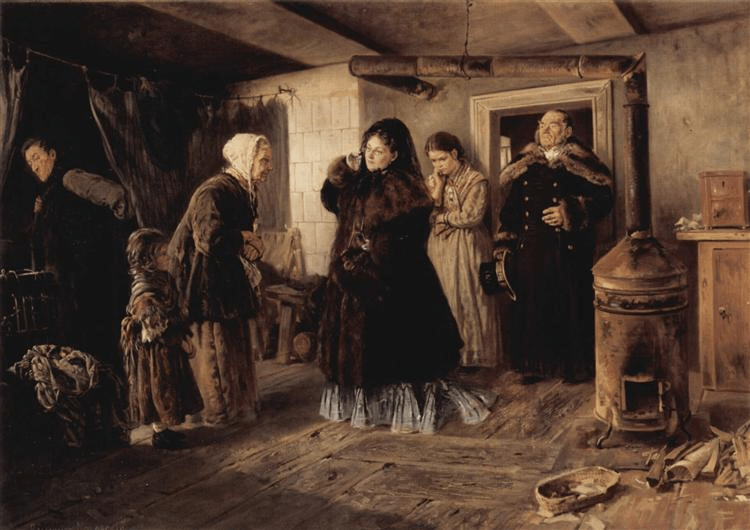
Visiting a Poor People, by Vladimir Makovsky, 1874

The vision of Isaiah son of Amoz, which he saw concerning Judah and Jerusalem in the days of Uzziah, Jotham, Ahaz, and Hezekiah, kings of Judah…

Hear the word of the Lord,
    you rulers of Sodom!
Listen to the teaching of our God,
    you people of Gomorrah!
What to me is the multitude of your sacrifices?
    says the Lord;
I have had enough of burnt offerings of rams
    and the fat of fed beasts;
I do not delight in the blood of bulls
    or of lambs or of goats.

When you come to appear before me,
    who asked this from your hand?
    Trample my courts no more!
Bringing offerings is futile;
    incense is an abomination to me.
New moon and Sabbath and calling of convocation—
    I cannot endure solemn assemblies with iniquity.
Your new moons and your appointed festivals
    my soul hates;
they have become a burden to me;
    I am weary of bearing them.
When you stretch out your hands,
    I will hide my eyes from you;
even though you make many prayers,
    I will not listen;
    your hands are full of blood.
Wash yourselves; make yourselves clean;
    remove your evil deeds
    from before my eyes;
cease to do evil;
    learn to do good;
seek justice;
    rescue the oppressed;
defend the orphan;
    plead for the widow.

Come now, let us argue it out,
    says the Lord:
If your sins are like scarlet,
    will they become like snow?
If they are red like crimson,
    will they become like wool?
If you are willing and obedient,
    you shall eat the good of the land,
but if you refuse and rebel,
    you shall be devoured by the sword,
    for the mouth of the Lord has spoken. (New Revised Standard Version)

Today’s Old Testament lesson is a stout and ancient warning against an age-old problem: Worshiping properly on a high holy day, yet living an evil and unjust life the rest of the days. It’s the mentality of “I give to God what’s required on the Sabbaths and festivals, so I can therefore do what I want the rest of the time, because that’s my stuff and my time.”

Just to be clear: That sort of evil thinking and behavior will raise the ire of the Lord every time. It’s dichotomous messed-up thinking. It’s the wrongheaded notion of believing that my financial and professional success is obviously a validation of God’s blessing upon me.

However, motives of gaining more wealth, rather than being motivated by humility, meekness, righteousness, purity, mercy, and peacemaking, will end badly, no matter who we are.

One of the problems here is an arrogant assumption that we’re right in what we are doing. We feel justified in living a duplicitous life. I have power, authority, and wealth; you do not. Thus, I’m right; you’re wrong; and I can do whatever the heck I want because God is on my side, not yours.

In terms of contemporary Christianity, this is the megachurch mentality: Since there are so many church attenders and money being placed in the offering plates, this is an unquestioned sanction from God of our rightness.

Then, when Sunday passes and Monday comes, both parishioner and pastor feel justified in using their wealth in ways that are inconsistent with the ways and words of Jesus.

Indeed, many times the name of Jesus is rarely (if ever) used in justifications of living the rich life. A blind eye is turned away from the poor and needy. When pressed, far too many parishioners admit to the belief that the poor are underprivileged because of their own personal sin.

Such “Christians” get away with their injustice before God, largely because there is a mass of churchgoers who honor the wealthy and give them places of authority and power.

They think God has shown favor by “blessing” particular people and communities with wealth (because God would never bless someone with poverty!). This can even go so far as to elect a leader of a nation because he is exorbitantly rich. Never mind his daily immorality, meanness, and lying; God has blessed him, right?

Wrong! So says the prophet Isaiah. Judah and Jerusalem, in their hubris, claimed special status. They are God’s people; others are not. They believed they had divine immunity from judgment. After all, only the Judeans worshiped the Lord; all other nations were pagan worshipers.

But their worship and sacrifices, in Isaiah’s day, were offered with no concern for justice and righteousness. So, God called them to repent; and gave them a chance to learn how to please the Lord.

And what pleases God is removing evil and learning to do good.

“Good” is defined by God as seeking to meet the needs of the common people; rescuing those who are oppressed; defending the cause of the orphan, and pleading the case of the widow. There’s no mention of wealth as a sign of divine blessing.

In reality, Judah’s situation before God was pitiful. They failed, even refused, to do justice, love mercy, and walk humbly. Therefore, the Lord called them to repentance and reformation.

Just because Jerusalem had the temple, this sacred space didn’t inoculate the people from judgment. The bald fact of the matter is that the people were living with self-destructive habits of stupidity. And God had enough of it.

In essence, the Lord said to Judah, “Let’s get serious about this.” Despite all the disobedience, God was willing to entertain the people’s change of heart and life – that is, if they themselves were willing to do so.

It’s important for all of us to “have it out with God,” to engage the Lord forthrightly, passionately, intelligently, and realistically.

There are really only two choices: Choose life or choose death. Choose to connect in meaningful, right, good, and just ways with God and neighbor; or choose to disconnect from others and do whatever the heck you want.

Each of our choices impacts what will happen tomorrow and into the future.

Decisions consistent with justice, righteousness, and goodness will ultimately go well for us. Decision-making borne of selfishness, a lack of mercy, and callousness toward others will create all sorts of problems.

Judah’s practical and existential decision came down to whether they wanted a just and productive society, or an invading Assyrian army. Which would you rather have?

To have a public daily life of disrespect and disregard for the needs of others (and of God!) is to invite being up a stinking creek without a paddle, and no one around to hear the yells for help.

Nothing can ever replace good old-fashioned turning away from hate, unforgiveness, bitterness, and pride; and turning toward what is good, right, just, and godly – and then ordering our collective public life around caring for the least and the lost among us.

May it be so, to the glory of God.

God of judgment and grace, you ask not for sacrifices but lives of trusting faith that acknowledge Your power and mercy. Give us a deep belief in Your sovereign goodness, so that we may follow You all the days of our lives, as did Jesus Christ our Savior and Lord. Amen.

Pray with Persistence (Luke 11:1-13)

He [Jesus] was praying in a certain place, and after he had finished, one of his disciples said to him, “Lord, teach us to pray, as John taught his disciples.” So he said to them, “When you pray, say:

Father, may your name be revered as holy.
    May your kingdom come.
    Give us each day our daily bread.
    And forgive us our sins,
        for we ourselves forgive everyone indebted to us.
    And do not bring us to the time of trial.”

And he said to them, “Suppose one of you has a friend, and you go to him at midnight and say to him, ‘Friend, lend me three loaves of bread, for a friend of mine has arrived, and I have nothing to set before him.’ And he answers from within, ‘Do not bother me; the door has already been locked, and my children are with me in bed; I cannot get up and give you anything.’ I tell you, even though he will not get up and give him anything out of friendship, at least because of his persistence he will get up and give him whatever he needs.

“So I say to you, Ask, and it will be given to you; search, and you will find; knock, and the door will be opened for you. For everyone who asks receives, and everyone who searches finds, and for everyone who knocks, the door will be opened. Is there anyone among you who, if your child asked for a fish, would give a snake instead of a fish? Or if the child asked for an egg, would give a scorpion? If you, then, who are evil, know how to give good gifts to your children, how much more will the heavenly Father give the Holy Spirit to those who ask him!” (New Revised Standard Version)

If we desire to see the power of prayer become a reality in our lives, we will have to avoid drive-by prayers in favor of sustained and focused prayers taught to us from the Lord Jesus.

Prayer empowered Jesus in his earthly ministry. His disciples saw this, and wanted it, too. So, Christ encouraged them in what to pray, and to keep persistently praying, despite the circumstances.

We are instructed by Jesus to approach the heavenly Father just as he himself did – in a straightforward and intimate manner. The content of our prayers ought to encompass the following five petitions:

  • Let God’s name be made holy. In other words, we are to let the Lord’s name be seen by others as holy within us in our daily lives. This is a petition for God to establish divine sovereignty and holiness in the heart of the believer. When this happens, the name of God is exalted and set apart as holy before a watching world.
  • Let God’s kingdom come. This is a prayer that asks for the reign of God to extend over the entire earth in a very practical way – to have God’s rule draw near to everyone and everything, including ourselves.
  • Let us have our daily bread. That is, pray that God will give us everything we need for life and godliness in this present evil age, including physical sustenance, mental acuity, emotional intelligence, and spiritual food. None of us lives by bread alone, but by every word that proceeds from the mouth of God.
  • Let forgiveness come. Sin is a reality. Therefore, every one of us needs forgiveness; and everyone needs to forgive others. Forgiveness is powerful; it releases us to freedom. And thus, we have the power to release others through the act of forgiving the egregious sins of others. The failure to do this is why the kingdom of God is so disestablished in this world.
  • Let us not become victims of the cosmic conflict. There is a continual struggle of unseen powers on this earth that no human is armed to deal with. Apart from God’s intervention, humanity gets caught in the crosshairs of the conflict. We are to pray that this trial does not overcome us.

These prayers are to be consistently and persistently prayed every day. Christ wants us to keep asking, seeking, and knocking.

Jesus, in his teaching ministry on earth, often used the lesser-to-greater argument in getting his point across. And that is precisely what he was doing with his disciples in today’s Gospel lesson by instructing them about the nature and motivation of prayer.

The lesser-to-greater argument implies a comparison of values. It’s grounded on a common sense and logical convention that if this lesser thing is true, then, of course, how much more is this greater thing!

If something less likely to happen is true, then something more likely to happen will probably be true as well. The technical phrase for this is an argument a fortiori – a Latin term meaning, “for a still stronger reason.”

Jesus wanted his followers to understand that prayer has value because God is a loving Father, not a begrudging friend. Whereas the friend in the story was badgered just so the person could get some real necessities, God needs no badgering to generously give good gifts that may or may not be considered as necessities by us.

Jesus desired to highlight that prayer has veracity because of whom those prayers are directed.

In the ancient world, it was common understanding you needed to get the local gods attention if you wanted something. Which is why, for example, in the prophet Elijah’s showdown with the prophets of Baal, that Baal’s worshipers were yelling, gesticulating, and even cutting themselves for hours. They fully expected to put a lot of work into getting Baal’s attention, maybe even needing to convince him of intervening in their ancient version of a wild West shootout.

In contrast to four-hundred prophets of Baal, a single prophet of the Lord utters one simple prayer, then fire comes rushing down from heaven. Much like the person who badgered the friend for bread, the prophets pestered Baal for hours. (1 Kings 18)

In Christ’s story, it all comes down to who really cares. The friend? Not enough to jump out of bed right away and meet a need. Baal? Not so much. God? Now we’re talking.

We typically don’t ask, seek, or knock, if we believe we will not get a response – or if it will take a lot of energy, time, and effort we don’t have. Yet, if we are confident of being heard and our requests taken seriously with care, then we are likely to have a habit of asking, seeking, and knocking.

If a friend begrudgingly gives to you because of persistent knocking, how much more will God graciously, generously, and with gaiety give you goodness when you ask?

Because God is good, God gives. The largess of the Lord is willing and ready to dispense grace from an infinite storehouse of mercy.

This is why Jesus encouraged people to not pray like those who don’t know God, babbling on because they think they’ll be heard because of the sheer volume of words. (Matthew 6:7-8)

Two misconceptions of prayer existed in Christ’s day (and today); they come from non-Christian sources:

  1. There must be a lot of prayer before prayer “works.” Although I believe repetition is important for forming good habits, praying the same prayers over and over again so as to be heard betrays an ignorance of God, not to mention an actual lack of faith. Many ancient religions were based in learning how to manipulate the spiritual forces out there to get what we need. It’s kind of like a divine version of hustling for love in all the wrong places. Christians need to know they don’t need to have thousands of people praying in order to get God’s attention to answer prayer.
  2. I must convince God of the need to answer my prayer. God is not a reluctant listener. The reason the Lord already knows what we need before we ask is because God has been paying close attention to us well before we got around to asking, seeking, and knocking on the divine door. God’s ear is already inclined to hear us – expectantly and anxiously awaiting our petitions. This is a tremendously freeing idea, that I can come to God openly and honestly, without drudgery, and without wondering if I am heard, or not.

May we be encouraged to pray, to truly connect with God, because the Lord is available without appointment, and is waiting for us to ask with bended ear.

Eternal God, by whose power we are created and by whose love we are redeemed: Guide and strengthen us by your Spirit so that we may give ourselves to your service and live today and every day in love to one another and to you, through Jesus Christ our Lord, in the strength of the Holy Spirit. Amen.

Return To the Lord (Amos 4:6-13)

I gave you cleanness of teeth in all your cities
    and lack of bread in all your places;
yet you did not return to me,
            says the Lord.

And I also withheld the rain from you
    when there were still three months to the harvest;
I would send rain on one city
    and send no rain on another city;
one field would be rained upon,
    and the field on which it did not rain withered;
so two or three towns wandered to one town
    to drink water and were not satisfied;
yet you did not return to me,
            says the Lord.

I struck you with blight and mildew;
    I laid waste your gardens and your vineyards;
    the locust devoured your fig trees and your olive trees;
yet you did not return to me,
            says the Lord.

I sent among you a pestilence after the manner of Egypt;
    I killed your young men with the sword;
I carried away your horses;
    and I made the stench of your camp go up into your nostrils;
yet you did not return to me,
            says the Lord.

I overthrew some of you
    as when God overthrew Sodom and Gomorrah,
    and you were like a brand snatched from the fire;
yet you did not return to me,
            says the Lord.

Therefore thus I will do to you, O Israel;
    because I will do this to you,
    prepare to meet your God, O Israel!

For the one who forms the mountains, creates the wind,
    reveals his thoughts to mortals,
makes the morning darkness,
    and treads on the heights of the earth—
    the Lord, the God of hosts, is his name! (New Revised Standard Version)

“Luxury often leads to forgetfulness. As for you, my beloved, if you sit at table, remember that from the table you must go to prayer. Fill your belly so moderately that you may not become too heavy to bend your knees and call upon your God.” St. John Chrysostom, On Wealth and Poverty 

Let us test and examine our ways and return to the Lord.

Lamentations 3:40, NRSV

Again and again, century after century, Israel’s God, Yahweh, sent prophets and calamities in order to shake God’s people from their wayward path.

It was expected that observance and faithfulness to God’s covenant would bring times of goodness and prosperity. Conversely, times of disobedience would elicit misfortune. It seems the people forgot that infidelity to the covenant leads to calamitous circumstances.

Through it all, Israel and Judah were unfaithful. All Yahweh ever wanted was for the people to return to their God, and enjoy all the blessings and benefits of being in a divine/human harmony. But the people weren’t having it.

Amos, throughout his prophecy, made it clear that personal transgressions, social injustice, religious infidelity, and national sins were at the heart of the trouble.

There was a tremendous wealth inequality which existed in ancient Israel. The people lost sight of the reality that everything belongs to God. Therefore, any resources they were blessed with should have been used to help the common good of all, especially the poor and needy.

It was from the prophets like Amos that the great early church preacher, St. John Chrysostom, developed his understanding of personal responsibility, church ministry, and national concern.

In sermon after sermon, Chrysostom argued and established that excessive wealth is dangerous to the soul. He continually warned his parishioners that those who accumulate exorbitant wealth are actually storing up a great retribution for themselves in the next life.

He insisted that the proper response to the extravagance of one’s possessions and money is to return to God and give liberally to others. One must understand, St. John argued, that all things belong to God. Thus, to acquire more and more is, in reality, a form of stealing from the poor.

Kindness and charity to the poor is imperative. Otherwise, a society cannot expect to realize ongoing blessing from God. Chrysostom constantly advocated for people to be generous in giving, not only to help the poor, but also to spur one’s spiritual growth and spiritual wealth. Building treasure in heaven, rather than on earth, was St. John’s basic orientation in life.

In today’s Old Testament lesson, after rehearsing seven different calamities which were meant as warnings, the eighth calamity would be to meet God face to face. We get the gist of the argument as a meeting that wouldn’t go so well for the filthy rich… that is, unless they willingly return to God and submit themselves and their stuff to the Lord of all.

Every one of us must ultimately come to grips with the fact that mercy and wrath are very real concepts that look one another in the eye. There is both hope and warning.

Will we return to the Lord, or will God effect a great visitation upon us?

Will God save us at the eleventh hour, or will the Lord bring devastation?

Either way, there is a meeting coming. Prepare to meet your God. It’s up to us how that meeting is going to shake out.

There is yet hope for those who are penitent, even and especially for those who finagled to obtain power and wealth for themselves. But if they are stubborn, they will find out what is the face opposite of mercy. This is the era of return, because it is still possible to change.

Yet even now, says the Lord,
    return to me with all your heart,
with fasting, with weeping, and with mourning;
    rend your hearts and not your clothing.
Return to the Lord your God,
    for he is gracious and merciful,
slow to anger, abounding in steadfast love,
    and relenting from punishment. (Joel 2:12-13, NRSV)

Most merciful God, we confess that we have sinned against you in thought, word, and deed, by what we have done, and by what we have left undone.

We have not loved you with our whole heart; we have not loved our neighbors as ourselves. We are truly sorry and we humbly repent.

For the sake of your Son Jesus Christ, have mercy on us and forgive us; that we may delight in your will, and walk in your ways, to the glory of your Name. Amen. (Book of Common Prayer)