Psalm 28 – Prayer, Praise, and Possibility

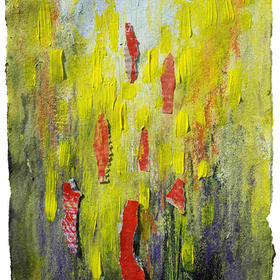
Psalm 28 by Dutch artist Wim van de Wege

I pray to you, O Lord, my rock.
    Do not turn a deaf ear to me.
For if you are silent,
    I might as well give up and die.
Listen to my prayer for mercy
    as I cry out to you for help,
    as I lift my hands toward your holy sanctuary.

Do not drag me away with the wicked—
    with those who do evil—
those who speak friendly words to their neighbors
    while planning evil in their hearts.
Give them the punishment they so richly deserve!
    Measure it out in proportion to their wickedness.
Pay them back for all their evil deeds!
    Give them a taste of what they have done to others.
They care nothing for what the Lord has done
    or for what his hands have made.
So he will tear them down,
    and they will never be rebuilt!

Praise the Lord!
    For he has heard my cry for mercy.
The Lord is my strength and shield.
    I trust him with all my heart.
He helps me, and my heart is filled with joy.
    I burst out in songs of thanksgiving.

The Lord gives his people strength.
    He is a safe fortress for his anointed king.
Save your people!
    Bless Israel, your special possession.
Lead them like a shepherd,
    and carry them in your arms forever. (New Living Translation)

The biblical character David, in frustration and agony, cried out for help, for God to hear his prayers. And, when his prayer was heard, David gave exuberant praise to the Lord for listening to him.

We are not told specifically of how that prayer was answered and what happened between the request and the response. It seems the juicy details are left out on purpose, so that maybe we would not get lost in the retribution but stick with the fact that there was a desperate need and the Lord stepped in and did something about it.

As I pondered this psalm and its lack of life-detail, I wondered about David’s situation:

Could it be that David gave God praise just for being heard by him? 

Was David cured in some way, or was he healed from the need to be healed? 

Was there even any actual deliverance that occurred? 

Did David come to praise God despite a lack of deliverance? 

Was David’s joy in his relationship with God conditional, or unconditional?

William Shakespeare’s Hamlet (c.1601 C.E.) put the question this way: “To be, or not to be, that is the question.” Hamlet’s soliloquy went on to say:

“Whether ’tis nobler in the mind to suffer
The slings and arrows of outrageous fortune,
Or to take arms against a sea of troubles,
And by opposing end them? To die: to sleep;
No more; and by a sleep to say we end
The heartache and the thousand natural shocks
That flesh is heir to, ’tis a consummation
Devoutly to be wish’d. To die, to sleep;
To sleep: perchance, to dream: ay, there’s the rub;
For in that sleep of death what dreams may come
When we have shuffled off this mortal coil,
Must give us pause: there’s the respect
That makes calamity of so long life;
For who would bear the whips and scorns of time,
The oppressor’s wrong, the proud man’s contumely,
The pangs of despised love, the law’s delay,
The insolence of office and the spurns
That patient merit of the unworthy takes,
When he himself might his quietus make
With a bare bodkin (knitting needle)?”

Hamlet, much like David of old, was miserable and burdened with a profound lack of power to change his circumstances. So, he reflects on life and death in a morbid and melancholy way. It’s not that Hamlet was contemplating suicide as much as he meditated on what life truly is and finding some meaning within it. Unlike David, Hamlet cannot find the courage to deal with his frustration and feels stymied with fear of the unknown.

If we are blatantly honest with ourselves, we must admit that far too often we have a particular outcome in mind that we want or expect God to do.  Our hopes become tethered to God doing something extremely specific so that, if it does not come to pass (or does not come quickly!) we become discouraged and disillusioned. Like Hamlet, we become lost in the shadows of our thinking and ponder some sort of escape.

So, here is another set of questions I am asking myself: 

If my adverse circumstances do not change, can I praise God anyway? 

Can I, like David, take joy in simply being heard? 

Can I find gratitude in all situations? 

Do I only express thanks and praise to God when things are going my way? 

Am I open to whatever God wants to do in my life, even if it is not what I would choose? 

Do I feel that I am above having to put up with the wickedness of this world? 

Am I expecting heaven on earth, or am I willing to suffer as Jesus did? 

I honestly believe the answers to those questions will determine the trajectory of our Christian experience. For the identity and meaning of all persons is found in the divine.

I praise you, O God, in the good and the bad, the easy and the difficult, the failures and the victories.  You are Lord over all things.  You are my strength and shield in every circumstance.  When I am weak, I am strong. I can do all things through Christ who strengthens me. Amen.

Nehemiah 1:1-11 – A Prayer of Solidarity and Confession

These are the memoirs of Nehemiah son of Hacaliah.

In late autumn, in the month of Kislev, in the twentieth year of King Artaxerxes’ reign, I was at the fortress of Susa. Hanani, one of my brothers, came to visit me with some other men who had just arrived from Judah. I asked them about the Jews who had returned there from captivity and about how things were going in Jerusalem.

They said to me, “Things are not going well for those who returned to the province of Judah. They are in great trouble and disgrace. The wall of Jerusalem has been torn down, and the gates have been destroyed by fire.”

When I heard this, I sat down and wept. In fact, for days I mourned, fasted, and prayed to the God of heaven. Then I said,

“O Lord, God of heaven, the great and awesome God who keeps his covenant of unfailing love with those who love him and obey his commands, listen to my prayer! Look down and see me praying night and day for your people Israel. I confess that we have sinned against you. Yes, even my own family and I have sinned! We have sinned terribly by not obeying the commands, decrees, and regulations that you gave us through your servant Moses.

“Please remember what you told your servant Moses: ‘If you are unfaithful to me, I will scatter you among the nations. But if you return to me and obey my commands and live by them, then even if you are exiled to the ends of the earth, I will bring you back to the place I have chosen for my name to be honored.’

“The people you rescued by your great power and strong hand are your servants.O Lord, please hear my prayer! Listen to the prayers of those of us who delight in honoring you. Please grant me success today by making the king favorable to me. Put it into his heart to be kind to me.”

In those days I was the king’s cup-bearer. (New Living Translation)

I believe that nothing of eternal significance happens apart from God. Jesus said it clearly: “Apart from me you can do nothing.” (John 15:5, NIV) 

There is simply no substitute for a close relationship with God. The will of God can only be accomplished through the spiritual practice of prayer. Prayer is not a passive activity. If done well, prayer takes time, a great deal of effort, and a sense of priority. It is quite possible that biblical praying can be the most challenging, exhausting, laborious, and rewarding thing we do.

Through prayer we can become filled with the Holy Spirit, gain wisdom to make godly decisions, and access spiritual power that can melt the hardest of hearts and change the minds of the most stubborn of people. 

In prayer we have the privilege of expressing our concerns and needs, as well as having God’s agenda revealed to us for what to do. Our personal and communal holiness is in direct proportion to the great task of prayer.

When faced with the reality that his hometown, Jerusalem, was in trouble, Nehemiah, the king’s wine steward, prayed. In prayer he owned the problems Jerusalem faced. He owned it through a prayer that emphasized and reminded God of the covenant with God’s people; he confessed the sins by which Israel violated that covenant; and he held onto the promise that God would lift the curse on the city if the people would only repent.

Nehemiah had a compassionate heart that was attentive to what was going on in his native land. Hearing the tragic news of the city’s condition, he immediately wept, mourned, fasted, and prayed.

Nehemiah was profoundly disturbed by the news that Jerusalem was in trouble. Rather than being preoccupied with himself and his own situation as an exile in Babylon, Nehemiah sought to do something about the security and spiritual health of his people.

In his prayer to God, Nehemiah was genuine, persistent, confident, humble, and submissive to God. He did not distance himself from the sins of the people, but clearly identified with them through a prayer of confession.  That confession was intense, honest, real, and urgent.

Sin always needs to be identified, acknowledged, and pardoned. If it isn’t, there is no hope for things to be different.

There is a season for everything. Hunting seasons may come and go, but it is always open season for prayer.  And Nehemiah’s prayer is a solid biblical model for us to emulate. We have our challenges. Like Nehemiah, let’s own those challenges through prayers which are biblically focused, compassionately offered, and spiritually curious to know and do God’s agenda for the church and the world.

Let us continually have a spirit of prayer to God in everything we say and do – prayerful spirits that above all seeks God’s will and implementing that will through God’s love.

Almighty and gracious God, we lower our heads before you and confess we too often forget that we are yours. Sometimes we carry on our lives as if there was no God and we fall short of being a credible witness to you and your incredible mercy. For these things we ask your forgiveness and strength. Give us clear minds and open hearts so we may witness to the love of Christ in our world. Remind us to be who you would have us to be regardless of what we are doing or who we are with. Hold us to closely and tightly in your good strong hands. Build our relationship with you and with those you have given us on earth, through Jesus Christ our Lord, in the power of your Holy Spirit. Amen.

Psalm 39 – Being Honest with God

I promised I would watch my steps
    so as not to sin with my tongue;
    promised to keep my mouth shut
    as long as the wicked were in my presence.
So I was completely quiet, silent.
    I kept my peace, but it did no good.
    My pain got worse.
My heart got hot inside me;
    while stewing over it, the fire burned.
Then I spoke out with my tongue:
    “Let me know my end, Lord.
    How many days do I have left?
    I want to know how brief my time is.”
You’ve made my days so short;
    my lifetime is like nothing in your eyes.
        Yes, a human life is nothing but a puff of air! Selah

Yes, people wander around like shadows;
    yes, they hustle and bustle, but pointlessly;
        they don’t even know who will get the wealth they’ve amassed.
So now, Lord, what should I be waiting for?
        My hope is set on you.
Deliver me from all my sins;
    don’t make me some foolish person’s joke.
I am completely silent; I won’t open my mouth
    because you have acted.
Get this plague of yours off me!
    I’m being destroyed by the blows from your fist.
You discipline people for their sin, punishing them;
    like a moth, you ruin what they treasure.
        Yes, a human life is just a puff of air! Selah

Hear my prayer, Lord!
    Listen closely to my cry for help!
Please don’t ignore my tears!
    I’m just a foreigner—
        an immigrant staying with you,
        just like all my ancestors were.
Look away from me
    so I can be happy again
    before I pass away and am gone. (Common English Bible)

God is big. The Lord is big enough to hear whatever is on our hearts. It really does no one any good to have pretense with God. The psalmist initially thought he had to hold back in speaking with God:  He was silent and held his peace with God. However, his distress grew worse.

The psalmist, David, finally opened up. He went on to speak openly and honestly to God, with flavorful expression, about what was really on his heart and mind.

Sometimes we may mistakenly believe we need to be guarded with God – that somehow we should treat the Lord of the universe like we do with other people – coy, hesitant, keeping a respectable distance in conversation.  Maybe that ought to occasionally happen with other people, but it is silly to approach God in such a manner. With God, we ought to be brutally honest about how we are really doing and how we are actually feeling. 

If we desire to move mountains and have God work powerfully in and through us, then we need to acknowledge and admit there is a mountain smack in front of our faces.

I’m quite sure God has heard it all from people in the long millennia of human existence. The Lord isn’t going to be surprised by any of our thoughts and words. So, why hide them? 

It may be a radical thought for some that we can say anything to God and express our deepest emotions to the Lord who desires to listen. God wants to help us journey in this pilgrimage of faith we are on. For that to happen, we must be up front about our current location and how we are doing.

Like everything in life, honesty is a skill to be developed and utilized. Being honest with ourselves and the Lord involves the following:

Acknowledging both the good and the bad.

Shying away from the shadowy places of our hearts will never resolve the icky-ness we may feel inside. Neither will peace come only by focusing on our screw-ups and bad traits. There is both bad and good within us all, and so, we need to hold them both together, recognizing the tension. The better we accept this reality, the sooner we can walk the path of faith with patience and confidence. Both prayers of confession and praise help us keep the good and the bad in mind.

Giving some time and space, daily, to reflect.

Debrief with yourself about your day or events within the day. What did you do well? What could you have improved? Is there anything you will do differently next time? How might you engraft this kind of reflection into your daily prayers?

Admitting your mistakes and when you need help.

Only a person who admits their mistakes can learn from them and correct them. This is a necessary part of spiritual growth and development. Faith cannot be properly formed if we don’t face up to our own reality. Blaming others only causes us to take the focus off our own needs. Failure and admitting need is to be human. Asking for assistance requires humility and courage – qualities we all possess if we will access them.

Paying attention to your emotions.

David, the psalmist, did it. He was aware of his emotions, acknowledged them, and expressed them to God. Our feelings are not some necessary evil. Rather, they are important to our faith and well-being. All emotions exist as signs for us to pay attention to something, whatever it is.

Listening to the gut.

You and I can learn the difference between an impulsive reaction and an intuitive response. The gut level instinct we possess is our conscience giving us insight. Avoiding this important epistemic ally usually results in a lack of self-awareness and poor decision-making. However, listening to the spiritual whispers within can serve us well.

Reading a psalm every day.

The psalms are emotional. They are also, obviously, biblical. Therefore, emotions are godly. A daily regimen of reading at least one psalm out loud can have the effect of bringing our mind, spirit, and emotions into alignment so that they are not disparate parts inside us.

God of the Ages, you are above all and know all things. Hear my prayer, O Lord, and give ear to my cry; hold not your peace at my tears.  I am a sojourner with you, a guest, like all my forefathers. Look away from me, that I may smile again, before I depart and am no more!  My hope is in you; without your abiding presence I am nothing. Maranatha, come, Lord Jesus. Amen.

Job 8:1-22 – Face the Pain

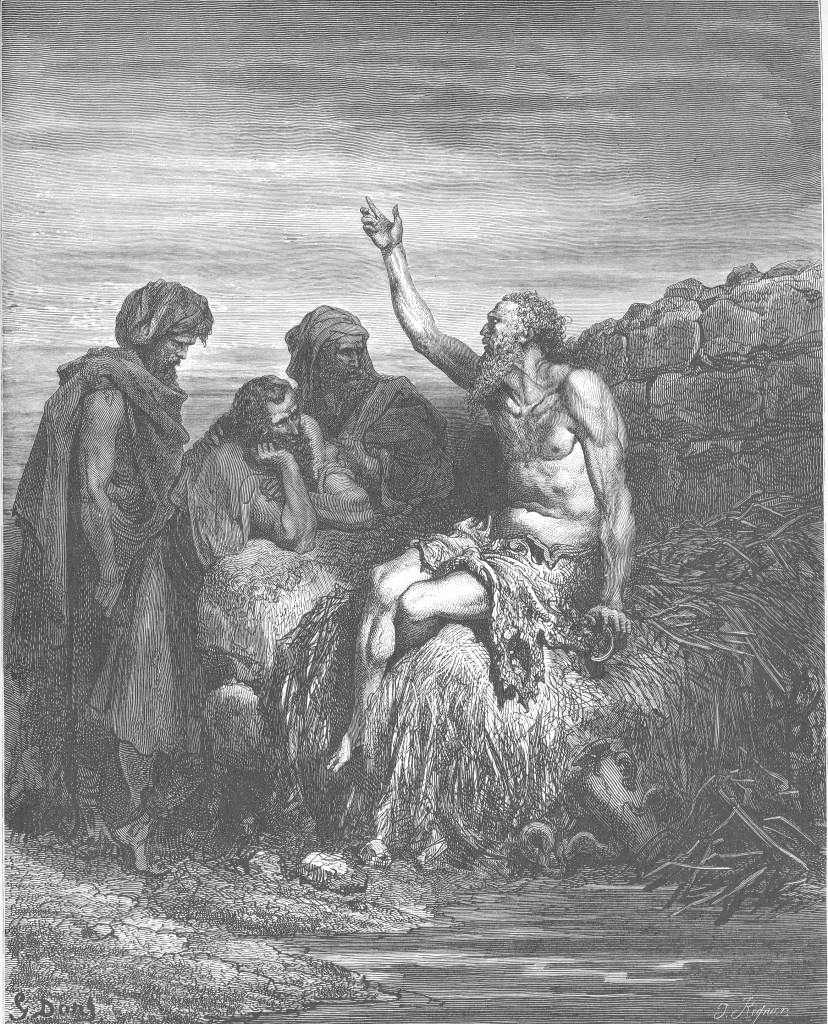
Job Speaks with His Friends by Gustave Doré (1832-1883)

Are you finally through with your windy speech?
God never twists justice;
    he never fails to do what is right.
Your children must have sinned against God,
    and so he punished them as they deserved.
But turn now and plead with Almighty God;
    if you are so honest and pure,
    then God will come and help you
    and restore your household as your reward.
All the wealth you lost will be nothing
    compared with what God will give you then.

Look for a moment at ancient wisdom;
    consider the truths our ancestors learned.
Our life is short; we know nothing at all;
    we pass like shadows across the earth.
But let the ancient wise people teach you;
    listen to what they had to say:

“Reeds can’t grow where there is no water;
    they are never found outside a swamp.
If the water dries up, they are the first to wither,
    while still too small to be cut and used.
Godless people are like those reeds;
    their hope is gone, once God is forgotten.
They trust a thread—a spider’s web.
    If they lean on a web, will it hold them up?
    If they grab for a thread, will it help them stand?”

Evil people sprout like weeds in the sun,
    like weeds that spread all through the garden.
Their roots wrap around the stones
    and hold fast to every rock.
But then pull them up—
    no one will ever know they were there.
Yes, that’s all the joy evil people have;
    others now come and take their places.

But God will never abandon the faithful
    or ever give help to evil people.
He will let you laugh and shout again,
    but he will bring disgrace on those who hate you,
    and the homes of the wicked will vanish. (Good News Translation)

These are the words of Bildad, a “friend” of Job. The guy just couldn’t take it anymore. As Job expressed his deep grief, Bildad grew perturbed. Whereas Job needed to be heard, to tell his story with others who would offer listening ears of empathy, Bildad was uncomfortable with all this grief junk and felt he needed to rebuke Job…. Oy vey.

There are various kinds of suffering, and the biblical character of Job experienced them all. One of the most severe kinds of hurt, and the one that gets far more attention than any other in the book of Job, are the short-sighted rebukes from Job’s “friends.” 

God had a severe mercy for Job. The friends, however, lived in a black and white world of either/or – either you confess your sin, or you don’t – as if all suffering is connected to personal sin. Bildad’s left-brained linear explanation was expressed this way: God will not reject a blameless man.

For Bildad, personal suffering equals personal sin and God’s disfavor. Bildad could only see a sequential connection, a direct line from sin to calamity. It was simply out of his equation to think otherwise. Since Bildad saw suffering as the direct result of sin, his remedy was to exhort toward confession of sin. 

The problem with this view is that we, as the readers, already know this to be a patently false understanding of Job’s suffering. Although Bildad saw the suffering, he did not discern the unseen dimension of good and evil contending behind-the-scenes between God and Satan.

It is only normal to wonder if we have sinned against God whenever finding ourselves in the crucible of suffering. But if we have done patient work to determine there is no personal reason for the pain, perhaps there is something going on that is much bigger than us. 

Our task, like Job’s, is to entrust ourselves to God. We might chafe at such counsel because we like to fix things that hurt. Suffering, however, will not last forever; it will eventually pass. And God’s way will always prevail, in the end. So, we must continually keep in mind that permanent faith transcends temporary pain.

There are four types of pain we experience in this life:

  1. Spiritual pain that arises from within us in our connection, or lack thereof, with the divine.
  2. Emotional pain that arises from our relationship with others.
  3. Physical pain that arises from our bodies and from natural forces on this earth.
  4. Mental pain that arises from cognitive disorders, childhood trauma, and all forms of abuse or neglect.

In all pain, the story we tell ourselves about the reason for the hurt is significant. We have a relationship with our pain. If the story we are telling ourselves is that the pain is all in my head, or that others have it worse than me, we are ignoring or stuffing our pain. If the story is that pain is bad and I must rid myself of it, then we will completely miss what our pain is trying to tell us.

Job was trying to come to grips with his pain. He was facing it, talking about it, expressing his wonderings concerning it, and allowing himself to completely feel all of it.

Conversely, Bildad so tightly held onto his own story about what pain and suffering is that he was unable to be the friend Job needed. And, I might add, at the end of the story, God didn’t look with favor on Bildad’s approach.

So, what will you do with your pain?

What is the story you are telling yourself about your pain?

Who do you trust so that you can talk about your pain?

Where is God in your pain?

How is your current relationship to the pain helping or hindering you?

Where will you turn, in the future, when pain comes upon you?

Loving God, take pity on my life as I seek to embrace you in both good times and bad. I belong to you; therefore, I will not forsake you, no matter how much I do not understand the suffering. Amen.