1 Kings 8:22-30 – Solomon’s Prayer of Dedication

Then Solomon stood before the altar of the Lord in the presence of all the assembly of Israel and spread out his hands to heaven. He said, “O Lord, God of Israel, there is no God like you in heaven above or on earth beneath, keeping covenant and steadfast love for your servants who walk before you with all their heart, the covenant that you kept for your servant my father David as you declared to him; you promised with your mouth and have this day fulfilled with your hand. Therefore, O Lord, God of Israel, keep for your servant my father David that which you promised him, saying, ‘There shall never fail you a successor before me to sit on the throne of Israel, if only your children look to their way, to walk before me as you have walked before me.’ Therefore, O God of Israel, let your word be confirmed, which you promised to your servant my father David.

“But will God indeed dwell on the earth? Even heaven and the highest heaven cannot contain you, much less this house that I have built! Regard your servant’s prayer and his plea, O Lord my God, heeding the cry and the prayer that your servant prays to you today; that your eyes may be open night and day toward this house, the place of which you said, ‘My name shall be there,’ that you may heed the prayer that your servant prays toward this place. Hear the plea of your servant and of your people Israel when they pray toward this place; O hear in heaven your dwelling place; heed and forgive. (New Revised Standard Version)

I grew up in rural Iowa, a place with lots of gravel roads. In the seasons of Spring and Fall, the thawing and re-freezing lead to some impressive ruts in those roads. It’s difficult to avoid them since they nearly dominate the driving space. 

With our prayers, there are seasons of life where we can slip into ruts – times where focused wrestling in prayer is set aside by just going along with the rut of prayer with the same lifeless words and phrases. There are Christians who pray wonderful prayers… over and over again with almost no thought to it, continually saying the same things anytime they pray.

In today’s Old Testament lesson, we have a prayer of Solomon at the dedication of the Lord’s temple. The two aspects of this prayer that jump out to me are: 

  1. Solomon reminded God of divine promises to the covenant people.
  2. Solomon reminded God of who God is. 

Solomon, as the wisest person to ever live, did not believe that somehow God forgot about promises made or had some sort of divine dementia about theology proper. Instead, Solomon prayed with the kind of prayer that God delights to hear. 

“Prayer does not change God, but it changes him who prays.”

Søren Kierkegaard 

God enjoys hearing us pray. The Lord likes it when we pray according to the promises given us. God adores when we pray with a focused understanding of whom we are praying to.

So, then, in our prayers, it is good to emulate the example of King Solomon. Know the promises of God contained in Holy Scripture and pray they will be confirmed in our lives, families, churches, and world. 

Also, pray with the intention of declaring God’s inherent nature, attributes, and character. Acknowledge the basic trait of God’s steadfast love. Believers serve a big God whose hugeness is continually above all things, and whose work is always continuing according to divine decrees and words. 

One way of moving our prayers out of the ruts of familiar language and thoughts is to journal them. Writing our prayers can become for us an act of worship as we slow down enough to craft a response to God that is thoughtful and connects us with him beyond the rote and routine.

In its simplest definition prayer is a conversation between the one who is praying and the one to whom those prayers is directed. So, whenever we craft a written or spoken prayer, it’s good to get out of a rut by:

  • Using language and words that are meaningful to you.
  • Making your intentions clear by stating exactly what you need or want.
  • Taking your time and not rushing.
  • Lighting candles, burning incense, or creating a special sacred space for prayer. 

Thank you Lord God for the opportunity of prayer and worship. Thank you that I can put aside uncertainties of this world and rest and rely upon the certainties of your good promises. Thank you that we can bring to your feet all the hurts and fears that trouble us and leave them there knowing that your strength and assurance are all that we require. May all your people find peace, healing, wholeness, and joy in your presence, through Jesus Christ, your Son, our Savior, who with you and the Holy Spirit exist as one God, now and forever. Amen.

1 Samuel 3:1-18 – Speak Lord, For I Am Listening

Stained glass of the boy Samuel at the bed of Eli the priest

Now the boy Samuel was ministering to the Lord under Eli. The word of the Lord was rare in those days; visions were not widespread.

At that time Eli, whose eyesight had begun to grow dim so that he could not see, was lying down in his room; the lamp of God had not yet gone out, and Samuel was lying down in the temple of the Lord, where the ark of God was. Then the Lord called, “Samuel! Samuel!” and he said, “Here I am!” and ran to Eli, and said, “Here I am, for you called me.” But he said, “I did not call; lie down again.” So, he went and lay down. The Lord called again, “Samuel!” Samuel got up and went to Eli, and said, “Here I am, for you called me.” But he said, “I did not call, my son; lie down again.” Now Samuel did not yet know the Lord, and the word of the Lord had not yet been revealed to him. The Lord called Samuel again, a third time. And he got up and went to Eli, and said, “Here I am, for you called me.” Then Eli perceived that the Lord was calling the boy. Therefore, Eli said to Samuel, “Go, lie down; and if he calls you, you shall say, ‘Speak, Lord, for your servant is listening.’” So, Samuel went and lay down in his place.

Now the Lord came and stood there, calling as before, “Samuel! Samuel!” And Samuel said, “Speak, for your servant is listening.” Then the Lord said to Samuel, “See, I am about to do something in Israel that will make both ears of anyone who hears of it tingle. On that day I will fulfill against Eli all that I have spoken concerning his house, from beginning to end. For I have told him that I am about to punish his house forever, for the iniquity that he knew, because his sons were blaspheming God, and he did not restrain them. Therefore, I swear to the house of Eli that the iniquity of Eli’s house shall not be expiated by sacrifice or offering forever.”

Samuel lay there until morning; then he opened the doors of the house of the Lord. Samuel was afraid to tell the vision to Eli. But Eli called Samuel and said, “Samuel, my son.” He said, “Here I am.” Eli said, “What was it that he told you? Do not hide it from me. May God do so to you and more also, if you hide anything from me of all that he told you.” So, Samuel told him everything and hid nothing from him. Then he said, “It is the Lord; let him do what seems good to him.” (New Revised Standard Version)

There are two different ways of being silent.

Old Testament narrative stories are typically arranged in such a way that we can perceive clear contrasts between two different people. In our lesson for today, the boy Samuel and Eli the priest are contrasting characters. They each display a different way of silence – one good, and one not.

Stained glass of Eli and Samuel in Christchurch Cathedral, Oxford, England

Samuel takes a posture of listening. He is quiet so that he can hear the voice of the Lord. Samuel responds with few words. 

Eli is also quiet – but for all the wrong reasons. His sons are also priests who receive sacrifices from God’s people. However, they do not handle their responsibility with any care for what the Lord really desires or wants.  Eli knew what his sons were doing, and he was silent about it.

Wisdom knows when to speak and when to be silent. And when being quiet is required, it is to be for the purpose of listening. 

Listening is a lost art and a forgotten skill today. Many people are so concerned to express their opinions and say what they want to say that the virtue of listening is not valued. Yet, God puts a premium on taking the stance of listening.

A person who talks too much gets into trouble. A wise person learns to be quiet.

Proverbs 10:19, ERV

Busyness and constant locomotion are the bane of listening well. Taking precious time to stop and truly listen to another is very much needed in today’s world. If we are to hear God’s voice, it will require being still and silent for long enough to listen to what the Lord is saying to us.

Many folks are also quite uncomfortable with silence. They seek to fill any quiet space with noise so as to avoid facing what is really going on inside the soul. I once attended a pastor’s retreat in which I got to know a church planter in an urban ministry. He grew up in a large family and incessantly talked. The man was a beehive of words and was constantly moving. 

Having been to these types of retreats before, I knew what was probably going to happen, and it did. The retreat host made a pronouncement after dinner on the first day that there was to be absolutely no talking until lunch the next day. There was to be a full eighteen hours of total silence.

Some might think this is some sort of punishment. However, that line of thinking likely expresses how much we prize our words and how much noise means to us. 

The sole purpose of the retreat’s imposed silence was for listening to God. Some of us are so busy moving from one thing to another, and constantly talking, to the point of drowning out the voice of the Lord. 

When we broke our silence the next day, the pastor confessed that in his whole life, he had never been quiet for more than fifteen minutes. He said this:

“Those eighteen hours of silence were the loudest hours I ever experienced. My mind was so noisy and so filled with stuff that the evening nearly drove me nuts. But in the morning, as the noise started to fade away, I could begin to hear the still small voice of God.” 

This wonderful brother went back to his church a different pastor, determined to sit still long enough and be quiet long enough to hear what God wanted for his life and work.

“All men’s miseries derive from not being able to sit in a quiet room alone.”

Blaise Pascal

If we want to hear God speak to us, we can take the same approach as the boy Samuel and say, “Speak, Lord, for your servant is listening.” Then, be quiet and listen…. 

Any fool can babble on about their gripes and opinions. But in the Bible, talking is generally viewed as being overrated. Solitude and silence are prized so that we might listen and learn.

Genuine listening can be scary. We might want to avoid what God is saying because it may be something we don’t want to hear. Eli got bad news from Samuel’s listening to God. Yet here is where words are to follow listening. When we take the time to listen to God, we must do and say what God tells us. And God might tell us to say or do something we may not want. 

Therefore, we must take up the shield of faith with which to extinguish all the flaming arrows of the evil one who wants to keep us trapped in either a cycle of constant chatter without listening, or continual silence without acting upon what we hear from God. We need to have times of silence so that we hear God speak, and we must act in faith to say and do what God calls us to.

Loving God, we admit we are uncomfortable with silence; we do not like to listen because it is such hard work.  We confess to you our idol of filling every nook and cranny of our lives with being busy and productive, achieving and doing. There are so many words and so much information we hear every day that we do not hear your voice. We admit we keep looking for you to act without first listening to what you are saying to us.  We confess we feel that we cannot get away with you; and feel powerless over the forces at work in our lives.

Today, we choose a posture of listening to your Holy Spirit speak to us through your Holy Word. As you speak and have spoken, fill us with the courage to act upon what you tell us to do. We lean into the faith we have in the Lord Jesus so that our lives may be shaped and formed in ways that please you. Be gracious to answer us and lead us to the green pastures and quiet waters of your sacred space. Amen.

1 Samuel 2:1-10 – A Hope Fulfilled

Then Hannah prayed:

“My heart rejoices in the Lord!
    The Lord has made me strong.
Now I have an answer for my enemies;
    I rejoice because you rescued me.
No one is holy like the Lord!
    There is no one besides you;
    there is no Rock like our God.

“Stop acting so proud and haughty!
    Don’t speak with such arrogance!
For the Lord is a God who knows what you have done;
    he will judge your actions.
The bow of the mighty is now broken,
    and those who stumbled are now strong.
Those who were well fed are now starving,
    and those who were starving are now full.
The childless woman now has seven children,
    and the woman with many children wastes away.
The Lord gives both death and life;
    he brings some down to the grave but raises others up.
The Lord makes some poor and others rich;
    he brings some down and lifts others up.
He lifts the poor from the dust
    and the needy from the garbage dump.
He sets them among princes,
    placing them in seats of honor.
For all the earth is the Lord’s,
    and he has set the world in order.

“He will protect his faithful ones,
    but the wicked will disappear in darkness.
No one will succeed by strength alone.
    Those who fight against the Lord will be shattered.
He thunders against them from heaven;
    the Lord judges throughout the earth.
He gives power to his king;
    he increases the strength of his anointed one.” (New Living Translation)

This is the song of Hannah, a woman unable to conceive children. She offered a heartfelt petition to God for a child. Hannah’s prayer was answered. A thousand years later, Mary, the mother of Jesus, took this same song, reworked it, and personalized it, to voice and sing her own praise to God. (Luke 1:46-55)

Hannah dared to hope. It might seem from the perspective of one who has never struggled with being childless that offering a prayer for children is easy. However, when hope has been dashed and all seems impossible, putting oneself out there to ask, even to beg, is downright hard. In the fear of having what little hope remains be crushed, it is far easier to stay away from God and keep the prayers to oneself.

Hannah actively sought divine help and risked praying and emoting. The Lord heard. Hannah’s weeping turned to singing. And, like Mary’s Magnificat, Hannah quickly moved from her own experience to the experiences of people everywhere. Hannah focused on the God of the impossible and the divine accessibility which exists when we become vulnerable and put ourselves out there in risky hope.

“Hope is to our spirits what oxygen is to our lungs. Lose hope and you die. They may not bury you for awhile, but without hope you are dead inside. The only way to face the future is to fly straight into it on the wings of hope….hope is the energy of the soul. Hope is the power of tomorrow.”

Lewis Smedes (1921-2002)

The great reversal of Hannah’s condition from barren to fertile gives hope for the weak to become strong, the hungry to be filled, and the lost person to be found. In a world where God is the Sovereign, nothing needs to stay the same – nothing is carved in stone. Since no part of our existence as humans is outside the purview of God, there is always the possibility of change, of a reversal of fortunes.

The underdog has a champion with God. The misfits, the exploited, and the downtrodden – those who cannot lift themselves or pull themselves up by their bootstraps – are precisely the persons whom the Lord raises up. God’s providential care shall oversee them, and justice will be dispensed with perfect equity.

It is one thing to hope; it is another thing altogether in daring to hope against all odds and while others poo-poo your dreams. Godly hope is not wishful thinking; it is a confident expectation that God will show up and be gracious, merciful, and kind.

The place of crying and weeping is important because it is our tears which find a better way.

Anyone can offer cheap praise. Yet, the person who sits with their sadness and feels the heart-wrenching agony of a hope unfulfilled is the one who is able to give genuine praise and to sing with authenticity. Since their hope was planted and watered with tears, their joy in the harvest is abundant and plenteous.

As Christians anticipate the season of Advent, allow the daring hope of Mary and Hannah to conceive a fresh hope in your own life so that you will give birth to new life.

God of hope, in these times of change, helplessness, and uncertainty give us courage to overcome our fears, and help us to build a future in which all may prosper and share together, through Jesus Christ our Lord. Amen.

Psalm 127 – How to View Our Work

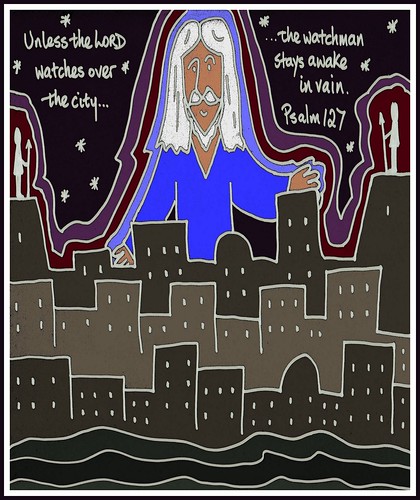
Psalm 127:1 by Stushie Art

Unless the Lord builds the house,
    those who build it labor in vain.
Unless the Lord guards the city,
    the guard keeps watch in vain.
It is in vain that you rise up early
    and go late to rest,
eating the bread of anxious toil;
    for he gives sleep to his beloved.

Sons are indeed a heritage from the Lord,
    the fruit of the womb a reward.
Like arrows in the hand of a warrior
    are the sons of one’s youth.
Happy is the man who has
    his quiver full of them.
He shall not be put to shame
    when he speaks with his enemies in the gate. (New Revised Standard Version)

When my wife was growing up, her family had a prominent portrait of John Wayne in the living room above the television. That picture spoke volumes about the family ethos. They had horses and loved to ride and enjoy the outdoors. Hard work was a daily reality of life, as well as a rugged individualism that often suppressed all else in order to engage in work. 

Doing your best, striving for excellence, and learning responsibility are good things that mature people do every day. Yet, there is a fine line between hard work that provides and enriches, and lonely work that is frenetic and fueled by anxiety about the future.

Today’s psalm gives us a wake-up call. All our work is useless, in vain, unless it is connected to the G-d who gives strength and sweet sleep.

The motives that lie behind why we burn the candle at both ends are just as important to the Lord as the work itself. 

If we independently believe that our life is in our own hands, and we work with worry animating our every job, then we have lost touch with the understanding that it is G-d who ultimately provides us with every good thing in life. 

However, if we begin to relax and let go of our stubborn independent streak, then we work hard with the strength G-d gives and let the Lord watch over us.

Trusting G-d in our work is connected to children being a heritage from the Lord. Children worked with their parents in the ancient world. Fathers and mothers did not go it alone – it was a family affair, as well a community endeavor. 

Whenever we slip into a groove of worshiping individualism rather than simply taking personal responsibility, then we must come back to the inter-dependence that we were designed for as people. 

The ethos the psalmist is looking for is trust in God, reliance on others, and working together for the common good of all. 

Here are a few ways of working together and not carrying the load of work on our own:

Ask for what you want and need to accomplish the task. Whenever we don’t ask, we inevitably go the route of hustling for help through manipulation, guilt, and shaming others.

If someone says, “no,” simply ask another person or persons. Asking once just won’t do. And neither is commanding others to get things done. We have the ability to ask calmly, confidently, and compassionately. Accept the “no” which you might get without retreating back to manipulation. This is especially necessary when it comes to asking family members.

Ask God to help you in your work. Each day as I enter the hospital for which I am a Chaplain, I say a prayer, “God almighty, blessed Father, Son, and Spirit, please go before me, with me, and after me to each patient, their family members, and every team member I encounter today, with the love and compassion of Jesus Christ.”

Delegate, if possible. This is not the same thing as barking orders. It is a realization that we are finite creatures with limitations of time, energy, and resources. It’s okay to share the load with others. In fact, most people are more than willing to help, if you and I will just ask. It enables them to feel needed and important.

Be vulnerable and gracious. We all mess up our work, at times. And it’s important that we are own our mistakes without heaping unnecessary criticism on ourselves, or others. Offering an apology, recognizing that you’ve bit off more than you can chew, and admitting your lack of energy are healthy, not sinful. Also, whenever others fall short of their responsibilities, it’s our job to handle it with grace – seeking to understand and help rather than criticize and judge.

Working together, consulting, collaborating, and engaging in fellowship enable us to speak with those who may oppose, misunderstand, or misinterpret us. It’s also a more joyful way to live.

Sovereign God, you created all things and in you everything holds together. Preserve me with your mighty power that I may not fall into disconnection with you and others, nor be overcome by anxiety. In all I do direct me to the fulfilling of your purposes, through Jesus Christ my Lord. Amen.