John 6:35-40 – The Bread of Life

I Am the Bread of Life by Joseph Matar

Jesus said, “I am the Bread of Life. The person who aligns with me hungers no more and thirsts no more, ever. I have told you this explicitly because even though you have seen me in action, you don’t really believe me. Every person the Father gives me eventually comes running to me. And once that person is with me, I hold on and don’t let go. I came down from heaven not to follow my own agenda but to accomplish the will of the One who sent me.

“This, in a nutshell, is that will: that everything handed over to me by the Father be completed—not a single detail missed—and at the wrap-up of time I have everything, and everyone put together, upright and whole. This is what my Father wants: that anyone who sees the Son and trusts who he is and what he does and then aligns with him will enter real life, eternal life. My part is to put them on their feet alive and whole at the completion of time.” (The Message)

Bread has always been a food staple throughout human history. Whereas many people today try and avoid bread because of either carbohydrates or gluten, a lack of bread in the ancient world usually meant people would starve to death. Bread is a big deal.

So, when Jesus gave a self-description as the Bread of Life, he was saying a lot.

The cup we use in the Lord’s Supper and for which we give thanks to God: when we drink from it, we are sharing in the blood of Christ. And the bread we break, when we eat it, we are sharing in the body of Christ. (1 Corinthians 10:16, GNT)

After the Israelites were delivered by God from their bondage in Egypt, and found themselves in the desert without food, the divine provision of manna – a unique kind of bread – literally showed up on the desert floor every morning. It was just enough for everyone for that day. Once the Israelites entered the Promised Land, the manna disappeared.

As Jesus entered fully into his earthly ministry, throngs of people began following him. At one point, the thousands of men, women, and children were together with nothing but a couple of fish and a few loaves of bread. Much like the miraculous provision of manna which sustained their ancestors centuries earlier, Jesus multiplied the measly morsels of bread into enough to feed the entire bunch, with leftovers.

Little is much when God is in it. Just a smidgeon of Jesus is enough to fill a crowd of growling stomachs.

The Lord Jesus is not like a loaf of bread bought in a grocery store which has all kinds of funky additives, loaded up with sugars, and questionable ingredients you can’t even pronounce. Christ is fortified with everything we need to thrive and flourish. Jesus is so packed with good stuff that a seemingly paltry communion wafer is filling and satisfying.

The bread that comes down from heaven isn’t like what your ancestors ate. They died, but whoever eats this bread will live forever. (John 6:58, CEV)

Just as bread is a simple mixture of water and flour, so partaking of Jesus is rather uncomplicated. There aren’t hoops to jump through or lengthy recipes to follow. If we simply align ourselves with Christ, come to him and believe, we will never be hungry again.

The world needs bread. They ask for bread. In response, Jesus gave them himself.

Give us the bread we need for today. (Matthew 6:11, CEB)

All the world has to offer, and of which so many humans strive to obtain and accumulate treasures on earth, money and possessions, does not bring ultimate satisfaction. The drive for more is never satiated. Humanity is afflicted with boredom, dissatisfaction, anxiety, and worry over losing what they have and fretting about how they can obtain just one more thing in the misguided belief their fear will finally melt.

But it doesn’t. So, like a hamster running in a wheel and going nowhere, there is the constant activity of racing thoughts and workaholic behavior to try and somehow keep ahead. Yet, authentic rest never comes. The more the striving, the more the anxiety.

There is a divine/human responsibility and cooperative at work. Jesus will hold us secure. And we need to let him do it, and fully align our lives according to Christ’s words and ways. The divine bread is available. God isn’t going to force feed us. We will need to take and eat.

It requires faith to take and eat. We might wonder: Will I like it? Is it really going to satisfy me? What if I’m allergic to it? Do I need some other food handy to eat in case I gag or vomit? Will there be pie? Mac & cheese? Bacon? (insert your own comfort food) Do I have to eat alone?

Try it. You’ll like it.

My own experience of having tasted much of what the world has to offer, and tasting the good flavor of God’s grace, I can say that I never want to go back to the gruel of guilt and shame.

I have tasted and seen that the Lord is good. And that is what I want for you, too.

Taste and see that the Lord is good; blessed is the one who takes refuge in him. (Psalm 34:8, NIV)

The bread is for me, and it is for you. There is plenty of bread for the life of everyone in the world. No rationing is necessary. This is the place of abundance.

“I am the living bread which came down from heaven. If anyone eats of this bread, he will live forever; and the bread that I shall give is My flesh, which I shall give for the life of the world.” (John 6:51, NKJV)

Almighty and everlasting God, I thank and praise you for feeding me with Jesus, the Bread of Life. Send your Holy Spirit so that I may by faith obtain and eternally enjoy your divine grace, the forgiveness of sins, unity with Christ, and everlasting life; through Jesus Christ my Lord. Amen.


Psalm 50:16-23 – Follow with Both Lips and Life

Photo by Adrien Olichon on Pexels.com

But God says to the wicked,
    Why should you recite my commandments?
    Why should you talk about my covenant?
You refuse to let me correct you;
    you reject my commands.
You become the friend of every thief you see,
    and you associate with adulterers.

You are always ready to speak evil;
    you never hesitate to tell lies.
You are ready to accuse your own relatives
    and to find fault with them.
You have done all this, and I have said nothing,
    so you thought that I am like you.
But now I reprimand you
    and make the matter plain to you.

Listen to this, you that ignore me,
    or I will destroy you,
    and there will be no one to save you.
Giving thanks is the sacrifice that honors me,
    and I will surely save all who obey me.
(Good News Translation)

God has something to say to the wicked, that is, those who claim the Lord’s Name, yet fail to honor the divine/human relationship.

One of the things people might oftentimes overlook or misunderstand is that God and humans are not on the same level. Whereas all humanity is equal, and so must be egalitarian in all they do, humans are the creatures and God is the Creator. It isn’t an equitable relationship.

That means our stance as people is to obey the Lord – without question. There’s no room for negotiation. There isn’t any way of leveraging to get the upper hand with God.

Ignorance, or outright disobedience, is manifested through trivializing or picking-and-choosing God’s commands. When a person quotes or cites instructions from the Lord, then completely disregards those divine words and does what they please, there will be a harsh reprimand.

The wicked, those who ignore the covenant relationship with God, tend to talk a good line and then turn around and participate in stealing, adultery, and slander. They glowingly cite the first few commands of the Ten Commandments, then generally flip the middle finger at the rest of the commands – doing whatever the heck they want.

The reason the Lord is so hard in today’s psalm is that the wickedness of humanity believes themselves to be like God. In other words, the people took what was true about themselves and superimposed that on God. This is the dual act of elevating humanity higher than who they are and making themselves like God, while simultaneously minimizing God, making the Lord smaller, to be just like us.

These are just some the mind tricks wicked persons play on themselves to justify their behavior. And God will have none of it. God is not some average household idol. The Lord is to be honored and worshiped as Supreme.

Wherever there is disorder, chaos, systemic evil, and injustice, the root of it is found in disparaging the divine relationship – making God a good ol’ boy who understands things just like you and me.

Wherever you see human life cheapened, taken advantage of, and oppressed, there you will find people and institutions who do not take God as holy, sovereign, and other than them.

Human life is cheapened because talk itself is cheap without the commitment to obey the Lord. So, how might we keep our lips and our life aligned together and working as a committed whole?

  • Be authentic. Embrace being genuine and real. If you’re happy, smile. If you’re sad, don’t. If you say, “yes,” do it. If you need to reinforce good boundaries, say “no,” and don’t do it. What’s more, if you have written statements in your business or organization about diversity, equity, and inclusion, then authentically and actively live into those ideals.

Jesus said, “Let your yes mean yes, and your no mean no. Anything more than this comes from the evil one.” (Matthew 5:37, CEB)

My brothers and sisters, practice your faith in our glorious Lord Jesus Christ by not favoring one person over another. (James 2:1, GW)

  • Be trustworthy. Charlatans and slicksters try to make instantaneous trust so they can take advantage of another. The godly person realizes trust must be earned – mostly through quietly doing what needs to be done without complaint or bluster. Someone once said, “People don’t care how much you know until they know how much you care.”

Do what God’s teaching says, don’t just listen and do nothing. When you only sit and listen, you are fooling yourselves. (James 1:22, ERV)

Now that by your obedience to the truth you have purified yourselves and have come to have a sincere love for other believers, love one another earnestly with all your heart. (1 Peter 1:22, GNT)

  • Be obedient. Observe the Lord’s commands. Biblical instructions include both our speech and our behavior.

For the love of God is this, that we obey his commandments. And his commandments are not burdensome. (1 John 5:3, NRSV)

Let your speech always be with grace, seasoned with salt, that you may know how you ought to answer each one. (Colossians 4:6, NKJV)

Jesus said, “If any of you want to be my follower, you must stop thinking about yourself and what you want. You must be willing to carry the cross that is given to you for following me. (Matthew 16:24, ERV)

  • Be thankful. Words and actions which hurt and damage cannot be said whenever we are using our tongues to express gratitude. And if we keep our feet happy through dancing our thankfulness, then we will not walk into trouble.

Be cheerful no matter what; pray all the time; thank God no matter what happens. This is the way God wants you who belong to Christ Jesus to live. (1 Thessalonians 5:18, MSG)

And whatever you do or say, do it as a representative of the Lord Jesus, giving thanks through him to God the Father. (Colossians 3:17, NLT)

O God, you made us in your own image and redeemed us through Jesus your Son: Look with compassion on the whole human family; take away the arrogance and hatred which infect our hearts; break down the walls that separate us; unite us in bonds of love; and work through our struggle and confusion to accomplish your purposes on earth; that, in your good time, all nations and races may serve you in harmony around your heavenly throne; through Jesus Christ our Lord. Amen.

Numbers 10:11-36 – The Center of Worship

On the twentieth day of the second month of that same year, the cloud over the sacred tent moved on. So, the Israelites broke camp and left the Sinai Desert. And sometime later, the cloud stopped in the Paran Desert. This was the first time the Lord had told Moses to command the people of Israel to move on.

Judah and the tribes that camped alongside it marched out first, carrying their banner. Nahshon son of Amminadab was the leader of the Judah tribe, Nethanel son of Zuar was the leader of the Issachar tribe, and Eliab son of Helon was the leader of the Zebulun tribe.

The sacred tent had been taken down, and the Gershonites and the Merarites carried it, marching behind the Judah camp.

Reuben and the tribes that camped alongside it marched out second, carrying their banner. Elizur son of Shedeur was the leader of the Reuben tribe, Shelumiel son of Zurishaddai was the leader of the Simeon tribe, and Eliasaph son of Deuel was the leader of the Gad tribe.

Next were the Kohathites, carrying the objects for the sacred tent, which was to be set up before they arrived at the new camp.

Ephraim and the tribes that camped alongside it marched next, carrying their banner. Elishama son of Ammihud was the leader of the Ephraim tribe, Gamaliel son of Pedahzur was the leader of the Manasseh tribe,and Abidan son of Gideoni was the leader of the Benjamin tribe.

Dan and the tribes that camped alongside it were to protect the Israelites against an attack from behind, and so they marched last, carrying their banner. Ahiezer son of Ammishaddai was the leader of the tribe of Dan, Pagiel son of Ochran was the leader of the Asher tribe, and Ahira son of Enan was the leader of the Naphtali tribe.

This was the order in which the Israelites marched each time they moved their camp.

Hobab the Midianite, the father-in-law of Moses, was there. And Moses said to him, “We’re leaving for the place the Lord has promised us. He has said that all will go well for us. So come along, and we will make sure that all goes well for you.”

“No, I won’t go,” Hobab answered. “I’m returning home to be with my own people.”

“Please go with us!” Moses said. “You can be our guide because you know the places to camp in the desert. Besides that, if you go, we will give you a share of the good things the Lord gives us.”

The people of Israel began their journey from Mount Sinai. They traveled three days, and the Levites who carried the sacred chest led the way, so the Lord could show them where to camp. And the cloud always stayed with them.

Each day as the Israelites began their journey, Moses would pray, “Our Lord, defeat your enemies and make them run!” And when they stopped to set up camp, he would pray, “Our Lord, stay close to Israel’s thousands and thousands of people.” (Contemporary English Version)

“The most important feature of sacred space is found in what it is by definition: the place of God’s presence. The cosmic-temple idea recognizes that God is here and that all of this is his. It is this theology that becomes the basis for our respect of our world.”

John Walton

These verses from the book of Numbers might, at first glance, seem irrelevant to contemporary worshipers of God. The Old Testament book of Numbers matter-of-factly informs us of how the ancient Israelites set out in the desert by stages according to their respective tribes and how they proceeded when stopping their sojourns. Yet, if we take the time to engage in pilgrimage with the Israelites, we observe the heart of worship and life for God’s people.

The tabernacle, that is, the ark of the covenant with its accompanying tent and holy articles, was the primary symbol for Israel of God’s presence. As such, the tabernacle was at the actual center of Israelite life, both physically and spiritually. The tabernacle would leave first and be set up by the tribe of Levites before the other tribes came and encamped around it – completely encircling the tent housing the ark.

Observing this constant ancient ritual in the desert begs several questions for us today: 

Is God at the center of our life and worship? 

Or do we expect the Lord to come and bless our already camped-out thoughts, ideas, and practices? 

If God is truly at the center of all we do, what is the evidence this is so? 

Are we patient to wait for God’s leading to present itself? 

Or do we act and then seek God to give his stamp of approval over it? 

The wise believer will allow God to set the agenda and pace of our life journey, and not the other way around.

Sovereign God, you always lead in a way that is good, just, and right. Help me to slow down long enough to enter into the rest and connection with your will that I so desperately need through Jesus my Lord. Amen.

*Above painting: Israel Encamped Roundabout the Tabernacle in the Wilderness of Sinai
by John W. Kelchner (1866-1942)

1 Samuel 16:14-23 – The Work of God

Now the Lord’s spirit had departed from Saul, and an evil spirit from the Lord tormented him. Saul’s servants said to him, “Look, an evil spirit from God is tormenting you. If our master just says the word, your servants will search for someone who knows how to play the lyre. The musician can play whenever the evil spirit from God is affecting you, and then you’ll feel better.”

Saul said to his servants, “Find me a good musician and bring him to me.”

One of the servants responded, “I know that one of Jesse’s sons from Bethlehem is a good musician. He’s a strong man and heroic, a warrior who speaks well and is good-looking too. The Lord is with him.”

So, Saul sent messengers to Jesse to say, “Send me your son David, the one who keeps the sheep.”

Jesse then took a donkey and loaded it with a homer of bread, a jar of wine, and a young goat, and he sent it along with his son David to Saul. That is how David came to Saul and entered his service. Saul liked David very much, and David became his armor-bearer. Saul sent a message to Jesse: “Please allow David to remain in my service because I am pleased with him.” Whenever the evil spirit from God affected Saul, David would take the lyre and play it. Then Saul would relax and feel better, and the evil spirit would leave him alone. (Common English Bible)

In the realm of God, everything seems upside-down. Those who are first are last, and the last are first. The rich are really poor, and the poor are actually rich. People of low position are the highest in God’s realm, while those at the top are really at the bottom. The religious insiders, appearing close to God, are on the outside; and the outsiders, seemingly far from God, are really the insiders and close to the Lord.

If we judge circumstances according to human standards of fair-play and what seems right to us, God’s ethics might not make much sense. There are two extreme responses to this reality of God’s odd working in the world. 

One response is to try and nail down everything we don’t understand, to create a black and white world where every question has an answer, and all things are certain so that we know exactly how God works, all the time. 

The opposite response is to never try answering anything about the mysterious working of God, saying, “whatever will be, will be.” Somewhere in the middle of the extremes is probably a good place to be – working to know God better and how divinity operates in the world, while being comfortable with mystery and discerning we will never completely understand everything in this life.

There are times we feel confident of what God is doing. Other times, maybe most of the time, we are clueless as to how God is working. We do not have all the answers to God’s activity. Yet, there is still a lot we know about God. The Lord worked in quite different ways with Saul than with David.  

The difference in the two characters, Saul and David, hinges upon the presence and absence of God. God withdrew divine presence from Saul. King Saul’s deliberate and consistent disobedience of God’s direct commands led to the divine absence. Not only did God leave Saul, but an evil or bad spirit from the Lord tormented him. That reality might be something way off your understanding of how God works with people.  God departed from Saul and put him in a situation of inflicting pain.

Bear in mind, in a biblical worldview, there are not two equally opposing forces of God and Satan. Rather, Lucifer is a created being who aspired to be like God and fell from heaven. God stands alone as the one sovereign Being who controls all things in heaven and earth. 

Saul is not an isolated occurrence of experiencing a bad spirit. For example, God hardened the heart of Pharaoh so that he acted harshly against the people of Israel (Exodus 9:12; 10:20, 27; 11:10). From a strictly human perspective, it seemed God was kicking the can down the road, pushing off the people’s deliverance. Yet, the Lord was orchestrating deliverance from bondage, and a redemption far beyond what the Israelites could have ever imagined. 

Sometimes, we are privy to God’s working. For example, in the days of the Judges:

Abimelech ruled over Israel three years. But God sent an evil spirit between Abimelech and the lords of Shechem; and the lords of Shechem dealt treacherously with Abimelech. This happened so that the violence done to the seventy sons of Jerubbaal might be avenged and their blood be laid on their brother Abimelech, who killed them, and on the lords of Shechem, who strengthened his hands to kill his brothers. (Judges 9:22-24, NRSV)

In whatever way we understand an evil spirit from God in the life of Saul, the point to grasp is that God is aware and in control – whereas Saul is a disturbed man due to his own bad choices. Some ancient interpreters of the story view this as an act of mercy on God’s part, by not just eradicating Saul altogether, but, instead, giving Saul an opportunity to turn his life around and again experience the presence of God.

Keep in mind, just because someone experiences mental or emotional pain in the form of depression or anxiety or other disorder, does not necessarily mean there is a bad decision behind it. To go down that route is to take the extreme position of living in the black and white world of trying to be certain of everything. We only need consider the life of Job to know that pain, even extreme pain and horrible circumstances, does not necessarily mean sin is at the root of it all. (Job 2:7-10)

“People with absolute certainty are usually the misguided souls who confidently tell other people in terrible circumstances how God is either punishing them or that this will all work out in some fairy tale ending of the miraculous (which it rarely does).” 

Mit Tdrahrhe

On the other extreme, those embracing only mystery simply say to people in pain to trust God and accept your situation because God has a plan (not helpful, even hurtful). So, what is helpful?

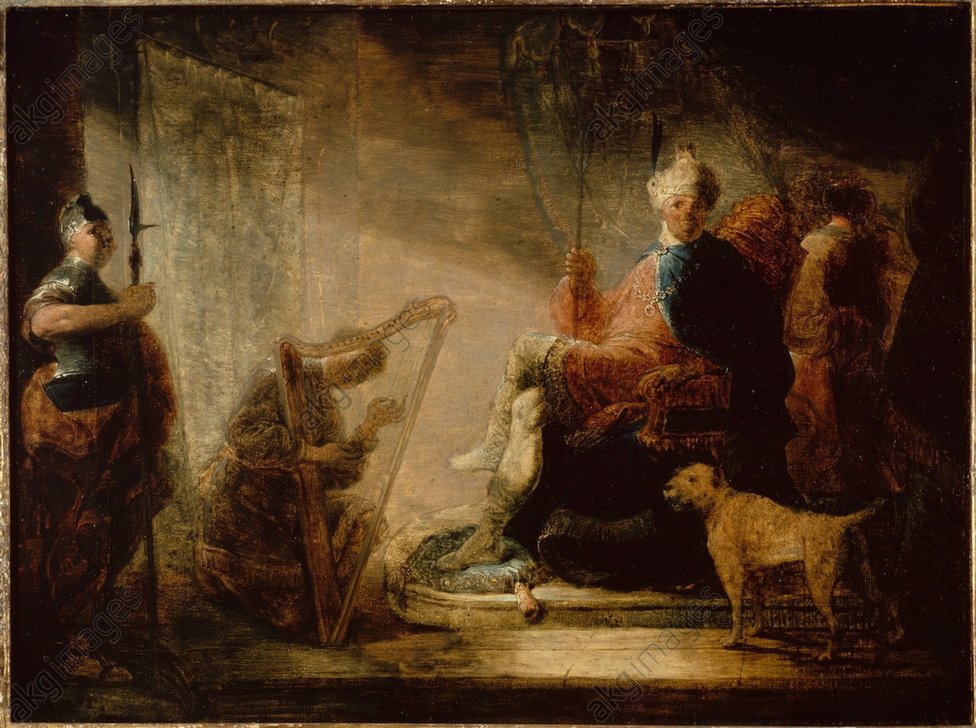
The servants of Saul knew what was helpful. They asked the king to put out an ad for a music therapist. And the best one they could find was David. The problem of Saul’s anguish needed the answer of a good harpist. 

Saul got some relief from pain, got a chance to perhaps come back to God, and David (already the next anointed king) got to learn the job of leading first-hand from the bottom-up by being in Saul’s service.

David needed to learn lowly service before becoming an exalted king. God could have simply knocked Saul off the throne and did away with him (which would make sense to a lot of people). Instead, God graciously gave young David time to observe the duties of a king.

God isn’t off his rocker. God knows what he is doing. God knew both Saul and David, inside and out. And, the Lord intimately knows each person, family, faith community, nation, and people group. If anyone claims to know precisely what God is doing and should do, they are a spiritual huckster speaking from ignorant pride. Conversely, if anyone throws up their arms in exasperation, mumbling how nobody can know God’s working, they are spiritually immature and irresponsible.

How we act or not act, what we say and do not say, is all a function of our theology – our real view of God. So, what might we take away from this story?

  1. The mystery of God and the certainty of people do not mix well. Claiming to always know what God is doing is delusional and just doesn’t help anyone.
  2. The clarity of God through divine commands, and the apathy of people to them, is a bad situation.  Claiming to never know what God is doing is a cop-out (because God has spoken clearly about a lot of things, like the Ten Commandments).
  3. Unlike Saul, do the best you can in the circumstances before you. Many situations we cannot avoid. However, in every situation we can control our response.
  4. Like David, be an agent of comfort, healing, and blessing to others. Most of the psalms were written in times of doubt, distress, and disturbance. We can take those psalms and pray them directly to God in the midst of our own discomfort.

We are in God’s hands, all of time. There is never a time when we are outside of God’s sight or ability to work.  The Lord’s arm is not too short to accomplish good purposes. God is our strong tower and mighty fortress for every life circumstance.

**Above painting: David playing the harp for King Saul, by German painter, Januarius Zick, 1750