Come Away with Me (Song of Songs 2:8-15)

Song of Songs No. 19, by Egon Tschirch, 1923

Ah, I hear my lover coming!
    He is leaping over the mountains,
    bounding over the hills.
My lover is like a swift gazelle
    or a young stag.
Look, there he is behind the wall,
    looking through the window,
    peering into the room.

My lover said to me,
    “Rise up, my darling!
    Come away with me, my fair one!
Look, the winter is past,
    and the rains are over and gone.
The flowers are springing up,
    the season of singing birds has come,
    and the cooing of turtledoves fills the air.
The fig trees are forming young fruit,
    and the fragrant grapevines are blossoming.
Rise up, my darling!
    Come away with me, my fair one!”

My dove is hiding behind the rocks,
    behind an outcrop on the cliff.
Let me see your face;
    let me hear your voice.
For your voice is pleasant,
    and your face is lovely.

Catch all the foxes,
    those little foxes,
before they ruin the vineyard of love,
    for the grapevines are blossoming! (New Living Translation)

Spring is the season of love, the time of coming together and enjoying one another’s presence.

God is love. God is calling us. God wants to be with you.

There is a reason why so many people in this cruel and calloused world are unloving and unkind: They are unaware that God loves them, desires to be with them, and is calling out to them. 

If we neither believe nor know God’s infinite love and desire for us, then our words and our actions will reflect more of hate than love. God really truly does want to be with you and me. This is crucial. Do not forget this. Believe it. Live it. Enjoy it. Know it. Tell it to yourself until you are thoroughly bathed in it, because it is more wonderful than any ‘70’s sappy love song could ever describe it.

I believe the small Old Testament book of Solomon’s Song of Songs too often gets a weird hermeneutical spin of literalism from modern-minded simpletons. For nearly all of history, this poetic ode to love was understood as an allegory of divine love for humanity – and the believer’s reciprocal response.
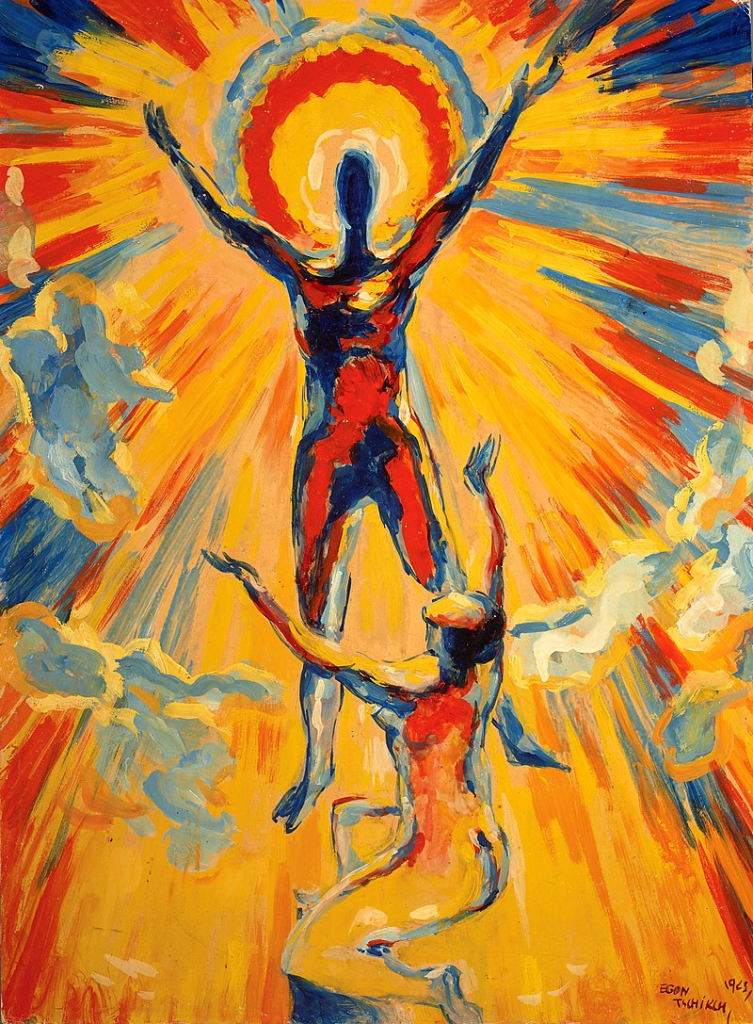
Song of Songs No. 8, by Egon Tschirch, 1923

When Scripture says I am my beloved’s and my beloved is mine, and that his desire is for me, it is a wonderful way of communicating that God’s love for us is not abstract, distant, or detached. (Song of Songs 6:3, 7:10) 

The truth is: We belong to God. The Lord’s desire is for you and me. God has an intense and overpowering longing for you. Let the deep desire of God for you shape and form your thoughts so that fear is replaced with faith; loneliness with enjoyment; the fickle nature of others with satisfaction; praying as duty with praying because I want to be with the God who loves me so much.

Oh, how we need a vision of God singing over us with joy! Yes, God loves you that much! Grab a hold of what the prophet says:

The Lord will take delight in you with gladness.
    With his love, he will calm all your fears.
    He will rejoice over you with joyful songs. (Zephaniah 3:17, NLT)

Even the most unlovely of people are made lovely through God’s persistent and pursuing love for them. You are being wholly seen every single day by the infinite gaze and eternal compassion of God, who watches our every step with delight.

Christianity does not “happen” simply by knowing some beliefs about God, as if it is a mere contractual signing-off on a doctrinal statement. Rather, Christianity “happens” when individuals experience the white hot burning love of God in Jesus Christ. 

Jesus came not only for those who skip church and only occasionally read their Bibles. Christ came also for the hard-hearted prick, the immoral adulterer, the strung-out addict, the terrorist, the murderer, and for all those caught in bad choices and failed relationships. 

“I have not come to call respectable people, but outcasts.” (Matthew 9:13, GNT)

“Go out and train everyone you meet, far and near, in this way of life.” (Matthew 28:19, MSG)

“You will be witnesses for me.” (Acts 1:8, GNT)

“Love each other in the same way that I have loved you.” (John 13:34, GW)

All Christ’s words and actions are because of the Lord’s intense desire to love the world, and to love it through the divine beloved people of God.

God’s love is never based on our performance, or how good we look to others; it is never conditioned by our moods. The love of God only looks longingly at you and me with the potential of what we can become in Christ and cares for us as we are. It is a world-altering revolutionary thought that God loves me as I am and not as I should be. 

God has shown us how much he loves us—it was while we were still sinners that Christ died for us! (Romans 5:8, GNT)

Despite the erosion of church attendance, the majority of people still believe God exists. Conversely, however, many people do not believe God really loves them. We are in a crisis of love. People need to know the God who is pure Love. They need to hear and heed the call to come away with God.

Christianity never begins with what we do for God to make ourselves lovely. Christianity always starts with what God has done for us, the great and wonderful love that exists for us in Christ Jesus.

It wasn’t so long ago that we ourselves were stupid and stubborn, easy marks for sin, ordered every which way by our glands, going around with a chip on our shoulder, hated and hating back.

But when God, our kind and loving Savior God, stepped in, he saved us from all that. It was all his doing; we had nothing to do with it. He gave us a good bath, and we came out of it new people, washed inside and out by the Holy Spirit.

Our Savior Jesus poured out new life so generously. God’s gift has restored our relationship with him and given us back our lives. And there’s more life to come—an eternity of life! You can count on this. (Titus 3:3-8, MSG)

All the wrong turns in the past, the mistakes and the moral lapses, everything that is ugly or painful, all melts in the light of God’s acceptance and love for us.

If the consuming passion of Christ’s followers is not showing God’s love, then we have lost both our mission and our first love of Jesus. Perhaps we must let time evaporate, as we bow at the foot of the cross, and experientially know the great love of God in Christ for us and for the world.

May it be so, to the glory of God.

Trust the Promises (Joshua 3:1-17)

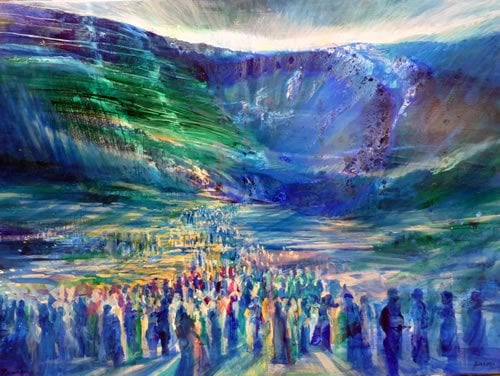
Crossing the Jordan River, by Yoram Raanan

Early in the morning Joshua and all the Israelites set out from Shittim and went to the Jordan, where they camped before crossing over. After three days the officers went throughout the camp, giving orders to the people: “When you see the ark of the covenant of the Lord your God, and the Levitical priests carrying it, you are to move out from your positions and follow it. Then you will know which way to go, since you have never been this way before. But keep a distance of about two thousand cubits between you and the ark; do not go near it.”

Joshua told the people, “Consecrate yourselves, for tomorrow the Lord will do amazing things among you.”

Joshua said to the priests, “Take up the ark of the covenant and pass on ahead of the people.” So they took it up and went ahead of them.

And the Lord said to Joshua, “Today I will begin to exalt you in the eyes of all Israel, so they may know that I am with you as I was with Moses. Tell the priests who carry the ark of the covenant: ‘When you reach the edge of the Jordan’s waters, go and stand in the river.’”

Joshua said to the Israelites, “Come here and listen to the words of the Lord your God. This is how you will know that the living God is among you and that he will certainly drive out before you the Canaanites, Hittites, Hivites, Perizzites, Girgashites, Amorites and Jebusites. See, the ark of the covenant of the Lord of all the earth will go into the Jordan ahead of you. Now then, choose twelve men from the tribes of Israel, one from each tribe. And as soon as the priests who carry the ark of the Lord—the Lord of all the earth—set foot in the Jordan, its waters flowing downstream will be cut off and stand up in a heap.”

So when the people broke camp to cross the Jordan, the priests carrying the ark of the covenant went ahead of them. Now the Jordan is at flood stage all during harvest. Yet as soon as the priests who carried the ark reached the Jordan and their feet touched the water’s edge, the water from upstream stopped flowing. It piled up in a heap a great distance away, at a town called Adam in the vicinity of Zarethan, while the water flowing down to the Sea of the Arabah (that is, the Dead Sea) was completely cut off. So the people crossed over opposite Jericho. The priests who carried the ark of the covenant of the Lord stopped in the middle of the Jordan and stood on dry ground, while all Israel passed by until the whole nation had completed the crossing on dry ground. (New International Version)

400 years of Egyptian slavery. Then deliverance from bondage. Another 40 years of wandering around the desert. It might have seemed to the ancient Israelites that getting to the Promised Land would never happen.

How can we know God is with us? Will divine promises really hold up? Can I keep trusting in the Lord, even though it is taking so darned long to get where I need to be?

Through yet another miracle of the parting of the waters and walking on dry land to get to the other side, Joshua and people of Israel (and us) are given a visual, tactile, experiential way of trusting God. By this indelible encounter, the people will know that the living God is among them, and without fail, the Lord will drive out all obstacles and opposition to entering and taking the land.

All the dramatic events that occurred were for the sake of the people, so that they would know that God is with them and will give them victory. To heighten the experience, the Jordan River was at flood stage at the time of the crossing. If you have ever been on the bank of a raging river, you know how significant a miracle this really was to behold. 

Today, we may not have the experience of seeing a rushing river stop and crossing over on dry ground; yet we have these stories that bear witness to the truth that God is among us, that God will do what was promised, and that God will give us victory.

Know that the victory came after a long liminal period of moving from one reality to another. A “liminal space” (an intermediate position characterized by transition, a place where things are either coming or going) is where the Israelites had to hang out for a very long time. Now, the promises were about to be realized.

Miracles and wonders and victories are neither easy nor cheap. They come as a result of significantly hard movements from the past into the future. In other words, our present experiences can be quite adverse and difficult. If we lose where we’ve come from, and where we’re going, we may too easily lose heart or become afraid and simply give up all hope.

That’s why God gives divine promises, so that we will be sustained with God’s words until the promised time is realized. It’s our job to encourage one another and remind each other of those promises; they are meant to buoy up our flagging spirits when things get rough.

So, keep looking and praying for that miracle. Just understand that you may need to persevere in faith, patience, and holiness for a while before it happens.

Blessed and holy God, continue the good work begun in me, so that I may increase daily in wholeness, integrity, and strength. I rejoice in your goodness and think and do that which pleases you, through Jesus Christ our Redeemer. Amen.

The Power of Deliverance (Exodus 14:10-31, 15:20-21)

The Parting of the Sea, by Yoram Ranaan

As Pharaoh approached, the Israelites looked up and saw that the Egyptians were coming after them. Terrified, the Israelites cried out to the Lord. They said to Moses, “Did you bring us out into the desert to die because there were no graves in Egypt? Look what you’ve done by bringing us out of Egypt! Didn’t we tell you in Egypt, ‘Leave us alone! Let us go on serving the Egyptians’? It would have been better for us to serve the Egyptians than to die in the desert!”

Moses answered the people, “Don’t be afraid! Stand still, and see what the Lord will do to save you today. You will never see these Egyptians again. The Lord is fighting for you! So be still!”

Then the Lord said to Moses, “Why are you crying out to me? Tell the Israelites to start moving. Raise your staff, stretch out your hand over the sea, and divide the water. Then the Israelites will go through the sea on dry ground. I am making the Egyptians so stubborn that they will follow the Israelites. I will receive honor because of what I will do to Pharaoh, his entire army, his chariots, and cavalry. The Egyptians will know that I am the Lord when I am honored for what I did to Pharaoh, his chariots, and his cavalry.”

The Messenger of God, who had been in front of the Israelites, moved behind them. So the column of smoke moved from in front of the Israelites and stood behind them between the Egyptian camp and the Israelite camp. The column of smoke was there when darkness came, and it lit up the night. Neither side came near the other all night long.

Then Moses stretched out his hand over the sea. All that night the Lord pushed back the sea with a strong east wind and turned the sea into dry ground. The water divided, and the Israelites went through the middle of the sea on dry ground. The water stood like a wall on their right and on their left.

The Egyptians pursued them, and all Pharaoh’s horses, chariots, and cavalry followed them into the sea. Just before dawn, the Lord looked down from the column of fire and smoke and threw the Egyptian camp into a panic. He made the wheels of their chariots come off so that they could hardly move. Then the Egyptians shouted, “Let’s get out of here! The Lord is fighting for Israel! He’s against us!”

Then the Lord said to Moses, “Stretch out your hand over the sea so that the water will flow back over the Egyptians, their chariots, and their cavalry.”

Moses stretched his hand over the sea, and at daybreak the water returned to its usual place. The Egyptians tried to escape, but the Lord swept them into the sea. The water flowed back and covered Pharaoh’s entire army, as well as the chariots and the cavalry that had followed Israel into the sea. Not one of them survived.

Meanwhile, the Israelites had gone through the sea on dry ground while the water stood like a wall on their right and on their left. That day the Lord saved Israel from the Egyptians, and Israel saw the Egyptians lying dead on the seashore. When the Israelites saw the great power the Lord had used against the Egyptians, they feared the Lord and believed in him and in his servant Moses….

Then the prophet Miriam, Aaron’s sister, took a tambourine in her hand. All the women, dancing with tambourines, followed her. Miriam sang to them:

“Sing to the Lord.
He has won a glorious victory.
He has thrown horses and their riders into the sea.” (God’s Word Translation)

Things can change quickly.

One day, you’re living in slavery, and the next, you’re free. One minute, you’re celebrating freedom, then the next minute, you’re backed into a corner, and it looks like the end – only to be dramatically delivered from calamity.

One day (Holy Saturday) the disciples were lower than a snake’s belly in a wagon wheel rut; the next day (Easter Sunday) they’re wondrously slack-jawed with hopes higher than the sky.

Today’s Old Testament reading impresses on us the necessity of trusting God one day at a time, one minute at a time. Circumstances will change; God’s basic character will not change. Therefore, we have the continual opportunity of exercising our faith, and practicing trust in the Lord, by living into a new reality.

In this Christian season of Eastertide (spanning the next 50 days until the Day of Pentecost) we discover resurrection power in putting to death old unhealthy practices and adopting new healthy life-giving habits. Eastertide’s intentional focus is to recognize and celebrate the resurrection of the Lord Jesus Christ, and so, to exult in our own new life in him.

Revisiting both Christ’s resurrection, and the Red Sea deliverance, helps to remind us God’s invisible power to save is stronger and greater than any visible powers on this earth. Both of these deliverance stories keep us focused on the hope of individual renewal, corporate revitalization, and worldwide revival.

Eastertide is the season to engage in some renewal practices. The following are a few ideas for living into our deliverance from God:

  • Pray for revival of spirituality. Christ brings salvation and life, so praying to God for revival is a deliberate way of connecting with God.
  • Pay attention to words. Gossip, back-biting, slander, and other sins of the tongue kill people. Instead, consider how to use your speech for encouragement, love, mercy, forgiveness, and building up one another. This promotes growth, health, and life.
  • Proclaim resurrection. I believe the church is meant to be the hope of the world because Christ is the risen Lord. Graciously proclaim the resurrected Christ and how the spiritual life makes a difference in life.
  • Put yourself out there. Start the new ministry you always believed would make a difference. Take a risk. You’ve been given eternal life, so can you really fail?
  • Promote daily habits of spiritual health and life. Develop a realistic and workable plan for yourself when it comes to basic spiritual practices of Scripture reading, prayer, worship, etc. And stick to it by involving others.

There will always be people in our lives who try and pull us from what’s most important, even persons who want to keep the status quo to the point of seeking to destroy us. Be ready. Keep Eastertide in front of you; God has raised us to new life.

Allow Christ’s resurrection take root in your heart to such an extent that life itself informs all your thinking, speaking, feeling, and acting. The victory is won. So, sing to the Lord!

Tuesday of Holy Week (Psalm 71:1-14)

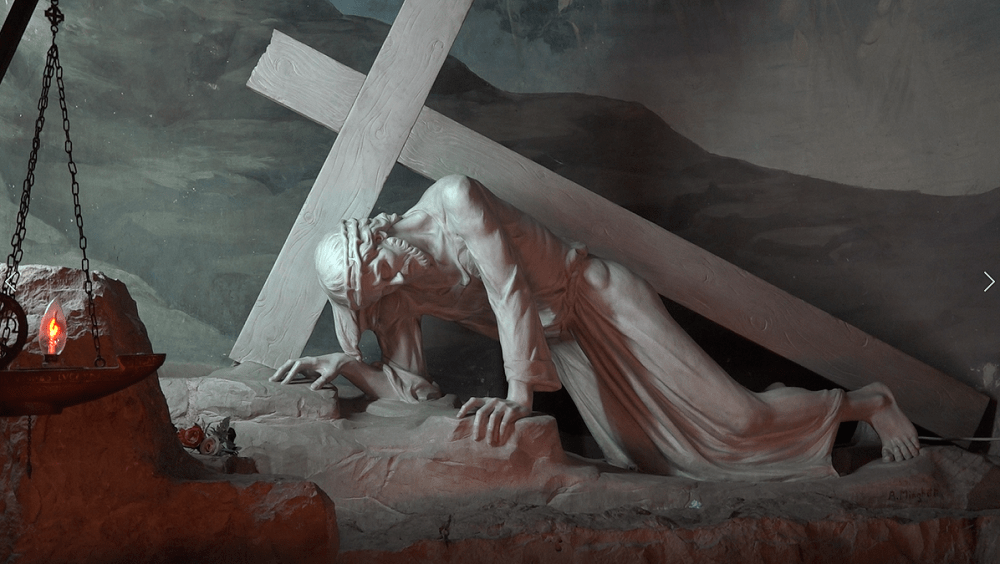
Station 3 of the Stations of the Cross, along the Via Dolorosa in Jerusalem

In you, O Lord, I take refuge;
    let me never be put to shame.
In your righteousness deliver me and rescue me;
    incline your ear to me and save me.
Be to me a rock of refuge,
    a strong fortress to save me,
    for you are my rock and my fortress.

Rescue me, O my God, from the hand of the wicked,
    from the grasp of the unjust and cruel.
For you, O Lord, are my hope,
    my trust, O Lord, from my youth.
From my birth I have leaned upon you,
    my protector since my mother’s womb.
My praise is continually of you.

I have been like a portent to many,
    but you are my strong refuge.
My mouth is filled with your praise
    and with your glory all day long.
Do not cast me off in the time of old age;
    do not forsake me when my strength is spent.
For my enemies speak concerning me,
    and those who watch for my life consult together.
They say, “Pursue and seize that person
    whom God has forsaken,
    for there is no one to deliver.”

O God do not be far from me;
    O my God, make haste to help me!
Let my accusers be put to shame and consumed;
    let those who seek to hurt me
    be covered with scorn and disgrace.
But I will hope continually
    and will praise you yet more and more. (New Revised Standard Version)

Christians take a decided interpretation of seeing Christ in the psalms. For us, we can envision Jesus saying these words of lament in the last days of his earthly life and ministry.

Why lament?

Lament is a significant piece of Lent, and is especially present in these final days of the season, Holy Week. To lament is to offer a public and passionate expression of grief. And it’s not optional but necessary and vital to the Christian experience, not to mention the human condition.

Without lamenting our great losses, our grief comes out sideways, inevitably harming others with our snarky vitriol. Lament gives expression to our deep grief. It enables us to come to grips with what has happened in the past, or happening to us in the present, and within us.

What does it mean to lament?

  • A lament is an expression of personal grief, due to any significant change or loss; it is the normal emotional, spiritual, physical, and relational reaction to that loss.
  • Lamenting is an intentional process of letting go. Relationships, dreams, plans, and people all die. We cannot get them back. Lament helps us find and live into a new identity after the loss or change.
  • Expressing grief through lament is intensely personal; there is no one-size-fits-all. No one else can do our lamentation for us.

How do I lament?

There are many psalms of lament, including our psalm lesson for today. They all have a typical structure to them, including:

  • Addressing God: Crying out for help. Some psalms of lament expand to include a statement of praise or a recollection of God’s intervention in the past. (Psalm 71:1-3)
  • Complaint: Telling God (said with some flavor!) about our problem or experience through a range and depth of emotional, relational, and spiritual reactions to the change or loss. (Psalm 71:4)
  • Confession of Trust: Remaining confident in God despite the circumstances. Beginning to see problems differently. (Psalm 71:5-8)
  • Petition: Proclaiming confidence in God. Appealing to God for deliverance and intervention. Keep in mind that petitioning is not bargaining with God or a refusal to accept loss. Rather, it is a legitimate seeking of help. (Psalm 71:9-13)
  • Words of Assurance: Expressing certainty that the petition will be heard by God. (Psalm 71:14a)
  • Vow of Praise: Vowing to testify in the future to what God will do with praise. (Psalm 71:14b-24)

I encourage and urge you to consider the following spiritual practice in this Holy Week: Set aside some time and craft your own psalm of lament.

Choose an event from your past which created grief for you. It can be recent or from years ago. Using the structure of lament psalms, thoughtfully write out each element as I have outlined it. Then, read it aloud to God. Perhaps even take another step by reading your lament aloud to a trusted family member, friend, or faith leader.

Our grief needs the outlet of lament. Grief which is not expressed ends up sitting heavily in the soul. Eventually, over time, if not acknowledged and spoken aloud, it can easily become putrid and rancid, poisoning our spirit, and compromising our faith.

Sharing your story through lament is biblical, practical, and I insist, necessary. I regularly craft psalms of lament whenever I have events or people who keep sticking with me in my thoughts and in my heart. Here is one example from a few years ago, after a mass shooting in my city:

Lord, in our shock and confusion, we come before you.

In our grief and despair, in the midst of hate,

in our sense of helplessness in the face of violence,

we lean on you. How long, O Lord, must we keep facing this!?

For the families of those who have been killed, we pray.

For the family of the shooter—help us to pray, Lord.

For the communities that have lost members—their anger, grief, fear—we pray.

For the churches striving to be your light in darkness, beyond our comprehension, we pray.

In the face of hatred, may we claim love, Lord.

May we love those far off and those near.

May we love those who are strangers and those who are friends.

May we love those who we agree with and understand,

and even more so, Lord, those who we consider to be our enemies.

Lord, have mercy. Christ, have mercy. Lord, have mercy.

Heal our sin-sick souls, and grant us your peace.

Make these wounds whole, Lord, for you can do it. Amen.