A Prayer of Desperation (Jonah 2:1-10)

From inside the fish, Jonah prayed to the Lord his God:

When I was in trouble, Lord,
I prayed to you,
    and you listened to me.
From deep in the world
    of the dead,
I begged for your help,
    and you answered my prayer.

You threw me down
    to the bottom of the sea.
The water was churning
    all around;
I was completely covered
    by your mighty waves.
I thought I was swept away
    from your sight,
never again to see
    your holy temple.

I was almost drowned
by the swirling waters
    that surrounded me.
Seaweed had wrapped
    around my head.
I had sunk down deep
    below the mountains
    beneath the sea.
I knew that forever,
    I would be a prisoner there.

But you, Lord God,
    rescued me from that pit.
When my life was slipping away,
    I remembered you—
and in your holy temple
    you heard my prayer.

All who worship worthless idols
turn from the God
    who offers them mercy.
But with shouts of praise,
I will offer a sacrifice
    to you, my Lord.
I will keep my promise,
because you are the one
    with power to save.

The Lord commanded the fish to vomit up Jonah on the shore. And it did. (Contemporary English Version)

Desperate (adjective):

  1. reckless or dangerous because of despair, hopelessness, or urgency: a desperate prayer for help
  2. having an urgent need, desire: desperate to stay alive in a watery grave
  3. leaving little or no hope; very serious or dangerous: desperately stuck in the belly of a fish
  4. extremely bad; intolerable or shocking: skin being bleached white inside of a stomach
  5. extreme or excessive: swallowed and puked-out by a fish

Out of all the postures of prayer I have taken in my life, and in every prayer of desperation I’ve ever uttered to God, none of my experiences were ever quite like Jonah’s. Curled up in a fetal position inside the belly of a big fish will tend to bring out a desperate plea for help. And desperate prayers are the sort God wants from us.

I am God Most High!
    The only sacrifice I want
is for you to be thankful
    and to keep your word.
Pray to me in time of trouble.
I will rescue you,
    and you will honor me. (Psalm 50:14-15, CEV)

The Lord says, “If you love me
    and truly know who I am,
I will rescue you
    and keep you safe.
When you are in trouble,
    call out to me.
I will answer and be there
    to protect and honor you.
You will live a long life
    and see my saving power.” (Psalm 91:14-16, CEV)

Anyplace of difficulty, adversity, or overwhelming situation, can be transformed from the acid belly of a fish to a womb of possibility and new life.

In running from God, Jonah chose unwisely, and took the path of separation and death. Being swallowed whole by a great fish, and languishing in such a place of sheer isolation, is also a metaphor mirroring the actual circumstance of Jonah’s great separation from everyone, everything, especially God.

Our own fleeing from what we hate, and searching for safety apart from the Lord, only lands us in a place of horror. Jonah got himself so far from everything that he became entombed in a living death. In truth, God is the only safe and sacred place we have, our only secure refuge. We don’t need to run in order to be protected – not when God has our backs.

The turning point is whenever we come to our senses and make the choice to unmask our actual thoughts, feelings, and intentions before the Lord. The change comes whenever we make an honest cry of desperation in prayer. For prayer is the very breath of life; it is our hope.

What do you do when you are in distress?

Prayer elicits mercy from the heart of God. The value of adopting biblical prayers, like the ones in the psalter and Jonah’s prayer, is that frequent use of praying them fills our minds and hearts with words in times of great distress.

Its when we are in overwhelming need that scriptural prayers and familiar passages reawaken us with fresh hope for deliverance and renewal.

Jonah’s dark watery grave became empty when he decided to voice his desperate prayer to God. It’s one thing to pray because you want something; it’s another thing to pray because your very life is on the line.

Living for God is much more than holding to particular doctrines or making pious statements about God. The spiritual life is one in which we open ourselves to new beginnings and new life – going beyond ourselves and connecting with a transcendent God.

We must abandon ourselves to God. We are in no position to negotiate or make deals with the Lord. There needs to be a radical letting go of hatred and bigotry, injustice and unrighteousness, and especially our bent toward wanting things our way.

It is from the empty places of life that we find possibility. It was from the grave of the fish’s belly that set up Jonah’s experience of being vomited out in a spiritual resurrection.

Jonah was in the stomach of a big fish for three days and nights, just as the Son of Man will be deep in the earth for three days and nights. (Matthew 12:40, CEV)

Abandoning the false self, forsaking the old life, and coming to the end of ourselves, puts us in a position to pray desperate prayers which God delights to answer beyond what we can even ask or think.

Most holy and merciful God, I am in your care. Help me know that I need not face my troubles alone. May you grant me consolation in my sorrow, courage in my fear, and healing in the midst of my suffering. Fill me with the grace to accept whatever lies ahead for me; and strengthen my faith. Thank you that I have a living hope, through Jesus Christ my Lord, who with you and the Holy Spirit are one God, now and forever. Amen.

Assurance for the Next Step in Life (Judges 6:36-40)

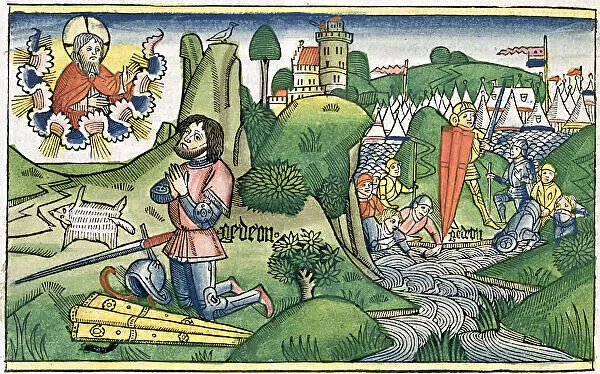
15th century German artist depiction of Gideon putting out the fleece

Gideon prayed to God, “I know that you promised to help me rescue Israel, but I need proof. Tonight I’ll spread a sheep skin on the stone floor of that threshing place over there. If you really will help me rescue Israel, then tomorrow morning let there be dew on the skin, but let the stone floor be dry.”

And that’s just what happened. Early the next morning, Gideon got up and checked the sheep skin. He squeezed out enough water to fill a bowl. But Gideon prayed to God again. “Don’t be angry with me,” Gideon said. “Let me try this just one more time, so I’ll really be sure you’ll help me. Only this time, let the skin be dry and the stone floor be wet.”

That night, God made the stone floor wet with dew, but he kept the sheep skin dry. (Contemporary English Version)

It’s only human to want assurances. And since humanity requires some sort of affirmation that they’re hearing things right, or are on the right track, God graciously accommodates to our need. Much like the disciple of Jesus, Thomas, who desired an assurance that Christ is alive and was victorious over the grave, so Gideon needed clarification that victory was truly at hand.

In both cases of doubting Thomas and anxious Gideon, the Lord does not chide them for needing such assurances. Rather, God immediately responds to their requests. You and I might feel ourselves weak or confused in needing such support, yet God doesn’t feel this way about us.

Sometimes, in our disorientation and our dismay, we try and put feelings aside and stoically attempt to do whatever must be done with complete dispassion and lack of emotion. But that’s to try and be somebody we are not; humans simply aren’t wired that way. There’s no need to try and stir up the courage and confidence on our own.

To navigate this life with any success, we’ll need to pay attention to the inner person, to what’s going on inside us, whenever we are in stressful or confusing times. Then we can connect with the God who mercifully awaits hearing our request. It’s good to be equipped and ready for what’s ahead by having a few convictions….

It’s not the destination that’s important; it’s the journey

Gideon needed to come around to seeing that getting from Point A to Point B as quickly and as efficiently as possible was not the goal. The process of getting from one place to another is the very opportunity needed to connect with the Lord and with others around us. God’s instructions may seem, at times, nonsensical – which is why we often look for assurances that we’ve heard them correctly!

Gideon and the fleece, in the Frauenkirche, Esslingen, Germany

For us modern folk, the Lord doesn’t want us getting lost in the race to become ever more streamlined and productive, only looking at the end goal. If relationships, human connection, justice, love and respect of others is our highest value, then we really need to pay a lot more attention to the process of what we’re doing, and not just the product and outcomes.

Focusing solely on a final outcome turns factory workers into extensions of the machines they are using to churn out a quality product; it turns families at church into giving units with potential to support all the programs and ministries; it turns adversity into an unwanted obstacle to achieving victory; and turns needy people into problems we can fix.

Life is a pilgrimage to walk; it’s not a race to run

At the end of life, folks don’t reminisce about how much they produced, how many places they’ve been, or how much money they made. Instead, they talk about people, both the relationships that were rich and full, as well as the broken or lapsed relationships which cause them regret.

This is why, daily, I purpose to saunter, walk slowly, and observe the people and places around me. This practice allows me to take the time to greet others, connect with some, and even have a sit down conversation with another person – all on the way to doing something else.

Frankly, from a goal-oriented perspective of achievement and accomplishment, this practice does nothing to help whittle down my massive checklist for the day. But I do it, anyway, because human connection our real purpose in life.

Humanity is our business

It doesn’t matter what we do for a living, or where we live. Relationships are the only reality we take with us in the end – both with God and other people.

Dead with ball and chain, the ghost of Jacob Marley responded to Ebenezer Scrooge’s accolade that he was such a good man of business:

“Mankind was my business. The common welfare was my business; charity, mercy, forbearance, benevolence, were all my business. The dealings of my trade were but a drop of water in the comprehensive ocean of my business!” 

Jacob Marley, in Charles Dickens, A Christmas Carol

Marley had discovered this insight too late. 

All of life is a gift given by God, meant for us to be stewards toward the benefit and welfare of humanity. All our abilities, skills, intellectual acumen, possessions, and even the lack thereof – literally everything – is meant to be used in the betterment of our fellow human beings.

We all share the common human condition of needing our stories told and heard by one another, so that we can have some assurance and comfort through what we’re facing.

Will I be there to hear another? Will another be there to hear me? Will I listen to God? Will God listen to me?

Be fully present to others; avoid thinking about the past or focusing on the future

If you think about it, Jesus was perhaps the most productive person to ever walk this earth. In just three short years his ministry completely changed the world and continues to do so. Perhaps our Lord’s “secret” was no secret at all. 

Christ was fully present to the Father, and to the people right in front of him. He was never hurried, and didn’t capitulate to the anxiety of others who wanted him to pick up the pace of being a kickass Messiah.

So, my friends, may you slow down enough to observe, see, hear, smell, and witness the incredible and deep humanity that is present next door to you, down the hall from you, and sitting across the table with you. 

May you experience the wide mercy of God and graciously extend the same love to others. 

May you embrace the process of whatever you are doing to include the space of others and their unique humanity.

For this is how we gain our assurance that God is with us and that we are on the right track for that next step in life.

The Love of God for You (Song of Songs 8:6-7)

God Is Love, by Voss Creative

Place me like a seal over your heart,
    like a seal on your arm;
for love is as strong as death,
    its jealousy unyielding as the grave.
It burns like blazing fire,
    like a mighty flame.
Many waters cannot quench love;
    rivers cannot sweep it away.
If one were to give
    all the wealth of one’s house for love,
    it would be utterly scorned. (New International Version)

Throughout most of church history, the Old Testament poem of Solomon’s Song of Songs has been interpreted allegorically as the love between God and God’s people.

A more literal hermeneutic views the Song as an actual relationship between a man and woman – which has it’s merits in that it acknowledges and affirms our bodily nature.

Yet, no matter what interpretive grid one uses for the Song, this wondrous and unique biblical book is an Ode to Love, lifting the centrality and power of Love as the greatest force in the world.

As for me, I believe it’s likely that the Song purposely has both the literal and allegorical in view. There are many places throughout Holy Scripture which have intended double and even triple meanings to the text. However one chooses to see the Song, love begins with God, and gives shape to our own human love for God, one another, and one’s lover.

“God carries your picture in his wallet.”

Tony Campolo

We learn a great deal of love from God. The Lord is a jealous God. That doesn’t mean the Lord is some weird stalker deity with insecurities about losing the devotion of worshipers. No, instead, divine jealousy is the positive quality of showing steadfast love and commitment, being completely devoted to following through with divine promises and presence.

The Song is far from the only place in Scripture which likens the relationship between God and God’s people as a marriage of lovers. In fact, God’s covenant relationship with people is at the heart of understanding the whole of Scripture.

In the prophecy of Hosea, God expressed a longing for Israel to remain faithful, because the Lord loves her. Hosea had an unfaithful wife, and throughout the book of Hosea the relationship between him and his wife Gomer mirrored the relationship between God and Israel. Just as Hosea kept showing faithful love to Gomer, even though she was brazenly unfaithful, so too, God looked at Israel with affection and steadfast love, not bearing to give her up.

“If you have never known the power of God’s love, then maybe it is because you have never asked to know it – I mean really asked, expecting an answer.”

Frederick Buechner, The Magnificent Defeat

The love of God shall always win the day, despite our own human love, which can wax and wane according to mood or circumstance. Grace, mercy, and love are deep in the nature of God; Love is who God is, not just what God does.

The one marrying you is the one who made you—
    the Lord of heavenly forces is his name.
The one redeeming you is the holy one of Israel,
    the one called the God of all the earth.
As an abandoned and dejected woman the Lord has summoned you;
    as a young wife when she is rejected,
        says your God.
For a brief moment I abandoned you,
    but with great mercy I will bring you back.
    In an outburst of rage,
    I hid my face from you for a moment,
    but with everlasting love I have consoled you,
    says your redeemer, the Lord.

These are like the days of Noah for me,
    when I promised that Noah’s waters would never again cover the earth.
    Likewise I promise not to rage against you or rebuke you.
The mountains may shift,
    and the hills may be shaken,
    but my faithful love won’t shift from you,
    and my covenant of peace won’t be shaken,
    says the Lord, the one who pities you. (Isaiah 54:5-10, CEB)

As the Old Testament draws toward the end, God’s love remains constant, desiring the people to hold fast to their Lord:

This is what the Lord All-Powerful says: “I have a very strong love for Jerusalem. My strong love for her is like a fire burning in me.” (Zechariah 8:2, NCV) 

Into the New Testament, the love of God continues to burn for God’s people. In the Gospels, Jesus showed committed love to all sorts of people, going so far as to be the ultimate martyr, giving himself as sacrifice of atonement on behalf of a world who mostly rejected him.

“Do you see this woman? I came into your house. You did not give me any water for my feet, but she wet my feet with her tears and wiped them with her hair. You did not give me a kiss, but this woman, from the time I entered, has not stopped kissing my feet. You did not put oil on my head, but she poured perfume on my feet. Therefore, I tell you, her many sins have been forgiven—as her great love has shown. But whoever has been forgiven little loves little.” (Luke 7:44-47, NIV)

One of Christ’s disciples, the Apostle John, learned to channel his passionate anger into passionate love. John knew that people’s needs are supremely and fully met through the Lord who loves them – and not through alternate avenues of love:

Do not love this world nor the things it offers you, for when you love the world, you do not have the love of the Father in you. For the world offers only a craving for physical pleasure, a craving for everything we see, and pride in our achievements and possessions. These are not from the Father, but are from this world. And this world is fading away, along with everything that people crave. But anyone who does what pleases God will live forever. (1 John 2:15-17, NLT)

God knows that going elsewhere to satisfy our needs, ultimately gets us nowhere, especially our need for love. God yearns, passionately, for us to find our pleasure and enjoyment in him. God waits with loving patience to show grace and compassion.

“The Love of God” by Frederick M. Lehman, 1917

The love of God is greater far
than tongue or pen can ever tell;
it goes beyond the highest star,
and reaches to the lowest hell.
The wand’ring child is reconciled
by God’s beloved Son.
The aching soul again made whole,
and priceless pardon won.


O love of God, how rich and pure!
How measureless and strong!
It shall forevermore endure—
the saints’ and angels’ song.

It Just Won’t Do… (Psalm 16)

Protect me, Lord God!
    I run to you for safety,
and I have said,
    “Only you are my Lord!
Every good thing I have
    is a gift from you.”

Your people are wonderful,
    and they make me happy,
but worshipers of other gods
    will have much sorrow.
I refuse to offer sacrifices
of blood to those gods
    or worship in their name.

You, Lord, are all I want!
You are my choice,
    and you keep me safe.
You make my life pleasant,
    and my future is bright.

I praise you, Lord,
    for being my guide.
Even in the darkest night,
    your teachings fill my mind.
I will always look to you,
as you stand beside me
    and protect me from fear.
With all my heart,
I will celebrate,
    and I can safely rest.

I am your chosen one.
You won’t leave me in the grave
    or let my body decay.
You have shown me
    the path to life,
and you make me glad
    by being near to me.
Sitting at your right side,
    I will always be joyful. (Contemporary English Version)

The psalmist is profoundly glad to be with God and God’s people – but not with worshipers of other gods.

We live in an age where there are many people who are glad about God – they have a deep sense of spirituality and rely upon prayer. But they are not at all glad about the church or any sort of organized religion. They want nothing to do with it.

Why? Because they’ve had a bad, even traumatic, experience with gathered worshipers. Their experience has been one of observing worshipers offer blood sacrifices to a god they aren’t familiar with.

Unfortunately, the spiritually wounded are walking among us, too numerous to count. And this is mostly why church attendance in the Western world has dropped precipitously. After all, nobody wants to be a part of something where a pastor or priest preys upon innocent people; where a congregation seeks more people just to get money for their building; or where the people justify hate toward others in the name of religion.

I don’t want that either. Namely, because I have seen and experienced those things myself within various faith communities. Persons who know me well have sometimes expressed, “Why do you keep pastoring churches? Why put yourself in that position again and again?” For me, it’s a simple, yet heartfelt answer. I typically respond with sincerity, “The church is a whore, but I still love her.”

For me, it won’t do to simply retreat into a privatized religion and forget about the church and God’s people; Christianity is communal, not just personal. I can no more forsake the family of God and my spiritual DNA any more than I could deny my family of origin and my biological DNA.

I’m not suggesting that any of us put up with bad behavior and folks acting like a stupid cow instead of a person. Instead, I am insisting that a well-rounded worship of God requires the individual to be intimately connected with a community of redeemed persons.

Holy Scripture knows nothing of a solitary independent believer who has no links to God’s people. And, I might add, it just won’t do to have a virtual social media presence but never actually interact with people in the flesh. That’s not old fashioned; it’s biblical wisdom.

At some point, we must trust God. If we put our life out there by driving on a highway every day; and if we take risks with investing money or starting something new; then it only makes spiritual sense that we also trust God to take care of us and protect us in dealing with not only the world, but also with the church and God’s people.

We might believe that joy comes from getting everything we want, or being alone and living as a hermit in the woods, or surrounding ourselves with animals instead of people; yet, we were created by God for community, and so, we shall only find joy in the context of community.

The path to death is littered with the remains of people who thought that separation from others (or particular persons) was the path to life. The forces of darkness still use the tactic of divide and conquer because it works. But if God’s people focus on what unites us, and we choose to lock arms in love, no matter what, we will learn that the hard path of life is worth it.

It won’t do, for church folk to belittle others who have run from organized religion; and conversely, it won’t do, for those far from the community, to play armchair quarterback and criticize everything the church does.

We really need to open our clenched fists of ensconced hermeneutical approaches, pet preachers, beloved programs, isolationist ways, heady cerebral thoughts, and petty pride, so that we can then hold hands with our sisters and brothers in humble trust and faith.

In this Christian season of Eastertide, we have the perspective of understanding that it takes a cross to have a resurrection, that there must be suffering before glory, and that sorrow always precedes joy. We now need to take the next step, by a willingness to put in the blood, sweat, and tears necessary for both a good relationship with God and a robustly helpful relationship with God’s people.

So, what will you choose? And what will you do?

God of all, we pray as one, that we may be one, just as the Lord Jesus prayed we may be one in him. Your son Jesus compels us to be reconciled to one another. May our spirits be joined to your Holy Spirit, so that we may witness to the visible unity of your Church. May we all recognize that we are truly one with you – Father, Son, and Holy Spirit – and grow together in peace. We ask this in the name of Jesus our risen Lord. Amen.