Repent! (Luke 3:1-18)

John the Baptist Preaching by Frank Brangwyn (1867-1956)

In the fifteenth year of the reign of Tiberius Caesar—when Pontius Pilate was governor of Judea, Herod tetrarch of Galilee, his brother Philip tetrarch of Iturea and Traconitis, and Lysanias tetrarch of Abilene—during the high-priesthood of Annas and Caiaphas, the word of God came to John son of Zechariah in the wilderness. He went into all the country around the Jordan, preaching a baptism of repentance for the forgiveness of sins. As it is written in the book of the words of Isaiah the prophet:

“A voice of one calling in the wilderness,
‘Prepare the way for the Lord,
    make straight paths for him.
Every valley shall be filled in,
    every mountain and hill made low.
The crooked roads shall become straight,
    the rough ways smooth.
And all people will see God’s salvation.’”

John said to the crowds coming out to be baptized by him, “You brood of vipers! Who warned you to flee from the coming wrath? Produce fruit in keeping with repentance. And do not begin to say to yourselves, ‘We have Abraham as our father.’ For I tell you that out of these stones God can raise up children for Abraham. The ax is already at the root of the trees, and every tree that does not produce good fruit will be cut down and thrown into the fire.”

“What should we do then?” the crowd asked.

John answered, “Anyone who has two shirts should share with the one who has none, and anyone who has food should do the same.”

Even tax collectors came to be baptized. “Teacher,” they asked, “what should we do?”

“Don’t collect any more than you are required to,” he told them.

Then some soldiers asked him, “And what should we do?”

He replied, “Don’t extort money and don’t accuse people falsely—be content with your pay.”

The people were waiting expectantly and were all wondering in their hearts if John might possibly be the Messiah. John answered them all, “I baptize you with water. But one who is more powerful than I will come, the straps of whose sandals I am not worthy to untie. He will baptize you with the Holy Spirit and fire. His winnowing fork is in his hand to clear his threshing floor and to gather the wheat into his barn, but he will burn up the chaff with unquenchable fire.” And with many other words John exhorted the people and proclaimed the good news to them. (New International Version)

John the Baptist was the sort of guy that people either loved or hated. When I think of John, I picture a hippy driving a Volkswagen bus with bumper stickers plastered everywhere with sayings like, “Get Right or Get Left,” “Turn or Burn,” “Repent or Regret,” “Jesus Is Coming to Take Over,” “Here Comes the Judge,” “Armageddon Outta Here!” and “Axe Me What’s Next.”

He tended toward seeing things as black and white. John wasn’t much of a gray area sort of dude.

Yet, no matter what one things of John the Baptist, he was affirmed by Jesus as doing exactly what he was supposed to do: Prepare for the coming of the Lord. (Matthew 3:13-17, 11:1-19)

And the best way to prepare, as John pointed out, is to repent.

Repentance is one of those big biblical words that sometimes gets lost as being archaic and out of touch – sort of like a hippy John the Baptist. Yet, without repentance, nobody becomes a Christian and no one lives a fruitful life following Jesus. 

To “repent” simply means to change our minds – to stop doing one thing, and to start doing another. 

Orthodox icon of John the Baptist

Throughout Holy Scripture, repentance means to stop sinning and start worshiping God. “Sin” and “worship” are also words that don’t get used a lot and tend to get relegated as antiquated language.

To “sin” is to say and do things which harm others, or to fail to say and do things which are helpful. (Deuteronomy 15:9; Proverbs 10:19; Romans 14:23; James 4:17; 1 John 3:4, 5:17)

To “worship” means to bend the knee, to submit and honor a deity. (Psalm 95:6; Matthew 4:8-10; Revelation 4:10, 5:14, 7:11, 11:16, 19:10,

The prophet Isaiah saw a vision of God in the temple, a self-revealing of the One true God that caused him to be completely unraveled with repentance.

The Apostle Peter saw the Lord Jesus in his immensity and power through a miraculous catch of fish. He then fell at the Lord’s feet and said, “Go away from me, Lord; I am a sinful man.” (Luke 5:8) 

John the Apostle had a vision of Jesus Christ in all his glory and heard his voice. John fell at the Lord’s feet as though dead. (Revelation 1:12-17) 

Ezekiel the prophet had a vision of God and saw the appearance of God’s glory. Then, he fell facedown. (Ezekiel 1:25-28) 

Even Daniel, perhaps the most righteous person of all time, saw a vision of God in all his glory and fell prostrate with his face to the ground, totally overwhelmed with God’s holiness and human sinfulness. (Daniel 8:15-18)

Methinks there is so much sin in the world and so much indifference in the church because people are not seeing a vision of a glorious and holy God. Because if they did, they would be completely beside themselves and see sin’s terrible foulness and degradation; they would repent from all the ways in which they have been apathetic and complacent in living their lives.
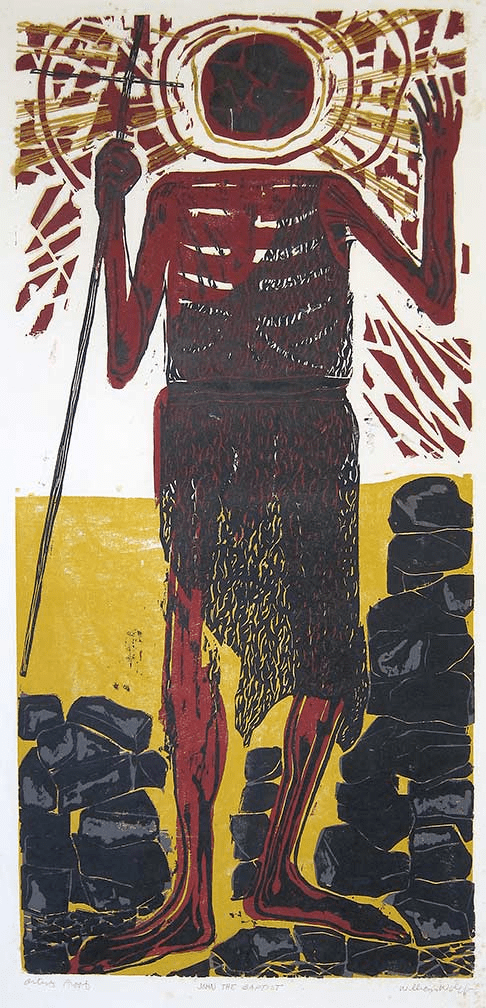
John the Baptist by William Wolff, 1968

We must, therefore, put ourselves in a position to see and hear God so that we can turn from all the obstacles that prevent us from experiencing Father, Son, and Spirit. 

And those hindrances to experiencing God are legion, including: 

  • Passiveness toward God’s Word and God’s creation, thus causing a lack of mindfulness and attention to the Holy Spirit.
  • Preoccupations and daydreams that prevents availability to the words and ways of Jesus.
  • Poverty of sleep, healthy habits, and an overall poor well-being that dulls the spiritual senses and prevents awareness of God.
  • Paucity of spiritual practices and disciplines that would put us in a position to experience a vision of God.

We must repent of all the ways we do not pay attention to God. The Lord is coming but we don’t perceive it.

  1. What, then, must we do to put ourselves in a position to see and hear God?
  2. In what ways might we corporately foster a sense of the holy God? 
  3. How will repentance fit into both our personal and corporate worship? 
  4. Have we identified and named the things that grieve the heart of God so that we can repent of them? 
  5. What is one action step you will take in response to this blog post?

None of us need to be like John the Baptist in order to be godly. We don’t have to eat locusts and be black-and-white thinkers. But we do all have to repent of the ways we make the road difficult by placing obstacles in the way of experiencing Jesus.

Most merciful God, we confess that we have sinned against you in thought, word, and deed, by what we have done, and by what we have left undone. We have not loved you with our whole heart; we have not loved our neighbors as ourselves. We are truly sorry and we humbly repent. For the sake of your Son Jesus Christ, have mercy on us and forgive us; that we may delight in your will, and walk in your ways, to the glory of your Name. Amen.

The Heart of Words (Matthew 12:33-37)

A good tree produces good fruit, and a bad tree produces bad fruit. You can tell what a tree is like by the fruit it produces. You are a bunch of evil snakes, so how can you say anything good? Your words show what is in your hearts. Good people bring good things out of their hearts, but evil people bring evil things out of their hearts. I promise you on the day of judgment, everyone will have to account for every careless word they have spoken. On that day they will be told they are either innocent or guilty because of the things they have said. (Contemporary English Version)

Words are important. They have meaning and power.

Our speech is the outward demonstration of what is really within the heart. There really isn’t any room to believe that a constant stream of gossip, backbiting, slander, and negative comments is anything but coming from a heart of evil. The person who speaks such words is not a loving, gracious, merciful person. Conversely, the person who continually encourages, uplifts, and seeks to be positive, reflects a deep heart of love for others.

Therefore, simply altering our speech when we’re around particular people is not the point; and it does no good. That kind of talking only breeds hypocrisy and is two-faced. Instead, the place to aim is the heart because that’s where the words come from. And the way to truly renovate a heart is to sub-contract the project to Jesus.

The people we typically hang-out with the most are the people that most influence our attitudes and our speech. 

So, if we spend copious amounts of time with Jesus, it’s inevitable that our hearts will become more like his heart, and thus, our words will be in alignment with the words and ways of Christ. Be rooted in Christ and the fruit of the tree will demonstrate it.

I always find public confessions on TV to be a rather disingenuous affair. Typically, celebrity apologies only take shape when one has been caught saying something and are called on the carpet. Then, when the apology comes, it’s predictably odd and incongruent, with the person saying something to the tune of, “I’m sorry if I hurt anybody by what I said. Saying that really wasn’t me. I’m not really like that.”

Well, apparently you are. It came out of your mouth. Jesus said that out of the overflow of the heart the mouth speaks. The words we say out loud betray what is truly inside us.

Jesus used the metaphor of a tree to illustrate his point. If the roots, the trunk, and the branches are good and healthy, then you can be sure the tree will produce good healthy fruit. However, if the tree is diseased, or infested with insects and rotting from the inside out, then no one can expect anything other than bad fruit, not fit to consume.

If the fruit is bad, the tree is bad. If the words are hateful, sarcastic, passive-aggressive, manipulative, conniving, racist, hurtful, ignorant, mean, unjust, foolish, and either subtly or overtly abusive, then the person has a dark heart and is need of redemption, not excuses.

Conversely, if the words are affirming, encouraging, loving, compassionate, gentle, caring, direct, helpful, peaceful, kind, giving hope and life, then there is a good heart behind it.

Yes, bad hearts can parrot good words. However, those words are not genuine but mere rote recitations to achieve some sort of personal agenda. And, of course, good people will occasionally say dumb or hurtful words. In such times, let it be a reminder that we all have some shadowy places within our hearts – and that we must depend on God’s grace to enlighten those dark spaces.

Let’s observe patterns, rather than focusing on isolated events where either good or bad words were said. A consistent pattern of invalidating another’s experiences or feelings; intimidating or threatening others; dismissing or discounting someone’s input; or being unnecessarily blunt, are all major red flags pointing to a severe heart issue.

Evil exists in the world. And if we are not vigilant to the power of language, wickedness can easily smack us upside the head when we aren’t looking.

The heart cannot be concealed forever. Eventually, the virtuous person will be shown as such by the stream of gracious speech which pours forth from the heart, as if it were living water for others to drink and enjoy. Their words reflect their good character.

The wicked person, however, cannot keep the bad words down. Those vile words sit in the soul, poisoning and making the person ill. Then, all of a sudden, the evil words come up and out with a great vomitous heave and spew impurity and unholiness all over the innocent. Their words betray their foolish and poor character.

Every tree that does not bear good fruit will be cut down and thrown into the fire. The wicked heart will not be able to speak ill of others with impunity forever. They will be called to account for their abusive words, whether overtly violent, or subtly undermining.

The righteous heart, however, shall experience divine pleasure and reward, as if the careful construction of helpful and building up words wins first-prize at the great heavenly fair.

The good person loves and does not hate. They are so far from harming anyone that they even pray and wish well for their enemies. They pray for blessings on those who curse them. There is an honest striving to speak good words to everyone, regardless of who they are.

The upright heart thinks the best of everyone and holds nothing over someone else’s head. Such a good heart condemns no one, leaving all judgment to God alone. It is patient with the most exasperating of people, praying they might come to their senses and become spiritually healthy.

The righteous are able to use their speech to admonish their neighbor with care and affection. They freely forgive, happily give, liberally encourage, and use their tongue to speak words of life. Indeed, their speech is wise, humble, full of grace, and above all, loving.

Almighty God, to you all hearts are open, all desires known, and from you no secrets are hid: Cleanse the thoughts of our hearts by the inspiration of your Holy Spirit so that we may perfectly love you, and worthily magnify your holy Name; through Christ our Lord. Amen.

God and the Human Condition (Romans 1:18-25)

For the wrath of God is revealed from heaven against all ungodliness and injustice of those who by their injustice suppress the truth. For what can be known about God is plain to them because God has made it plain to them. Ever since the creation of the world God’s eternal power and divine nature, invisible though they are, have been seen and understood through the things God has made.

So they are without excuse, for though they knew God, they did not honor him as God or give thanks to him, but they became futile in their thinking, and their senseless hearts were darkened. Claiming to be wise, they became fools, and they exchanged the glory of the immortal God for images resembling a mortal human or birds or four-footed animals or reptiles.

Therefore God gave them over in the desires of their hearts to impurity, to the dishonoring of their bodies among themselves. They exchanged the truth about God for a lie and worshiped and served the creature rather than the Creator, who is blessed forever! Amen. (New Revised Standard Version)

Exchanging Good for Bad

Nature abhors a vacuum. Everything is filled with something. If one thing is given up, another thing will take its place. Change is actually more like an exchange of one thing for another. Something is taken out, then replaced with something different.

We have exchanged:

  • Behavior that attends to the common good of all persons, for self-interested behavior to what is good for me and my family and/or group
  • Good deeds done from a pure heart, for good deeds done from an impure heart which give me an advantage or leverage over another
  • Steadfast committed love of others, for hustled love that gets discarded whenever things get hard
  • Submission to one another out of a sense of sacred reverence, for disobedience to anyone I don’t like
  • Dignity of being an image-bearer of God for the shame and ignominy of self-image
  • Majesty and worth of all persons in the world, for becoming masters of small worlds
Photo by Kindel Media on Pexels.com

And that’s not all, there’s more. We also have a nasty tendency to replace:

  • Freedom for shackles
  • Virtue for vice
  • Morality for immorality
  • Justice for injustice
  • Goodness for ungodliness
  • Truth for a lie
  • Wisdom for foolishness
  • Immortality for mortality
  • Honor for dishonor
  • Devotion for disregard
  • God for gods

These are all very poor replacements. In fact, the exchanges are so dark that they leave us in a state of guilt before God and all creation. Indeed, we all have sinned and fallen short of our intended purpose on this earth.

Guilt and Shame

Our response must not exchange guilt for shame because they are different words:

Guilt is assigned by God so that repentance and reconciliation might happen.

Shame, however, is introduced by us; we are the ones who label ourselves as a bucket of pig slop, not God.

Guilt is a function of the conscience, letting us know when we have said or done something wrong or hurtful; it is specific to a particular action or lack of action.

Shame, however, is a function of the “inner critic.” It interprets bad words or actions as we ourselves being bad, focusing not on actions but on our very personhood in the form of judgmentalism leveled at myself.

Guilt says, “I have done something bad.”

Shame, however, says, “I am bad.”

Guilt serves a redemptive purpose through alerting us that we need to deal with a wrong.

Shame, however, damages our spirits through telling us we are flawed and unworthy of love and connection with others.

Because guilt and shame are not the same, they need to be dealt with in different ways.

Guilt, if not faced and dealt with, becomes gangrene of the soul. Over time it festers and poisons our spirits, leading to significant emotional and sometimes physical problems. Forgiveness (both in apologies and in forgiving oneself) is the primary tool in dealing with guilt.

Shame, however, lives in the shadows and feeds on secrets. If shame persists, we withdraw from others and experience grinding loneliness. Therefore, the path out of shame is to openly name your shame and tell your story – thus taking away shame’s power and giving it back to yourself. Vulnerability is the tool which erases shame.

“Shame, blame, disrespect, betrayal, and the withholding of affection damage the roots from which love grows. Love can only survive these injuries if they are acknowledged and healed.”

Brené Brown

Emotional Creatures

In the absence of light, there is darkness. Purging oneself of belief in God merely means that another god will take her place. Scripture labels this “idolatry.”

What’s more, in the absence of feeling, in the quest to absolve oneself of unwanted emotions, there still remains emotion – because humans are emotional creatures.

People mostly rid themselves of any god concept because of how they feel about it. In fact, we do just about everything in life based on our emotions. This is a good thing, not a bad thing. We get into problems and fuss about emotions mucking up things, only because we never faced those feelings to begin with.

A person will never know God unless they understand this. The worship of God and the practice of Christianity is not only to engage the mind and the spirit, but also the body and the emotions.

Emotions and feelings are not like foreign microbes that enter the body as unwanted interlopers. They didn’t enter humanity as part of the world’s curse, after Adam and Eve’s fall into disobedience. No!

Rather, we are our emotions, just as much as we are our body, mind, and soul. Therefore, every emotion which exists, resides in us, all the time. We cannot purge ourselves of our emotions any more than we can remove the heart, the brain, or the bowels, and then expect to live.

Denying our emotions, suppressing feelings, and leaving them unacknowledged is terribly unhealthy and will slowly kill us – because our emotions are vital to our very existence.

Getting Rid of God

There are millions of spiritually dead zombies walking the earth who have jettisoned God altogether – either deliberately or unwittingly – because they discarded their emotions, long before they exchanged the sacred for the secular.

We all sometimes get physically ill; it’s part of the human condition, and we all understand that. So, we go to bed, or to the doctor, or to the hospital’s emergency department – depending upon the severity of our illness. We even go to a physician when we are healthy, just to get a check-up and make sure everything in the body is working as it should.

We also all get spiritually and emotionally ill; it’s part of the human condition. But we all don’t understand that. So, we soldier on, going about our regular business as if everything is hunky-dory. We don’t attend to our emotional selves. We don’t slow down and address what’s going on, or go to a church, or go to anyone. Instead, we suffer in silence.

Just as it ludicrous to get rid of the body altogether whenever we get a disease, so we must not rid ourselves of God whenever we get spiritually and emotionally sick. We face the illness and deal with it. It might require surgery. Recovery will hurt. That’s all part of facing it.

Ignoring God is about as smart as ignoring a heart attack. It might go away for a short time, but it’ll come back with a vengeance and do you in.

Emotions aren’t to blame when things are rough. Neither is God to blame when bad stuff happens. Both our emotions and God are realities we must deal with.

Just like the force of gravity is always there and needs to be respected (by not simply walking off the roof of your house, believing you don’t need gravity anymore) so the person and the power of God is always here and we absolutely need to come to terms with that reality, instead of walking away.

What will you do?…

Take the Path of Peace (Zechariah 1:1-17)

Michelangelo’s depiction of the prophet Zechariah, Sistine Chapel, Rome

In the eighth month of the second year of Darius, the word of the Lord came to the prophet Zechariah son of Berekiah, the son of Iddo:

“The Lord was very angry with your ancestors. Therefore tell the people: This is what the Lord Almighty says: ‘Return to me,’ declares the Lord Almighty, ‘and I will return to you,’ says the Lord Almighty. Do not be like your ancestors, to whom the earlier prophets proclaimed: This is what the Lord Almighty says: ‘Turn from your evil ways and your evil practices.’ But they would not listen or pay attention to me, declares the Lord. Where are your ancestors now? And the prophets, do they live forever? But did not my words and my decrees, which I commanded my servants the prophets, overtake your ancestors?

“Then they repented and said, ‘The Lord Almighty has done to us what our ways and practices deserve, just as he determined to do.’”

On the twenty-fourth day of the eleventh month, the month of Shebat, in the second year of Darius, the word of the Lord came to the prophet Zechariah son of Berekiah, the son of Iddo.

During the night I had a vision, and there before me was a man mounted on a red horse. He was standing among the myrtle trees in a ravine. Behind him were red, brown and white horses.

I asked, “What are these, my lord?”

The angel who was talking with me answered, “I will show you what they are.”

Then the man standing among the myrtle trees explained, “They are the ones the Lord has sent to go throughout the earth.”

And they reported to the angel of the Lord who was standing among the myrtle trees, “We have gone throughout the earth and found the whole world at rest and in peace.”

Then the angel of the Lord said, “Lord Almighty, how long will you withhold mercy from Jerusalem and from the towns of Judah, which you have been angry with these seventy years?” So the Lord spoke kind and comforting words to the angel who talked with me.

Then the angel who was speaking to me said, “Proclaim this word: This is what the Lord Almighty says: ‘I am very jealous for Jerusalem and Zion, and I am very angry with the nations that feel secure. I was only a little angry, but they went too far with the punishment.’

“Therefore this is what the Lord says: ‘I will return to Jerusalem with mercy, and there my house will be rebuilt. And the measuring line will be stretched out over Jerusalem,’ declares the Lord Almighty.

“Proclaim further: This is what the Lord Almighty says: ‘My towns will again overflow with prosperity, and the Lord will again comfort Zion and choose Jerusalem.’” (New International Version)

God hulking-out isn’t something you want to see repeated, insisted the prophet.

Zechariah directed his message to the Jews returning from their exile in Babylon. He reminded them that their parents and forebears had been called to repent and return to the Lord. They didn’t. Hence, the Babylonian exile. Big hint from the prophet to the people: Don’t ever do that again. Things will get angry, large, and green if you do.

Zechariah’s generation was being given a chance: To live into God’s covenant and law; to hold fast onto their identity as God’s people.

The people listened to the prophet. They expressed their repentance and a desire to turn from past evil ways and embrace the ways of the Lord. And the returning exiles also acknowledged and accepted God’s judgment. The returning exiles understood that, as a people, they deserve the consequences to centuries of neglecting justice, mercy, and humility.

Every generation of believers must learn from the past. Not only do they need to receive the teachings and traditions of those who went before them, but each generation must also struggle with how to put that teaching and tradition into practice.

The past needs to be squarely faced and deliberately pulled into the present. That is the way a genuine hope is born, giving direction for the future. In other words, old words and ways from the past need new experiences in the present; only by doing this will there be guidance.

Bring in your kingdom so that your will is done on earth as it’s done in heaven. (Matthew 6:10, CEB)

Today’s Old Testament lesson includes the first of eight night visions from the prophet Zechariah. The gist of the first prophetic oracle is a message of assurance and comfort: God will restore. The Lord will renew.

Divine intervention is about to happen in the rebuilding of the temple – a physical example of the spiritual reality that is happening. Just as the ancient temple was being restored for new generations of worshipers, so the people were being renewed to be an example of piety and fidelity to God for millennia to come.

Peace and prosperity will again be realized.

Throughout Scripture, trees are a symbol of a thriving and flourishing life. The myrtle tree is a sign of God’s promise to bring new life, branching out to spread into the next generations. Like all trees, the myrtle needs plenty of moisture when young. Yet, it is distinctive in that the myrtle tree can tolerate drought, grow despite limited soil, and remain hardy when it becomes mature.

Your anger lasts a little while,
but your kindness lasts
    for a lifetime.
At night we may cry,
but when morning comes
    we will celebrate. (Psalm 30:5, CEV)

“Tolerate,” “grow,” and “remain” are anything but passive words. People are more than mere observers. “Repent” and “return” and “renew” are verbs. There is a great deal of activity to do. A divine/human cooperation needs to occur. On God’s end, even the angels get involved in the action. What’s happening here is both heavenly and earthly business.

Relational dynamics between God and God’s people are to be a dialogue and not a one-sided monologue. The Lord and the present generation are to demonstrate for future peoples how peace is actually realized and enjoyed.

The Vision of Zechariah, by Unknown artist, c.1300 C.E., Sicily

Like all biblical visions, Zechariah’s is not readily understandable. Nobody is sure about what the symbolism is behind the vision’s horses. Yet, I’ll venture to say that it’s the colors which are significant: red is the color of action; brown is a color of stability and fertility; and white represents purity and holiness. Red, brown, and white mixed together creates a beige color.

Beige is an earthy and dependable color. It’s an inherently welcoming and calming color, offering warmth and symbolizing harmony and comfort. Together, with the horses we have a representation of strength, stability, and structure. They are signs of peace and rest, of God’s shalom.

Spiritual wholeness, moral integrity, relational harmony, and settled peace don’t just magically happen. 

For the Christian, peace was bought at a price – the blood of Jesus. (Colossians 1:20)

Peace must be both passively received and actively pursued. (Ephesians 4:3)

Practices of peace need to be engrafted into our lives so that we might daily experience it. (Romans 14:13-15:7)

The name “Zechariah” is a Hebrew word meaning, “God remembered.” God has not forgotten divine promises. 

The time has come to take hold of the vision God had from the very beginning to walk with humanity in continual fellowship and happiness in the garden, a place of abundant growth, beauty, and health – a place of peace and rest.

The happiest, fully rested, and most peaceful people and nations on earth continually find a steady stream of joy in their families, their rituals/traditions, and their religion.

To find joy and happiness in life is to find peace and rest. And peace is something to be shared, to be passed onto others.

“The peace of Christ be with you.”

“And also with you.”

Such ritual words and practices are reminders of continually returning to the Lord and finding simplicity and satisfaction in Jesus.

In observing and celebrating the Lord’s Table, we find our penultimate remembrance of how peace was achieved, as well as our supreme participation in the triune God.

Perhaps, then, peace and prosperity will extend their tree-like branches over the earth and into the next generations.

Grace to you and peace from God our Father and the Lord Jesus Christ.

Peace before us,
Peace behind us,
Peace under our feet.

Peace within us,
Peace over us,
Let all around us be peace.

Christ before us,
Christ behind us,
Christ under our feet.

Christ within us,
Christ over us,
Let all around us be Christ. – a Navajo Prayer