Galatians 6:7-10 – You Harvest What You Plant

Photo by Johann Piber on Pexels.com

Do not be deceived; God is not mocked, for you reap whatever you sow. If you sow to your own flesh, you will reap corruption from the flesh; but if you sow to the Spirit, you will reap eternal life from the Spirit. So let us not grow weary in doing what is right, for we will reap at harvest time if we do not give up. So then, whenever we have an opportunity, let us work for the good of all, and especially for those of the family of faith. (New Revised Standard Version)

“You reap what you sow” is one of those famous (or infamous) phrases of the Bible. Some people have a visceral reaction to the statement because it was used in the negative sense to keep kids obedient. 

However. the actual context for the statement, while not excluding the need to avoid disobedience, is aimed much more toward the necessity of doing good works for others. 

In the Church’s and the Christian’s work of burden-bearing on behalf of those with crushing loads to carry, we are not to become weary as the walk goes on and on. Persevering in good works will eventually lead to a bumper crop of righteousness.

We don’t typically use the words “sow” and “reap” much anymore. We really don’t use very many agrarian metaphors anymore since most folks are no longer living on farms and working the soil. We’re likely more familiar with the words “plant” and “harvest.”

We understand that if we plant seeds in our garden, it will take some time for them to germinate, take root, break the ground, grow, and produce what we want from them. The same is true in life. To expect instantaneous results for the spiritual life is unrealistic; it just doesn’t work that way.

The main orientation of today’s New Testament lesson is patience and perseverance in the doing of good works. Although it might not seem, at the moment, that our labors are really making a dent at all, God is taking notice. The Lord sees each act of service.  Eventually, if we will keep up the slow, tedious, and often dull work of persisting in doing what is right, it will all pay-off in a harvest of righteousness.

Perhaps you have been struggling lately – wanting to see something happen that you’ve been working on or praying for. And it hasn’t happened yet. You’re ready for the harvest and are tired of waiting. 

There are times when I grow weary of having the same conversations with people over and over again. I sometimes grow impatient with impenitent people who only seem to think of themselves. Alas, welcome to the human race! 

God cares just as much, or more, about the process of planting and tending as the actual end of the harvest. In other words, the means of how we go about things are as important as the end result. To help us be accountable, we very much need the encouragement of others in our Christian pilgrimage through this life. 

Accountability is a humble willingness to accept the consequences of our choices, our words, and our behaviors. That is, we need to own our part in situations we’ve been in. It’s about taking responsibility (not for others and their behavior) for one’s self and making things right.

Now all discipline seems painful at the time, not joyful. But later it produces the fruit of peace and righteousness for those trained by it. (Hebrews 12:11, NET)

Honesty, integrity, wisdom, courage, forgiveness, and humility don’t simply fall out of the sky for us. A good and abundant harvest which can be shared with many requires patient and tedious work. These virtues, along with the fruit of the Spirit – love, joy, peace, patience, kindness, goodness, gentleness, and self-control – need careful attention. Like a faithful and patient gardener, we must tend to them, keeping ourselves free of weeds, bugs, and critters.

As we daily tend to our personal garden, we pay attention to how we use our time; know and honor our limits; and remain open to change. We cannot control outside forces, such as the weather, but we can take responsibility for our own choices and the consequences which result from them.

We cannot care for others and do good works unless we have done the work of self-care. Doing good flows from being good, first to ourselves, then to others. We can only give what we have. If we have tended to our garden with care, then the bounteous harvest can be shared with many. But if we neglect our own garden, there will be nothing to give when the season of harvest comes around.

“Which of the commands is most important?” Jesus answered, “The most important command is this: ‘Listen, people of Israel! The Lord our God is the only Lord. Love the Lord your God with all your heart, all your soul, all your mind, and all your strength.’The second command is this: ‘Love your neighbor as you love yourself.’ There are no commands more important than these.” (Mark 12:28-31, NCV)

Caring for ourselves isn’t a luxury. We must give ourselves permission to do it. The way in which we talk to ourselves will eventually become the manner in which we talk to others. The care we learn to extend to ourselves will be the care we give to others.

If we sow and plant good things in our own lives, then we will reap a harvest of good works for others. So, let us do good, especially to our sisters and brothers in the faith.

Patient God, you have been waiting for several millennia to complete your work in this world. It is a small thing for me to keep doing your will with perseverance over the span of my own lifetime. I look to my model, Jesus Christ, who for the joy set before him endured the cross and reaped eternal life for all who would believe. Amen.

Galatians 5:16-25 – Let the Spirit Guide You

So, I say, let the Holy Spirit guide your lives. Then you won’t be doing what your sinful nature craves. The sinful nature wants to do evil, which is just the opposite of what the Spirit wants. And the Spirit gives us desires that are the opposite of what the sinful nature desires. These two forces are constantly fighting each other, so you are not free to carry out your good intentions. But when you are directed by the Spirit, you are not under obligation to the law of Moses.

When you follow the desires of your sinful nature, the results are very clear: sexual immorality, impurity, lustful pleasures, idolatry, sorcery, hostility, quarreling, jealousy, outbursts of anger, selfish ambition, dissension, division, envy, drunkenness, wild parties, and other sins like these. Let me tell you again, as I have before, that anyone living that sort of life will not inherit the Kingdom of God.

But the Holy Spirit produces this kind of fruit in our lives: love, joy, peace, patience, kindness, goodness, faithfulness, gentleness, and self-control. There is no law against these things!

Those who belong to Christ Jesus have nailed the passions and desires of their sinful nature to his cross and crucified them there. Since we are living by the Spirit, let us follow the Spirit’s leading in every part of our lives. (New Living Translation)

It seems that sometimes the Holy Spirit gets treated as a third wheel.

For example, there are some Christians who rigidly rank the Holy Trinity as Father, Son, and Spirit – in that order – as if the Spirit were nothing more than some ethereal “it.” In fact, I’ve been in some churches where it seems their understanding of the Trinity is Father, Son, and Holy Bible – with the Spirit nowhere to be found.

Even among those who respect and acknowledge the Holy Spirit, the Spirit still gets the short end of the stick. We pray to the almighty heavenly Father. We pray in the blessed name of Jesus. And what of the Holy Spirit? Seems the Spirit gets treated like a younger sibling in the Trinity family.

Truth is, we never quite know what the Spirit might do. Heck, we aren’t even sure what pronoun to use for the Holy Spirit. It? He? She? They?  Because the Spirit seems so mysterious, otherworldly, and unpredictable, we send he/she/it off to some metaphorical bedtime so that we can watch TV and do whatever we want. 

Perhaps we strive, work, and wrestle to live a good life. Yet, somehow, we too often fall short and feel like a failure. Why is that?

Could be that we’ve looked at the Holy Spirit as some weird stepchild and largely ignore the Spirit’s presence. We believe in the Spirit. We have faith the Spirit is there. Yet, we don’t have any idea how to relate.

God is big and sovereign. Jesus has a real body and blood. The Spirit? Well, the Spirit’s out there, man, like some old hippie past his prime.

“What we need is not more learning, not more eloquence, not more persuasion, not more organization, but more power from the Holy Spirit.”

John R.W. Stott

How do you have a relationship with such an incorporeal Being who seems so different? Well, it’s time we got to know the Spirit….

The Holy Spirit is the power source of the Christian life. Without the Spirit, we can easily degenerate into all kinds of illicit thinking and behavior – including immorality, moral corruption, doing whatever feels good, idolatry, substance abuse, casting evil spells, hate, fighting, obsessive behaviors, violent anger, competitive opposition, conflict, selfishness, group rivalry,jealousy, drunkenness, or living for the party.

It is the Spirit who helps, comforts, provides strength, and enables us to replace old habits with new ones, and dead practices with solid spiritual action. The Christian virtues which flower and produce the fruit of love, joy, peace, patience, kindness, goodness, faithfulness, gentleness, and self-control occur through a close intimate relationship with the Holy Spirit. 

The Spirit helps us in our weakness when we pray, speak, and act. The Christian actually has such a close association with the Holy Spirit that it is as if we are a like a sacred temple in which the Spirit takes up residence. 

By means of the Holy Spirit, God is always with us and continually, at this moment, working within us to make our redemption in Christ an actual real-live encounter. The Spirit helps us walk the path of Christianity with God’s love inside us and overflowing out of us.

Here’s a simple observation: All the spiritual virtues mentioned in today’s New Testament lesson are the “fruit” of the Spirit, not “fruits.” The nine ethics are a package deal. To have the Spirit and spiritual fruit, you have all nine Christian values. 

If we look at the list and say, “Well, I’m pretty good at kindness and goodness, but I don’t have much peace or patience,” this means we are probably doing kindness and goodness from a different place than by means of the Holy Spirit. Because when the Spirit is manifested in us, we exhibit spiritual fruit. We cannot separate the nine spiritual virtues any more than we can separate the Trinity. They’re all one spiritual fruit, cultivated and produced within the inner person by the agency of God’s Spirit.

Maybe we need to consider the shadow side of our lives. It could be that, for example, we are far more driven by our anxiety about most things than about genuine altruism and love. The results of our actions and words might look the same, but the motivation might be far from truly altruistic. It simply will not last if our actions are generated from a place of worry – because it is not of the Spirit.

So, what to do about it?  We must mortify (put to death) the deeds of the sinful nature.

My old self has been crucified with Christ. It is no longer I who live, but Christ lives in me. So, I live in this earthly body by trusting in the Son of God, who loved me and gave himself for me. (Galatians 2:20, NLT)

If we have C-clamped our hearts so tight that the Spirit cannot get in, then it’s high time to loosen the grip and enable God to do some gracious and merciful work within us.  It’s the only way to experience genuine transformation of life.

The spiritual life can be scary. Letting go of control is hard for many people, including me. But the results are worth it. The Spirit is competent and cannot be controlled by us.

The Holy Spirit often works in wild and crazy ways and might show up on “Saturday Night Live” where you least expect to discover her.

Jesus said that the work of God is to believe in the one he sent (John 6:29). The Spirit always points us to Christ, the one who has delivered us from the realm of sin and brought us forgiveness. This work of Christ enables the work of the Spirit, who now makes our deliverance a practical reality in daily life.

The Holy Spirit is not a third wheel, but the real deal. Whenever we open our hearts to the Spirit, we experience the wideness of God’s mercy.

Pentecost is nearly here. Get ready to receive the Spirit.

Psalm 122 – A Spiritual Journey

I was glad when they said to me,
“Let’s go to the house of the Lord.”
Our feet are standing inside your gates, Jerusalem.
Jerusalem is built to be a city
where the people are united.
All of the Lord’s tribes go to that city
because it is a law in Israel
to give thanks to the name of the Lord.
The court of justice sits there.
It consists of princes who are
David’s descendants.

Pray for the peace of Jerusalem:
“May those who love you prosper.
May there be peace inside your walls
and prosperity in your palaces.”
For the sake of my relatives and friends, let me say,
“May it go well for you!”
For the sake of the house of the Lord our God,
I will seek what is good for you. (God’s Word Translation)

The spiritual life is a pilgrimage—a journey of constant growth, sacrifice, and faith in what we cannot see. As both pilgrims and disciples, we continually move and learn.

The biblical psalms of ascent (Psalms 120-134) were sung by worshipers as they made the journey to Jerusalem for the annual feasts, and up the temple mount to unite together in worship.

Many pilgrims spent hours and/or days walking to the holy city. In the great anticipation of collective worship, the people quoted and sang the several psalms of ascent together. They enjoyed the journey.

I once spent some time reading the journals of several medieval Christian pilgrims who went to various holy sites in Europe, and some who even made the trek all the way to Jerusalem – on foot. Early in their journals, they mostly wrote about the anticipation of reaching their destination. These pilgrims went into great detail about the hospitality they encountered, and friends made along the way.

I was struck, however, with the profound lack of space and detail devoted to visiting the actual holy site – especially when they returned home and reflected on their experiences. The vast majority of pilgrims had the journey itself as their most memorable time.

Of course, we all can worship individually and personally anywhere and anyplace. Yet, if we want to have worship experiences which truly shape our spiritual lives, then we will need to have plenty of corporate encounters with fellow pilgrims on the same path as us.

Within today’s psalm, we are told that part of Israel’s decree in approaching the Lord is to give thanks. The Jewish pilgrims were to have an attitude of gratitude when they came to Jerusalem and the house of God. Each pilgrimage to Jerusalem was to have a marked expression of thanksgiving to God for giving them a place to worship and a land to dwell within.

I cannot help but wonder if attending church services would be much more appreciated and impactful if we took the mental and emotional posture of gratitude when approaching worship. 

Within some church buildings and sacred spaces there is a flight of stairs that one must ascend to reach the sanctuary. Slowly going up the stairs, we can give thanks for one thing in each step. Even if you attend a church with a zero entry, you can still give thanks to God while walking from the parking lot to the building. 

The point is that the worship of God needs some thought and intent behind it. Simply showing up and flopping down in a seat – almost daring the worship leaders and/or pastor to bless them – is far from the imagination the psalmist had for approaching a sovereign God.

Pilgrimage is about more than a long walk. It’s about the soul in community with others and God.

One way of being a pilgrim close to home is through walking a Labyrinth – an ancient practice of the Church meant for spiritual centering, contemplation, and prayer.

Entering the serpentine path of a Labyrinth, one walks slowly while quieting the mind and focusing on a spiritual question or prayer. A Labyrinth is not a maze. It has only one winding path to the center and back out. 

The wisdom of the Labyrinth is that it reflects the way life actually is – that our lives are not about the destination but about the long circuitous journey. The Christian life is consistently described in the New Testament as a road or a way. We walk with Jesus.

Labyrinths can be found within some church buildings, on church grounds, in hospitals, or park spaces. There are also “finger” Labyrinths. Rather than physically walking, the pilgrim can slowly trace the path on a paper or small Labyrinth object with a finger. 

You might also get creative and make your own homemade Labyrinth within a space of your home or out in the yard. labyrinthsociety.org has free printable Labyrinths, as well as a virtual Labyrinth walk.

The Labyrinth is not meant to be a race to the center; it only “works” if we move at a pace which enables us to meditatively pray, paying attention to what God is doing within us. Generally, there are four stages to the walk:

  • Releasing on the way toward the center – letting go of all that weighs us down in the Christian life.  “Let’s throw off any extra baggage, get rid of the sin that trips us up, and fix our eyes on Jesus, faith’s pioneer and perfecter.” (Hebrews 12:1-2, CEB)
  • Receiving in the center – accepting the love God has for you. Jesus said, “Ask and you will receive, so that your joy may be complete.” (John 16:24, NRSV)
  • Returning through following the path back out – integrating what you have received for the life of the world. “I will give them a heart to know me, God. They will be my people and I will be their God, for they will have returned to me with all their hearts.” (Jeremiah 24:7, MSG)
  • Responding to the love of God through gratitude – thus finding joy, even in the most troubling of circumstances. “O give thanks to the Lord, for he is good; his steadfast love endures forever!” (Psalm 118:1, NRSV)

The penitent heart will resonate deeply with the psalms as worship liturgy. This is because liturgical practices impress the spirit and bring spiritual freedom.

Walking together in a common spiritual journey is like going through a gate into a new reality and rejoicing with all the other redeemed pilgrims who are walking the road to Jerusalem.

Lord Jesus Christ, you call me to follow you, and I choose to walk with you. Open the eyes of my heart to see my life in a new way. With each step I take, help me to be open to change. As I walk this pilgrimage, give me the grace to journey deliberately and patiently. Amen.

Psalm 126 – Planting in Tears and Harvesting with Joy

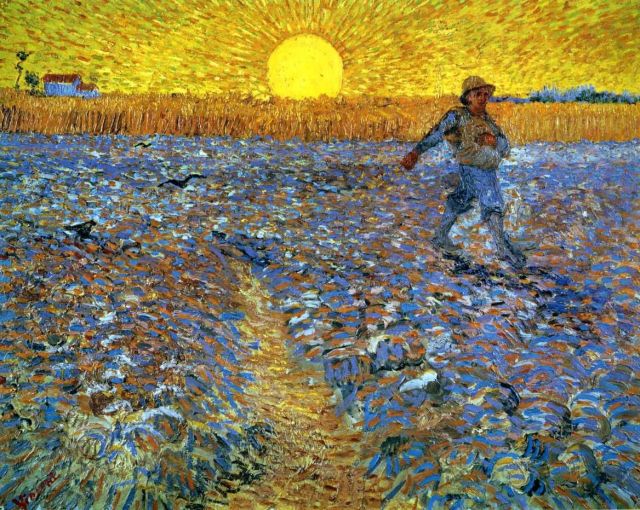
The Sower, by Vincent Van Gogh, 1881

When the Lord brought back his exiles to Jerusalem,
    it was like a dream!
We were filled with laughter,
    and we sang for joy.
And the other nations said,
    “What amazing things the Lord has done for them.”
Yes, the Lord has done amazing things for us!
    What joy!

Restore our fortunes, Lord,
    as streams renew the desert.
Those who plant in tears
    will harvest with shouts of joy.
They weep as they go to plant their seed,
    but they sing as they return with the harvest. (New Living Translation)

Many people are familiar with the phrase, “You reap what you sow.” Although the saying is typically referred to in the context of avoiding poor decisions (Galatians 6:7) the principle is woven throughout Holy Scripture in other scenarios, as well, as it is in today’s psalm.  

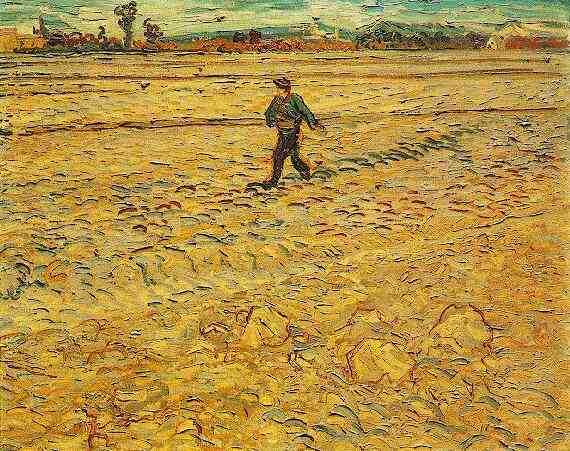
Sowing and reaping are, of course, agricultural terms. Farmers and gardeners tend to the soil through tilling, planting, cultivating, weeding, and eventually harvesting. The images of farming and the growth of plants serve as fitting metaphors for the spiritual life. Growth does not occur quickly. Instead, constant and vigilant attention to one’s spirit eventually brings a harvest of good works and godly attitudes. 

Jesus said, “My food is to do what the one who sent me wants me to do. My food is to finish the work that he gave me to do.” (John 4:34, ERV)

In a culture which values immediacy and having things now, the slow growth of the spiritual life can be a difficult principle to grasp. We may think that whenever we sin – with no immediate lightning to zap us – that therefore what we did must not have been so bad. 

Eventually, however, our implanted seeds will sprout and become visible to all. Conversely, we might believe whenever we dedicate ourselves to altruistic service, and then see no immediate results, that we must be doing something wrong. So, we may easily become discouraged and give up.

Sow for yourselves righteousness; reap steadfast love. Break up your fallow ground; for it is time to seek the Lord, that he may come and rain righteousness upon you. (Hosea 10:12, NRSV)

The psalmist reminds us of the need for patience. Just as it takes continual watering to reap a harvest in the field, so the Christian’s life of weeping and tears, of tilling deeply into the things of God, is the necessary work to eventually spot a sprout, see growth, and finally bear fruit. 

The tedious cultivating and weeding of our souls is the task before us. If we are patient and consistent, we will realize a harvest of righteousness. 

The Sower, by Vincent Van Gogh, 1888

Jesus taught his Beatitudes to help us understand that righteousness, peace, and joy come through connecting with our poverty of spirit; mourning over personal and corporate sin; embracing humility and meekness; hungering and thirsting after righteousness.

Only through the blood, sweat, and tears of spiritual agony will we come through to the deep happiness of seeing the Lord accomplish great things in our lives. In other words, joy is neither cheap nor easy. It is the fruit of many tears.

Spiritual farming involves sound practices of sowing and reaping. There is suffering before glory, tears before joy, lament before healing.

Just as a farmer cannot take short-cuts in the planting and cultivating process if he wants to have a bounteous and delicious harvest, so there is no getting around the painful work of grieving our changes and losses.

Avoiding the hard work of spiritual farming leads to a bogus harvest where we bite into a fresh ear of sweet corn only to discover a mouthful of worms.

Remember this: The person who plants a little will have a small harvest, but the person who plants a lot will have a big harvest.

2 Corinthians 9:6, NCV

The bulk of our lives are played out in the liminal space between sowing and reaping. The farmer plants and waits, attentive to the land and the weather until the time of harvest. We, too, exist in a time of patience. So, we pray, recalling past harvests and anticipate that with God’s good help, we will enjoy abundance.

This in-between time is often characterized by tears.

As she stood behind him at his feet weeping, she began to wet his feet with her tears. Then she wiped them with her hair, kissed them and poured perfume on them. (Luke 7:38, NIV)

I grew up on an Iowa farm. I only saw my father cry twice in my life. The first time, I was just a boy, two days after my eighth birthday – a devastating hailstorm destroyed the crops that had been planted just six weeks before. Despite farm equipment and technological savvy, the farmer is still at the mercy of the weather.

And we will always be at the mercy of God. Because God is good, just, and fair, the Lord does great and benevolent things. To be blessed, we need to embrace the dog days of summer in all its banality and its tears until we reach the time of reaping. There is joy, and it is coming, if we do the work of spiritual farming and wait patiently.

Likely, none of us awake in the morning, sit up on the edge of the bed, and say to ourselves, “Well, let’s see, I think I’ll cry and be sorrowful today.” We might do that with joy, but not with sadness. It can be easier to gravitate toward the fulfillment of dreams, laughter, and happiness than tears and weeping.

Yet, if we want to experience authentic joy, the path to it is through crying because it is our tears which find a better way.

“Normality is a paved road: It’s comfortable to walk, but no flowers grow on it.”

Vincent Van Gogh

Whether it comes from a certain denominational tradition, ethnic background, or family of origin dynamics, there are many Christians who love to emphasize Jesus as Victor and camp in resurrection power – while eschewing Christ as the man of sorrows, acquainted with grief and sadness.

By viewing only one dimension of Christ’s redemptive work, pastoral care often falls far short of true help. Trying to engineer cheerfulness and create solutions to a person’s genuine grief is, at best, not helpful, and at worst, damaging to their soul. It only leads to cheap inauthentic joy.

Sincerely singing spontaneous songs of joy, with a sense of abundant satisfaction, comes through suffering and sorrow. There must be a crucifixion before there is a resurrection. In the agrarian culture of ancient Israel, the metaphor of sowing a reaping connected well to the importance of planting tears and allowing them to flower later into an abundant harvest of joy.

Perhaps in contemporary American culture, a more apt metaphor would be financial investing and cashing out. The investment we put into attending to our grief with expressions of lament through tears, will eventually get a return, and we shall be able to cash out with a rich bounty of joy.

Easter is coming. Resurrection and new life will occur. The journey of Lent, with seeds repentance carefully planted, watered with tears, shall bring an abundant harvest of joy.

Gratias Deo. Thanks be to God.