Psalm 126 – Planting in Tears and Harvesting with Joy

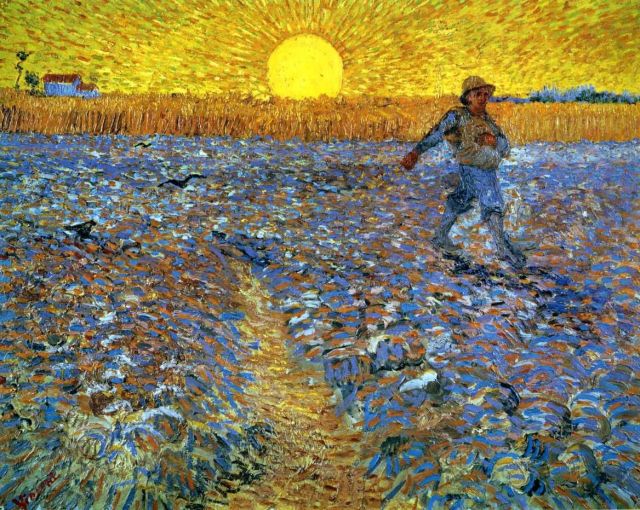
The Sower, by Vincent Van Gogh, 1881

When the Lord brought back his exiles to Jerusalem,
    it was like a dream!
We were filled with laughter,
    and we sang for joy.
And the other nations said,
    “What amazing things the Lord has done for them.”
Yes, the Lord has done amazing things for us!
    What joy!

Restore our fortunes, Lord,
    as streams renew the desert.
Those who plant in tears
    will harvest with shouts of joy.
They weep as they go to plant their seed,
    but they sing as they return with the harvest. (New Living Translation)

Many people are familiar with the phrase, “You reap what you sow.” Although the saying is typically referred to in the context of avoiding poor decisions (Galatians 6:7) the principle is woven throughout Holy Scripture in other scenarios, as well, as it is in today’s psalm.  

Sowing and reaping are, of course, agricultural terms. Farmers and gardeners tend to the soil through tilling, planting, cultivating, weeding, and eventually harvesting. The images of farming and the growth of plants serve as fitting metaphors for the spiritual life. Growth does not occur quickly. Instead, constant and vigilant attention to one’s spirit eventually brings a harvest of good works and godly attitudes. 

Jesus said, “My food is to do what the one who sent me wants me to do. My food is to finish the work that he gave me to do.” (John 4:34, ERV)

In a culture which values immediacy and having things now, the slow growth of the spiritual life can be a difficult principle to grasp. We may think that whenever we sin – with no immediate lightning to zap us – that therefore what we did must not have been so bad. 

Eventually, however, our implanted seeds will sprout and become visible to all. Conversely, we might believe whenever we dedicate ourselves to altruistic service, and then see no immediate results, that we must be doing something wrong. So, we may easily become discouraged and give up.

Sow for yourselves righteousness; reap steadfast love. Break up your fallow ground; for it is time to seek the Lord, that he may come and rain righteousness upon you. (Hosea 10:12, NRSV)

The psalmist reminds us of the need for patience. Just as it takes continual watering to reap a harvest in the field, so the Christian’s life of weeping and tears, of tilling deeply into the things of God, is the necessary work to eventually spot a sprout, see growth, and finally bear fruit. 

The tedious cultivating and weeding of our souls is the task before us. If we are patient and consistent, we will realize a harvest of righteousness. 

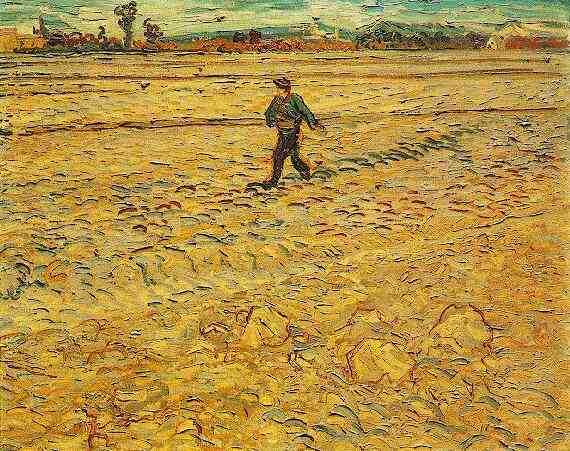
The Sower, by Vincent Van Gogh, 1888

Jesus taught his Beatitudes to help us understand that righteousness, peace, and joy come through connecting with our poverty of spirit; mourning over personal and corporate sin; embracing humility and meekness; hungering and thirsting after righteousness.

Only through the blood, sweat, and tears of spiritual agony will we come through to the deep happiness of seeing the Lord accomplish great things in our lives. In other words, joy is neither cheap nor easy. It is the fruit of many tears.

Spiritual farming involves sound practices of sowing and reaping. There is suffering before glory, tears before joy, lament before healing.

Just as a farmer cannot take short-cuts in the planting and cultivating process if he wants to have a bounteous and delicious harvest, so there is no getting around the painful work of grieving our changes and losses.

Avoiding the hard work of spiritual farming leads to a bogus harvest where we bite into a fresh ear of sweet corn only to discover a mouthful of worms.

Remember this: The person who plants a little will have a small harvest, but the person who plants a lot will have a big harvest.

2 Corinthians 9:6, NCV

The bulk of our lives are played out in the liminal space between sowing and reaping. The farmer plants and waits, attentive to the land and the weather until the time of harvest. We, too, exist in a time of patience. So, we pray, recalling past harvests and anticipate that with God’s good help, we will enjoy abundance.

This in-between time is often characterized by tears.

As she stood behind him at his feet weeping, she began to wet his feet with her tears. Then she wiped them with her hair, kissed them and poured perfume on them. (Luke 7:38, NIV)

I grew up on an Iowa farm. I only saw my father cry twice in my life. The first time, I was just a boy, two days after my eighth birthday – a devastating hailstorm destroyed the crops that had been planted just six weeks before. Despite farm equipment and technological savvy, the farmer is still at the mercy of the weather.

And we will always be at the mercy of God. Because God is good, just, and fair, the Lord does great and benevolent things. To be blessed, we need to embrace the dog days of summer in all its banality and its tears until we reach the time of reaping. There is joy, and it is coming, if we do the work of spiritual farming and wait patiently.

Likely, none of us awake in the morning, sit up on the edge of the bed, and say to ourselves, “Well, let’s see, I think I’ll cry and be sorrowful today.” We might do that with joy, but not with sadness. It can be easier to gravitate toward the fulfillment of dreams, laughter, and happiness than tears and weeping.

Yet, if we want to experience authentic joy, the path to it is through crying because it is our tears which find a better way.

“Normality is a paved road: It’s comfortable to walk, but no flowers grow on it.”

Vincent Van Gogh

Whether it comes from a certain denominational tradition, ethnic background, or family of origin dynamics, there are many Christians who love to emphasize Jesus as Victor and camp in resurrection power – while eschewing Christ as the man of sorrows, acquainted with grief and sadness.

By viewing only one dimension of Christ’s redemptive work, pastoral care often falls far short of true help. Trying to engineer cheerfulness and create solutions to a person’s genuine grief is, at best, not helpful, and at worst, damaging to their soul. It only leads to cheap inauthentic joy.

Sincerely singing spontaneous songs of joy, with a sense of abundant satisfaction, comes through suffering and sorrow. There must be a crucifixion before there is a resurrection. In the agrarian culture of ancient Israel, the metaphor of sowing a reaping connected well to the importance of planting tears and allowing them to flower later into an abundant harvest of joy.

Perhaps in contemporary American culture, a more apt metaphor would be financial investing and cashing out. The investment we put into attending to our grief with expressions of lament through tears, will eventually get a return, and we shall be able to cash out with a rich bounty of joy.

Easter is coming. Resurrection and new life will occur. The journey of Lent, with seeds repentance carefully planted, watered with tears, shall bring an abundant harvest of joy.

Gratias Deo. Thanks be to God.

Luke 13:18-21 – What is the Kingdom of God Like?

A mustard seed

Jesus asked, “What is God’s kingdom like? What can I compare it to? It’s like a mustard seed that someone planted in a garden. It grew and became a tree, and the birds nested in its branches.”

He asked again, “What can I compare God’s kingdom to? It’s like yeast that a woman mixed into a large amount of flour until the yeast worked its way through all the dough.” (God’s Word Translation)

I grew up on a rural Mid-West America farm. Working with seeds was our livelihood. And making bread was second nature to us. Even though my parents worried incessantly about the weather and the price of groceries, there were two things they were never anxious about: seeds and yeast.

My dad knew that when we planted seeds in the Spring, there would be a harvest in the Fall. That’s because he knew the seed already has within itself everything it needs to germinate, take root, grow, and produce a harvest. His role was simply to tend to it all by keeping the fields free of weeds, worms, and critters.

My mom knew that when she put the bread in the oven, it would bake and rise into a glorious loaf. That’s because she had full confidence that the little bit of yeast she worked into the dough would do it’s job. Her role was simply to ensure the proper amount of ingredients and oversee the time and temperature of baking.

Since I was the youngest, I typically got the grunt work of our massive garden. I was always excited when we planted things because I knew what was coming in a few months: some delicious veggies on my dinner plate which were fresh from the garden I tended. I never wondered whether there would be food on the table, or not.

Seeds are, of course, small. If you think about it, they appear quite unimpressive. Yet, we know better. We understand that when planted, watered, and cultivated, those seeds turn into amazing plants. 

But it takes time. Even as dumb little kid, I clearly knew that my planting seeds would not result in seeing anything above ground the next day. I understood it would take a few weeks before new growth would break the ground.

The kingdom of God, Jesus told us, is like a mustard seed – a very small seed which can grow into a tree big enough for birds to nest. Unlike the mighty Roman Empire, or contemporary powerful national governments, the kingdom of God had humble beginnings. It grows, over a long period of time, to become a force greater than anything the world can produce.

While our world races forcefully on with the speed of the hare, Jesus is carefully and patiently building his church at the pace of a tortoise. In the end, the kingdom of God will rule over all creation, while the kingdoms of this world shall no longer exist. 

Even though many of us now live in a society where the quick, the fast, and the strong dominate everything, still the best things in life come as a result of tedious perseverance over an extended period of time. 

We are in such a hurry to accomplish our goals, make as much money as we can, and keep constant vigilance over our work. And for what purpose?

“What an unspeakable comfort it is to know that in the midst of humanity’s mischief, in the midst of their scheming and bad speculations, their shaping and misshaping, their activism and their failures, there is still another stream of events flowing silently on, that God is letting divine seeds grow and achieving divine ends.” 

Helmut Theilicke

Quiet, humble submission to King Jesus is at the heart of the kingdom. God is working-out good purposes in and through us with all the care of the farmer expecting to eventually reap a harvest. To get ourselves into the groove of God’s unforced rhythms of grace, we must learn to slow down, so as to not miss Christ’s benevolent kingdom. So, how do we do that?

  • Listen to yourself. Our bodies send us signals all the time, telling us what we need. There is a time for work and a time for rest, a time to hurry and a time to slow down. If we continually stressed, it could be that we are trying to force God’s kingdom into our lives or the lives of others.

But if you listen to me,
you will be safe and secure
    without fear of disaster. (Proverbs 1:33, CEV)

  • Practice gratitude. Count your blessings. Keep things in proper perspective. Sit with joy and happiness. Whenever something really good happens, slow down and savor the moment – don’t just quickly move on to the next thing. The kingdom of heaven revolves on thankfulness, not criticism.

O give thanks to the Lord, for he is good,
    for his steadfast love endures forever.
O give thanks to the God of gods,
    for his steadfast love endures forever.
O give thanks to the Lord of lords,
    for his steadfast love endures forever. (Psalm 136:1-3, NRSV)

  • Use breath prayers. Take some deep breaths. While inhaling, pray, “More of you, Lord.” And exhale saying, “Less of me.” Or inhale, praying, “Fill me with your Spirit,” then exhaling, “So that I may be a blessing.” Go ahead and develop your own prayers, as well.

“Speak, Lord, for your servant is listening.” (1 Samuel 3:10, NRSV)

  • Say, “no.” If we are in the habit of helping others, it can be hard to say “no.” But if we are working to understand how to slow down, learning to say “no” is a skill we need to develop. We must set boundaries and manage our time responsibility. That means leaving plenty of time to slow down, rest, observe, and relax.

Just say ‘yes’ and ‘no.’ When you manipulate words to get your own way, you go wrong. (Matthew 5:37, MSG)

  • Walk outdoors. Nature walks are an opportunity to stroll through God’s creation and notice the wonder that is all around us.

The heavens proclaim the glory of God.
    The skies display his craftsmanship.
Day after day they continue to speak;
    night after night they make him known.
They speak without a sound or word;
    their voice is never heard.
Yet their message has gone throughout the earth,
    and their words to all the world. (Psalm 19:1-4, NLT)

  • Ask for help. To ask for what we need and want is neither selfish nor a sign of weakness. Rather, piling on responsibilities only causes us to run ragged and never get around to slowing down. Asking for help requires humility, which is the very thing needed to enter the kingdom of heaven.

Jesus said, “Ask and it will be given to you; seek and you will find; knock and the door will be opened to you. For everyone who asks receives; the one who seeks finds; and to the one who knocks, the door will be opened.” (Matthew 7:7-8, NIV)

Spiritual formation and development are dependent upon slow growth over a long period of time. Don’t short circuit the process through accumulating more and more responsibility and constant busyness. Let God’s grace do its work and sense the kingdom of God near you.

Lord God, everlasting Father, you have brought me to this point in time.  Preserve me according to your unassuming power so that I might not be seduced by worldly might, nor be overcome by the rantings of politicians, but in all things daily direct me to the fulfilling of your purpose, through Jesus Christ, my Lord.  Amen.

Psalm 118:26-29 – A Guided Meditation into Gratitude

Blessed is the one who comes in the name of the Lord.
    We bless you from the house of the Lord.
The Lord is God,
    and he has given us light.
Bind the festal procession with branches,
    up to the horns of the altar.

You are my God, and I will give thanks to you;
    you are my God, I will extol you.

O give thanks to the Lord, for he is good,
    for his steadfast love endures forever
. (New Revised Standard Version)

Today, take some meditative time to connect with the Lord. Allow yourself some space and grace to meaningfully get in touch with God and your own deep spirituality.

Make yourself comfortable… either sit down, stand outdoors, or recline in your favorite easy chair…. whatever posture helps you relax and relate to God.

Take several deep breaths in and out…

Give yourself permission right now to focus on your relationship with the Lord…

Make God and you a priority…

There is nowhere else you need to be…

You are deserving of this time…

If you get distracted by a thought or sound, simply acknowledge that it occurred and release it. Do not allow it to take you away from this time. For the next several minutes, focus on you and your God….

Imagine you are a kernel of corn, snuggled in the ground…

Although you are small, the Lord has given you everything you need within yourself to become a tall stalk with many ears of corn…

Breathe in, feeling your lungs expand as you inhale… and as you breathe out and exhale, stretch your arms slowly over your head, as if you are breaking the ground…

Slowly bring your arms down…

Lift your face toward heaven…

Imagine feeling the warmth of the sun and the light of God upon you… basking in the Lord’s grace for you…

Feel the refreshment of a gentle rain from heaven falling on you… giving you God’s steadfast love…

Sense your created self and all the potential within coming out… growing… lifting toward the immense sky of the Lord’s favor…

See yourself standing as a nine-foot tall stalk with multiple ears of corn…

Bask in the reality that you are a gift to a hungry world… that you are blessed to be on this earth, and to be a blessing to many… know that you are enough and express your gratitude to God using the following practice:

Look around you. Identify and name:

5 things you see…

4 things you feel…

3 things you hear…

2 things you smell…

1 thing you taste…

Express your thanks to the Lord for each of those things you identified.

End your time by slowly saying out loud with flavor:

You are my God, and I will give thanks to you;
    you are my God, I will extol you.

O give thanks to the Lord, for he is good,
    for his steadfast love endures forever.

Psalm 1 – Two Different Ways

Oh, the joys of those who do not
    follow the advice of the wicked,
    or stand around with sinners,
    or join in with mockers.
But they delight in the law of the Lord,
    meditating on it day and night.
They are like trees planted along the riverbank,
    bearing fruit each season.
Their leaves never wither,
    and they prosper in all they do.

But not the wicked!
    They are like worthless chaff, scattered by the wind.
They will be condemned at the time of judgment.
    Sinners will have no place among the godly.
For the Lord watches over the path of the godly,
    but the path of the wicked leads to destruction. (New Living Translation)

Today’s psalm presents us with two differing ways we can choose to shape our lives: The way of the upright and virtuous, or the way of the unethical and depraved. 

The way of the right and just person leads to human flourishing and life – whereas the way of the wicked and unjust person leads to human degradation and death. 

Distinguishing between the righteous and the wicked is not always as easy as it looks.

Only at the end of the age, when the Day of Judgment comes, will we know for certain the righteous and the wicked.

The magisterial Reformer, Martin Luther, contrasted these two ways with his Heidelberg Disputation of 1518. Luther called the way of the wicked a theology of glory – and described the way of the righteous as the theology of the cross.

The cross of Christ, as expressed by Luther, is God’s attack on human sin. Christ’s death is central to Christianity, and one must embrace the cross and rely completely and totally upon Christ’s finished work on the cross to handle human sin. Through being crucified with Christ, we find the way to human flourishing and life. In other words, righteousness is gained by grace through faith in Christ.

Conversely, the theology of glory is the opposing way of the cross. For Luther, the wicked person, and the vilest offender of God, is not the person who has done all kinds of outward sinning and heinous acts. The worst of sinners do good works.

Specifically, the wicked person is the one who does all kinds of nice things – yet does them disconnected from God by wanting others to see their good actions. Another way of putting this: The wicked person is one who seeks to gain glory for self, rather than giving glory to God.

Our good works can be the greatest hindrance to righteousness.

It is far too easy to place faith in our good works done apart from God, rather than having a naked trust in Christ alone. And it is far too easy to do good things for the primary purpose of having others observe our goodness, rather than do them out of the good soil of being planted in God’s Word. 

The remedy for sin is the cross, and the sinner is one who lives apart from that cross, trusting in self so that people can recognize and give them their perceived due respect and accolades.

“It is impossible for a person not to be puffed by his good works unless he has first been deflated and destroyed by suffering and evil until he knows that he is worthless and that his works are not his but God’s.”

Martin Luther

We are not to avoid good works but do them from the good soil of being planted in the law of God and connected to the vine of Christ. When the psalmist uses the term “law” he is referring to Scripture as a whole, to all the acquired wisdom about how life is supposed to be lived in God’s big world.

The righteous are those who immerse themselves in the law; secretly rise early to meditate on God’s Word; privately pour over Scripture’s message and pray to put it into practice because they want to delight in God. Their fruit will be abundant and sweet.  

The wicked, however, are simply too busy to take note what the law says; only serve to be seen; and publicly desire to be recognized for their charity and works. Such works will not stand when Judgment Day comes.

You’re nothing but show-offs. You’re like tombs that have been whitewashed. On the outside they are beautiful, but inside they are full of bones and filth. (Matthew 23:27, CEV)

Truly righteous people have a humble sense that they could easily drift from God, if not staying connected and rooted in Jesus and the way of the cross. 

The wicked, in contrast, are like chaff – worthless, and not adding value to anything. They are arrogant and annoying – wanting all the attention that God rightly deserves. The wicked have nothing to contribute to God’s kingdom. They hinder the harvest of souls God is working toward with their irritating attitudes.

Generosity marks the righteous because God is generous. Grace defines the righteous because God is gracious.  Gentleness is the way of the righteous because Christ is gentle. Spiritual prosperity is the result of a righteous relationship cultivated with Jesus Christ. The Lord watches over the way of such persons.

The way of the wicked will perish.

We have sixteen prophetic books in the Old Testament, all given to a single message: Judgment is coming because of wickedness.  And the wicked turn out to be God’s covenant people, because they selectively did their good works to gain glory for themselves. They withheld the good they could have done because it did not add any value to their reputation or their personal goals.

God desires genuine spiritual growth for us. That will only happen if we avoid the theology of glory and embrace a theology of the cross – delighting in God and the law.

Every day, we have a choice to make: The way of connection and life, or the way of disconnection and death. 

Look here! Today I’ve set before you, life and what’s good versus death and what’s wrong. If you obey the Lord your God’s commandments that I’m commanding you right now by loving the Lord your God, by walking in his ways, and by keeping his commandments, his regulations, and his case laws, then you will live and thrive, and the Lord your God will bless you…. But if your heart turns away and you refuse to listen, and so are misled, worshipping other gods and serving them,I’m telling you right now that you will definitely die…. I have set life and death, blessing and curse before you. Now choose life—so that you and your descendants will live—by loving the Lord your God, by obeying his voice, and by clinging to him. That’s how you will survive and live long…. (Deuteronomy 30:15-20, CEB)

The idols of our hearts can so easily draw us away from God so that our own good works are done for an audience who will recognize and affirm. Instead, our daily choice must be to love God supremely and give God glory for everything good in our lives. 

What will you choose this day?