You Have What You Need (1 Corinthians 1:1-9)

Paul, called to be an apostle of Christ Jesus by the will of God, and our brother Sosthenes,

To the church of God in Corinth, to those sanctified in Christ Jesus and called to be his holy people, together with all those everywhere who call on the name of our Lord Jesus Christ—their Lord and ours:

Grace and peace to you from God our Father and the Lord Jesus Christ.

I always thank my God for you because of his grace given you in Christ Jesus. For in him you have been enriched in every way—with all kinds of speech and with all knowledge—God thus confirming our testimony about Christ among you. Therefore you do not lack any spiritual gift as you eagerly wait for our Lord Jesus Christ to be revealed. He will also keep you firm to the end, so that you will be blameless on the day of our Lord Jesus Christ. God is faithful, who has called you into fellowship with his Son, Jesus Christ our Lord. (New International Version)

God has already provided for us everything we need to live the Christian life. We lack nothing in Jesus Christ; and possess the following five gifts….

God’s Light

Every year, after the 12 Days of Christmas, beginning on January 6 and going to Ash Wednesday, is the season of Epiphany. It is a celebration and recognition that Christ’s coming to this earth as a child is much more than a baby in a manger. Epiphany brings a vision and understanding of God’s glory to all kinds of people of the world.

Epiphany means “manifestation” or “appearance.” The focus of these weeks is that salvation is not limited to Israel but extends to the Gentiles, as well. In other words, the gospel is for everyone.

Epiphany illumines one of the most scandalous truths of Christianity: God gives the light of Christ to common ordinary people who seem far from God with the gift of Jesus. God grants repentance that leads to life for all kinds of people – no matter their race, ethnicity, class, gender, or background – even pagan astrologers like the Magi. It’s a glorious truth that God’s merciful concern is not limited to a certain type of person or a particular group of people.

This old broken world is wrapped in darkness. All kinds of people have no light at the end of the tunnel of their lives for hope and new life. The good news is that Christ brings light to those walking around with no ability to see. Jesus, in his teaching ministry in the Sermon on the Mount, exhorted his followers not to hide their light but to let it shine for all to see.

Oftentimes, the best way to bring resolution to our own troubles and problems is through helping others make sense of their lives through the gracious light of Christ so that they can see an appearance, an epiphany, of what their lives can be in the gracious rule of the kingdom of God. 

God’s Grace

The Church has struggled throughout its history to uphold this basic message of the gospel of grace for everyone. From the Council of Jerusalem in the book of Acts that met to decide whether one ought to become a Jew first in order to be a Christian; to the with-holding of membership to African Americans in many churches in the twentieth century; to ignoring the poor and least among us; we must be intentional and deliberate about reaching and ministering to all people.

The joy of salvation is that I do not need to jump through certain spiritual hoops to enter into Christianity, nor be a certain kind of person. The Church is not an exclusive club of people based in a particular spiritual pedigree or preferences. Through repentance and faith in Jesus, all may come to God.

In him we have redemption through his blood, the forgiveness of sins, in accordance with the riches of God’s grace that he lavished on us.

Ephesians 1:7, NIV

Everyone has intrinsic worth as individuals created in the image of God; and therefore need the attention of Christians in bringing the gospel to them. It is easy to ignore people we do not understand and who are different from us; or to look down on those who do not agree with me on disputable matters. To intentionally reach and minister to a different class or generation or race requires much love and many resources. It requires grace.

Jesus had a big enough inner space to accommodate prostitutes, drunkards, tax collectors, and a whole variety of “sinners.” How big is your inner space? Is it big enough to allow people in your life who are not like you without you feeling threatened and insecure?

In Christ’s day, some feared being contaminated if having table fellowship with such people; religious leaders were afraid of losing their power over people if the status quo was changed in ministering to such low life’s; and others feared continued Roman domination if Jesus kept up spending his time in graciousness to all kinds of sinners. So, all the religious people killed him.

God’s Peace

Because of Christ, we have wholeness and integrity; we have peace.

Therefore, since we have been justified through faith, we have peace with God through our Lord Jesus Christ (Romans 5:1, NIV)

Peace is a gift. Yet, we must unpack the gift in order to enjoy it – which is why we get encouragements to seek peace and pursue it – not because we don’t have it, but because we need to use it.

Finally, all of you, be like-minded, be sympathetic, love one another, be compassionate and humble. Do not repay evil with evil or insult with insult. On the contrary, repay evil with blessing, because to this you were called so that you may inherit a blessing. For,

“Whoever would love life
    and see good days
must keep their tongue from evil
    and their lips from deceitful speech.
They must turn from evil and do good;
    they must seek peace and pursue it.
For the eyes of the Lord are on the righteous
    and his ears are attentive to their prayer,
but the face of the Lord is against those who do evil.” (1 Peter 3:8-12, NIV)

God’s spiritual gifts of speaking and serving

We also need to unpack our spiritual gift(s). We have them. They’re there inside us. But we must let it out!

Each of you should use whatever gift you have received to serve others, as faithful stewards of God’s grace in its various forms. If anyone speaks, they should do so as one who speaks the very words of God. If anyone serves, they should do so with the strength God provides, so that in all things God may be praised through Jesus Christ. To him be the glory and the power for ever and ever. Amen. (1 Peter 4:10-11, NIV)

God’s eternal security

God will keep us firm till the end.

“I give them eternal life, and they shall never perish; no one will snatch them out of my hand. My Father, who has given them to me, is greater than all; no one can snatch them out of my Father’s hand.”

Jesus (John 10:28-29, NIV)

We might jump from finger to finger, but we aren’t getting out of God’s hand! The Lord has us in his loving and gracious grip. God’s faithfulness is what makes all the difference.

Insecurity comes from us trying to be our own Security Officer. We simply don’t know everything, or why some people say or do what they say and do. A believer’s security comes solely from the Good Shepherd, Jesus, taking ownership of the flock and protecting it from harm.

Conclusion

You already have what you need for the Christian life. Jesus is the Light of the World. The good news is the gospel of grace and peace. The Holy Spirit is within us. And the Father has us in his good strong hand.

Our triune God has given us provision to live life to the full. We need to affirm what we have in Jesus Christ:

  • No matter what gets done and how much is left undone, I am enough.
  • I am worthy of love and belonging.
  • I am brave and resilient.
  • I am blessed on this earth to be a blessing to others.
  • I am not my mistakes nor my successes, my illness nor my health, my idleness nor my work.
  • I am loved by God.

These are all things we already true of us. We cannot try and obtain any of them because we presently now possess them by a merciful God.

May the strength of God sustain us.

May the power of God preserve us.

May the hands of God protect us.

May the way of God direct us.

May the love of God surround us.

Now and forever. Amen.

Be Wise and Beware (1 Kings 10:1-13)

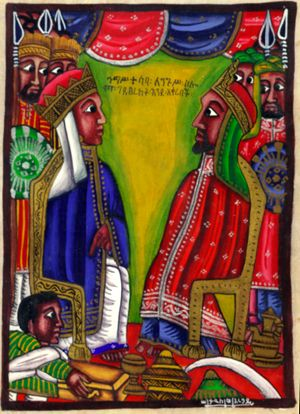
Ethiopian depiction of the Queen of Sheba and King Solomon

The Queen of Sheba heard how famous Solomon was, so she went to Jerusalem to test him with difficult questions. She took along several of her officials, and she loaded her camels with gifts of spices, jewels, and gold. When she arrived, she and Solomon talked about everything she could think of. He answered every question, no matter how difficult it was.

The Queen was amazed at Solomon’s wisdom. She was breathless when she saw his palace, the food on his table, his officials, his servants in their uniforms, the people who served his food, and the sacrifices he offered at the Lord’s temple. She said:

Solomon, in my own country I had heard about your wisdom and all you’ve done. But I didn’t believe it until I saw it with my own eyes! And there’s so much I didn’t hear about. You are wiser and richer than I was told. Your wives and officials are lucky to be here where they can listen to the wise things you say.

I praise the Lord your God. He is pleased with you and has made you king of Israel. The Lord has always loved Israel, so he has given them a king who will rule fairly and honestly.

The Queen of Sheba gave Solomon more than four tons of gold, many jewels, and more spices than anyone had ever brought into Israel.

In return, Solomon gave her the gifts he would have given any other ruler, but he also gave her everything else she wanted. Then she and her officials went back to their own country.

King Hiram’s ships brought gold, juniper wood, and jewels from the country of Ophir. Solomon used the wood to make steps for the temple and palace, and harps and other stringed instruments for the musicians. It was the best juniper wood anyone in Israel had ever seen. (Contemporary English Version)

The ancient Sabeans were a wealthy people. The kingdom of Sheba was geographically located on the southwest corner of the Arabian peninsula (present day Yemen). They were ideally situated to control all the trade in and out of the Red Sea.

Since the Sabeans were a maritime people, the Queen of Sheba made it a habit to engage in trade missions and relations with other kingdoms. King Solomon was making quite a name for himself, and his nation, through his own extensive trade endeavors. It was inevitable that the two would meet.

Solomon had wisdom and wealth because of the divine gift given to him by the Lord. It’s wonderful to have a gracious gift given by God. Most of us can relate to desiring spiritual gifts and blessings from the God we serve.

Yet, what doesn’t usually get talked about is that every divine gift given to us carries with it not only opportunities to bless the world, but also the temptation to avoid proper stewardship and use the gift for personal aggrandizement.

Slowly, over time, it can become rather easy to slip into a mode of getting more and more, of expanding influence, seeking greater honor and accolades, and increasing wealth to exorbitant extremes. For those who know the biblical storyline of Solomon, this is precisely what happened to him. Perhaps in today’s Old Testament lesson, we begin to get a glimpse of the beginnings of that slippery slope into the bottomless abyss of more.

The Queen of Sheba and King Solomon meet

The Queen of Sheba, who herself was one of the wealthiest and most influential monarchs of her day, knew what affluence looked like. So, for her to be breathless over what she observed in Solomon’s kingdom must have been over-the-top abundance and riches.

It’s telling that many contemporary Westerners can read this account and see no problem with it. In fact, some even seem to believe this is something to aspire to – to be just like King Solomon, as if this is what God wants for us.

Yet, it could be that the writer and historian of the biblical kings was leading us to a different conclusion, placing Solomon in the unfavorable light of abusing his divine gift.

After all, it’s clear Solomon used his wisdom and wealth for himself in ways that went well beyond the simple meeting of needs. Solomon was a really smart guy, familiar with God’s Law, so he knew what Moses said about all this stuff:

The king should not have many horses, especially those from Egypt. The Lord has said never to go back there again. And the king must not have a lot of wives—they might tempt him to be unfaithful to the Lord. Finally, the king must not try to get huge amounts of silver and gold.

The official copy of God’s laws will be kept by the priests of the Levi tribe. So, as soon as anyone becomes king, he must go to the priests and write out a copy of these laws while they watch. Each day the king must read and obey these laws, so that he will learn to worship the Lord with fear and trembling and not think that he’s better than everyone else.

If the king completely obeys the Lord’s commands, he and his descendants will rule Israel for many years. (Deuteronomy 17:16-20, CEV)

But Solomon ended up not heeding any of these warnings. And so, it ought to have been no surprise that, after Solomon’s death, the kingdom became divided and was never the same again.

Sheba’s Queen is the one who seemed to have both her head and her heart in the right place. She’s the one who blesses Yahweh and reminds Solomon about the need to rule with integrity and justice. The Queen was able to affirm Solomon’s gift, while at the same time reminding him of what that gift is truly for.

The wise person knows there is always a shadow side to every good gift we have. If we fail to acknowledge this, and not pay attention to it, we will find ourselves doing as much harm as we do benefit.

Generous and loving God, all we are and all that we have is a gift from you. In faith and love, help us to do your will. We offer to you this day all the facets of our lives, whether it be at home, at work, or at school. We seek to be patient, merciful, generous, and holy. Give us the wisdom and insight to understand your will for us and the fervor to carry out our good intentions. We offer to you our gifts of time, abilities, and possessions as a true act of faith, to reflect our love for you and our neighbors. Help us to reach out to others as you have reached out to us. Amen.

1 Peter 4:7-11 – Be Hospitable

One of the Family, Frederick George Cotman, 1880

The end of all things is near; therefore, be serious and discipline yourselves for the sake of your prayers. Above all, maintain constant love for one another, for love covers a multitude of sins. Be hospitable to one another without complaining. 

Like good stewards of the manifold grace of God, serve one another with whatever gift each of you has received. Whoever speaks must do so as one speaking the very words of God; whoever serves must do so with the strength that God supplies, so that God may be glorified in all things through Jesus Christ. To him belong the glory and the power forever and ever. Amen. (New Revised Standard Version)

One of the most practical and biblical ways of demonstrating love is through hospitality.

Hospitality, at its heart, is an invitation to come into my home and into my life. It is a ministry of acceptance, encouragement, restoration, and healing. 

The loving work of hospitality “covers a multitude of sins” through the power of influence. When we have face-to-face conversations around the table, it prevents us from engaging in sins that would otherwise be committed if left to ourselves.

Because the end of all things is near, we need our wits about us through a determined focus on prayer, love, and hospitality.

The word “hospitality” literally means, “love of the stranger.” I invite someone whom I do not know very well into my home and befriend them. This is what Jesus did for us. Although we were all estranged from God and on the outside, Jesus came to eat with us.

“Listen! I stand at the door and knock; if any hear my voice and open the door, I will come into their house and eat with them, and they will eat with me.” (Revelation 3:20, GNT)

Jesus invites us into the life of God; and so, we are to invite others into our lives. Jesus has so closely identified with his people that when we practice hospitality, we are inviting Jesus in. In fact, we may not realize that some people we host are angels: 

Do not forget to show hospitality to strangers, for by so doing some people have shown hospitality to angels without knowing it. (Hebrews 13:2, NIV)

Inviting another person into my home and my heart takes time and effort. Doing it without grumbling is a necessity.

In an ideal world, we always receive something back for our work of hospitality – an invitation from the other person, or, at least, a simple thank you. That does not always happen; it must not be the driving reason why we are generous.

Hospitality is a work of love which originates from a heart that has been touched by the hospitality of God. Our earthly hospitality is a form of saying “thank you” to God for the grace given to us.

Complaints break into the house like unwanted burglars when we expect to receive, and do not. If you receive another person as though they were Christ himself, grumbling will likely be far from you. Instead, there will be rejoicing over the opportunity to serve Jesus.

Jesus said, “Anyone who welcomes you welcomes me. And anyone who welcomes me also welcomes the one who sent me.”

Matthew 10:40, CEV

In the New Testament world, a concrete expression of love to other believers in Jesus was providing food and shelter for Christians traveling throughout the Roman Empire. Often, the traveling strangers were itinerant evangelists spreading the message of the gospel from place to place. 

Dear friend, you are faithful in what you are doing for the brothers and sisters, even though they are strangers to you. They have told the church about your love. Please send them on their way in a manner that honors God. It was for the sake of the Name that they went out, receiving no help from the pagans. We ought therefore to show hospitality to such people so that we may work together for the truth. (3 John 5-8, NIV)

At times, believers were deprived of necessities due to occasional waves of persecution. The people Peter addressed were mostly Jewish Christians. As they faced persecution in Jerusalem, they fled to geographical places dominated by pagan Gentiles.

As refugees, they were often poor and needy; and the townspeople where they went were not hospitable. So, they had to rely on the love and hospitality of those believers they could connect with who had the means to help.

Contribute to the needs of God’s people, and welcome strangers into your home.

Romans 12:13, CEB

There is a great need for hospitality in our world. 

Many American’s circle of friends is shrinking. According to one study, the number of people who said they had no one to talk to about important matters has more than doubled in the past 10 years. Over 35 million Americans now live alone (28% of all households). 

Hospitality cuts both ways for us. We are to invite the lonely into our hearts and homes; and the lonely are to invite others into their hearts and homes, instead of waiting for somebody to just show up.

Food is to hospitality what weightlifting is to bodybuilders; you really need food, meals, and the sharing that goes with it to make a difference in another’s life.

In biblical times, eating a meal together was a sacred affair.  To have another person in your house, sitting around your table, was a way of communicating acceptance, care, and friendship. That’s why the religious leaders had such difficulty seeing Jesus eat with “sinners.” Jesus was unequivocally loving and accepting of such persons.

Looking at our world, it can often be a sad place. We may wonder:

  • Can people of different races live in peace? 
  • Can Democrats find common ground with Republicans? 
  • Can a Christian family carry on a civil friendship with neighbors down the street far from Christianity? 
  • Can people worlds apart from each other get along? 

The early church did. And they did it without all the stuff we have – through the simplest tool of the home.

No matter our gifts and abilities, each one of us can be hospitable. Something mystical happens at a dinner table that does not happen anywhere else – it opens the door to true community.

“Table of Hope” by Joey Velasco

While they were eating, Jesus took a loaf of bread, and after blessing it he broke it, gave it to the disciples, and said, “Take, eat; this is my body.” Then he took a cup, and after giving thanks he gave it to them, saying, “Drink from it, all of you; for this is my blood of the covenant, which is poured out for many for the forgiveness of sins. (Matthew 26:26-28, NRSV)

For the Christian, eating and ingesting bread and wine serves as a tangible way of understanding what life is to be like. We take Jesus into the depths of our lives. We ingest him, that is, we engage in an intimate relationship whereby the two of us can never be separated.

We are meant for life together, to enjoy eating and drinking together. True life is sharing both our resources and our hearts with one another. 

Loving God, thank you for your generosity. I am a stranger in this world, yet you invite me to be your guest. You lavishly offer me your hospitality and welcome me into your family. You invite me to share in the abundance of your kingdom. Help me remember that when I offer hospitality to others, I am receiving Christ into my home.

Gracious God, I open my heart to those who are wounded; those who have wounded me; those who are outcasts; and to all who are searching. I want my everyday ordinary life to please you. I am grateful that there is always room at your Table; through Jesus, my Lord. Amen.

Ephesians 4:7-16 – Be Mature

Christ has generously divided out his gifts to us. As the Scriptures say,

“When he went up
    to the highest place,
he led away many prisoners
    and gave gifts to people.”

When it says, “he went up,” it means that Christ had been deep in the earth. This also means that the one who went deep into the earth is the same one who went into the highest heaven, so he would fill the whole universe.

Christ chose some of us to be apostles, prophets, missionaries, pastors, and teachers, so his people would learn to serve, and his body would grow strong. This will continue until we are united by our faith and by our understanding of the Son of God. Then we will be mature, just as Christ is, and we will be completely like him.

We must stop acting like children. We must not let deceitful people trick us by their false teachings, which are like winds that toss us around from place to place. Love should always make us tell the truth. Then we will grow in every way and be more like Christ, the head of the body. Christ holds it together and makes all of its parts work perfectly, as it grows and becomes strong because of love. (Contemporary English Version)

The Body of Christ, without love as its skeletal structure, would be as ridiculous and silly as a boneless chicken ranch. 

The Apostle Paul, a concerned spiritual father, was encouraging the Church toward maturity, to act as adults in the faith and not like immature children.

Just as the physical body begins small, then grows and matures over time, so the spiritual body (the church) is to focus on incremental slow growth across the years so that it realizes maturity. And the consummate evidence of that spiritual development is strong bonds of love.

Ten days after the Lord Jesus ascended to heaven, the Day of Pentecost occurred. On that day, the Holy Spirit came upon the small band of believers and the church became a full-fledged phenomenon, growing and expanding. (Acts 2:1-47)

The gracious gifts of the Spirit are given to each and every Christian so that growth and strength will come to the Body of Christ through love. Each spiritual gift might be different from person to person, but every one of them is meant to be used in love for the benefit of the entire church.

Without any bones or skeleton, the church will be weak and ineffective. It might look like a church but will not be able to do anything in the world. 

For spiritual maturity to happen, it is necessary for every single Christian in the church to discover their spiritual gift, and then, use it in love to build up the entire Body. This is the God-ordained means of realizing a healthy functioning church. 

It may appear that you and I, as believers in and followers of Jesus, have the luxury of pursuing other interests rather than providing loving and gifted service to Christ’s Church. After all, church attendance, Christian mission and service are all voluntary, right? A volunteer can choose to sit out, right?

Uh-hem (clearing of throat). Wrong. That sort of thinking is based in the goofy notion that the Church is a voluntary society which we choose to become a part of, or not. It isn’t. The Body of Christ, the Church, the people for whom Christ died, was chosen by God – and not the other way around.

Before we chose God, God chose us. We can no more choose to decline Christian mission and service anymore than a physical heart or bodily organ can decide it needs to go do something else – as if they could simply leave the Body or just stop doing what they’re doing without consequence.

No, my friends, for the Body to function, it must work in concert, paying attention to the unique parts which keep it alive and thriving, while at the same time, maintaining the overall health of all the Bodily systems.

Bottom line: We need one another. Going off and continually doing my own thing or picking up my marbles and going home because I’m mad or frustrated, is what children do. When adults act like children, we rightly discern they are immature and need to grow up.

So, instead of lacking self-awareness or being pouty about my blog post, focus on the following questions:

What is your passion and desire for Christ’s church? 

What issues stir you emotionally? 

What group of people do you feel most attracted to reach? 

What area of Christian mission or church ministry would you most like to influence? 

Are there people whom you notice that others seem to ignore? 

Will you step out in faith and learn how God has wired you for ministry? 

Will you speak and serve in the name of Jesus through the enablement of the Spirit?

Loving God, I ask you to give me a heart of faith to trust the Spirit and the Spirit’s work in my life. I ask for a heart that desires the gifts of the Spirit for the common good of all persons. I ask you to help me be open to the gifts of the Spirit in others. I ask for jealousy of others’ gifts to be quieted in me. I pray that my gifts would build up the church. Most of all, I ask for the gift of love. Use me for the strengthening of Christ’s church, and for a positive influence in the world. Amen.