The Pharisees Question Jesus, by James Tissot (1836-1902)
Again they entered Jerusalem. As Jesus was walking through the Temple area, the leading priests, the teachers of religious law, and the elders came up to him. They demanded, “By what authority are you doing all these things? Who gave you the right to do them?”
“I’ll tell you by what authority I do these things if you answer one question,” Jesus replied. “Did John’s authority to baptize come from heaven, or was it merely human? Answer me!”
They talked it over among themselves. “If we say it was from heaven, he will ask why we didn’t believe John. But do we dare say it was merely human?” For they were afraid of what the people would do because everyone believed that John was a prophet. So they finally replied, “We don’t know.”
And Jesus responded, “Then I won’t tell you by what authority I do these things.” (New Living Translation)
Jesus was an outsider. During his earthly ministry, he was viewed, at best, as an avant-garde leader; and, at worst, a flat out heretic. It may be easy to overlook that reality, because we typically think of Christ as Lord and always on the inside of things.
Although Jesus was a teacher and a rabbi – and was neither a priest nor a member of any Jewish religious sect – he nevertheless walked around as if he owned the place (which he did). That gave the established religious leadership of the day no end of consternation and frustration.
Jesus made significant inroads into people’s lives, especially with outsiders like himself. And this situation created anger and jealousy with many of the religious ruling class. Since Jesus was not a card-carrying member, the leaders wanted to hear from him why he kept acting confidently and deliberately on their religious turf.
“What gives you the right? Who authorized you to act this way?” was their cry.
The established authorities are depicted in today’s Gospel lesson as a craven bunch who did not want to alienate the crowds, and yet were eager to get the upstart Jesus out the way. This appears to be an age-old situation of leaders putting their fingers to the wind to go with whatever will keep them popular and in power.
Since Jesus consistently refused to play such games, the authorities believed he needed to go. They, however, had no intention of risking an outright confrontation and showing their shadow motives.
Jesus clearly connected himself with John the Baptist, as both coming from the same authority. John was yet another figure for whom the established leaders could not control.
We ought never to underestimate both perceived and actual threats to status quo leadership. Such leaders have no inkling of being public servants when true moral authority comes along. The lack of conformity from John and Jesus would cost them both their very lives.
Speaking truth to power while not becoming defensive doing so is a tricky art. Yet, Jesus did it. Continual challenges to his authority left him unfazed as to his mission and purpose on this earth. Christ was assertive without becoming despotic; forward without taking the bait of useless arguments; confident with no hint of arrogance.
For me, the contrast between Jesus and the religious authorities is trenchant. The confident, wise, and calm authority of Christ is in direct opposition to the fear, anxiety, and worry of the ruling leaders. Whereas they kept anxiously ruminating about what to do about this threat to their established authority, Jesus exhibited a non-anxious presence which maintained a steadfast focus on God’s righteous, holy, and benevolent rule and reign.
Sometimes, continual fear is a big red flag that the leader is so worried about losing their place or position, that the will of God gets pushed aside as merely a secondary concern.
Questioning Christ’s credentials was the giveaway that the existing religious authorities were concerned about their power and privilege, and not the people. The wise person will see such queries for what they are.
Wherever we observe those who refuse to share power, have a xenophobic bent toward outsiders, and seem to do just about anything to maintain the status quo, there we will find the abuse of authority.
Conversely, where we observe a deep concern for equity, justice, and the common good of all persons, there we see compassionate leadership who will champion ethical leadership and espouse moral authority.
In any democratic society, we must choose our leaders wisely.
Great God of hope, in these times of change and uncertainty, unite your people and guide our leaders with your wisdom. Give us courage to overcome our fears and help us to build a future in which all may prosper and share together through Jesus Christ our Lord in the strength of your Holy Spirit. Amen.
We are part of the same body. Stop lying and start telling each other the truth. Don’t get so angry that you sin. Don’t go to bed angry and don’t give the devil a chance.
If you are a thief, quit stealing. Be honest and work hard, so you will have something to give to people in need.
Stop all your dirty talk. Say the right thing at the right time and help others by what you say.
Don’t make God’s Spirit sad. The Spirit makes you sure that someday you will be free from your sins.
Stop being bitter and angry and mad at others. Don’t yell at one another or curse each other or ever be rude. Instead, be kind and merciful, and forgive others, just as God forgave you because of Christ. (Contemporary English Version)
New life means being a part of a new society; and a new society means new rules to live by which benefit and uplift the entire community. Old destructive practices must be replaced with new encouraging and supportive ways of being together. Stop taking the broad easy road to destruction and start walking the hard path to life and contentment.
Stop Lying and Start Telling the Truth
Lying exists because people believe that being truthful and transparent is too traumatic. Many people don’t think that being open, honest, real, vulnerable, and genuine is worth the risk. They have believed the lie that they won’t be accepted, that they’ll lose face with others, or that people will just gossip about me if they really knew about me. So, we hide from others and avoid the truth.
In truth, we are responsible for one another – to make and keep promises to each other because that is what God does with us. Churches that love truth will make a safe place for the awkwardness of confession, forgiveness, and healing.
Truthful communities are places of hospitality where we are safe to be real. No one ought to ever suffer in silence, cry alone, or wonder whether others will forsake them. We belong to one another. Therefore, to have union with Christ is to have union with one another; you can’t have one without the other.
Stop Stealing and Start Giving
Theft comes in many forms, especially in our contemporary age. Embezzlement, shoplifting, fraud, plagiarism, and robbery are just a few examples of the ways in which we humans steal from one another.
Embezzlement is the theft of assets (money or property) by a person who has been trusted to keep those assets safe. Instead of embezzling funds, we are to steward those assets well, distributing them with care and a conscience – using them for the benefit of others, not simply ourselves.
Shoplifting involves stealing goods from retail establishments. Some people steal because they are in dire need. Many more steal because they can and want to. We must stop taking things we want, and learn to be satisfied with what we have. And we will only do this by using our own money to buy things for others who are in need.
Fraud is stealing that involves convincing the victim to surrender their money or property under false pretenses. This is nothing more than manipulating someone to get what you want. Work hard to defend the defenseless and ensure their justice, rather than commit a gross injustice against them.
Plagiarism is the practice of taking someone else’s work or ideas and passing them off as one’s own. It’s cheap. It’s easy. And don’t do it, period. Someone else worked very hard to create what you may nonchalantly use for your quick benefit. Take the pains to credit someone else’s work and document the sources you use.
Robbery is a theft that involves using violence, intimidation, or threats to obtain property. Put the threats, guns, and false confidence away. In it’s place, do whatever it takes to do things right, hold a job, and give something back to society.
Stop All the Unhelpful Talk and Start Encouraging
Corrupt or dirty talk is totally unnecessary. It’s unwholesome and benefits nobody. Rather, make it your aim to use your words for good by encouraging others.
Encouragement involves strongly urging someone to do something with an equal commitment to lovingly come alongside and help. This requires both verbal exhortations and tangible assistance. Encouragement is the glue which holds a people together. Without it, a society degenerates into watching-out-for-number-one, and destructive personal survival tactics which will say anything to get what one wants.
Stop the Bitterness and Start Forgiving
Forgiveness is choosing not to hold another’s persons offensive words or actions over their head. It is:
Specific to an event, action, or words.
A process: it takes time to truly forgive.
Something anybody can do, regardless of race, creed, religion, etc.
Hard.
Freeing.
Ongoing.
Gracious.
“To forgive is to set a prisoner free and discover that the prisoner was you.”
Lewis Smedes, Forgive and Forget: Healing the Hurts We Don’t Deserve
Bitterness, however, wants to hold onto a grudge and seeks to punish the one who has offended them. That’s the way of Satan, not God. Even if the person has set themselves up as your enemy, we have clear exhortations from Jesus to love our enemies and do good to them, not harm. (Matthew 5:43-48)
The world revolves on the axis of mercy, not judgment. The sooner we get in the groove of how things actually operate for us to live a good life, the better that our relationships and society will be.
Good and gracious God, we ask that you make our life journey safe as we choose integrity, not disintegration. Shed light on those who follow crooked paths. May their dishonesty be exposed so that corrections can be made before further damage occurs. Help our nations, neighborhoods, and faith communities choose a path of mercy and goodness, rather than the crooked way of lies, theft, vitriol, and grudge-bearing. May we see a new wave of integrity sweeping over our world, through Jesus Christ our Lord, by the power of your Holy Spirit. Amen.
A Bengali depiction of Christ’s Sermon on the Mount
“You have heard that it was said to the people long ago, ‘You shall not murder, and anyone who murders will be subject to judgment.’ But I tell you that anyone who is angry with a brother or sister will be subject to judgment. Again, anyone who says to a brother or sister, ‘Raca,’ is answerable to the court. And anyone who says, ‘You fool!’ will be in danger of the fire of hell.
“Therefore, if you are offering your gift at the altar and there remember that your brother or sister has something against you, leave your gift there in front of the altar. First go and be reconciled to them; then come and offer your gift.
“Settle matters quickly with your adversary who is taking you to court. Do it while you are still together on the way, or your adversary may hand you over to the judge, and the judge may hand you over to the officer, and you may be thrown into prison. Truly I tell you; you will not get out until you have paid the last penny.
“You have heard that it was said, ‘You shall not commit adultery.’ But I tell you that anyone who looks at a woman lustfully has already committed adultery with her in his heart. If your right eye causes you to stumble, gouge it out and throw it away. It is better for you to lose one part of your body than for your whole body to be thrown into hell. And if your right hand causes you to stumble, cut it off and throw it away. It is better for you to lose one part of your body than for your whole body to go into hell.
“It has been said, ‘Anyone who divorces his wife must give her a certificate of divorce.’ But I tell you that anyone who divorces his wife, except for sexual immorality, makes her the victim of adultery, and anyone who marries a divorced woman commits adultery.
“Again, you have heard that it was said to the people long ago, ‘Do not break your oath, but fulfill to the Lord the vows you have made.’ But I tell you, do not swear an oath at all: either by heaven, for it is God’s throne; or by the earth, for it is his footstool; or by Jerusalem, for it is the city of the Great King. And do not swear by your head, for you cannot make even one hair white or black. All you need to say is simply ‘Yes’ or ‘No’; anything beyond this comes from the evil one. (New International Version)
Christ’s Sermon on the Mount by Joseph Matar
Relationships are important to God (and us!); we need one another because we are created in the image of a relational God. So, God wants us to have good relations with each other.
Murder, adultery, divorce, and oaths all have to do with interpersonal relations. These are topics from the Ten Commandments (6, 7, 9, and 10) that Jesus wanted to uphold.
Murder
Just because no blood is spilled doesn’t mean a killing hasn’t taken place. At the heart of the killing is angry contempt – which makes us all mass-murderers. The sort of anger Jesus refers to is nursing a grudge that morphs into hatred. It’s the deliberate decision to let anger sit in the pit of the gut and slow cook into deep resentment. Once that resentment is well done, murder becomes the meal.
Name-calling is the outward expression of resentful grudge bearing. “Raca” is an “airhead.” It means to be empty or stupid. The word “fool” is literally a “moron” – one who lacks both brains and morality. Both names hurt deeply, which is the expressed aim of the name caller. To have our intelligence and character questioned, cuts to the heart.
Jesus insists that harboring internal resentment comes out in external name-calling, verbally lynching people without a trial. Whenever we string a person up, divine judgment is coming to town.
No one has a right to nurse a grudge. Repaying hatred with hatred is a highway to the grave. If you have ever wished someone dead, hated anyone, or belittled another; then, you have assassinated that person in your heart and are under the judgment of a holy God.
So, what to do in overcoming the resentment? Seek reconciliation immediately. Jesus used two illustrations to illumine the need for reconciliation with others when there are sour relations: an example of worship and an example with the court.
If you are worshiping, and remember that someone else is nursing a grudge against you, it is your responsibility to go and make things right. The Lord does not want to talk to anyone who won’t talk to their sister or brother.
Forgive us our debts, as we also have forgiven our debtors… For if you forgive other people when they sin against you, your heavenly Father will also forgive you. But if you do not forgive others their sins, your Father will not forgive your sins. (Matthew 6:12, 14-15, NIV)
None of this is meant to minimize the hurt or trauma that has taken place. Many people have faced hell in the shape of a human. Yet, because Jesus takes your hurt seriously, he calls for forgiveness and reconciliation. Without it, the pain unnecessarily continues and there is no healing.
In the illustration of court, we are to settle matters quickly and make things right so that judgment won’t happen. Let’s avoid living with the regret of vengeance because of destroying someone’s life. Forgiveness and reconciliation are always options on the table.
See to it that no one falls short of the grace of God and that no bitter root grows up to cause trouble and defile many.
Hebrews 12:15, NIV
Adultery
Adultery has its origins in mental sexual activity with another person. Jesus is not against normal gender attraction, nor sex itself (which is a gift of God). Rather, Jesus condemns the leering upon another with sexual fantasy. All adulterous relationships and inappropriate sexual relations start with the “look.”
“Lust” is to intensely desire something, to seek mastery over another. The reason people stare, and lust, is not because of the other person’s manner or dress; it’s because they already have an adulterous heart.
Managing adultery with a band aid is like trying to contain a nuclear meltdown with some duct tape; it’s an amputation we need. Jesus leaves no room to think it’s okay to lust in the heart because “I’m not hurting anybody.” Mental adultery demeans and degrades women.
Our lustful desires are powerful; yet God’s grace is more powerful. There’s no need to be burdened with shame and guilt when the cross of Christ has already taken care of it. There is a multi-billion dollar industry of pornography because our hearts are black. Now is the time for forgiveness, grace, and healing in Jesus Christ.
Sermon on the Mount by Jorge Cocco Santiago
Divorce
Today in America, more than one-third of all adults have experienced divorce. Jesus condemns the cavalier divorce, the thought of having a better spouse, even though there is no marital unfaithfulness. This is yet another form of mental adultery which believes someone else can better meet my needs.
Jesus makes provision for divorce to occur in certain circumstances. Yet, he doesn’t bend to liquidating a marriage over unhappiness with what God has joined together. The intent of Old Testament legislation on divorce is to avoid a casual stance toward marriage (Deuteronomy 24:1-4). Over the centuries, people found creative ways of getting around the law. Although a divorce may be legal, it might not be ethical. Jesus wanted divorce practiced with concern for the woman, so that her rights and needs were considered.
For most of human history, if a husband did not like his wife (e.g. for continually burning his supper) he could divorce her. Jesus, however, insisted divorce must not happen because of a hard time getting along; or don’t love your spouse anymore; or that your spouse keeps irritating you.
Being frustrated or unhappy are not biblical grounds for divorce. The answer to most marital problems does not lie in a new spouse, but in the hard work of identifying the idols of our hearts, overthrowing them, and re-connecting.
Christ sought to defend women who are victims. In biblical times, if a wife was given a certificate of divorce, she had four options: 1) return to her family of origin; 2) become a beggar; 3) become a prostitute to make ends meet; or, 4) marry again, which was extremely difficult to do.
In reality, divorce is a legal testimony verifying that a separation has already occurred. It’s a recognition that disunity and division is already present, that a terrible break already happened, damaging the people involved.
If God found it necessary to divorce his own covenant people, then it’s inevitable that divorce will happen among couples (Jeremiah 3:1-8). So, let’s be discerning in how we handle each individual situation of marital difficulty.
Oaths
“I swear on a stack of Bibles I won’t…” “I will, if I get around to it….” These are a few of the caveats we give when making a promise or oath. Oaths communicate our level or ability of getting something done, or not.
That’s fine. What isn’t fine is making excuses or false promises with no intention of doing what you say you will do. Jesus takes all that extraneous language out. Say “yes” or “no” and then follow through; if you don’t, you’re a liar.
We often lie because we don’t want to do something to begin with. “Yes” and “no” are clear boundary words. Boundaries define where I end and someone else begins, leading me to a sense of ownership. Knowing what I am to take and not take responsibility for gives me freedom.
Jesus wants us to clarify our values; make wise decisions; identify what we will accept and reject; and follow through on what we say we will do, period.
Murder, adultery, divorce, and oaths are all related. They have to do with how we relate to others, especially those closest to us and to God. We are to live responsibly by keeping our hearts large and soft.
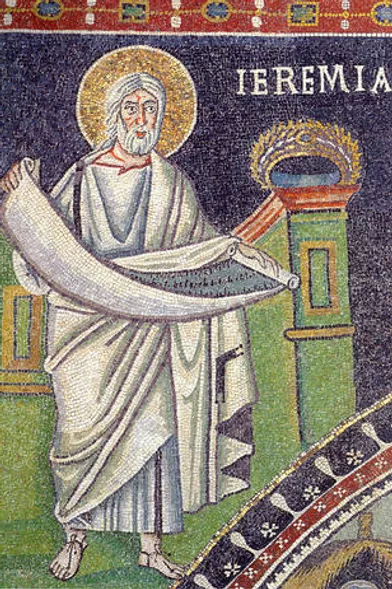
The prophet Jeremiah, 6th century mosaic, Ravenna, Italy
Early in the rule of Judah’s King Jehoiakim, Josiah’s son, this word came from the Lord: The Lord proclaims: Stand in the temple courtyard and speak to all the people of the towns of Judah who have come to the temple to worship. Tell them everything I command you; leave nothing out. Perhaps they will listen, and each will turn from their evil ways. If they do, I will relent and not carry out the harm I have in mind for them because of the wrong they have done.
So tell them, The Lord proclaims: If you don’t listen to me or follow the Instruction I have set before you—if you don’t listen to the words of the prophets that I have sent to you time and again, though you haven’t listened, then I will make this temple a ruin like Shiloh, and this city I will make a curse before all nations on earth.
The priests, the prophets, and all the people heard Jeremiah declare these words in the Lord’s temple. And when Jeremiah finished saying everything the Lord told him to say, the priests and the prophets and all the people seized him and said, “You must die! Why do you prophesy in the Lord’s name that ‘this temple will become a ruin like Shiloh, and this city will be destroyed and left without inhabitant’?” Then all the people joined ranks against Jeremiah in the Lord’s temple.
When the officials of Judah heard these things, they went up from the royal palace to the Lord’s temple and took their places at the entrance of the New Gate of the Lord’s temple. The priests and the prophets said to the officials and all the people: “This man deserves to die for prophesying against this city as you have all heard firsthand.”
Jeremiah said to all the officials and to all the people, “The Lord sent me to prophesy to this temple and this city everything you have heard. So now transform your ways and actions. Obey the Lord your God, and the Lord may relent and not carry out the harm that he’s pronounced against you.
But me? I’m in your hands. Do whatever you would like to me. Only know for certain that if you sentence me to death, you and the people of this city will be guilty of killing an innocent man. The Lord has in fact sent me to speak everything I have said to you.” (Common English Bible)
When it comes to the spiritual and religious life, on the one hand, we hold the joy and contentment of divine connection and peace; and, on the other hand, we hold the sadness that many turn their backs on divine realities. In Christian terms, Jesus is both the cornerstone of faith and the stone which causes people to stumble and fall. (1 Peter 2:8)
Frankly, the Lord is not okay with cruel injustice, hollow worship, and inattention to both the divine and human. There is a way to make things right. But not everyone wants that. Systemic evil persists because there are always those who benefit from the current structures of power – and they care little about how it impacts those on the underbelly of their control.
Things may be going well for a large chunk of people. And, conversely, things may not be going well at all, for an even larger group of folks. Therefore, it is necessary to acknowledge that the world is not only good, but also quite broken. We must speak truth to power. I understand that this is no easy task, because rarely are things simply black and white, all good or all bad.
Jeremiah preaches in the temple gate, a woodcut by Unknown artist, 1886
In the prophet Jeremiah’s day, it was not that his opponents were pure evil with no acknowledgment of God. Rather, the problem was that the power brokers in Judah tried to keep a strict separation of religion from everything else; they were perfectly fine with God, that is, if the Lord would stay in the temple where he belonged.
But Jeremiah would have none of this sort of mentality and behavior. Keeping Yahweh out of matters of social justice, geopolitics, and institutional governance led to severe humanitarian problems. Jeremiah became God’s voice to a generation of people who ignored the divine in everything but religious ritual.
Bifurcating worship and work disconnects daily life from divine resources. Without God infused in all of life, a lack of grace fills the empty places. What’s more, the sovereign Lord can neither be silenced nor dismissed; God will find a way to accomplish peace and justice for the common good of everyone, and not just the few.
The heart of Jeremiah’s message was for king and people to be obedient in all of life, to recenter themselves around God’s law – not just the religious bits but the social ones, as well. Jeremiah did not proclaim something new. He was calling those in places of power and authority to a proper Torah observance.
The true needs and interests of our communities can never be addressed and lifted-up in the narrow self-serving interests of persons in power who turn a blind eye to anyone unlike them.
The needs and interests of our world lie in becoming who we were designed to be from the beginning: A people belonging to God, tapping into the deep reservoir of light and spirituality within us. It is to acknowledge the image of God inside us all.
We are to follow in the way of grace and truth. There is to be no division between the sacred and the secular because, for the Christian, Jesus is Lord of all.
We are to continually use our voice for both praise and prophecy, for shouting celebration to God and for speaking truth to power.
Holy God, the gracious Sovereign of all, we give you praise for your steadfast love toward us, your people. Keep us grounded in humility, sensitive to sin, attentive to that which is just and right, merciful in all things, pure in worship, and peace-loving through Christ our Lord in the strength of the Spirit. Amen.









 Rev. Tim Ehrhardt