
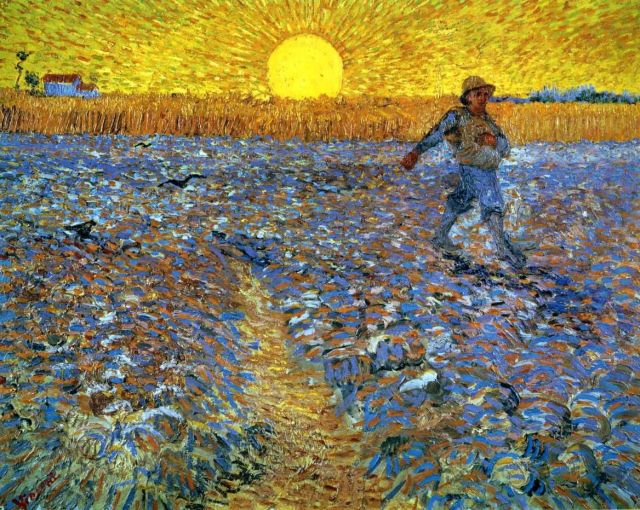
Christ’s Parable of the Sower (Matthew 13:1-9, 18-23)

“The Sower” by Vincent Van Gogh, 1881

…Jesus left the house and sat on the beach. In no time at all a crowd gathered along the shoreline, forcing him to get into a boat. Using the boat as a pulpit, he addressed his congregation, telling stories.

“What do you make of this? A farmer planted seed. As he scattered the seed, some of it fell on the road, and birds ate it. Some fell in the gravel; it sprouted quickly but didn’t put down roots, so when the sun came up it withered just as quickly. Some fell in the weeds; as it came up, it was strangled by the weeds. Some fell on good earth, and produced a harvest beyond his wildest dreams.

“Are you listening to this? Really listening?”…

“Study this story of the farmer planting seed. When anyone hears news of the kingdom and doesn’t take it in, it just remains on the surface, and so the Evil One comes along and plucks it right out of that person’s heart. This is the seed the farmer scatters on the road.

“The seed cast in the gravel—this is the person who hears and instantly responds with enthusiasm. But there is no soil of character, and so when the emotions wear off and some difficulty arrives, there is nothing to show for it.

“The seed cast in the weeds is the person who hears the kingdom news, but weeds of worry and illusions about getting more and wanting everything under the sun strangle what was heard, and nothing comes of it.

“The seed cast on good earth is the person who hears and takes in the News, and then produces a harvest beyond his wildest dreams.” (The Message)

It takes focused attention to listen well. Allowing the understanding of Christ’s words to awash over us – drinking-in the life-giving good news – is required for the act of listening to achieve its intended purpose.

It is most necessary that we all develop the skill of effective listening, so as to understand what is being said. And yet, understanding, as important as it is – all by itself – is inadequate. If hearing isn’t accompanied by obedient follow-through, then all the listening comes to nothing.

Christian discipleship (following the words and the ways of Jesus) demands that the believer takes Christ’s words and walks faithfully in the way of the good news, which has been absorbed into the mind and heart through effective listening.

Failing to both listen and put the words into practice is like the person who looks into the mirror and then walks away forgetting what he looks like.

Don’t fool yourself into thinking that you are a listener when you are anything but, letting the Word go in one ear and out the other. Act on what you hear! Those who hear and don’t act are like those who glance in the mirror, walk away, and two minutes later have no idea who they are, what they look like.

But whoever catches a glimpse of the revealed counsel of God—the free life!—even out of the corner of his eye, and sticks with it, is no distracted scatterbrain but a man or woman of action. That person will find delight and affirmation in the action. (James 1:22-25, MSG)

Appropriate and fruitful action begins with, and is dependent upon, attentive and effective listening – which is why the ability to hear the words of Jesus are so very vital to our lives.

“The Sower” by Vincent Van Gogh, 1888

The Parable

Our ears are the soil of our lives. Ears that are attentive and devoted to listening to Jesus are good soil; ears that are distracted, inattentive, and/or stopped up with ear wax are the bad soil. 

Receptive listening to the Word of God brings a fruitful harvest of righteousness, peace, and joy in the Holy Spirit (Romans 14:17). Christ’s parable lets us know that planting the Word is important. It is sown on four different soils:

  1. The seed on the road. A path is for walking; and for us, a road is for driving – which is why the seed never takes root. Here there is no real listening. When we act without listening, our actions will inevitably be misguided. 
  2. The seed on gravel. Here there is no deep listening. A lack of attentive hearing results in a shallow person who perhaps relies more on Christian clichés or on one’s personality or abilities, instead of the planted Word.
  3. The seed in the weeds. Here there is some significant listening. However, there are too many voices being heard, and not enough singular listening to the sown Word. Listening to the wrong voices will cause an unfruitful life, so we must be careful to whom we choose to give our listening ears to!
  4. The seed on good earth. A devoted listening to the Word without distraction leads to a productive, fruitful believer.

The Parable Interpreted

The interpretation of the parable which Jesus provided to his disciples focuses on the experience of the seed in a variety of soils, as well as the outside powers which act on the message. It all demonstrates that the words of Jesus – the good news of Christ – is central to our lives, and needs to be received well.

  1. The road is the person who hears the message yet is unable to hear Christ’s words because their heart is hard. The forces of evil snatch up the message before any real understanding, and therefore action, can take place. We must observe that the forces of evil are real; they have the ability to influence people with listening issues.
  2. The gravel is the person who hears just enough to respond with joy but drops out when hard circumstances come around. “I didn’t sign up for this!” is their cry. What they needed was to count the cost of discipleship before responding to the message. This is the mere professing Christian, nothing more. Rather than listening well, and internalizing Christ’s words, there is only positive affirmation without any action or practice. Therefore tomorrow, the message is gone.  When difficulty comes, there are no supporting words to draw from. The person then fades away, unable to navigate life successfully.
  3. The weedy soil hears and responds to the message; and is also a professing Christian, nothing more. The issue with such persons is that they also listen to the voices of worry and wealth. Like some sort of spiritual A.D.D., there is no ability to filter all the voices calling out; and so, there is no growth. The words of Jesus for us must reign supreme; there cannot be two thrones of Wealth and Word, nor two Masters of both God and Money.
  4. The good earth listens with the full intention of understanding, and then puts into practice the message heard. This is what brings about the fruit of righteousness and peace in both the individual and the community. Receiving the implanted word through careful listening brings about spiritual growth.  The first priority must be to listening well to this word. And when an entire group listens well and acts accordingly, then it creates a greenhouse effect in which people cannot help but grow in the Lord.

Conclusion

Jesus was not saying anything new, or what wasn’t already in the First Testament:

How well God must like you—
    you don’t walk in the ruts of those blind-as-bats,
    you don’t stand with the good-for-nothings,
    you don’t take your seat among the know-it-alls.

Instead you thrill to God’s Word,
    you chew on Scripture day and night.
You’re a tree replanted in Eden,
    bearing fresh fruit every month,
Never dropping a leaf,
    always in blossom. (Psalm 1:1-3, MSG)

We live in a time of great conflict – largely due to the refusal to listen well to one another, and to Holy Scripture, especially the New Testament Gospels.

Esoteric and harmful interpretations of the Bible result from failing to hear what Scripture itself is saying to us, especially the words of Jesus. Ignoring the Gospels and myopically focusing on particular parts of the Bible is a sure prescription for poor hearing, and thus, misguided decisions and actions.

This is just one reason why reading Scripture aloud with others in a communal setting is important. Robust discussion around the spoken word is what helps us to move in the sort of directions which the Spirit is leading us.

It is what Jesus and his original disciples did. We must do no less.

O Ancient and Wise Gardener, your holy word is planted in our hearts as good seed in fertile soil. So, nurture us, so that we may bear fruit abundantly, through your Son, Jesus Christ our Lord. Amen.


There Are Consequences to Injustice (Exodus 12:29-42)

Exodus Out of Egypt, by Rivka Lemberg

At midnight the Lord struck down all the firstborn in Egypt, from the firstborn of Pharaoh, who sat on the throne, to the firstborn of the prisoner, who was in the dungeon, and the firstborn of all the livestock as well. Pharaoh and all his officials and all the Egyptians got up during the night, and there was loud wailing in Egypt, for there was not a house without someone dead.

During the night Pharaoh summoned Moses and Aaron and said, “Up! Leave my people, you and the Israelites! Go, worship the Lord as you have requested. Take your flocks and herds, as you have said, and go. And also bless me.”

The Egyptians urged the people to hurry and leave the country. “For otherwise,” they said, “we will all die!” So the people took their dough before the yeast was added, and carried it on their shoulders in kneading troughs wrapped in clothing. The Israelites did as Moses instructed and asked the Egyptians for articles of silver and gold and for clothing. The Lord had made the Egyptians favorably disposed toward the people, and they gave them what they asked for; so they plundered the Egyptians.

The Israelites journeyed from Rameses to Sukkoth. There were about six hundred thousand men on foot, besides women and children. Many other people went up with them, and also large droves of livestock, both flocks and herds. With the dough the Israelites had brought from Egypt, they baked loaves of unleavened bread. The dough was without yeast because they had been driven out of Egypt and did not have time to prepare food for themselves.

Now the length of time the Israelite people lived in Egypt was 430 years. At the end of the 430 years, to the very day, all the Lord’s divisions left Egypt. Because the Lord kept vigil that night to bring them out of Egypt, on this night all the Israelites are to keep vigil to honor the Lord for the generations to come. (New International Version)

“A horse may run quickly but it cannot escape its tail.”

Russian proverb

The ancient Israelites were in bondage to the Egyptians for hundreds of years. Their oppression finally came to and end with the Lord’s dramatic deliverance of them in the tenth and final plague directed against Egypt.

The actions of the Egyptians eventually and finally caught up with them. Their making slaves of the Israelites was not going to last forever. Even though it took a while, Egypt was held accountable and experienced divine judgment. The empire’s internal moral emptiness would not be able to hold up under the justice of God.

“Empty sacks will never stand upright.”

Italian proverb

Pharaoh was a hard man. The more Moses talked to him the more stubborn Pharaoh got. Eventually, Pharaoh’s heart became like stone; he and his empire fell because they were bent toward the way of injustice. Oppression had been Pharaoh’s proclivity by instructing the Jewish midwifes to kill firstborn sons of Israelite mothers. Now the Egyptians would fall into the very trouble they created for others.

The death of so many on one night, all at once, was too much for Pharaoh and the Egyptians. In such a grief, Pharaoh’s dogged resolve in holding onto Israelite slavery and ostracizing Moses was loosened. He summoned Moses in the middle of the night and commanded the Israelite slaves to be gone – without any conditions or strings attached to it.

The Egyptians wanted them gone, and so, urged them to leave in a hurry – just as God had predicted. All sorts of articles – including silver and gold – were willingly given to the fleeing Israelites by the lamenting Egyptians. No matter how hard and stubborn any earthly ruler is, the plans and purposes of a sovereign God cannot be thwarted.

Finally, the deliverance out of Egyptian bondage happened. The Israelites were free. It was a hasty departure. It was as if the Hebrew people had become so upsetting to the great Egyptian empire, that they vomited them out of their land, projecting the former slaves as far away as they could.

Sometimes people get the notion that if they do something bad, they will be struck by lightning or have some sort of tragedy occur. And when it doesn’t happen, they might reason further in their misguided notions by believing they can get away with bad behavior. So, they keep doing it. But, eventually, this all has a terrible effect.

“Those who lie down with the dogs, rise with the fleas.” English proverb

Actions and inactions have consequences. Those consequences may not happen immediately. However, all of us shall someday harvest the fruit of decisions that were made months, even years or decades, ago.

Make no mistake, God is not mocked. A person will harvest what they plant. Those who plant only for their own benefit will harvest devastation from their selfishness, but those who plant for the benefit of the Spirit will harvest eternal life from the Spirit. Let’s not get tired of doing good, because in time we’ll have a harvest if we don’t give up. (Galatians 6:7-9, CEB)

Almighty God, Creator and Preserver of all humanity, we humbly ask that you make your ways known to people everywhere, and bring saving help to all nations. We pray for Christ’s Church, and all faith communities across the earth, that they be guided and governed by your good, gracious, and benevolent Spirit; and that all who profess and call themselves Christians may be led into truth, and hold the faith in unity, peace, and righteousness.

Blessed Lord, we pray for all who are afflicted or distressed in mind, body, or spirit. May your divine mercy bring them comfort and relief, according to their need. Give them patience through their sufferings, and a joyful outcome from their distress. This we pray through Jesus Christ our Savior and Lord. Amen.

Galatians 6:1-16 – Fulfill the Law of Christ

Brothers and sisters, if someone is caught in a sin, you who live by the Spirit should restore that person gently. But watch yourselves, or you also may be tempted. Carry each other’s burdens, and in this way you will fulfill the law of Christ. If anyone thinks they are something when they are not, they deceive themselves. Each one should test their own actions. Then they can take pride in themselves alone, without comparing themselves to someone else, for each one should carry their own load. Nevertheless, the one who receives instruction in the word should share all good things with their instructor.

Do not be deceived: God cannot be mocked. A man reaps what he sows. Whoever sows to please their flesh, from the flesh will reap destruction; whoever sows to please the Spirit, from the Spirit will reap eternal life. Let us not become weary in doing good, for at the proper time we will reap a harvest if we do not give up. Therefore, as we have opportunity, let us do good to all people, especially to those who belong to the family of believers.

See what large letters I use as I write to you with my own hand!

Those who want to impress people by means of the flesh are trying to compel you to be circumcised. The only reason they do this is to avoid being persecuted for the cross of Christ. Not even those who are circumcised keep the law, yet they want you to be circumcised that they may boast about your circumcision in the flesh. May I never boast except in the cross of our Lord Jesus Christ, through which the world has been crucified to me, and I to the world. Neither circumcision nor uncircumcision means anything; what counts is the new creation. Peace and mercy to all who follow this rule—to the Israel of God. (New International Version)

It’s all about grace. God’s grace. Not rules. Not a list of principles to live by. Not judgment. Not punishment or penance. Grace – amazing, wonderful, scandalous grace.

The Law of Christ is to help each other in our troubles, no matter what.

Overwhelming physical, mental, emotional, and spiritual burdens can become even more heavy through failing to live up to someone’s or some group’s unwritten list of rules. “Keep a stiff upper lip.” “Everything is possible for those who love God.” “Stay positive.” “Just have faith and trust God.” Or someone’s silence…. These and hundred other phrases communicate to people with crushing spiritual and emotional loads that they will have to carry them alone.

The letter to the Galatian believers spells out what is to truly characterize Christian interactions, and what it means to walk in the Spirit. Believers in Jesus are to emulate the behavior of Christ, the ultimate burden-bearer, who came to restore sinners, not condemn them. We have a responsibility to rescue, renew, and revitalize persons who have lost their way. We are our brother’s and our sister’s keeper.

Someone caught in the crosshairs of a bad decision, or ensnared by making a wrong step, who is now in over their heads, needs help. In such a case, we are to restore, not punish. The person’s wound needs spiritual cauterizing. The broken spirit needs to be set back into place to heal properly.

The tone and the attitude which we do this important work of restoring people is through gentleness (meekness). We are to have a mindset and a heart stance which understands there is no moral superiority with me. I could easily be that person in need of restoration.

With a gentle spirit, we discern no one is above falling into the same trouble. We, too, are ethically and morally vulnerable. So, the church has a corporate responsibility to bear one another’s burdens.

There are other people who, through no fault of their own, find themselves in over their heads, too. Their physical struggles, mental health challenges, the emotional weight of hard circumstances, and their broken spirits require others to help shoulder the load so that the weighted-down person is not crushed.

Burden-bearing is the work of everyone and not a select few. You and I are to take responsibility for our own backpack of stuff – our own actions and attitudes. A mature spiritual community of people are able to distinguish those loads which individuals must bear for themselves, and those burdens where help is sorely needed. We are accountable to carry our own backpack. And we are also accountable before Christ to share our load with others when it becomes too heavy to carry.

If we choose not to allow others to assist us when we need it, then we will reap what we sow – we’ll feel the full weight and consequences of our silence. The planting and harvesting metaphor isn’t just for those who have engaged in wrongdoing. It is also for those who don’t put any seeds in the ground to begin with. They shouldn’t expect a harvest, at all.

Grace lived out in real experiences knows when to get under a load and help carry it. And grace also knows when to be kind to self and share the heavy burden with others who can help shoulder it for a bit. This is a Christianity which relies on the enablement of the Spirit, made possible by Christ, who carried our crushing weight of guilt and shame for us.

“Come to me, all you who are weary and burdened, and I will give you rest. Take my yoke upon you and learn from me, for I am gentle and humble in heart, and you will find rest for your souls. For my yoke is easy and my burden is light.”

Jesus (Matthew 11:28-30, NIV)

Motives matter. The interior life of a person is important. Life is neither a mere getting things done nor doing what is needed on the exterior. A house may be beautiful and orderly on the outside, with careful landscaping, a manicured lawn, and attractive appearance – yet on the inside it might be disorderly, full of relational discord, and completely discombobulated.

The exterior life of a person is also important. But it’s only half the person. And, unlike God who sees the heart, we aren’t always privy to what’s going on inside someone. Folks who are enamored with outward displays of spirituality and righteousness tend to be compulsive about maintaining appearances – for both themselves, and everyone else.

Policing outward forms of righteousness through clear identifiable means is really nothing more than old fashioned judging of one another. It’s antithetical to grace. And it smacks of the snooty superiority of Star-Bellied Sneetches.

Rather than a star on the belly, in the Apostle Paul’s day it was circumcision. Those who had it were “in” and those without it were “out.” Never mind the interior life. A hard outward boundary of righteousness was established by false teachers who made the Christian life easy by simply holding to readily observable forms, like circumcision.

It wasn’t that circumcision was a bad thing. The issue was making it a necessary part of the Christian life. Not circumcised? Not a Christian, insisted the false teachers. In other words, one had to become Jewish before becoming a Christian. I can picture the Apostle Paul doing a  face palm, saying, “Oy vey.”

For the Christian, one must be vigilant not to exaggerate baptism. On the one hand, I would argue far too many believers underestimate the significance and importance of baptism. Flippantly making it a personal choice, as if the individual is in complete control of one’s own salvation, is not only wrongheaded – it’s downright blasphemous.

Yet, on the other hand, a preoccupation with getting a person, especially a child, baptized, as if the world might end if it doesn’t happen, betrays the same problem as Paul faced with circumcision in the first century.

The proper approach, it seems to me, is to embrace the full spectrum of Christianity – both outward and inward – the whole person. And Paul addresses this by anticipating a question of the Galatian congregation: What, then, is of central importance?

The answer is: a new creation. To be transformed by the power of the Spirit is what really counts. The grace of God in Christ, applied to a person, brings a change to inner motives and attitudes, as well as outer behavior through loving actions.

We must always keep in mind that the sign points to the substance. It would be weird if I were traveling to Milwaukee on I-94 and pulled over on the interstate next to the sign marking the city is ahead, crawl all over it, and say, “I’m here!”

The overall thrust of Paul’s letter to the Galatians is that they were debasing the true worship of God into an outward show, honoring Christ with their lips but not holding him in their hearts through carrying one another’s burdens.

Christianity is fundamentally not about what we do for God but what God has done for us in Jesus Christ. It is divine grace which saves people. We belong to God. Just as we neither chose our own parents nor the time when we were born, so also, before we chose God, God chose us. We don’t “born again” ourselves; God does the rebirthing.

Since salvation is solely the work of God in us, there is zero reason to boast about the circumstances of our new birth and becoming a new creation in Christ. We didn’t save ourselves. It would be like getting a COVID-19 vaccine and then bragging about how we personally stopped the pandemic.

Instead, we are to bear the spiritual marks of Christ’s crucifixion on our inner selves. No one is saved because they deserve it but simply because they need saving. That’s what grace truly is – and that’s how we are to live toward one another.

Merciful God, you are our Burden-Bearer. Awaken our hearts to remember your love. Open our eyes to see your grace. Stir up hope in those who are overwhelmed with sorrow and fear. Teach them to place their burdens at your feet as an offering — a sacrifice well-pleasing to you. Teach us all to allow others to help us in our time of need, through Jesus Christ our Lord, who with you and the Holy Spirit are one God, now and forever. Amen.

Galatians 6:7-10 – You Harvest What You Plant

Photo by Johann Piber on Pexels.com

Do not be deceived; God is not mocked, for you reap whatever you sow. If you sow to your own flesh, you will reap corruption from the flesh; but if you sow to the Spirit, you will reap eternal life from the Spirit. So let us not grow weary in doing what is right, for we will reap at harvest time if we do not give up. So then, whenever we have an opportunity, let us work for the good of all, and especially for those of the family of faith. (New Revised Standard Version)

“You reap what you sow” is one of those famous (or infamous) phrases of the Bible. Some people have a visceral reaction to the statement because it was used in the negative sense to keep kids obedient. 

However. the actual context for the statement, while not excluding the need to avoid disobedience, is aimed much more toward the necessity of doing good works for others. 

In the Church’s and the Christian’s work of burden-bearing on behalf of those with crushing loads to carry, we are not to become weary as the walk goes on and on. Persevering in good works will eventually lead to a bumper crop of righteousness.

We don’t typically use the words “sow” and “reap” much anymore. We really don’t use very many agrarian metaphors anymore since most folks are no longer living on farms and working the soil. We’re likely more familiar with the words “plant” and “harvest.”

We understand that if we plant seeds in our garden, it will take some time for them to germinate, take root, break the ground, grow, and produce what we want from them. The same is true in life. To expect instantaneous results for the spiritual life is unrealistic; it just doesn’t work that way.

The main orientation of today’s New Testament lesson is patience and perseverance in the doing of good works. Although it might not seem, at the moment, that our labors are really making a dent at all, God is taking notice. The Lord sees each act of service.  Eventually, if we will keep up the slow, tedious, and often dull work of persisting in doing what is right, it will all pay-off in a harvest of righteousness.

Perhaps you have been struggling lately – wanting to see something happen that you’ve been working on or praying for. And it hasn’t happened yet. You’re ready for the harvest and are tired of waiting. 

There are times when I grow weary of having the same conversations with people over and over again. I sometimes grow impatient with impenitent people who only seem to think of themselves. Alas, welcome to the human race! 

God cares just as much, or more, about the process of planting and tending as the actual end of the harvest. In other words, the means of how we go about things are as important as the end result. To help us be accountable, we very much need the encouragement of others in our Christian pilgrimage through this life. 

Accountability is a humble willingness to accept the consequences of our choices, our words, and our behaviors. That is, we need to own our part in situations we’ve been in. It’s about taking responsibility (not for others and their behavior) for one’s self and making things right.

Now all discipline seems painful at the time, not joyful. But later it produces the fruit of peace and righteousness for those trained by it. (Hebrews 12:11, NET)

Honesty, integrity, wisdom, courage, forgiveness, and humility don’t simply fall out of the sky for us. A good and abundant harvest which can be shared with many requires patient and tedious work. These virtues, along with the fruit of the Spirit – love, joy, peace, patience, kindness, goodness, gentleness, and self-control – need careful attention. Like a faithful and patient gardener, we must tend to them, keeping ourselves free of weeds, bugs, and critters.

As we daily tend to our personal garden, we pay attention to how we use our time; know and honor our limits; and remain open to change. We cannot control outside forces, such as the weather, but we can take responsibility for our own choices and the consequences which result from them.

We cannot care for others and do good works unless we have done the work of self-care. Doing good flows from being good, first to ourselves, then to others. We can only give what we have. If we have tended to our garden with care, then the bounteous harvest can be shared with many. But if we neglect our own garden, there will be nothing to give when the season of harvest comes around.

“Which of the commands is most important?” Jesus answered, “The most important command is this: ‘Listen, people of Israel! The Lord our God is the only Lord. Love the Lord your God with all your heart, all your soul, all your mind, and all your strength.’The second command is this: ‘Love your neighbor as you love yourself.’ There are no commands more important than these.” (Mark 12:28-31, NCV)

Caring for ourselves isn’t a luxury. We must give ourselves permission to do it. The way in which we talk to ourselves will eventually become the manner in which we talk to others. The care we learn to extend to ourselves will be the care we give to others.

If we sow and plant good things in our own lives, then we will reap a harvest of good works for others. So, let us do good, especially to our sisters and brothers in the faith.

Patient God, you have been waiting for several millennia to complete your work in this world. It is a small thing for me to keep doing your will with perseverance over the span of my own lifetime. I look to my model, Jesus Christ, who for the joy set before him endured the cross and reaped eternal life for all who would believe. Amen.