Jesus Is Greater (Hebrews 1:5-14)

Christ the Redeemer, in Rio de Janeiro, Brazil

For to which of the angels did God ever say,

“You are my Son;
    today I have become your Father”?

Or again,

“I will be his Father,
    and he will be my Son”?

And again when God brings his firstborn into the world, he says,

“Let all God’s angels worship him.”

In speaking of the angels he says,

“He makes his angels spirits,
    and his servants flames of fire.”

But about the Son he says,

“Your throne, O God, will last for ever and ever;
    a scepter of justice will be the scepter of your kingdom.
You have loved righteousness and hated wickedness;
    therefore God, your God, has set you above your companions
    by anointing you with the oil of joy.”

He also says,

“In the beginning, Lord, you laid the foundations of the earth,
    and the heavens are the work of your hands.
They will perish, but you remain;
    they will all wear out like a garment.
You will roll them up like a robe;
    like a garment they will be changed.
But you remain the same,
    and your years will never end.”

To which of the angels did God ever say,

“Sit at my right hand
    until I make your enemies
    a footstool for your feet”?

Are not all angels ministering spirits sent to serve those who will inherit salvation? (New International Version)

The people were weary. They were good and faithful Jews in Jerusalem, just trying to worship God and live their lives in faith, patience, and righteousness. And then, through incredible events, they came to believe that Jesus is the promised Messiah. They placed all their hopes and their very lives upon him.

And then, persecution broke out against the believers in Jesus. They were scattered. They fled Jerusalem. The people found themselves as Christian refugees in strange Gentile countries. In those places, they faced hardship and disrespect, not only for being Jews, but for being Christians. In many cases, their families disowned them; and the laws of the land were not good to them.

The believers started off well. But over time, the difficulty began to get to them. The people started wondering if all this commitment to Jesus Christ was worth it, or not. Their spiritual resolve was slowly ebbing away.

The author of Hebrews insists, biblically, that Jesus is superior over everything and everyone. The author stepped into the flagging believers’ situation, and went about answering that question of whether Jesus is truly all he’s cracked up to be. And he began the comparisons of superiority with Jesus over the angels.

Jesus Christ is greater than the angels

Jesus is the Son – the Son of God – which is a way of saying that Jesus is God. And he proved it through his life and ministry, his death and resurrection, his ascension and glorification.

When Jesus began his earthly ministry, he was sent into the desert for 40 days and nights. That experience demonstrated his true muster. Christ fully identified with the people, accomplished what no other human did, and became the pioneer of our salvation.

In bringing many sons and daughters to glory, it was fitting that God, for whom and through whom everything exists, should make the pioneer of their salvation perfect through what he suffered. Both the one who makes people holy and those who are made holy are of the same family. So Jesus is not ashamed to call them brothers and sisters. (Hebrews 2:10-11, NIV)

Jesus Christ has greater dignity than the angels

Unlike angels, Jesus, the Son, is worthy of worship. Angels may be exalted and immortal beings, but they are creatures, just like us humans. Jesus, however, as God, was there at creation. What’s more, Jesus presently holds all things together.

The Son is the image of the invisible God, the firstborn over all creation. For in him all things were created: things in heaven and on earth, visible and invisible, whether thrones or powers or rulers or authorities; all things have been created through him and for him. He is before all things, and in him all things hold together. (Colossians 1:15-17, NIV)

Jesus Christ has a greater status than the angels

Times change. Circumstances change. People are fickle. What is celebrated today is condemned tomorrow, and vice versa. But God never changes in the basic divine character. And God is eternal. Therefore, the Lord Jesus is a solid rock from which to construct a firm spiritual life.

Jesus Christ is the same yesterday and today and forever.

Hebrews 13:8, NIV

Jesus Christ has a greater function than the angels

As the Son of God, Jesus is the sovereign ruler over all things. We do not simply make him the Lord of our lives; he already is that. We just need to acknowledge this reality, submit to Christ’s authority, and persevere in faith. We must continually remember this, or we will become spiritually weary.

So do not throw away your confidence; it will be richly rewarded.

You need to persevere so that when you have done the will of God, you will receive what he has promised. For,

“In just a little while,
    he who is coming will come
    and will not delay.” And,

“But my righteous one will live by faith.
    And I take no pleasure
    in the one who shrinks back.”

But we do not belong to those who shrink back and are destroyed, but to those who have faith and are saved. (Hebrews 10:35-39, NIV)

Christians are never defenseless in this world. God has not only provided salvation through the Son, but has also given the angels to help us sustain our commitment to Christ. God cares so much about us that he has enlisted millions of angels for our benefit, so that we can continue to live out the words and ways of Jesus till the very end of our earthly lives.

God of wonder and of joy: grace comes from you, and you alone are the source of life and love. Without you, we cannot please you; without your love, our deeds are worth nothing. Send your Holy Spirit, and pour into our hearts that most excellent gift of love, that we may worship you now with thankful hearts and serve you always with willing minds; through Jesus Christ our Lord. Amen.

Jesus the Messiah (Matthew 1:1-17)

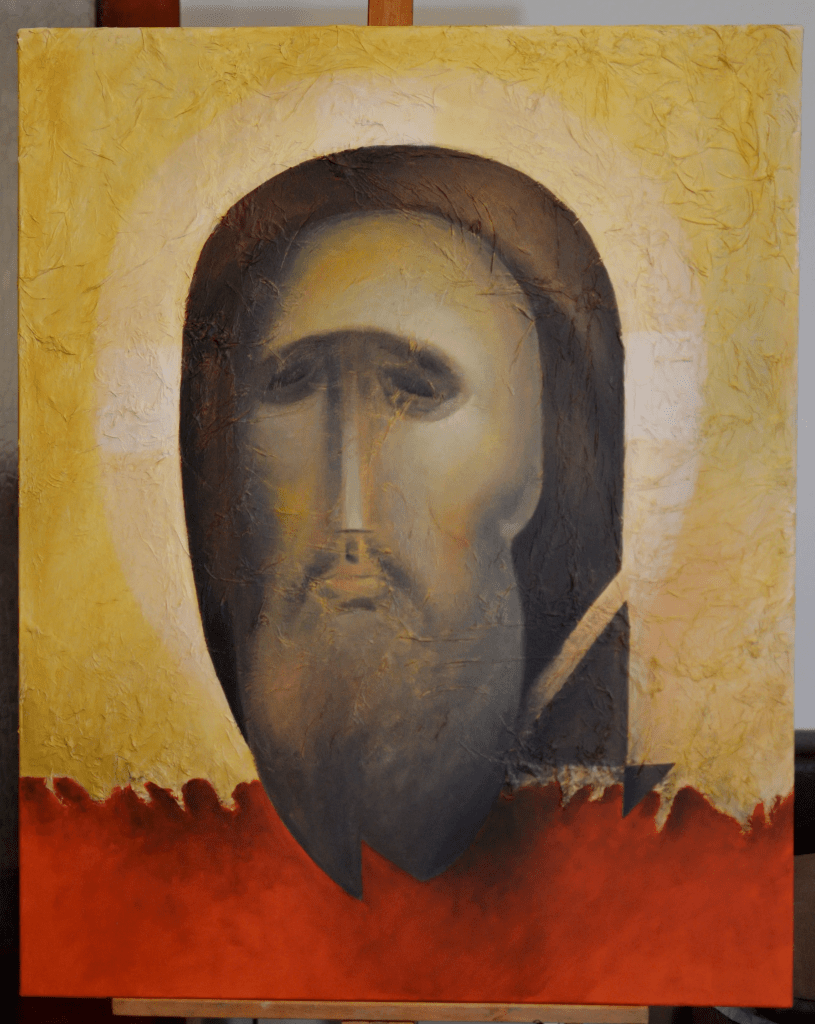
Jesus Christ by Liviu Dumitrescu, 2017

This is the genealogy of Jesus the Messiah the son of David, the son of Abraham:

Abraham was the father of Isaac,

Isaac the father of Jacob,

Jacob the father of Judah and his brothers,

Judah the father of Perez and Zerah, whose mother was Tamar,

Perez the father of Hezron,

Hezron the father of Ram,

Ram the father of Amminadab,

Amminadab the father of Nahshon,

Nahshon the father of Salmon,

Salmon the father of Boaz, whose mother was Rahab,

Boaz the father of Obed, whose mother was Ruth,

Obed the father of Jesse,

and Jesse the father of King David.

David was the father of Solomon, whose mother had been Uriah’s wife,

Solomon the father of Rehoboam,

Rehoboam the father of Abijah,

Abijah the father of Asa,

Asa the father of Jehoshaphat,

Jehoshaphat the father of Jehoram,

Jehoram the father of Uzziah,

Uzziah the father of Jotham,

Jotham the father of Ahaz,

Ahaz the father of Hezekiah,

Hezekiah the father of Manasseh,

Manasseh the father of Amon,

Amon the father of Josiah,

and Josiah the father of Jeconiah and his brothers at the time of the exile to Babylon.

After the exile to Babylon:

Jeconiah was the father of Shealtiel,

Shealtiel the father of Zerubbabel,

Zerubbabel the father of Abihud,

Abihud the father of Eliakim,

Eliakim the father of Azor,

Azor the father of Zadok,

Zadok the father of Akim,

Akim the father of Elihud,

Elihud the father of Eleazar,

Eleazar the father of Matthan,

Matthan the father of Jacob,

and Jacob the father of Joseph, the husband of Mary, and Mary was the mother of Jesus who is called the Messiah.

Thus there were fourteen generations in all from Abraham to David, fourteen from David to the exile to Babylon, and fourteen from the exile to the Messiah. (New International Version)

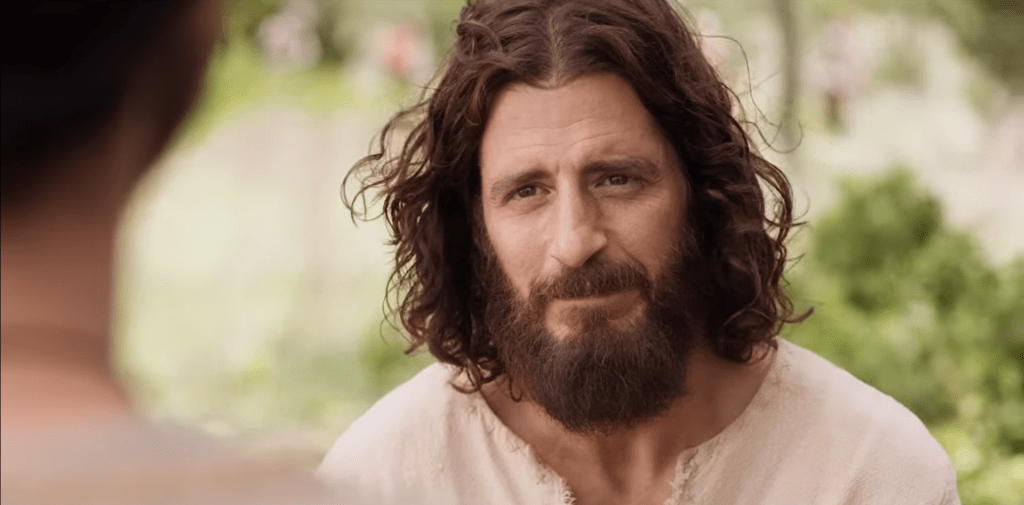
Jonathan Roumie as Jesus in the series “The Chosen”

You might be saying to yourself, “Really? You’re doing a reflection on this, a genealogy? Are you kidding?”

Why? Because all of Holy Scripture drips with grace, including genealogies.

The gospel of grace is the good news of Jesus; and, through the genealogy, we have the opportunity to understand and appreciate Christ better.

At the heart of Matthew’s gospel is a presentation of Jesus and Christ’s teaching which centers on the kingdom of God. Jesus is the King who fulfills all Old Testament promises. The genealogy is more than a chronicle of Christ’s lineage; it is a theological statement that Jesus is the promised Messiah, the anointed King of Israel, and the Savior of the world.

Who is Jesus?

Jesus is the Christ. The name “Jesus” means “God is salvation.” And “Christ” means “anointed one” (king). The name “Jesus Christ” communicates his person and his mission; he is the sovereign king who brings deliverance. 

Matthew, throughout his Gospel, takes pain to convey that Jesus is the King over an ethical kingdom of righteousness, and not a political kingdom. Therefore, Jesus is unlike King Herod or any other earthly king who seeks to have power and serve his own interests. Instead, Jesus uses his authority to serve others through love and grace; he doesn’t make subjects by coercion.

Jesus is the son of David 

Matthew establishes Christ’s pedigree by saying that Jesus was not some new kid on the block; he was anticipated for centuries. Jesus is the fulfillment of the covenant given to King David by God:

When the time comes for you to die, I will raise up a descendant of yours after you, one of your own sons, to succeed you, and I will establish his kingship. He is the one who will build me a temple, and I will establish his throne forever. I will become his father and he will become my son, and I’ll never withdraw my faithful love from him as I did from the one before you. I’ll install him in my house and in my kingdom forever, and his throne will be established forever. (1 Chronicles 17:11-14, CEB)

Jesus is a king in the same line and spirit of David. For example, when David became king, he didn’t immediately set out to annihilate all of the previous king’s (Saul) sons. That’s often how kings did it back then. Instead, David used his power to scan the land and show kindness to them. (2 Samuel 9:1-16)

Jesus is the son of Abraham

Matthew also establishes Christ’s pedigree as the rightful king of the universe by saying that Jesus is the fulfillment of the covenant given to Abraham:

I will make you a great nation,
I will bless you.
I will make your name great,
and you will be a blessing.
I will bless those who bless you,
and whoever curses you, I will curse.
Through you every family on earth will be blessed.” (Genesis 12:2-3, GW)
                 

Abraham was called by God because of sheer grace. There was nothing special about Abraham, other than the fact that God called him out of a pagan land to create a people for God’s own possession. Jesus is the fulfillment of that promise; all nations are blessed by coming to Christ the Lord and King.

From Abraham to David

Matthew made a statement about God through the genealogy: the Lord is merciful and full of grace. Grace is seen in the inclusion of four women: Tamar, Rahab, Ruth, and Bathsheba. 

The use of genealogy was a conventional form in the ancient world for establishing the credibility of a king’s right to rule. What was highly unconventional was including women. Matthew purposefully included them for two reasons:

  1. Women are central to the kingdom of God and play a pivotal role in the New Covenant.
  2. The women in the genealogy are Gentiles and were all notorious for their sexual exploits. 

Matthew highlighted a gospel of grace. No matter your gender, race, or even sordid past, the kingdom message is for everyone and is not an exclusive club. 

God is acting to redeem and reconcile the world. The gospel is not bound in any way by scandal, race, or gender. Jesus is the Savior and uses whomever he wants to extend his gospel of grace. 

From Solomon to the Exile

The men listed in this part of the genealogy are all kings; most of them not very good kings; and many of them downright evil. Because of this, God’s wrath was aroused, and the people were expelled from the land for following the unrighteous kings. 

However, grace overcomes everything. God’s purposes are still providentially accomplished despite human failure and sin. The lineage of Jesus was neither cut off nor thwarted because of powerful men who went in the wrong direction. In the end, God’s promises prevail.

Though the mountains be shaken
    and the hills be removed,
yet my unfailing love for you will not be shaken
    nor my covenant of peace be removed,”
    says the Lord, who has compassion on you. (Isaiah 54:10, NIV)

From the Exile to Christ

God is faithful, despite human unfaithfulness. Even though the people didn’t listen to the prophets during the reign of the earthly kings, the Lord quietly preserved a remnant who carried on the kingdom ethic. 

“I myself will gather the remnant of my flock out of all the lands where I have driven them, and I will bring them back to their fold, and they shall be fruitful and multiply.” (Jeremiah 23:3, NRSV)

Instead of extermination, God sent a Savior to settle the sin issue once for all. God’s grace and providence reign supreme in the universe.

Jesus is the Promised King

Matthew’s genealogy is presented with 3 sets of 14. The number 14 is symbolic: the name “David” has three consonants in Hebrew, and the number value of that name is 4+6+4=14. By modern standards, this doesn’t make much sense. However, by ancient standards, this was a conventional use of genealogy. And so, Matthew’s original readers got the point that David is the center of the genealogy; and Jesus is the promised king to come. It’s a creative way of pointing to Jesus, which connected to people accustomed to using numerology for making arguments.

It’s good to think about avenues of communication that speak to the people we want to reach. For example, in raising three girls, playing tea party with dolls was a way to love them and have a conversation on their level.  

In other words, we must ask: How do I need to change in order to reach the people I want to reach? (and not how others need to conform to what I’m doing).

Conclusion

God acted in history by sending Jesus, who is the rightful king of the universe. Christ is the Anointed One, sent to restore people to God. He is our peace, and our hope. To walk in the footsteps of Jesus is to walk in grace, not self-serving, but looking to use what has been given us to live as God’s subjects in the kingdom. 

May we make our own theological statement of who God is by the manner in which we live and speak, truly having Jesus at the center of all we do and say.

Soli Deo Gloria

Philippians 2:5-11 – Descending Into Greatness

In your relationships with one another, have the same mindset as Christ Jesus:

Who, being in very nature God,
    did not consider equality with God something to be used to his own advantage;
rather, he made himself nothing
    by taking the very nature of a servant,
    being made in human likeness.
And being found in appearance as a man,
    he humbled himself
    by becoming obedient to death—
        even death on a cross!

Therefore, God exalted him to the highest place
    and gave him the name that is above every name,
that at the name of Jesus every knee should bow,
    in heaven and on earth and under the earth,
and every tongue acknowledge that Jesus Christ is Lord,
    to the glory of God the Father. (New International Version)

So, what kind of people (and what kind of church) would we be if we resembled these verses of Holy Scripture?  

The Apostle Paul said to the church in Philippi that their “attitude” or “mindset” should be the same as Christ Jesus. Their thinking ought to be like the mind of Christ. To think well, live well, and be well, we need the mind of Christ.

To relate to others in a godly way, to navigate this fallen world with integrity and truth, to make an impact on those around us, we must adopt the mindset and attitude of Jesus.  

Everything comes down to God – how we should think and how we ought to live. Within the life of the one true God, exists three persons: Father, Son, and Spirit. Within the Holy Trinity, there exists perfect love, absolute holiness, united harmony, and constant respect. 

Just as God is holy, we are to be holy.

Therefore, once you have your minds ready for action and you are thinking clearly, place your hope completely on the grace that will be brought to you when Jesus Christ is revealed. Don’t be conformed to your former desires, those that shaped you when you were ignorant. But, as obedient children, you must be holy in every aspect of your lives, just as the one who called you is holy. It is written, You will be holy, because I am holy. (1 Peter 1:13-16, CEB)

Just as God is love, so we are to love one another.

Dear friends, we should love each other, because love comes from God…. This is how God showed his love to us: He sent his one and only Son into the world so that we could have life through him. This is what real love is: It is not our love for God; it is God’s love for us. He sent his Son to die in our place to take away our sins. Dear friends, if God loved us that much, we also should love each other. (1 John 4:7-11, NCV)

Just as Jesus is a humble servant, so we are to practice humble service in all relationships.

Everyone must live in harmony, be sympathetic, love each other, have compassion, and be humble. Don’t pay people back with evil for the evil they do to you, or ridicule those who ridicule you. Instead, bless them, because you were called to inherit a blessing. (1 Peter 3:8-9, GW)

Humility is vital to Christian existence, and not optional. There is no place in the believer’s life for pride, posturing, and power-broking. Instead, we are to take the posture of lowliness, using any kind of influence for the benefit and encouragement of others – just like Jesus did while on this earth. 

In a world pre-occupied with power and control, safety and security, influence and throwing its weight around, there is Jesus. Christ did the opposite of engaging in upward mobility; he practiced downward mobility. In doing so Jesus Christ descended into greatness as Lord and Savior.

To have the mind and attitude of Christ happens through emulating our Lord’s example of humility. Jesus is God. Yet, despite that reality, the pre-incarnate Christ did not sit in heaven as the second person of the Trinity and hold onto his lofty position with tight fists. 

Jesus came to this earth with a humble willingness to open his hands and relinquish his rights and privileges as God. Christ divested himself of all his privilege. He became a slave. Jesus gladly emptied himself and held nothing back. Christ completely gave himself up for us.

Jesus became one of us, yet never ceased being the Lord of all. It’s just that he willingly put his kingly robe in the closet and put on Dickies and work boots. Jesus came among us and purposely limited himself to identify with us fully – and secured for us the greatest generosity imaginable: an answer to the problem of guilt and shame through forgiveness of sins.

Jesus became a servant, a bond-slave. Christ completely tied himself to us, not coming to this earth seeking to be served, but serving and giving his life as a ransom for many. 

What’s more, Christ kept going lower and lower to the point of descending to the greatest humiliation and shame of all – death on a cross. The King of the universe was killed by sinful humanity so that he might redeem and save those very same people from their terrible plight of bondage to the power of sin.

Therefore, we are to be humble, embracing the lowly status of being slaves to God and to one another. The Philippian church had a real problem with pride. Hear the exhortations given to the Philippian church so that they would practice humility in all their relationships: 

  • Live your life in a manner worthy of the gospel of Christ, so that, whether I come and see you or am absent and hear about you, I will know you are standing firm in one spirit, striving side by side with one mind for the faith of the gospel (Philippians 1:27, NRSV)
  • Don’t be jealous or proud but be humble and consider others more important than yourselves. (Philippians 2:3, CEV)
  • You must continue to live in a way that gives meaning to your salvation. (Philippians 2:12, ERV)
  • Do all things without murmuring and arguing. (Philippians 2:14, NRSV)
  • Brothers and sisters, imitate me, and pay attention to those who live by the example we have given you. (Philippians 3:17, GW)
  • Do not be anxious [tight-fisted control] about anything, but in every situation, by prayer and petition, with thanksgiving [open-handed humility] present your requests to God. (Philippians 4:6, NIV)

As a result of Christ’s humble obedience to the Father, he was exalted from the lowest place to the highest place. King Jesus is on the throne, above everyone and everything. Because of his descent to this earth, he ascended in glory and honor. We now see God in a new way, through Jesus – and it causes us to bend the knee and confess with the tongue that Jesus Christ is Lord.

In the ancient Roman world, Jesus as Lord was subversive language. Because if Jesus is Lord, Caesar is not, and ultimate allegiance does not belong to the Empire. And it is no different in our day. The issue of who we pledge our fealty to, still pertains to us. If Jesus is Lord, no earthly politician or religious figure is owed lordship status.

To follow Jesus, one must practice downward mobility and embrace humility.

Bowing the knee to Christ becomes second nature whenever we give our unflagging allegiance to him. We accept that we are the creatures and God is the Creator, that God is God, and we are not.

As we enter Holy Week, hear the prophet Isaiah’s words of humiliation and exaltation:

Just watch my servant blossom!
    Exalted, tall, head and shoulders above the crowd!
But he didn’t begin that way.
    At first everyone was appalled.
He didn’t even look human—
    a ruined face, disfigured past recognition.
Nations all over the world will be in awe, taken aback,
    kings shocked into silence when they see him.
For what was unheard of they’ll see with their own eyes,
    what was unthinkable they’ll have right before them.

Who believes what we’ve heard and seen?
    Who would have thought God’s saving power would look like this?

The servant grew up before God—a scrawny seedling,
    a scrubby plant in a parched field.
There was nothing attractive about him,
    nothing to cause us to take a second look.
He was looked down on and passed over,
    a man who suffered, who knew pain firsthand.
One look at him and people turned away.
    We looked down on him, thought he was scum.
But the fact is, it was our pains he carried—
    our disfigurements, all the things wrong with us.
We thought he brought it on himself,
    that God was punishing him for his own failures.

But it was our sins that did that to him,
    that ripped and tore and crushed him—our sins!
He took the punishment, and that made us whole.
    Through his bruises we get healed.
We’re all like sheep who’ve wandered off and gotten lost.
    We’ve all done our own thing, gone our own way.
And God has piled all our sins, everything we’ve done wrong,
    on him, on him.

He was beaten, he was tortured,
    but he didn’t say a word.
Like a lamb taken to be slaughtered
    and like a sheep being sheared,
    he took it all in silence.
Justice miscarried, and he was led off—
    and did anyone really know what was happening?
He died without a thought for his own welfare,
    beaten bloody for the sins of my people.
They buried him with the wicked,
    threw him in a grave with a rich man,
Even though he’d never hurt a soul
    or said one word that wasn’t true.

Still, it’s what God had in mind all along,
    to crush him with pain.
The plan was that he give himself as an offering for sin
    so that he’d see life come from it—life, life, and more life.
    And God’s plan will deeply prosper through him.

Out of that terrible travail of soul,
    he’ll see that it’s worth it and be glad he did it.
Through what he experienced, my righteous one, my servant,
    will make many “righteous ones,”
    as he himself carries the burden of their sins.
Therefore I’ll reward him extravagantly—
    the best of everything, the highest honors—
Because he looked death in the face and didn’t flinch,
    because he embraced the company of the lowest.
He took on his own shoulders the sin of the many,
    he took up the cause of all the black sheep. (Isaiah 52:13-53:12, MSG)

Lord Jesus, Son of God, you walked the earth with humility, despite being Lord of all. Your meekness confused the proud and arrogant. Your nobly attended to the needy and destitute. Teach me to model my life after you, to live with a humble spirit. Help us to never view ourselves as greater or better than others. Let our hearts always imitate your humility. Amen.

Matthew 14:22-33 – Walking on Water?

Welcome, friends! Click the video below and let’s have a time together around God’s Word.

You may also view this video at TimEhrhardtYouTube

For a classic hymn on God’s peace, click Like a River Glorious by Stonebriar Music.

For a contemporary song based on today’s story, click Walking on Water by the group NeedToBreathe.

May Christ dwell in your heart through faith, now and always. Amen.