Grateful to God (1 Thessalonians 2:13-20)

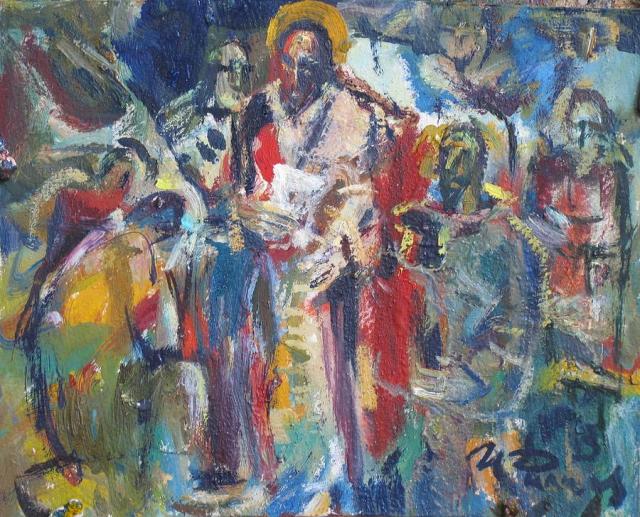
Apostle Paul, by Ivan Filichev

And we also thank God continually because, when you received the word of God, which you heard from us, you accepted it not as a human word, but as it actually is, the word of God, which is indeed at work in you who believe. For you, brothers and sisters, became imitators of God’s churches in Judea, which are in Christ Jesus: You suffered from your own people the same things those churches suffered from the Jews who killed the Lord Jesus and the prophets and also drove us out. They displease God and are hostile to everyone in their effort to keep us from speaking to the Gentiles so that they may be saved. In this way they always heap up their sins to the limit. The wrath of God has come upon them at last.

But, brothers and sisters, when we were orphaned by being separated from you for a short time (in person, not in thought), out of our intense longing we made every effort to see you. For we wanted to come to you—certainly I, Paul, did, again and again—but Satan blocked our way.For what is our hope, our joy, or the crown in which we will glory in the presence of our Lord Jesus when he comes? Is it not you? Indeed, you are our glory and joy. (New International Version)

Reception and Acceptance of God’s Word

The Apostle Paul, in all of his letters to the churches, was attentive to affirming those things which are good amongst the believers; and not only the aspects of church life that needed change and/or repentance.

For the Thessalonians, Paul was profoundly grateful to God for the people’s receiving of the Word and their accepting it as from God. Perhaps there is no greater affirmation than this for the Christian.

In order to receive and accept God’s Word, people must know it. And people cannot know God’s Word unless they take the time and effort to read it and discover it for themselves.

Scripture reading is a foundational spiritual practice for Christians everywhere, and for all of Christ’s Church throughout the earth. Church worship liturgies, as well as individual Christians’ daily disciplines of faith, ought to be thoroughly saturated with Holy Scripture. Yet, many churches are believers, sadly, are not.

I am specifically calling out the conservative evangelical church on this. Although they claim to be Bible-centered, with an extended time for the sermon, there is a paucity of actual Scripture contained within those gathered times.

Too much of the preaching fails to truly explain Scripture, and there are virtually no Scripture readings or references outside the sermon and in the worship service. This is a travesty, and also a testament to the biblical ignorance of so many evangelicals.

What’s more, the evangelical impulse for a “personal quiet time with the Lord” is, in reality, practiced by precious few believers – and usually consists of little more than a daily crumb of the Bible.

I perhaps sound cranky and crotchety. Yet in a previous life, I was an evangelical Pastor for many years, and know the frustrations and challenges of attempting to bring biblical literacy to such churches and Christians. There’s a better way, but alas, that is a topic for another time and another post.

Imitators and Sufferers with God’s Churches

The true muster of a Christian and any Christian Church is the desire, speech, and action of actually following the words and ways of Jesus. It was the Lord Jesus himself who said:

“Remember what I told you: ‘A servant is not greater than his master.’ If they persecuted me, they will persecute you also.” (John 15:20, NIV)

“In this world you will have trouble. But take heart! I have overcome the world.”

Jesus (John 16:33, NIV)

Paul was thankful for the Thessalonians because of their solidarity with the other churches; and their willingness to suffer as Jesus did. What’s more, they did not try to reinvent the wheel, but affirmed the sound practices they saw in the original churches of Judea and imitated those good things.

This was not a matter of pragmatism, that is, just doing something that worked somewhere else and adopting it for yourself. Instead, Paul was talking about following the example of the first and earliest of churches. Those churches were made up of Jewish Christians who received a lot of persecution from their fellow Jews.

The Thessalonians, too, received grief and belligerence from the same sort of people, trying to bully them around and tell them what to do. But the believers held fast to the pattern of teaching and living they observed from both Paul and the churches who endured suffering in Judea.

It’s one thing to express belief. It’s quite another thing to suffer for those beliefs and experience persecution for them. God will handle the persecutors on Judgment Day, not us. It’s our job to remain faithful and persevere in the Christian life until that Day comes.

Glory and Joy in God’s Presence

For the Apostle Paul, glory and joy was not found in his great intellect and persuading many people, or his many accomplishments of planting churches and defending the faith. Paul’s highest joy was found in people coming to know Christ and living for Jesus.

His glory was in the hundreds of relationships established with people, and all the believers he mentored. In other words, Paul’s glory and joy was the real names and faces of people he encountered and gathered into the one Church, for whom Christ died and sacrificed himself.

It wasn’t even a thought in the Apostle’s big old head to gain glory for himself, or to pursue joy for it’s own sake. Rather, Paul discovered that real joy and glory comes in fulfilling the mission give to him by Christ:

To make disciples of all nations, baptizing them in the name of the Father, and of the Son, and of the Holy Spirit; teaching them to receive and accept God’s Word, to become imitators and sufferers with God, and to glory and joy in God’s presence.

Almighty God, Father of all mercies, we your unworthy servants give you humble thanks for all your goodness and loving-kindness to us and to all whom you have made.

We bless you for our creation, preservation, and all the blessings of this life; but above all for your immeasurable love in the redemption of the world by our Lord Jesus Christ; for the means of grace, and for the hope of glory.

And, we pray, give us such an awareness of your mercies, that with truly thankful hearts we may show forth your praise, not only with our lips, but in our lives, by giving up ourselves to your service, and by walking before you in holiness and righteousness all our days, through Jesus Christ our Lord, to whom, with you and the Holy Spirit, be honor and glory throughout all ages. Amen.

Persevere Through Adversity (Psalm 129)

Painting of Jerusalem by Alex Levin

From my earliest youth my enemies have persecuted me.
    Let all Israel repeat this:
From my earliest youth my enemies have persecuted me,
    but they have never defeated me.
My back is covered with cuts,
    as if a farmer had plowed long furrows.
But the Lord is good;
    he has cut me free from the ropes of the ungodly.

May all who hate Jerusalem
    be turned back in shameful defeat.
May they be as useless as grass on a rooftop,
    turning yellow when only half grown,
ignored by the harvester,
    despised by the binder.
And may those who pass by
    refuse to give them this blessing:
“The Lord bless you;
    we bless you in the Lord’s name.” (New Living Translation)

The Jewish people know a thing or two about perseverance through suffering; they’ve been enduring it for millennia. If we let them, they can show us a better way of facing adversity.

It seems to me that we modern Gentiles could learn from our Jewish brothers and sisters. We Westerners tend toward burying the past, putting things behind us, and forgetting all the bad things which occurred back there. But the Psalms, a wonderful depository of Jewish thought and practice, will have none of that approach.

Today’s Psalm comes from a group known as the “Psalms of Ascent.” (Psalms 120-134) These were sung by ancient Jewish worshipers as they made the journey up to Jerusalem for the Feast of Tabernacles.

As the pilgrims walked together on their ascent to the great city, the experience of collectively singing and worshiping made the people feel united in joy, purpose, and sorrow. Remembering was central to that sense of solidarity.

The Jewish people have been attacked by countless enemies, not only throughout the Old Testament, but also throughout their long history. Empires tend to not like Jews because Jews hold to their own set of laws and worship practices – which seem to always come into conflict with what some Emperor, Dictator, or Tyrant wants. So, they try to be rid of Jews, like plowing a field to break up the stubborn hard ground of Yahweh worship. The Jewish people end up being treated, literally, like dirt.

“The attempt to eliminate the people of God was an attempt to eradicate the presence of God from the human situation. The fact that after Auschwitz the Jewish people still lives and can still affirm its faith is the most powerful testimony that God still lives.”

Rabbi Jonathan Sacks, Crisis and Covenant

God will deliver… eventually. Whether Jew or Christian, there will always be enemies to the faith. And sadly, the history of Christianity includes their own brand of persecuting Jews. *Sigh*

Haters, the Psalm hopes, will be like grass in shallow soil: They may sprout quickly, but will also wither quickly and blow away to be gone forever.

The evil of this fallen world is terrible and ugly; but it isn’t permanent. Therefore, we need patience and perseverance through the suffering and adversity to realize the deliverance.

And as much as aggressive bullies try to wipe out those not conforming to their ways, the Lord simply brings in a harvest of righteousness, despite it all.

Even though the Psalms of Ascent were written long ago by people living in a time and place very different from ours, yet they express the emotions we all feel, which makes them helpful for our journey through life, as well.

Although none of us delights in persecution, pain, and struggle, we can take the stance of embracing our hard circumstances because suffering produces perseverance; perseverance, character; and character, hope. And hope does not put us to shame, since love is the force that binds the world together. (Romans 5:3-8)

“When two friends climb a hill, the hill seems less steep than if they climbed it alone.”

Sherri Mandell

Oftentimes, it is inside the pain that we begin to become one with our own vulnerable humanity. And that humble humanity is where great courage, great creativity, and great work germinates within our spirits and cultivates the ground of this world, growing to produce faith, hope, and love.

Everyone facing adversity knows how hard it is to keep going without seeing the goal. Like the farmer, we must expectantly wait till the harvest. There is nothing we can do to speed up the process and go straight from planting to harvest. It takes time and plenty of patience. Grumbling and complaining about how long it is taking will not make it go any faster.

Perseverance in the face of hardship is a major pathway to realizing a holy life. Consider the ancient prophets:

  • Jeremiah was faithful to proclaim God’s message yet was thrown into a cistern and left for dead. Yet, he was delivered from it. (Jeremiah 38:1-28)
  • Micaiah was faithful to declare truth to King Zedekiah, who then promptly imprisoned him, even though the king asked for God’s message. (1 Kings 22:24-27)
  • Daniel was faithful to pray consistently to the one true God and was thrown into the lion’s den to be killed. But the Lord saved him. (Daniel 6:1-28)

The prophets all suffered for doing the right thing and did not waver in their commitment to the Lord. Through their troubles they learned to trust God and draw near to the Lord. The adversity strengthened, not weakened, their faith.

What’s more, consider the Old Testament character of Job, who is Exhibit A of perseverance through grinding hardship. Job had it all; and he lost it all… except his faith. Job tenaciously held onto righteousness, despite his awful physical, mental, emotional, and spiritual pain. And he eventually came through it, restored and whole.

We are to keep going in our faith and not give up – and the Psalms of Ascent can help us in our endurance.

The soul would have no rainbow if the eyes had no tears. We live in a time when we will either sink or swim – there is no in-between. God’s celestial shore is within sight; don’t miss it by getting discouraged by all the fog. 

Hang in there, my friend. There is good reason to do so.

Dealing with Grinding Pain (Psalm 79:1-9)

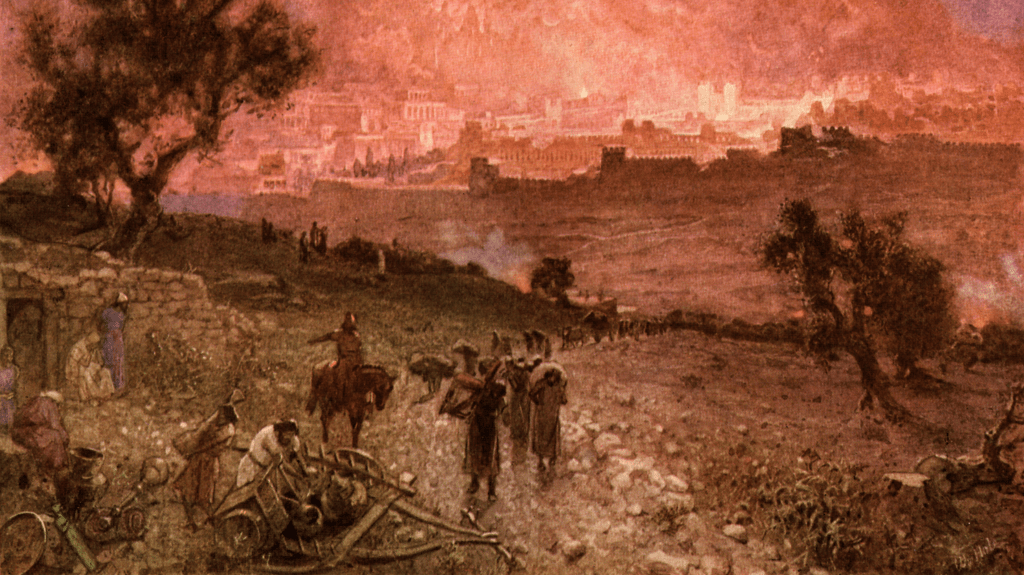
The Babylonian conquest of Jerusalem, by William Hole (1846-1917)

God, nations have come against your chosen people.
    They have ruined your holy Temple.
    They have turned Jerusalem into ruins.
They have given the bodies of your servants as food to the wild birds.
They have given the bodies of those who worship you to the wild animals.
They have spilled blood like water all around Jerusalem.
    No one was left to bury the dead.
We are a joke to the other nations;
    they laugh and make fun of us.

Lord, how long will this last?
    Will you be angry forever?
    How long will your jealousy burn like a fire?
Be angry with the nations that do not know you
    and with the kingdoms that do not honor you.
They have gobbled up the people of Jacob
    and destroyed their land.
Don’t punish us for our past sins.
    Show your mercy to us soon,
    because we are helpless!
God our Savior, help us
    so people will praise you.
Save us and forgive our sins
    so people will honor you. (New Century Version)

I don’t like evil. And I really don’t like arrogant people who want what they want and leave a path of destruction behind them.

The setting behind today’s Psalm is the destruction of the temple. It was razed by a conquering army who proudly gloated over their victory. This psalm, as all psalms, is a prayer. It’s a bitter and angry cry for God to step in and act on behalf of the humiliated people.

The psalm is more than a simple plea for help; it is a deeply passionate appeal. As a child of the 1960’s, my phrase for the psalmist’s entreaty is, “God, stick it to the man!”

There is no polite knock at the side door of God’s house in the face of such evil. This is a pounding on the front door with the demand for God to do something about this terrible trouble. For the psalmist, the incongruence between who God is and what has happened to God’s people is inconceivable and unacceptable.

To profane God’s temple is to profane God; and to kill and maim God’s people is to flip the middle finger at God. The psalmist is beside himself and overwhelmed with emotion.

There is something very instructive here that we ought not miss. When we have been brutalized, victimized, and/or demoralized, we just want someone, especially the Lord we serve, to take notice and feel what we are feeling.

Never underestimate the power of empathy and solidarity. To feel alone and bereft of help is an awful feeling.

Perhaps the psalmist’s prayer offends some sensibilities. I wonder, for those who find the language difficult, have ever had a daughter raped or a house destroyed by fire or seen a person killed without mercy in front of their own eyes. Methinks they have not. The feelings of helpless despair and sheer anger defy human words. These are not casual affronts but malicious destructions of property and people.

We need someone to affirm the raw ruthlessness of it all, to have some understanding of the impossible place we are in with such wanton cruelty. When our very support is ripped from our lives, the madness within is too much to bear.

Who will rescue us from this body of death?

God is big enough to handle our rage and our hurt. The Lord is available and hears our desperate voice of prayer. Yet, God is not always going to directly and immediately answer on the terms we stipulate. God acts out of God’s own providence and justice, and not from our expectations. And that is a good thing, not a bad thing.

God sees, knows, and feels with us. This realization enables us to recenter and reorient ourselves around faith, hope, and love. New life is never a gift in a vacuum; it comes out of agonizing struggle in reckoning with existing evil.

So, when someone goes through a hellish experience, we are to exercise our capacity to listen and witness their horrible spiritual pain. Healing hurts: it is not a pleasant affair. We are to hang in there and walk alongside another in their hour of need, even when their vitriol seems over the top to us.

For only in telling our story to another will any of us find relief and renewed hope.

The psalms permit us to use language appropriate to what has happened to us. They also allow us to move beyond the venom to the God who restores broken lives.

Lord Jesus Christ, by your patience in suffering you hallowed earthly pain and gave us the example of obedience to your Father’ will.

Be near me in my time of weakness and pain; sustain me by your grace, that my strength and courage may not fail; heal me according to you will; and help me always to believe that what happens to me here is of little account if you hold me in eternal life, my Lord and my God.

As the Lord Jesus cried out on the cross, I cry out to you in pain, O God my Creator. Do not forsake me. Grant me relief from this suffering and preserve me in peace, through the power of the Holy Spirit. Amen.

Psalm 6 – Independence Day Celebration or Mourning?

O Lord, do not rebuke me in your anger
    or discipline me in your wrath.
Be gracious to me, O Lord, for I am languishing;
    O Lord, heal me, for my bones are shaking with terror.
My soul also is struck with terror,
    while you, O Lord—how long?

Turn, O Lord, save my life;
    deliver me for the sake of your steadfast love.
For in death there is no remembrance of you;
    in Sheol who can give you praise?

I am weary with my moaning;
    every night I flood my bed with tears;
    I drench my couch with my weeping.
My eyes waste away because of grief;
    they grow weak because of all my foes.

Depart from me, all you workers of evil,
    for the Lord has heard the sound of my weeping.
The Lord has heard my supplication;
    the Lord accepts my prayer.
All my enemies shall be ashamed and struck with terror;
    they shall turn back and in a moment be put to shame. (New Revised Standard Version)

Methinks we Americans, especially on this our national Independence Day, must remember that this has not always been, nor currently is, a day of celebration for a sizable chunk of people in the United States.

Now before you begin offering some mental pushback that I am pouring cold water on a time-honored holiday, or begin believing I’m not a true patriot, I will simply point out that not only is today’s psalm lesson in the Revised Common Lectionary a lament, but also that I’m a guy with two academic degrees in American history.

If we only look at Independence Day from the perspective of white Northern European heritage persons, then it will seem that, speaking like this, I am not grateful for the blessings of being in this incredible country of my birth and the place I’ve lived my entire life.

But I am not looking from that angle today. I choose to acknowledge that on this day, every year for the past 246 years, today’s psalm has been the lived experience and expression of others who looked to the heavens and asked, “How long, O Lord!?”

A true people of compassion are able to suffer with those who suffer. The people of God really ought to be at the forefront of exhibiting empathy and standing in solidarity with suffering folk.

A patriot is one who acknowledges and affirms all it’s citizens, and not only the ones who look like me, talk like me, and act like me. After all, the original documents of the United States made room for this to be so. Empathy, compassion, and solidarity are intentionally built into our nation’s grand experiment of democracy and government.

“We the people of the Unites States, in order to form a more perfect union, establish justice, insure domestic tranquility, provide for the common defense, promote the general welfare, and secure the blessings of liberty to ourselves and our posterity, do ordain and establish this Constitution for the United States of America.”

Preamble of the United States Constitution

The very fact that the previous quotation is true for some, and not for everyone, is a telling testament to the reality that we need to keep striving to live into our heritage as Americans and ensure that welfare for the common good of all citizens is continually sought, even if done so imperfectly.

Grieving, tears, and lament was the response of the former slave Frederick Douglass.

“The rich inheritance of justice, liberty, prosperity and independence, bequeathed by your [white] fathers, is shared by you, not by me. The sunlight that brought light and healing to you, has brought stripes and death to me [a black man]. This Fourth July is yours, not mine. You may rejoice, I must mourn.”

Frederick Douglass, “What to the Slave is the 4th of July?” (An oration on July 4, 1852)

Mourning and weeping was and continues to be the experience of many Native American peoples.

“While the United States and its settlers claimed its independence from Great Britain, this came at a cost of others, including this land’s Indigenous Peoples that were stolen from their own homelands. This patriotic holiday is nothing to celebrate because freedom cannot come at the cost of another’s freedom. America’s Independence Day is a celebration of imperialism, genocide, and American exceptionalism, and there is no pride in genocide.”

Daisee Francour (Oneida Nation of Wisconsin)

We cannot change history, but we can work towards a better future where all of our rights are respected and we all experience freedom and independence equally. Those with non-European ancestry who today in our nation experience racism and anti-ethnic aggression need to be acknowledged and affirmed as Americans with equal standing and an equal voice alongside the white population.

So, I would argue that both celebration and weeping ought to occur on this day. We should weep for the dreams and lives of indigenous peoples who were destroyed through westward expansion, and even today experience the ongoing effects of cultural genocide.

We ought to acknowledge not only our nation’s blessings, but also our curses which are still seen in exploiting others through envy, greed, sloth, pride, lust, and gluttony.

We, the people of the United States of America, ought to actively seek to live in more simple and less harmful ways. We should offer our voices, not in violent speech and language, but with creative and healing words.

On this American Independence Day, the Church should reaffirm her allegiance and citizenship to Christ and God’s Kingdom and renounce any nationalistic, economic, ethnic, and political divisions which are contrary to the words and ways of Jesus.

All of the citizens of the earth should seek to embrace non-violent, self-sacrificial love on behalf of everyone. Today is an opportunity to affirm that Christ is the Friend of all people, not just some.

No one ought to be wasting away in their grief and languishing in their tears when we have the means to acknowledge their suffering and to do something about it.

Our Father who is in heaven,

uphold the holiness of your name.

Bring in your kingdom

so that your will is done on earth as it’s done in heaven.

Give us the bread we need for today.

Forgive us for the ways we have wronged you,

just as we also forgive those who have wronged us.

And don’t lead us into temptation,

but rescue us from the evil one. (Matthew 6:9-13, CEB)