
Matthew 23:29-36 – “Woe Is Me!”

Ethiopian Jesus
Jesus, from an Ethiopian Orthodox Church, c.1750 C.E.

“Woe to you, teachers of the law and Pharisees, you hypocrites! You build tombs for the prophets and decorate the graves of the righteous. And you say, ‘If we had lived in the days of our ancestors, we would not have taken part with them in shedding the blood of the prophets.’ So, you testify against yourselves that you are the descendants of those who murdered the prophets. Go ahead, then, and complete what your ancestors started! 

“You snakes! You brood of vipers! How will you escape being condemned to hell? Therefore, I am sending you prophets and sages and teachers. Some of them you will kill and crucify; others you will flog in your synagogues and pursue from town to town. And so upon you will come all the righteous blood that has been shed on earth, from the blood of righteous Abel to the blood of Zechariah son of Berekiah, whom you murdered between the temple and the altar. Truly I tell you; all this will come on this generation. (NIV) 

I almost feel the need to place a warning label on this blog post: “The writer has determined that a careful reading of this Scripture is dangerous to those who think their current state of Christianity is just fine.”  Jesus stands in a long line of Old Testament prophets as the ultimate prophesier calling the people to see things as they really are and come back to the God of all, not the God of their own making. 

I feel yet another warning is warranted, knowing from years of experience that there is an Enemy of our souls: The dark forces of this world will try every which way to get us to believe these words of Jesus are for other people, not me or you – that you and I are okay and that this is for “those” people [probably ones we don’t like] who are clearly deluded. We, however, are simply fine.   

We all need these words from Jesus and to let them speak to us. Christ’s scathing and damning critique was leveled against a distorted spirituality, a false Christianity, a controlling leadership that stifled and snuffed-out the true worship of God. Jesus pronounced seven woes on the religiously pious spiritual brokers of his day. Today’s Gospel lectionary contains only the seventh woe. This woe, along with the rest, are not directed toward the irreligious or the spiritually lackadaisical folks among us – the woes are aimed squarely at the religiously committed. 
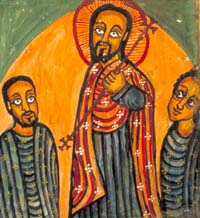
Ethiopian Orthodox Jesus
Ethiopian Orthodox Church depiction of Jesus

The word “woe” literally means “disaster” “calamity” and “misery.” Jesus pronounced a woe against ultra-religious persons who were obsessed with respecting the tombs and the graves of the ancient prophets. It was considered a terrible travesty to walk on such a grave, even accidentally. The concern about it would be something like today’s respect given to the American flag by many people. 

Here is what Jesus is getting at with his woe on those being so concerned with the tombs of the prophets: Honoring dead people and inanimate objects like graves while ignoring live people is not good. Respecting dead people of the past means nothing if we simultaneously ignore the live people right in front of us. For Jesus, one of the surest ways to hell is to give credence to Christian leaders long dead while flippantly disregarding the prophet or pastor presently in our lives who is taking pains to communicate God’s will and care for God’s people right now. 

Jesus knew quite well the telltale signs of hypocrisy: 1) hypocrites don’t practice what they preach; 2) hypocrites keep other people out of God’s kingdom; 3) hypocrites focus on externals; and, 4) hypocrites major on the minors. Hypocrisy, however, never has the last word – grace does. The final word to everything is God’s grace.  

For all of Christ’s severe words, his heart was filled with a love and a longing for his wayward people. Jesus died for the ungodly with deep concern, intention, and hope that everyone would come to know the true worship of God – filled with an abundance of mercy for the penitent sinner. 

When the prophet Isaiah experienced a vision of God his response was “woe is me!” (Isaiah 6:1-5). The appropriate response to today’s Gospel lesson is repentance – to see and turn from our own propensity toward spiritual and/or religious pride and the tendency to view the “other” as needing to repent, but not me.  

Let us, then, come to the cross of Jesus Christ and there find the grace which absolves us from such sin. Let us approach the empty tomb and find Christ’s resurrecting power of transformation. Let us approach the ascended Christ on the throne with both humility and confidence. Let us intercede for a world which desperately needs the peace of Christ. 

Lord Jesus Christ, you prayed that we would be one as you and your Father are one. We confess our resistance to your prayer. We have failed to maintain the unity of the Spirit. We have broken the bond of peace. For the times we have not listened to each other, when we have spoken in anger, haste, or fear, we are sorry. For the times we have not loved each other, when we have competed, or insulted or judged each other, we are sorry. For the harm that our disunity has done to our witness to the Gospel, we are sorry. Have mercy on us, we pray. Restore us to friendship with you and with one another, through the power of your Spirit. Lord, grant your grace for repentance to spiritual charlatans and victimizers; and, give your power to those distressed and victimized for forgiveness of their abusers, so that all of us together may strive to break the chains of oppression and show the peace of Christ in the world. Amen. 

Romans 7:7-20 – Facing Our Bundle of Contradictions

contradiction
“Humanity is an embodied paradox, a bundle of contradictions.”-Charles Caleb Colton, 1780-1832

What shall we say, then? Is the law sinful? Certainly not! Nevertheless, I would not have known what sin was had it not been for the law. For I would not have known what coveting really was if the law had not said, “You shall not covet.” But sin, seizing the opportunity afforded by the commandment, produced in me every kind of coveting. For apart from the law, sin was dead. Once I was alive apart from the law; but when the commandment came, sin sprang to life and I died. I found that the very commandment that was intended to bring life actually brought death. For sin, seizing the opportunity afforded by the commandment, deceived me, and through the commandment put me to death. So then, the law is holy, and the commandment is holy, righteous and good.

Did that which is good, then, become death to me? By no means! Nevertheless, in order that sin might be recognized as sin, it used what is good to bring about my death, so that through the commandment sin might become utterly sinful.

We know that the law is spiritual; but I am unspiritual, sold as a slave to sin. I do not understand what I do. For what I want to do I do not do, but what I hate I do. And if I do what I do not want to do, I agree that the law is good. As it is, it is no longer I myself who do it, but it is sin living in me. For I know that good itself does not dwell in me, that is, in my sinful nature. For I have the desire to do what is good, but I cannot carry it out. For I do not do the good I want to do, but the evil I do not want to do—this I keep on doing. Now if I do what I do not want to do, it is no longer I who do it, but it is sin living in me that does it. (NIV)

The Apostle Paul’s vulnerable expression of his dilemma resonates deeply with many people. There are times when we say things to ourselves such as, “I told myself I wasn’t going to be like my mother, and here I am responding just like she would;” “I know better than to drive by the liquor store on my way home and pick up a pint of vodka, yet, I still did it;” or, “I don’t want to die, but my thoughts keep racing about a plan for suicide.” And, there are many more situations in which we are both frustrated and befuddled by our doing the things we do not want to do, and not doing the things we want to do.

Yes, indeed, Paul’s existential angst is a timeless description of our common human condition. We all can relate to the seeming inability to do what is right in so many situations. It can really drive us nuts, even to a constant and never-ending low-level discouragement that underlies almost everything we do.

Paul’s prescription for dealing with this does not rely on law. He understood that putting our willpower and effort into obeying commands gets us nowhere because we will eventually fail. Neither our brains nor our spirits work that way. Our willpower was never designed to be the driver of what we do and do not do. If anything, willpower, and the lack thereof demonstrate just how much we are climbing the ladder on the wrong wall. People are a bundle of contradictions, doing good, then bad, and flip-flopping back and forth with great frustration.

God’s law was not crafted to transform us from the inside-out. The law has three solid purposes, none of which are meant to bring deep personal transformation: attention to the law works to restrain sin in the world; use of the law provides us with a helpful guide for grateful living in response to divine grace; and, it’s use here by Paul is to show us how bad off we really are in this world and in need of forgiveness.

We need a change of habits, and this is different than adopting a list of laws. Habits are developed from our desires, our affections. In other words, we do what we love – more specifically, our ultimate love(s) drive us to do what we want. To put it in a straightforward way: We sin because we like it. And the path to overcoming any besetting sin is to have an ultimate love trump the lesser sin which we like.

St Augustine quote 2

For example, I have developed daily habits or rituals of faith which enable me to commune with God. I love God with all my heart, soul, mind, and strength, and this ultimate love enables me to push out all competing gods who want my devotion. I also love my wife with all my heart. We work on developing habits of a marital relationship which reinforce our love for each other. Love is what drives me to do right and good by her.

So, what do we do when we mess up? For the Christian, no matter what the question is, the answer is always grace. God’s grace in the finished work of Jesus Christ applied to us by the Holy Spirit is the operative power that changes lives. The law has no power to do that kind of work. Freedom from the tyranny of our misplaced desires and disordered loves comes from Christ’s forgiveness through the cross. Like a lover enamored with his beloved, our desires become oriented toward Jesus for his indescribable gift to us. That is the strength of grace.

Saving God, I thank you for delivering me from sin, death, and hell through your Son, the Lord Jesus.  May your Holy Spirit apply the work of grace to my life every day so that I can realize spiritual healing and practical freedom from all that is damaging and destructive in my soul.  Amen.