What Should We Do? (Acts 2:37-42)

Apostle Peter Preaching, by Lorenzo Veneziano, c.1370

When the crowd heard this, they were deeply troubled. They said to Peter and the other apostles, “Brothers, what should we do?”

Peter replied, “Change your hearts and lives. Each of you must be baptized in the name of Jesus Christ for the forgiveness of your sins. Then you will receive the gift of the Holy Spirit. This promise is for you, your children, and for all who are far away—as many as the Lord our God invites.” With many other words he testified to them and encouraged them, saying, “Be saved from this perverse generation.” Those who accepted Peter’s message were baptized. God brought about three thousand people into the community on that day.

The believers devoted themselves to the apostles’ teaching, to the community, to their shared meals, and to their prayers. (Common English Bible)

The Apostle Peter, follower of Jesus, had a fire in his belly and fresh wind in his lungs.

Pentecost will do that to a person.

The promised Holy Spirit came – the Spirit of fire and wind – and the result was an impassioned, reasoned, and convicting message from Peter.

The crowd of people listening to Peter understood clearly that he was saying the person and work of Jesus was the activity of God.

And Christ was killed because of his presence and ministry. But three days later, he was raised from death. And then, ascended to heaven, promising the Spirit’s continual involvement.

The people listening to Peter were cut to the heart, convicted in the depths of their soul, and beside themselves as to their culpability in Christ’s situation. They cried out to Peter and asked him what they should do, how they could possibly be a part of what God is doing in the world.

Peter’s response to the crowd was to change – to repent and be baptized, receiving the gift of the Holy Spirit. The Apostle was telling them to turn away from the old way, and turn toward the new coming kingdom of God.

Baptism assures people that God has received their repentance, and has forgiven them. It initiates the believer into the new community of the redeemed, the church.

This was not only for Jewish people, but also for Gentiles; and for everyone, both far and near.

Celebration, by John August Swanson (1938-2021)

The four qualities which characterized the earliest church were these:

  1. The new community followed apostolic teaching (the story of Jesus)
  2. The church continually engaged in fellowship (mutual encouragement and working together in unity)
  3. The believers broke bread together (kept meeting together in shared meals to remember the person and work of Jesus)
  4. They prayed (as the Lord had taught them to pray – for God’s gracious and benevolent kingdom to come, and God’s ethical and moral will to be done, right now on this earth, as it is always done in God’s heaven)

For those who are established in the faith of Christianity, all of this material raises several questions to reflect upon in how our life together as Christians is going:

How do Christians understand the word “repentance?”

Because this determines a great deal of how we live as believers. If we discern repentance as following the rules – both written and unwritten – then we are likely behaving more in the old ways that the earliest believers were to repent of.

But if we see repentance as a way of life, of continually offering prayers of confession to God, and seeking to align our life with the words and ways of Jesus, then we are living more into the spirit of Peter’s original exhortation to the people.

Is the Church living as the baptized community of the redeemed?

Again, how do we understand the word “baptism?” If baptism is nothing more than a personal decision to outwardly show one’s faith, then we have severely truncated Peter’s meaning of the word.

Baptism is the outward sign that we belong to God. And belonging to God is something God does, not us.

One good way of understanding the whole of the Christian life is that we are to ‘live into our baptism,’ that is, we are to daily live our lives cognizant that our life is not our own.

We belong to God. Long before we happened to choose God, God chose us. And we must always remember that.

Are believers in Jesus living in the Spirit?

The Spirit has been given as the continuing presence of Jesus on this earth. The Spirit reminds us of Christ’s words and ways, his person and work. To live in the Spirit is to be continually reminded that what is important to Jesus, needs to be important to us.

“You’re blessed when you’re at the end of your rope. With less of you there is more of God and his rule.

“You’re blessed when you feel you’ve lost what is most dear to you. Only then can you be embraced by the One most dear to you.

“You’re blessed when you’re content with just who you are—no more, no less. That’s the moment you find yourselves proud owners of everything that can’t be bought.

“You’re blessed when you’ve worked up a good appetite for God. He’s food and drink in the best meal you’ll ever eat.

“You’re blessed when you care. At the moment of being ‘care-full,’ you find yourselves cared for.

“You’re blessed when you get your inside world—your mind and heart—put right. Then you can see God in the outside world.

“You’re blessed when you can show people how to cooperate instead of competing or fighting. That’s when you discover who you really are, and your place in God’s family.

“You’re blessed when your commitment to God provokes persecution. The persecution drives you even deeper into God’s kingdom. (Matthew 5:3-10, MSG)

Are individual Christians and the Church communicating the promise to those who are far away? In other words, are we seeking to include others in the community?

Too many churches are closed groups who have a lot of extraneous rules and ancillary beliefs in order to truly be a part of their local church.

This does not mean we are to have no rules or guidelines or any teaching about our particular Christian tradition. However, it does mean that make sure we are proclaiming good news (which is what the word “gospel” means) because the gospel is radically inclusive, not exclusive.

Therefore, to have a community of people who genuinely love one another by spiritually changing and growing, serving and helping, sharing and encouraging, praying and opening up, is to have a group of redeemed persons who give a compelling proclamation of good news through both their gracious words and their loving actions.

If we have little Christ’s walking about this world and living according to his words and ways, and being full of the Spirit, then we give other people a big reason for faith, hope, and love in a world that is too often characterized by being overwhelmed, jaded, and hopeless.

One can never go wrong with living a blessed life as Jesus has defined it; and as the early apostles and believers lived it.

May it be so, to the glory of God, and for the blessing of the church and the world. Amen.

Together As One (Philippians 1:1-11)

From Paul and Timothy, servants of Christ Jesus—

To all God’s people in Philippi who are in union with Christ Jesus, including the church leaders and helpers:

May God our Father and the Lord Jesus Christ give you grace and peace.

I thank my God for you every time I think of you; and every time I pray for you all, I pray with joy because of the way in which you have helped me in the work of the gospel from the very first day until now. And so I am sure that God, who began this good work in you, will carry it on until it is finished on the Day of Christ Jesus. You are always in my heart! And so it is only right for me to feel as I do about you. For you have all shared with me in this privilege that God has given me, both now that I am in prison and also while I was free to defend the gospel and establish it firmly. God is my witness that I tell the truth when I say that my deep feeling for you all comes from the heart of Christ Jesus himself.

I pray that your love will keep on growing more and more, together with true knowledge and perfect judgment, so that you will be able to choose what is best. Then you will be free from all impurity and blame on the Day of Christ. Your lives will be filled with the truly good qualities which only Jesus Christ can produce, for the glory and praise of God. (Good News Translation)

One In Purpose

The Church is the community of the redeemed, the Body of Christ. In order to maintain health, the spiritual body needs unity, joy, and fellowship. This happens through a shared purpose of embracing the good news of Jesus Christ and proclaiming it to others.

Paul emphasizes throughout his letter that the church is to be a common community, sharing life together, working on supporting one another and reaching out to others.

Every pronoun, “you,” used in today’s text is plural, not singular. And that’s significant. We’re in the Christian life and the Christian Church together. Just as God is one, we too, in union with Christ, are one Body.

Wherever there is an absence of shared purpose, there you will find complaining, arguing, and a bunch of crotchety curmudgeons who nobody wants to be around. Without being one in purpose, we become divided and fight one another.

A Common Mission

Our common life together as believers, revolves around a shared mission of gospel proclamation, namely, that the kingdom of God is near. Through repentance and faith in the person and work of Jesus, there is forgiveness of sins, new life, and participation in the life of God.

Christian mission is not for larger church attendance, although that is nice and may happen; it isn’t to do more, or to get other people to stop swearing, avoid tattoos, or vote Republican.

The Apostle Paul knew without a focus on mission, on encouraging one another with the good news and sharing the gospel with others, the lack of purpose would create spiritual sickness. Apart from a deliberate focus on centering life and mission around the person and work of Christ, a group of people will nit-pick one another to death with their various opinions and wants.

Conversely, with a polestar on mission, the community of the redeemed work closely together and enjoy one another. Happy people are a breath of fresh air to be around. A good healthy spirit is a delight to others. Folks will inevitably find hope and healing through a common purpose of life together which imbibes liberally from the redemptive events of Jesus.

Good news is fun to share. It is joyful. The gospel of Jesus Christ is wonderful news, worthy of exuberant celebration. The Apostle Paul had fond memories of his partnership in the gospel with the Philippian believers. Although he had been jailed and beaten in the city of Philippi, Paul joyously sang in the prison – to the point where the jailer took notice and listened to the gospel of new life in Christ. The jailer and his entire family became followers of Jesus. (Acts 16:16-34)

Shared Experiences

The Philippians were Paul’s spiritual children. They had sacrificed with Paul toward the shared vision of proclaiming good news. So, Paul wanted them to remember their own significant events of coming to faith, enjoying fellowship together, and working toward common objectives.

In reminding the Philippian believers, Paul hoped to help get their heads screwed on straight again. He was confident this would happen, having an unshakable belief that God would continue the good work started within them.

This confidence was the basis of Paul’s prayers for the church. He beseeched God to unleash the Philippians’ collective love in a grand experiential knowledge of the divine so that they might discern well, making solid decisions which place the gospel as central to all of life.

There is an incredible depth to human need – a deep spiritual longing for what is good and beautiful. Relational unity brings out the beauty and majesty of humanity. Sometimes, when we are facing hard circumstances, we need to recall our collective shared experiences, to remember why we were joyful.

In difficult times of injustice, we need a vision of humanity which locks arms in unity without vilifying one another. When we place priority on the good news, I believe we will again discover the joy of life, of knowing Christ.

Perhaps, with a watching world observing basic human kindness and joyful relations, we will find ways of being better together and working toward the common good of all persons. And methinks, Jesus wants to help with this, if we will only let him.

God and Father of our Lord Jesus Christ: Give us grace to set aside our cranky unhappiness and divisive spirits. Take away all hatred and prejudice, and everything which hinders us from godly union and connection: that, as there is but one Body, and one Spirit, and one hope of our calling, one Lord, one faith, one baptism, one God and Father of us all; so we may be all of one heart, and of one soul, united in one holy bond of truth and peace, of faith and love, and with one mind and one mouth to glorify you, through Jesus Christ our Lord, and in the strength of the Holy Spirit. Amen.

Bread from Heaven (Exodus 16:27-35)

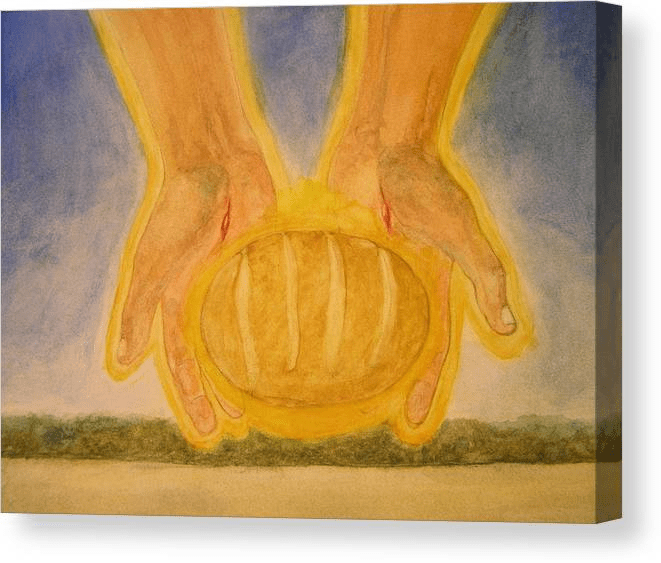
Bread From Heaven, by Nigel Wynter

On the seventh day some people went out to gather food, but they didn’t find any. The Lord said to Moses, “How long will you refuse to do what I have commanded and instructed you to do? Remember: The Lord has given you this day of rest as a holy day. That’s why he gives you enough food on the sixth day for two days. On the seventh day stay in your place—no one is to go out. Everyone, stay where you are.” So the people never worked on the seventh day of the week.

The Israelites called the food manna. It was like coriander seeds. It was white and tasted like wafers made with honey.

Moses said, “This is what the Lord has commanded: Take two quarts of manna to be kept for your descendants. This way they will see the food that I gave you to eat in the desert when I brought you out of Egypt.”

Moses said to Aaron, “Take a jar, put two quarts of manna in it, and put it in the Lord’s presence to be kept for your descendants.” Aaron put the jar of manna in front of the words of God’s promise to be kept there, as the Lord commanded Moses.

The Israelites ate manna for 40 years until they came to a place to settle. They ate manna until they came to the border of Canaan. (God’s Word Translation)

“What is it?” is the quite literal meaning of the word manna. And the answer is: It is bread from heaven.

The manna was food for the Israelite people in their 40 years of sojourning through the desert. There is also an implicit question surrounding this bread: What to do with it? Well, of course, you eat it. But, before eating it, there are issues and instructions about the manna’s arrival and collection.

The special food, only graciously given to this particular group of cantankerous people, appeared in the mornings for six days a week, not seven, and only had a shelf life of one day, with the exception of the singular Sabbath day each week.

There is a time to go out and gather, and there is a time to stay put and eat; a time to work, and a time to rest. The lack of wisdom in timing could cost you not only a meal, but also your overall sense of paying attention to God’s commands.

It is the fool who spurns the relationship between events, that is, the space between when the Lord speaks and when humanity responds. Our human responsibility is dependent upon Divine sovereignty. Ignoring the voice of God, or simply failing to listen out of present anxieties or fears, will nearly always result in a skewed response-ability.

Yes, indeed, we all have very legitimate needs for cuisine, clothing, companionship, care, and compassion. If these vital needs go unmet, we are undone and shall die. Yet, there is also the question of how we will go about getting those very important and basic needs met – and many people, having not listened well to the instructions about life, will go about attempting to meet those needs in illegitimate ways.

Trying to satisfy legitimate needs through illegitimate means ends up eroding the soul, compromising character, and searing the conscience. It’s inevitable that such a person will grumble and complain, projecting on God the evil that is, in reality, residing within the human heart.

Whenever folks go out and try to gather what isn’t there, they have lost their way and their very real needs will not really be met, at all.

This is why humans need remembrances – to have reminders of what time it is and what’s important to do and not do, to seek the appropriate paths of living well, and to avoid the pitfalls of dead end trails.

One purpose of Sabbath is to remember – to recall the great story of deliverance and never forget where we came from, so that we will continually have before us where we are going.

I Am the Bread of Life, by Joseph Matar

The Christian remembers the saving and redemptive events of Jesus by coming to the Table. We gather together to ingest bread from heaven, to partake of the Bread of Life. For those who choose to carefully listen and pay attention, the words of Christ will not only speak life into our weary selves, but shall also shape how we go about getting our needs met and satisfied:

The people began to murmur in disagreement because he had said, “I am the bread that came down from heaven….”

But Jesus replied, “Stop complaining about what I said. For no one can come to me unless the Father who sent me draws them to me, and at the last day I will raise them up. As it is written in the Scriptures, ‘They will all be taught by God.’ Everyone who listens to the Father and learns from him comes to me….

“I tell you the truth, anyone who believes has eternal life. Yes, I am the bread of life! Your ancestors ate manna in the wilderness, but they all died. Anyone who eats the bread from heaven, however, will never die. I am the living bread that came down from heaven. Anyone who eats this bread will live forever; and this bread, which I will offer so the world may live, is my flesh.”

Then the people began arguing with each other about what he meant. “How can this man give us his flesh to eat?” they asked.

So Jesus said again, “I tell you the truth, unless you eat the flesh of the Son of Man and drink his blood, you cannot have eternal life within you. But anyone who eats my flesh and drinks my blood has eternal life, and I will raise that person at the last day. For my flesh is true food, and my blood is true drink. Anyone who eats my flesh and drinks my blood remains in me, and I in him. I live because of the living Father who sent me; in the same way, anyone who feeds on me will live because of me. I am the true bread that came down from heaven. Anyone who eats this bread will not die as your ancestors did (even though they ate the manna) but will live forever.” (John 6:41-58, NLT)

Consider well, then, where and how you will find the sustenance of the soul, love, and in what ways you will listen to the words of Jesus and gather them for your next meal. Will you hoard your heaven-sent food, or will you share?

O God, our Provider and Sustainer, we who are many are one body in Christ, for we all share in the one bread. Refresh, strengthen, and preserve us as we journey in this life, in the name of Jesus Christ. Amen.

Deuteronomy 9:1-5 – A Reality Check

Jordan River by Ilan Szekely, 1944

Listen, Israel! Today you will cross the Jordan River to enter and take possession of nations larger and more powerful than you, along with huge cities with fortifications that reach to the sky. These people are large and tall—they are the Anakim. You know and have heard what people say: “Who can stand up to the Anakim?” Know right now that the Lord your God, who is crossing over before you, is an all-consuming fire! He will wipe them out! He will subdue them before you! Then you will take possession of their land, eliminating them quickly, exactly as the Lord told you.

Once the Lord your God has driven them out before you, don’t think to yourself, It’s because I’m righteous that the Lord brought me in to possess this land. It is instead because of these nations’ wickedness that the Lord is removing them before you. You aren’t entering and taking possession of their land because you are righteous or because your heart is especially virtuous; rather, it is because these nations are wicked—that’s why the Lord your God is removing them before you, and because he wishes to establish the promise he made to your ancestors: to Abraham, Isaac, and Jacob. (Common English Bible)

When my kids were small, I dealt with the issue of sharing, as every parent has to do. Once, two of my girls were fighting over a doll. As I entered the room, one of them quickly said, “She has my doll!” So, I sat her down with me and calmly asked, “Whose doll is it?” “It’s mine!” my daughter cried.

I asked again, “Whose doll is it?” Again, the answer came, “It’s my doll!” I asked yet a third time, “Whose doll is it?” Because this was not our first rodeo together about fighting over dolls and toys, my daughter bowed her head, gave a big sigh, and quietly said, “It’s God’s doll.”

“Yes, it’s God’s doll,” I said. “God is just letting you borrow it for a while and expects you to take good care of it and share his stuff with others.”

Kids often need a reality check of where things come from and who really owns it all. Many times, adults need the very same reality check.

We big people grow up and tend to think we are bigger than we really are. Over the years, we gain misguided notions of our possessions and accomplishments. We believe we did it all through our own skills and character.

Maybe you recognize some of these common notions about our life, work, and ministry:

  • “I worked a long time for my money. I’m not giving it to so-and-so.”
  • My church has a lot of people because we preach the Bible, not like other churches.”
  • “The government takes too much of my hard earned money.”
  • “Here, you can have this couch. I was going to throw it away, anyway. My couch is a nice new one.”
  • “I made a lot of sacrifices for my job. I’m not letting anyone steal my position from me.”
  • “I raised my kids and they’re all doing very well in life. They wouldn’t have made it without me.”
  • “Hey, that’s my yard. Your dog can’t be on it.”
  • “This is my time.”
  • “It’s my car. Don’t touch it.”
  • My way or the highway.”

Those are actual statements Christians have said to me over the years. In their extreme individualism, they believed they were the masters of their own goodness and achievements. In other words, they gave themselves more credit than they really deserved.

A person is proud and selfish not for pursuing their own good but for neglecting their neighbor’s.

It’s far too easy to chalk-up our positions, titles, degrees, jobs, and the good things which come with them as of our own doing. We then believe we are the true owners of all our stuff. Some can even take the next step of believing that if others would just do what I do and think the way I think, then all would be well in the world.

That’s pretty much how Lucifer thought about things. And even after getting cast from heaven, he still exists with the delusion that he didn’t deserve it, as if he were above ever getting treated any other way than like God does.

The reality, however, is that everything and everyone belongs to God. The Lord is the rightful ruler of the universe, and we are not. Every good and perfect thing we have in this life is a gift from a gracious heavenly Father.

Stupidity doesn’t come from a lack of brains or smarts; it’s a result of pride taking over one’s thinking.

Indifference doesn’t have its source in a lack of caring; it comes from believing certain people don’t deserve to have my attention, my stuff, or my time.

Arrogance isn’t an inbred personality trait; it’s the logical end of the successful person’s life who is convinced that everyone ought to adopt their particular set of societal mores, cultural values, political views, and personal disciplines.

Conversely, a person in humble circumstances with little to their name is not necessarily lazy or unwilling to work. And when they have giants in their lives, they can trust the God who specializes in taking down the stupid, the indifferent, and the arrogant.

All things are a gift from the Lord, even the difficult people and hard circumstances we face. They are really opportunities for God to show up and give us precisely what we need.

Everything is a trust from God that we are to steward well, whether it is people, things, or money. They are given to us, not because of any superior spirituality on our part or righteous ingenuity, but because God simply gives it. We have what we have because of God, period.

The appropriate way of stewarding our resources, as well as expressing thanks to God, is through sharing our stuff, our money, our time, and our love with others.

Whose life is it?

We do not presume to come to your Table, O merciful Lord, trusting in our own righteousness, but in your abundant and great mercies. We are not worthy so much as to gather up the crumbs under your table; but you are the same Lord whose character is always to have mercy. Grant us, therefore, gracious Lord, so to eat and drink that our sinful bodies may be made clean by his body, and our souls washed through his most precious blood, and that we may evermore dwell in him, and he in us. Amen.