Go and Serve the Lord (Genesis 24:1-9)

Abraham was now a very old man. The Lord had made him rich, and he was successful in everything he did. One day, Abraham called in his most trusted servant and said to him, “Solemnly promise me in the name of the Lord, who rules heaven and earth, that you won’t choose a wife for my son Isaac from the people here in the land of Canaan. Instead, go back to the land where I was born and find a wife for him from among my relatives.”

But the servant asked, “What if the young woman I choose refuses to leave home and come here with me? Should I send Isaac there to look for a wife?”

“No!” Abraham answered. “Don’t ever do that, no matter what. The Lord who rules heaven brought me here from the land where I was born and promised that he would give this land to my descendants forever. When you go back there, the Lord will send his angel ahead of you to help you find a wife for my son. If the woman refuses to come along, you don’t have to keep this promise. But don’t ever take my son back there.” So the servant gave Abraham his word that he would do everything he had been told to do. (Contemporary English Version)

The Spirit of God operates through us, God’s people. Although the Lord could do everything without us, God chooses to use us as servants doing the divine will. All of life is really and ideally a divine/human cooperative of the Lord working in and through us to accomplish good and divine purposes.

The spotlight of today’s Old Testament lesson follows Abraham’s servant – which is a picture of the Holy Spirit’s work. God has given us the responsibility and privilege of being humble servants in the world. Much like Abraham’s faithful and trusted servant, we are to fulfill God’s expectations to leave and go do the Lord’s bidding.

We have both the duty and delight of giving ourselves to the task of going out and finding the person(s) for whom the Lord sends us to find.

Jesus once said to his disciples:

“If any of you wants to be my follower, you must give up your own way, take up your cross, and follow me. If you try to hang on to your life, you will lose it. But if you give up your life for my sake and for the sake of the Good News, you will save it.” (Mark 8:34-35, NLT) 

Blessing from God happens when we leave everything and follow Jesus. God is still holding out this promise of blessing that can be realized through leaving and going. As Abraham sent out his servant, the Lord sends out so that divine promises are realized and humanity is blessed. Consider some biblical examples:

  • In order to experience marital blessing, God said in the beginning that a man must “leave his mother and father and cleave to his wife.” (Genesis 2:24) 
  • The writer of Proverbs says that if we want to see blessing, to experience God’s presence and approval, you must “leave your simple ways.” (Proverbs 9:6) 
  • Jesus said that if you have relational problems and are getting ready to worship you must “leave your gift at the altar.” Then, “first go and be reconciled to your brother.” (Matthew 5:23-24)  
  • Christ stated that, as the Great Shepherd, he will leave the ninety-nine sheep to go after one lost one. (Luke 15:4) 
  • The Lord Jesus commissioned us to do the business of leaving: “Go, and make disciples of all nations.” (Matthew 28:19). 
  • Jesus also said, “If you want to be perfect, go, sell your possessions and give to the poor, and you will have treasure in heaven.”(Matthew 19:21) 
  • The invitation has gone out concerning God’s great banquet of blessing: “Go to the street corners and invite to the banquet anyone you find.” (Matthew 22:9)

Being sent, leaving and blessing, go together.

I “leave” you with some thoughts on stepping out of our friendly and familiar environment to know the blessing of God:

  1. Hang around with others who want the blessing of God. Spend time with those who are eager to do God’s will and be God’s servant. Light each other’s fire, and let the Holy Spirit kindle a fresh flame in your heart by being around passionate Christian people. Don’t be a lone ranger, but instead consult and collaborate with others.
  2. Walk across the room. God may not be calling all of us to leave this country and go to an unreached people-group, but he is calling us all to leave our seats and walk across the room to encourage another person in their faith; or across the street to strike up a spiritual conversation with a lost neighbor; or across town to a lonely or hurting elderly person; or down the street to hang out at the laundry mat to meet new people who need the good news of grace. And, by all means, we are to walk across the pages of Scripture to follow Jesus in obedience to the Holy Spirit’s promptings.
  3. Step out in faith, no matter who you are. We might all consider Mother Teresa, who died in 1997, to be a super-Christian. She once stated, “By blood, I am Albanian. By citizenship, an Indian. By faith, I am a Catholic nun. As to my calling, I belong to the world. As to my heart, I belong entirely to the Heart of Jesus. God still loves the world and He sends you and me to be His love and His compassion to the poor to quench His thirst for love and for souls.”  Yet, at the same time, Teresa struggled in her faith for most of her life and often felt like her own soul was desolate. She once confessed, “In my soul, I feel just the terrible pain of loss, of God not wanting me, of God not being God, of God not really existing.” Even in this, her dark night of the soul was still the salvation for thousands.
  4. Don’t talk it to death. There is always more research and information and counsel to obtain. At some point you need to act. We have no need to create a sub-committee to investigate the findings of that other committee in order to decide. Frederick Buechner said, “The place God calls you to is the place where your deep gladness and the world’s deep hunger meet.” Where does your passion and the world’s great need meet? Leave, and go there. 

We are servants, meant to fulfill the instructions of a God who is calling us and sending us to do good work in this world.

Lord Jesus Christ, you stretched out your arms of love on the hard wood of the cross that everyone might come within the reach of your saving embrace. Clothe us in your Spirit so that, reaching forth our hands in love, we may bring those who do not know you to the knowledge and love of you; for the honor of your Name. Amen.

Forsaken (Jeremiah 2:4-13)

Hear the word of the Lord, you descendants of Jacob,
    all you clans of Israel.

This is what the Lord says:

“What fault did your ancestors find in me,
    that they strayed so far from me?
They followed worthless idols
    and became worthless themselves.
They did not ask, ‘Where is the Lord,
    who brought us up out of Egypt
and led us through the barren wilderness,
    through a land of deserts and ravines,
a land of drought and utter darkness,
    a land where no one travels and no one lives?’
I brought you into a fertile land
    to eat its fruit and rich produce.
But you came and defiled my land
    and made my inheritance detestable.
The priests did not ask,
    ‘Where is the Lord?’
Those who deal with the law did not know me;
    the leaders rebelled against me.
The prophets prophesied by Baal,
    following worthless idols.

“Therefore I bring charges against you again,”
declares the Lord.
    “And I will bring charges against your children’s children.
Cross over to the coasts of Cyprus and look,
    send to Kedar and observe closely;
    see if there has ever been anything like this:
Has a nation ever changed its gods?
    (Yet they are not gods at all.)
But my people have exchanged their glorious God
    for worthless idols.
Be appalled at this, you heavens,
    and shudder with great horror,”
declares the Lord.
“My people have committed two sins:
They have forsaken me,
    the spring of living water,
and have dug their own cisterns,
    broken cisterns that cannot hold water. (New International Version)

We are all wounded lovers. Keeping a steadfast commitment to someone who’s fickle, and sometimes spurns our love, is a universal feeling of deep hurt. And that is precisely how God felt about the ancient Israelites.

The feel of today’s Old Testament lesson is like being in a divorce court – God lamenting the distance which evolved between divinity and humanity. It happened because Israel went after other lovers, and practiced infidelity in their relationship with the Lord.

Since a person tends to take on the character of the god they follow, Israel had become a mess of a people. Because the gods they turned to were nothing but worthless idols. The Israelites became empty and vacuous, drained of all the robust spiritual character within their nation.

The object of love determines the quality of love.

To lose God is to lose our way of being in the world.

And the reason we lose God is that we stop telling our stories of grace, love, and forgiveness. New life, over time, becomes old hat. We end up forgetting where we came from, and so, discover that we don’t really know where we’re going.

We suffer from a severe case of spiritual amnesia.

God is who God is; I Am who I Am – and not as we may think God might be. The Lord is tied to justice and righteousness; and so, is concerned for both the individual and the community. Private life and public life each need to be characterized by integrity, service, and meeting one another’s needs.

Public institutions, corporate businesses, and even faith communities all collapse without the guiding compass of civic duty, social justice, and community service. Leaders everywhere have forgotten that power and authority is divinely given, not personally earned.

Whenever a people loses sight of their foundational stories and ethical points of reference, systemic evil arises to keep certain folks in power. And the rest of the people are coerced into serving those in authority. It’s a situation ripe for the judgment of God.

The Lord will take people to task for failing to remember who they are, where they came from, and thus, what they’re supposed to be doing.

Tragically, the Israelites swapped their God for other gods who are utterly unreliable and, frankly, not real. They lost touch with reality itself, not being able to distinguish between truth and error, and unable to discern what the good life actually is.

We must take God on God’s own terms. We are people created in the image of God, not people who create a god in the image they want. We can no more do that than a cake can claim self-existence apart from the baker.

Heaven and earth are witnesses to the folly of human forgetfulness – a lack of memory which forsakes commitment to the Divine. It’s the sort of madness that can result from a lack of sleep or water.

In such a condition, we need living water. We cannot conjure it up. There’s no way to be our own source of life, any more than a child can birth itself without any parents. Life must be given. Life is a gift.

The gift has been given. The real issue is whether we will receive it, open it, and use it.

There are many questions which cry out for us to answer:

  • Will the ego get in the way of living well?
  • Will a false sense of self delude us into believing we are the architects of our own reality?
  • Will we colonize others for what they can do for us, rather than seeking to uphold the common good of all persons?
  • What is our relationship to power and authority?
  • What are we doing with the influence we have?
  • What fault have you found with God?
  • When are we going to renew our vows to God?
  • Who are you?
  • What are you doing?
  • Where are you going?
  • Why are you here?
  • How, then, shall we live?

Sovereign God of all, I will try this day to live a simple, sincere and serene life, repelling every thought of discontent, anxiety, discouragement, impurity, and self-seeking; cultivating cheerfulness, magnanimity, charity, and the habit of holy silence; exercising economy in expenditure, generosity in giving, carefulness in conversation, diligence in appointed service, fidelity to every trust, and a childlike faith.

I will try to be faithful in those habits of prayer, work, study, physical exercise, eating, and sleep which I believe the Holy Spirit has shown me to be right. And as I cannot in my own strength do this, nor even with a hope of success attempt it, I look to you, O Lord God my Father, in Jesus my Savior, and ask for the gift of the Holy Spirit. Amen.

Your People Will Be My People (Ruth 1:6-18)

Naomi and Ruth by Chana Helen Rosenberg, 2017

When Naomi heard in Moab that the Lord had come to the aid of his people by providing food for them, she and her daughters-in-law prepared to return home from there. With her two daughters-in-law she left the place where she had been living and set out on the road that would take them back to the land of Judah.

Then Naomi said to her two daughters-in-law, “Go back, each of you, to your mother’s home. May the Lord show you kindness, as you have shown kindness to your dead husbands and to me. May the Lord grant that each of you will find rest in the home of another husband.”

Then she kissed them goodbye, and they wept aloud and said to her, “We will go back with you to your people.”

But Naomi said, “Return home, my daughters. Why would you come with me? Am I going to have any more sons, who could become your husbands? Return home, my daughters; I am too old to have another husband. Even if I thought there was still hope for me—even if I had a husband tonight and then gave birth to sons—would you wait until they grew up? Would you remain unmarried for them? No, my daughters. It is more bitter for me than for you, because the Lord’s hand has turned against me!”

At this they wept aloud again. Then Orpah kissed her mother-in-law goodbye, but Ruth clung to her.

“Look,” said Naomi, “your sister-in-law is going back to her people and her gods. Go back with her.”

But Ruth replied, “Don’t urge me to leave you or to turn back from you. Where you go I will go, and where you stay I will stay. Your people will be my people and your God my God. Where you die I will die, and there I will be buried. May the Lord deal with me, be it ever so severely, if even death separates you and me.” When Naomi realized that Ruth was determined to go with her, she stopped urging her. (New International Version)

Every time I read this account of Naomi and her daughters-in-law I’m reminded of my Dad because this was his favorite Old Testament story.

Dad was a lifelong farmer, and so, always related to the agrarian society of ancient Israel. But what really resonated for him in Scripture was Ruth’s response to her mother-in-law: “Your people are my people and your God my God. Where you die I will die, and there I will be buried.”

My father did not want to be a farmer. He wanted to go to college and become an engineer. In fact, without my grandfather’s knowledge, he was accepted to a university and secured an on-campus job. Yet, when Grandpa found out, he was less than pleased because Dad was needed on the farm during the depression era.

So, Dad, although he could have went to college, decided to stay on the farm. And the reason he decided to do so was not because he got his arm twisted, but because of the story of Ruth. He made the decision to stick with farming and never looked back. My Dad died ten years ago and is buried in the same cemetery as his father.

Ruth and Naomi by He Qi, 2001

The biblical character of Ruth is a solid example of one who was cognizant that she was part of a larger whole – that, although she was indeed an individual with personal choices, the decisions she made impact a much wider community. I believe Ruth discerned that the Israelite community understood this truth, and she wanted to be a part of it.

It is rare, in this age of extreme individualism, that people willingly give themselves to do what is best for the group, the family, the neighborhood, the faith community, the nation, and the world. There is a tendency to view things very narrowly in terms of what’s in it for me and ignore the rest.

So, I invite you to consider becoming ever more aware and connected to the communities around you. Discover the issues, problems, joys, sorrows, celebrations, and challenges they hold. And give yourself to the great struggles of that place. Jesus said:

If any of you want to be my followers, you must forget about yourself. You must take up your cross and follow me. If you want to save your life, you will destroy it. But if you give up your life for me, you will find it. (Matthew 16:24-25, CEV)

The One who is concerned to save the entire world only tolerates disciples who share his care for the entire human family.

Therefore, we ought neither to participate in nor support causes, activities, or speech that is harmful to others. Instead, we should find ways of using our particular gifts and abilities to serve the common good of all persons. We need more commitment and love, and a lot less anger, divisiveness, and hatred.

Grace and humility will always serve us, and others, very well. Judgment and pride, not so much.

Tell them to do good, to be rich in the good things they do, to be generous, and to share with others. (1 Timothy 6:18, CEB)

How, then, shall we live?

Your people will be my people.

Can you imagine a world in which all persons ascribe to this?

May it be so, to the glory of God.

We pray to you, Lord God, for all people everywhere:

For all people in their daily life and work;
For our families, friends, and neighbors, and for those who are alone.

For our community, the nation, and the world;
For all who work for justice, freedom, and peace.

For the just and proper use of your creation;
For the victims of hunger, fear, injustice, and oppression.

For all who are in danger, sorrow, or any kind of trouble;
For those who minister to the sick, the friendless, and the needy.

For the peace and unity of the Church;
For all who proclaim and seek the Truth.

Hear us, Lord; For your mercy is great. Amen.

Matthew 20:20-28 – Leadership as Service to Others

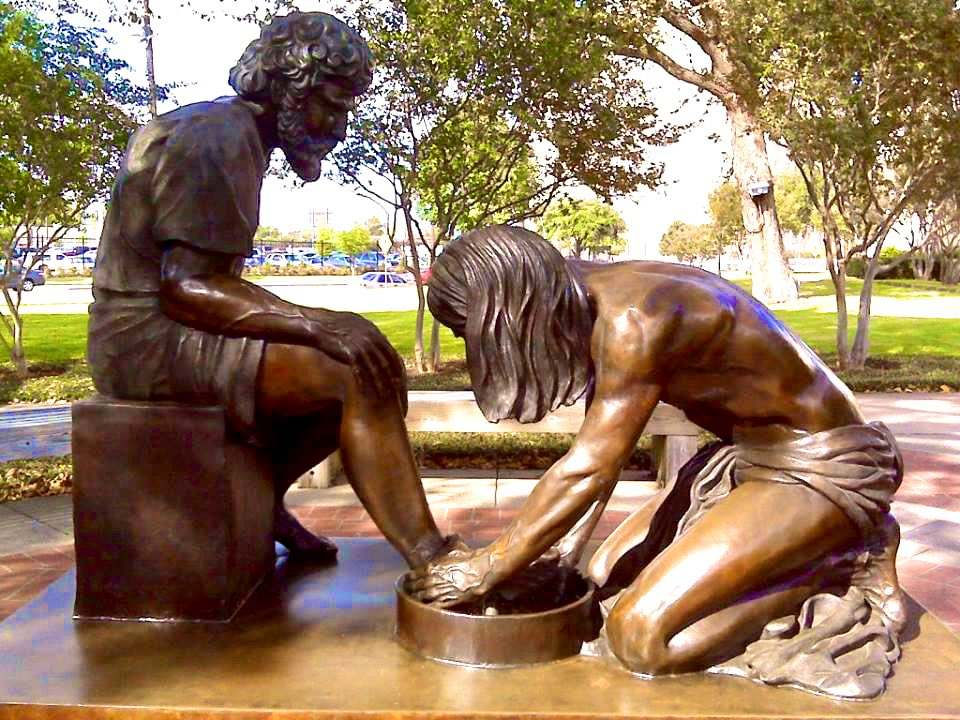
Statue of Jesus washing Peter’s feet, in Pittsburgh, Texas. Photo by Carol Highsmith

The mother of Zebedee’s sons came to Jesus with her sons and, kneeling down, asked a favor of him.

“What is it you want?” he asked.

She said, “Grant that one of these two sons of mine may sit at your right and the other at your left in your kingdom.”

“You don’t know what you are asking,” Jesus said to them. “Can you drink the cup I am going to drink?”

“We can,” they answered.

Jesus said to them, “You will indeed drink from my cup, but to sit at my right or left is not for me to grant. These places belong to those for whom they have been prepared by my Father.”

When the ten heard about this, they were indignant with the two brothers. Jesus called them together and said, “You know that the rulers of the Gentiles lord it over them, and their high officials exercise authority over them. Not so with you. Instead, whoever wants to become great among you must be your servant, and whoever wants to be first must be your slave—just as the Son of Man did not come to be served, but to serve, and to give his life as a ransom for many.” (New International Version)

Jesus and his disciples were not on the same page. That’s because they each had differing agendas.

Jesus was clear with the disciples about how things were going to shake out with him: torture, insults, crucifixion, and death was ahead. It seems the disciples and the mother of James and John missed the memo on this. Christ’s words went way over their heads.

It could be the disciples simply did not hear what Jesus was saying to them (repeatedly!). It’s more likely that the message of Jesus got filtered through an existing agenda of how they believed things ought to go.

The disciples, along with a lot of other Jewish folk in the first century, were looking for a Messiah in the mold of King David – a strong leader who would come and beat up the Romans, exert all kinds of power and influence, and establish an earthly rule over all the people they don’t like.

Submission to torture, humility before the very people they detested, and being killed by them were not factors into the disciples understanding of leadership and government.

Much like the powerful Aslan who had a thorough understanding of the world’s deep magic and submitted himself to the White Witch and death in C.S. Lewis’s The Lion, the Witch, and the Wardrobe – Jesus knew what he was doing, while everyone else seemed clueless about the true power which exists in the universe.

Let’s be clear about what that true power really is: grace. Yes, grace. Powerful, resplendent, subversive, scandalous, and radical grace.

Mercy was the missing factor in the disciples’ agenda. Jesus is not like other rulers. He does not operate by throwing his weight around to forcefully impose a crushing my-way-or-the-highway kind of rule (even though, ironically, he is The Way).

No, Jesus freely and unabashedly uses grace with its merciful tools of humility, gentleness, kindness, goodness, and love to introduce and establish a new kind of rule which is not posturing for self-serving authority.

Power, authority, and the positions which go with them are to be used for the common good of all persons. To be in any sort of leadership position is to be a servant of grace for the benefit of humanity and the world.

If Christ’s disciples had looked a bit closer into the Scriptures, they might have noticed, for all his power and authority, that King David trafficked in grace.

David, at the pinnacle of power, looked over the kingdom to see who from the family of his enemy, the former King Saul (who was into the power thing for himself) was around so he could show grace (2 Samuel 9). It was typical of ancient kings to secure their rule and power through killing-off rivals and family members of previous kings. Not so with David. And not so with Jesus.

Wherever there is posturing for position, preening for power, and a pestering for privilege – there you will find everything grace is not:

  • Reliance on making and calling-in favors
  • Arrogant and overinflated egos
  • Unrealistic expectations
  • Hatred and suspicion of others
  • Judgment and condemnation
  • An insistence on recognition
  • Compulsive manipulation and control over everything and everyone
  • Unilateral decision-making
  • Shaming of others
  • Hoarding resources
  • Coups and in-fighting
  • A demand of rights

We in the western world may not be in the habit of offing leaders and killing others to consolidate power, yet we still too often rely on violent speech and language, partisan policies, and good-old-boy systems which are foreign to the way of Christ.

In contrast to this, grace exists. It is the deep magic which resides within. Wherever grace operates, there you will find the heart of a servant:

Attending to the needs of all persons, especially the least, the last, and the lost

  • Freely consulting and collaborating with others
  • Focusing on responsibility
  • Loving discipline
  • Embracing accountability
  • Pursuing truth and integrity
  • Sharing power and resources
  • Encouraging feedback
  • Giving generously
  • Looking for ways to show mercy

This old world desperately needs leaders with a dutiful sense of public service which is compassionate and kind. Wielding authority is not about a show of strength; it is in the understanding that when I am weak, then I am strong.

Yes, this approach to leadership may bring some short-term suffering. Grace, however, results in longevity of righteousness and peace for those who have been trained by it. True service is being a servant of grace.

May it be so, to the glory of God, and for the blessing of the world. Amen.