Build Spiritual Wealth (1 Timothy 6:11-21)

But you, man of God, flee from all this [love of money] and pursue righteousness, godliness, faith, love, endurance and gentleness. Fight the good fight of the faith. Take hold of the eternal life to which you were called when you made your good confession in the presence of many witnesses. 

In the sight of God, who gives life to everything, and of Christ Jesus, who while testifying before Pontius Pilate made the good confession, I charge you to keep this command without spot or blame until the appearing of our Lord Jesus Christ, which God will bring about in his own time—God, the blessed and only Ruler, the King of kings and Lord of lords, who alone is immortal and who lives in unapproachable light, whom no one has seen or can see. To him be honor and might forever. Amen.

Command those who are rich in this present world not to be arrogant nor to put their hope in wealth, which is so uncertain, but to put their hope in God, who richly provides us with everything for our enjoyment. 

Command them to do good, to be rich in good deeds, and to be generous and willing to share. In this way they will lay up treasure for themselves as a firm foundation for the coming age, so that they may take hold of the life that is truly life.

Timothy, guard what has been entrusted to your care. Turn away from godless chatter and the opposing ideas of what is falsely called knowledge, which some have professed and in so doing have departed from the faith.

Grace be with you all. (New International Version)

Whether we like it, or not, every one of us is a slave. I don’t mean slavery in the sense of nineteenth century antebellum black chattel slavery; but a slave in the vein of being a bondservant – one who is bound to a particular master by choice, and not by coercion.

Jesus put the matter this way:

“No one can serve two masters. Either you will hate the one and love the other, or you will be devoted to the one and despise the other. You cannot serve both God and money.” (Matthew 6:24, NIV)

Both Jesus and Paul had the assumption that we are all in service to something or someone, without exception. So, the question then becomes, “Who is your master?”

Becoming a bondservant to Master Mammon will cause a person to place their ultimate hopes and dreams in wealth and possessing financial resources. However, money will possess them, and not the other way around. Their relationships will suffer, wither, and become disconnected.

Conversely, being a bondservant to the Lord Jesus will lead a person to place their ultimate hope in God. Possessing a godly life, faith, love, endurance, and gentleness will be their way of life. They will give themselves to a spirit of generosity and the pursuit of good deeds. These servants of God will take hold of eternal life, and find themselves possessed by it.

The Apostle Paul, in writing one of his final letters on this earth, reminded his young protégé Timothy to teach his congregation the importance of being bonded in service to the right master, to build spiritual wealth in heaven, and not just financial wealth here on this earth.

The letter of Paul to Timothy is given as a relational gift, reminding the young pastor of the many things taught to him in the apprenticed relationship they enjoyed together. In this sense, it was a personal letter, designed to recall the importance of keeping tethered to Christ their Lord.

Through written language, Paul came alongside Timothy and spoke to him, saying to never become intimidated by riches or rich persons. Financial wealth is merely superficial, and holds no credit or influence in the kingdom of God.

God is far richer, and infinitely more powerful than anyone or anything in this world, Paul insisted. So, keep serving God alone; continue being bonded and united to Christ, which Paul knew was not an easy thing to do.

In a world of looking out for number one, survival of the fittest, and hyper-capitalistic economies, many succumb to the allure of trusting in Master Mammon. Instead, stay focused on the Lord Jesus, his words and his ways, and on living an exemplary life.

What is more, Paul exhorted Timothy to command those who are rich in this world to become rich in good deeds. It is possible to be wealthy and be a bondservant of Christ; yet, it is not at all easy to do so.

Which is why the rich person needs continual encouragement, exhortation, and accountability, in order to remain bound to what is most important. Such persons need the command to put their hope continually in God, and not in money or bit-coins; in Christ, and not in building a strong financial portfolio that will keep one swimming in plenty of financial resources.

Again, none of this teaching of the Apostle means that having an array of financial capital is somehow wrong or ungodly. Rather, it means that we must be quite intentional and careful to build our equity in the kingdom of God, and use our worldly wealth for good and just purposes that reflect a righteous life—a life of wonder, faith, love, steadiness, and kindness.

Guard the precious treasure given to you, that is, the great spiritual riches entrusted to you. Allow the overwhelming grace of God in Jesus Christ to keep you faithful and loving in this greedy and feckless world.

The Lord Jesus taught us in his Sermon on the Mount:

“Don’t hoard treasure down here where it gets eaten by moths and corroded by rust or—worse!—stolen by burglars. Stockpile treasure in heaven, where it’s safe from moth and rust and burglars. It’s obvious, isn’t it? The place where your treasure is, is the place you will most want to be, and end up being.” (Matthew 6:19-21, MSG)

Lord of our lives, teach us how to use our money and our possessions. Deliver us from stinginess and wasteful extravagance; inspire our giving with the spirit of true generosity. Help us always to remember your generous love for us, that we may be wise and faithful stewards of the good gifts you have given us. Amen.


Take Responsibility (Deuteronomy 3:23-29)

It was also at that same time that I begged the Lord: Please, Lord God! You have only begun to show your servant your greatness and your mighty hand. What god in heaven or on earth can act as you do or can perform your deeds and powerful acts? Please let me cross over the Jordan River so I can see the wonderful land that lies beyond it: those beautiful highlands, even the Lebanon region.

But the Lord was angry with me because of you! He wouldn’t listen to me. He said to me: That’s enough from you! Don’t ever ask me about this again! Go up to the top of Mount Pisgah. Look west, north, south, and east. Have a good look, but you will not cross the Jordan River. Instead, command Joshua, strengthen him, and encourage him because he’s the one who will cross the river before this people. He’s the one who will make sure they inherit the land you will see.

After that, we stayed in the valley across from Beth-peor. (Common English Bible)

I wonder if God ever feels like the parents of elementary aged children. “Please, please, puh-leeeze let me have it!” It’s a good thing God is spirit, because there may be some divine eye rolling happening with certain people’s requests.

When Moses pleaded God to allow him to cross the Jordan River into the Promised Land, the Lord forbade him to do so. The reason God gave is that Moses had to bear the brunt of the Lord’s anger on behalf of the community.

But you [Israel] had no faith in the Lord your God about this matter, even though he went ahead of you, scouting places where you should camp, in fire by night, so you could see the road you were taking, and in cloud during the daytime.

The Lord heard what you said. He was angry and he swore: Not even one of these people—this wicked generation!—will see the wonderful land that I promised to give to your ancestors… (The Lord was even angry with me [Moses] because of what you did. “You won’t enter the land either,” God said. “But Nun’s son Joshua, your assistant, will enter it. Strengthen him because he’s the one who will help Israel inherit the land.”) (Deuteronomy 1:32-38, CEB)

Not allowing Moses to enter the land may seem strange to us whose culture prizes individualism and self-reliance. But that was not the culture of ancient Israel. There was a common core belief in corporate responsibility. The leader acted as the representative of the people, and so, Moses was answerable for the community’s sins.

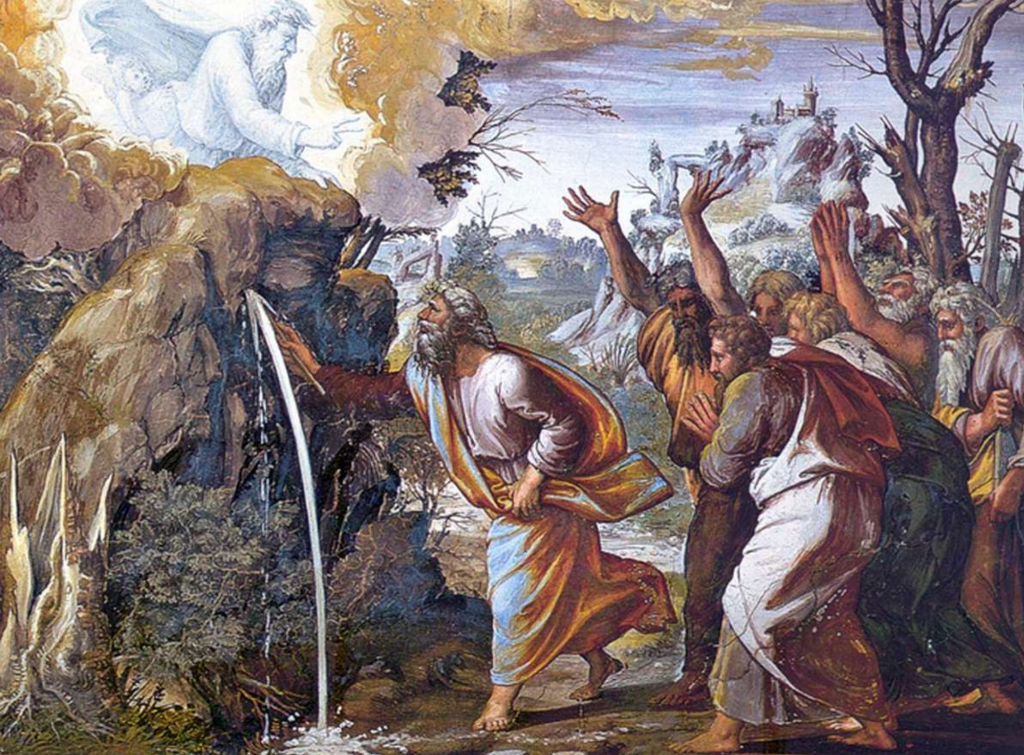
Fresco of Moses and water from the rock, by Raffaello Sanzio da Urbino (Raphael), 1519

Lest we still don’t like what’s going on here, elsewhere in scripture we get a perspective that it was also the lack of faith by Moses that caused him to lose privilege in entering the land:

Moses and Aaron gathered the assembly before the rock. He said to them, “Listen, you rebels! Should we produce water from the rock for you?” Then Moses raised his hand and struck the rock with his staff twice. Out flooded water so that the community and their animals could drink.

The Lord said to Moses and Aaron, “Because you didn’t trust me to show my holiness before the Israelites, you will not bring this assembly into the land that I am giving them.” These were the waters of Meribah, where the Israelites confronted the Lord with controversy and he showed his holiness to them. (Numbers 20:10-13, CEB)

The fact of the matter is that we are responsible for both our personal selves and the entire community of people we are a part of. Indeed, we truly are our brother’s and sister’s keeper.

It’s important that everyone considers what the Lord’s will is – not only personally – but for the common good of all the people. Perhaps this idea is captured best in the fictitious Star Trek adage of the alien Vulcans who would logically examine a decision and say, “The needs of the many outweigh the needs of the few (or the one).”

What’s more, believers in God are meant to consider what is pleasing to the Lord, and not only to one’s personal or communal pleasure. The Lord is God and we are not. Sovereignty belongs to God. Servanthood belongs to us; and our ultimate service is to the Lord.

The bottom line for me is believing that the Lord God is good, all the time, and truly has our best interests at mind and at heart. Since God did not allow Moses into the land, I reason that it was for a greater good that transcended the individual request of Moses to enter.

Maybe that’s a difficult perspective to find whenever we are in the middle of strong desires for something, but it is one that we must struggle to find. Since the Lord is high and holy above everyone and everything, God is able to see the big picture and every angle of a situation.

We, however, only see a very small slice of the total view. So, it only makes sound spiritual sense that we learn to entrust ourselves to the One who sees all and acts according to what is right, just, and good.

Gracious and generous God, Creator and Giver of all that is good, we thank you for our many blessings. We acknowledge that all that we have is from you. We offer you thanks and praise for the beauty of the earth, our work, our family, our loved ones, and all the gifts we have been given.

You are with us always. In each dark hour, you are here. In each bright hour, you are here. Blessed by your grace, may we show gratitude by sharing what we have been given. For by serving our brothers and sisters, we serve you.

We remain ever grateful for your constant love, the gift of your Son Jesus, and the presence of your Holy Spirit with us. Protect and guide us on our personal and collective journeys, as we seek to be your faithful stewards. Amen.

Go and Serve the Lord (Genesis 24:1-9)

Abraham was now a very old man. The Lord had made him rich, and he was successful in everything he did. One day, Abraham called in his most trusted servant and said to him, “Solemnly promise me in the name of the Lord, who rules heaven and earth, that you won’t choose a wife for my son Isaac from the people here in the land of Canaan. Instead, go back to the land where I was born and find a wife for him from among my relatives.”

But the servant asked, “What if the young woman I choose refuses to leave home and come here with me? Should I send Isaac there to look for a wife?”

“No!” Abraham answered. “Don’t ever do that, no matter what. The Lord who rules heaven brought me here from the land where I was born and promised that he would give this land to my descendants forever. When you go back there, the Lord will send his angel ahead of you to help you find a wife for my son. If the woman refuses to come along, you don’t have to keep this promise. But don’t ever take my son back there.” So the servant gave Abraham his word that he would do everything he had been told to do. (Contemporary English Version)

The Spirit of God operates through us, God’s people. Although the Lord could do everything without us, God chooses to use us as servants doing the divine will. All of life is really and ideally a divine/human cooperative of the Lord working in and through us to accomplish good and divine purposes.

The spotlight of today’s Old Testament lesson follows Abraham’s servant – which is a picture of the Holy Spirit’s work. God has given us the responsibility and privilege of being humble servants in the world. Much like Abraham’s faithful and trusted servant, we are to fulfill God’s expectations to leave and go do the Lord’s bidding.

We have both the duty and delight of giving ourselves to the task of going out and finding the person(s) for whom the Lord sends us to find.

Jesus once said to his disciples:

“If any of you wants to be my follower, you must give up your own way, take up your cross, and follow me. If you try to hang on to your life, you will lose it. But if you give up your life for my sake and for the sake of the Good News, you will save it.” (Mark 8:34-35, NLT) 

Blessing from God happens when we leave everything and follow Jesus. God is still holding out this promise of blessing that can be realized through leaving and going. As Abraham sent out his servant, the Lord sends out so that divine promises are realized and humanity is blessed. Consider some biblical examples:

  • In order to experience marital blessing, God said in the beginning that a man must “leave his mother and father and cleave to his wife.” (Genesis 2:24) 
  • The writer of Proverbs says that if we want to see blessing, to experience God’s presence and approval, you must “leave your simple ways.” (Proverbs 9:6) 
  • Jesus said that if you have relational problems and are getting ready to worship you must “leave your gift at the altar.” Then, “first go and be reconciled to your brother.” (Matthew 5:23-24)  
  • Christ stated that, as the Great Shepherd, he will leave the ninety-nine sheep to go after one lost one. (Luke 15:4) 
  • The Lord Jesus commissioned us to do the business of leaving: “Go, and make disciples of all nations.” (Matthew 28:19). 
  • Jesus also said, “If you want to be perfect, go, sell your possessions and give to the poor, and you will have treasure in heaven.”(Matthew 19:21) 
  • The invitation has gone out concerning God’s great banquet of blessing: “Go to the street corners and invite to the banquet anyone you find.” (Matthew 22:9)

Being sent, leaving and blessing, go together.

I “leave” you with some thoughts on stepping out of our friendly and familiar environment to know the blessing of God:

  1. Hang around with others who want the blessing of God. Spend time with those who are eager to do God’s will and be God’s servant. Light each other’s fire, and let the Holy Spirit kindle a fresh flame in your heart by being around passionate Christian people. Don’t be a lone ranger, but instead consult and collaborate with others.
  2. Walk across the room. God may not be calling all of us to leave this country and go to an unreached people-group, but he is calling us all to leave our seats and walk across the room to encourage another person in their faith; or across the street to strike up a spiritual conversation with a lost neighbor; or across town to a lonely or hurting elderly person; or down the street to hang out at the laundry mat to meet new people who need the good news of grace. And, by all means, we are to walk across the pages of Scripture to follow Jesus in obedience to the Holy Spirit’s promptings.
  3. Step out in faith, no matter who you are. We might all consider Mother Teresa, who died in 1997, to be a super-Christian. She once stated, “By blood, I am Albanian. By citizenship, an Indian. By faith, I am a Catholic nun. As to my calling, I belong to the world. As to my heart, I belong entirely to the Heart of Jesus. God still loves the world and He sends you and me to be His love and His compassion to the poor to quench His thirst for love and for souls.”  Yet, at the same time, Teresa struggled in her faith for most of her life and often felt like her own soul was desolate. She once confessed, “In my soul, I feel just the terrible pain of loss, of God not wanting me, of God not being God, of God not really existing.” Even in this, her dark night of the soul was still the salvation for thousands.
  4. Don’t talk it to death. There is always more research and information and counsel to obtain. At some point you need to act. We have no need to create a sub-committee to investigate the findings of that other committee in order to decide. Frederick Buechner said, “The place God calls you to is the place where your deep gladness and the world’s deep hunger meet.” Where does your passion and the world’s great need meet? Leave, and go there. 

We are servants, meant to fulfill the instructions of a God who is calling us and sending us to do good work in this world.

Lord Jesus Christ, you stretched out your arms of love on the hard wood of the cross that everyone might come within the reach of your saving embrace. Clothe us in your Spirit so that, reaching forth our hands in love, we may bring those who do not know you to the knowledge and love of you; for the honor of your Name. Amen.

What Will It Take to Reach Others? (1 Corinthians 9:19-23)

Even though I am free of the demands and expectations of everyone, I have voluntarily become a servant to any and all in order to reach a wide range of people: religious, nonreligious, meticulous moralists, loose-living immoralists, the defeated, the demoralized—whoever. I didn’t take on their way of life. I kept my bearings in Christ—but I entered their world and tried to experience things from their point of view. I’ve become just about every sort of servant there is in my attempts to lead those I meet into a God-saved life. I did all this because of the Message. I didn’t just want to talk about it; I wanted to be in on it! (The Message)

What will it take? 

What will it take to impact the world with the gospel of grace? 

What will it take to reach your neighbor with the love of God in Christ? 

What will it take to positively influence your relative, co-worker, or friend in grace and truth? 

The answer? It will take becoming a servant to them all. 

Reaching others with the glorious and incredible good news of forgiveness and new life in Jesus requires us to relinquish our rights and freedoms in order to have a ministry of presence. 

Somehow, far too many Churches and Christians have adopted the wrongheaded notion that they can reach people without interacting with them. They wing-it with a few tepid prayers, wishing that people will magically show up their church or event in order to experience their friendliness.

But it takes going to where people are and engaging in real human relationship to reach another person. It ought to be obvious, yet it isn’t for a lot of folks:

We have to be around other people in order to reach them. 

That’s why reaching the party-crowd takes going to the bar. 

It’s why reaching young moms takes sitting with them at the park while the kids play. 

It’s why reaching kids requires getting on the floor with them and playing what they want to play.

This is why it takes being present among the various people, businesses, and institutions in the community in order to reach them.

The goal is not to get other people to show up on our turf and become just like us. The goal is not for us to remain in comfortable surroundings while we expect others to get over their uncomfortableness to be with us.

Rather, the goal is to show up on their turf and relate to them, to become like them.

If it weren’t in the Bible we might think it blasphemous to say such a thing. But there it is, and we must wrestle with its implications for our lives. So, what needs to change?

My wife and I have a lot of experience working with dementia and Alzheimer’s patients – which means we also end up working a lot with their adult children and grandchildren. It’s difficult watching a person who raised you becoming a different person, living in a different world.

Many relatives try their darndest to get mom or dad back into “reality,” to return to their original selves and their surroundings. So, they correct, cajole, and criticize, in order to reach them and pull them back from their supposed mental abyss.

And it doesn’t work. More than that, it’s not only unhelpful, but it’s also often hurtful.

Instead of expecting a dementia patient to come into my world, I must go into their world.

Just the other day, my wife was talking with a self-described “Ninja Priestess.” And this dear woman was refusing to wear her socks on a hospital floor – which cannot happen in a healthcare setting. She didn’t want to wear them because “it diminishes my power and my connection to the ground.”

If we insist on remaining in our world, this immediately becomes a fight. Ultimatums are issued. Policies are pronounced. Security is called because everything escalates out of control.

Yet, if we enter the dear woman’s world, we choose to see things from her perspective and not ours.

My wife’s response? “It’s okay. The socks are cotton. All natural. They won’t hinder your power, at all.” And off they went together down the hall without incident and the patient feeling cared for and empowered.

When it comes to reaching people – anyone, no matter who they are – we must be willing to enter their world and be a part of it, seeing things as they see it, understanding where they’re coming from, without judgment and with plenty of empathy and compassion.

But if we insist on colonizing others in order to harvest their souls for our own spiritual benefit, then we have failed to understand the spirit and intent of the Apostle Paul’s teaching to us.

Being a servant means exactly that – serving others by listening, washing their feet, giving them time, and making compassionate connections.

God has cut us into the action of divine purposes in this world. This is privileged work. So, let’s do it with all the care and concern given us by the Spirit.

Merciful God, help us, your people, to live wisely among those who don’t yet know you, so that they can see the light of Christ in us, hear the words of Christ from us, and experience the salvation of Christ which is in us. Amen.