Acceptance (Acts 7:17-40)

“As the time drew near for God to fulfill his promise to Abraham, the number of our people in Egypt had greatly increased. Then ‘a new king, to whom Joseph meant nothing, came to power in Egypt.’He dealt treacherously with our people and oppressed our ancestors by forcing them to throw out their newborn babies so that they would die.

“At that time Moses was born, and he was no ordinary child. For three months he was cared for by his family. When he was placed outside, Pharaoh’s daughter took him and brought him up as her own son. Moses was educated in all the wisdom of the Egyptians and was powerful in speech and action.

“When Moses was forty years old, he decided to visit his own people, the Israelites. He saw one of them being mistreated by an Egyptian, so he went to his defense and avenged him by killing the Egyptian. Moses thought that his own people would realize that God was using him to rescue them, but they did not. The next day Moses came upon two Israelites who were fighting. He tried to reconcile them by saying, ‘Men, you are brothers; why do you want to hurt each other?’

“But the man who was mistreating the other pushed Moses aside and said, ‘Who made you ruler and judge over us? Are you thinking of killing me as you killed the Egyptian yesterday?’ When Moses heard this, he fled to Midian, where he settled as a foreigner and had two sons.

Moses and the Burning Bush, by Marc Chagall

“After forty years had passed, an angel appeared to Moses in the flames of a burning bush in the desert near Mount Sinai. When he saw this, he was amazed at the sight. As he went over to get a closer look, he heard the Lord say: ‘I am the God of your fathers, the God of Abraham, Isaac and Jacob.’ Moses trembled with fear and did not dare to look.

“Then the Lord said to him, ‘Take off your sandals, for the place where you are standing is holy ground. I have indeed seen the oppression of my people in Egypt. I have heard their groaning and have come down to set them free. Now come, I will send you back to Egypt.’

“This is the same Moses they had rejected with the words, ‘Who made you ruler and judge?’ He was sent to be their ruler and deliverer by God himself, through the angel who appeared to him in the bush. He led them out of Egypt and performed wonders and signs in Egypt, at the Red Sea and for forty years in the wilderness.

“This is the Moses who told the Israelites, ‘God will raise up for you a prophet like me from your own people.’ He was in the assembly in the wilderness, with the angel who spoke to him on Mount Sinai, and with our ancestors; and he received living words to pass on to us.

“But our ancestors refused to obey him. Instead, they rejected him and in their hearts turned back to Egypt. They told Aaron, ‘Make us gods who will go before us. As for this fellow Moses who led us out of Egypt—we don’t know what has happened to him!’ (New International Version)
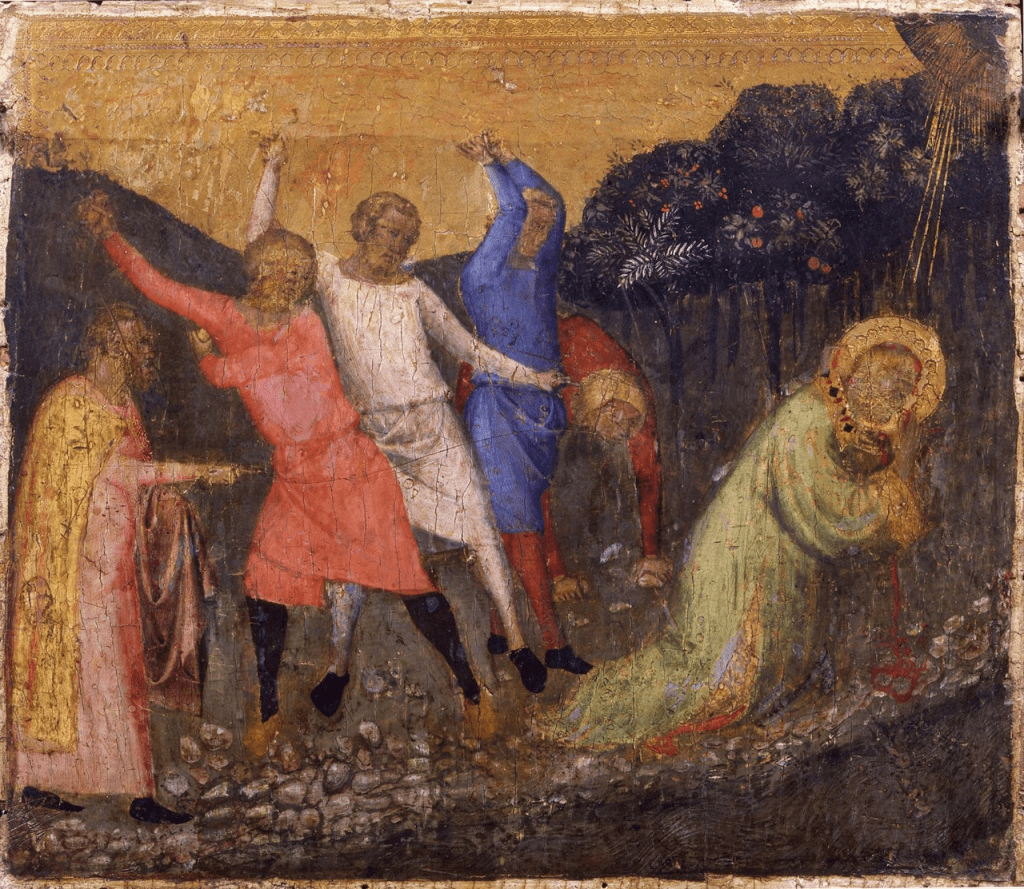
Martyrdom of St. Stephen, by Bernardo Daddi, 1345

We humans are a confusing paradox of sinner and saint. We are majestic people, created in the image and likeness of a good God.

And we are also profoundly fallen, touched by the power of sin in every area of our lives. Our hearts exist with both light and darkness, having the capacity for both incredible altruism as well as inexplicable evil.

So then, it will do no good to retreat into binary definitions of people as being either good or bad. No, we shine and shadow at the same time. The thing that really gets us into a terrible mess is when we ignore or deny our shadow selves. We then demonize the other while claiming purity for ourselves.

This is precisely what occurred with Stephen and a group of his fellow Jews who refused to acknowledge their shadow side. And it resulted in Stephen’s stoning and death. Whereas Stephen lifted and brought to light the unseemly aspects of their collective heritage, the people wanted nothing to do with it.

In our present day, the response might be something like, “Quit being so negative. We focus on the positive. Expel this recalcitrant troublemaker once and for all!”

Oy. Acceptance cuts two ways. We must accept both our blessings and our curses. And the acceptance of what is will not occur apart from a solid self-acceptance of who we are and how we are feeling in any given situation. On the practical level, it works something like the following story…

Several years ago, I went on a leadership retreat in the Canadian wilderness. We were so far out in the sticks that we needed special first aid training before leaving – because if someone got severely injured it would be hours before any medical attention could be received. There was no cell phone service, no towns, no anything except mile after square mile of wilderness. 

One day, it was very windy and several of us were on a lake canoeing to a destination. It was late May, which means the water was still ice cold in Canada. One of the canoes capsized and we had to act quickly and deliberately – which was no small feat in a stiff wind. More than fifteen minutes would result in hypothermia for the two people in the water.

I did not like being in that situation. In fact, I didn’t much like the Canadian wilderness. Too many black flies and giant mosquitoes for me. My shadow side was coming out. But here I was, and I had to accept the reality I was in. One of the lessons I learned in that moment was that acceptance can sit alongside other reactions and emotions.

For example, a person can be outraged by an injustice, as Stephen was, and accept that it is a reality. Acceptance does not mean complacency or giving up. We can accept something while at the same time trying to make it better.

I also needed to accept what was happening inside of me. I was cold and worried. Trying to push those feelings away would have only added to the stress of the situation. If I failed to accept what was true about myself, I would be less able to deal with the situation, and so, would compromise my ability to help two people at risk.

I needed to accept the whole circumstance, including myself. Accepting what is inside gave me more influence over the situation, not less. Self-acceptance became the key to acceptance of unwanted conditions, and more importantly, acceptance of one another as human beings.

In that moment of rescuing two people (which ultimately proved successful) I became aware of a part of myself – the part that gets afraid and irritated – and chose not to stuff it or deny its existence. I became the guy who talked to the panicked people in the water and kept them as calm as possible so that the others could get them out. I was able to do my part to help fearful people because I acknowledged and accepted my own fear.

Unlike my situation, however, Stephen’s experience ended in martyrdom. Just because we respond rightly is no guarantee that everything will work out for our benefit. Rather, we say and do the things we must say and do, while leaving the results to a sovereign Lord.

It is our responsibility to work on ourselves, not others. And acceptance is the path to get there, all of it, not just part of it.

Jesus, let your mighty calmness lift me above my fears and frustrations. By your deep patience, give me tranquility and stillness of soul in you. Make me in this, and in all things, more and more like you. Amen.

Dealing with Spiritual Blindness (John 9:1-41)

Coptic Church depiction of Jesus healing the man born blind

As he went along, he saw a man blind from birth. His disciples asked him, “Rabbi, who sinned, this man or his parents, that he was born blind?”

“Neither this man nor his parents sinned,” said Jesus, “but this happened so that the works of God might be displayed in him. As long as it is day, we must do the works of him who sent me. Night is coming when no one can work. While I am in the world, I am the light of the world.”

After saying this, he spit on the ground, made some mud with the saliva, and put it on the man’s eyes. “Go,” he told him, “wash in the Pool of Siloam” (this word means “Sent”). So the man went and washed, and came home seeing.

His neighbors and those who had formerly seen him begging asked, “Isn’t this the same man who used to sit and beg?” Some claimed that he was.

Others said, “No, he only looks like him.”

But he himself insisted, “I am the man.”

“How then were your eyes opened?” they asked.

He replied, “The man they call Jesus made some mud and put it on my eyes. He told me to go to Siloam and wash. So I went and washed, and then I could see.”

“Where is this man?” they asked him.

“I don’t know,” he said.

They brought to the Pharisees the man who had been blind. Now the day on which Jesus had made the mud and opened the man’s eyes was a Sabbath. Therefore the Pharisees also asked him how he had received his sight. “He put mud on my eyes,” the man replied, “and I washed, and now I see.”

Some of the Pharisees said, “This man is not from God, for he does not keep the Sabbath.”

But others asked, “How can a sinner perform such signs?” So they were divided.

Then they turned again to the blind man, “What have you to say about him? It was your eyes he opened.”

The man replied, “He is a prophet.”

They still did not believe that he had been blind and had received his sight until they sent for the man’s parents. “Is this your son?” they asked. “Is this the one you say was born blind? How is it that now he can see?”

“We know he is our son,” the parents answered, “and we know he was born blind. But how he can see now, or who opened his eyes, we don’t know. Ask him. He is of age; he will speak for himself.” His parents said this because they were afraid of the Jewish leaders, who already had decided that anyone who acknowledged that Jesus was the Messiah would be put out of the synagogue. That was why his parents said, “He is of age; ask him.”

A second time they summoned the man who had been blind. “Give glory to God by telling the truth,” they said. “We know this man is a sinner.”

He replied, “Whether he is a sinner or not, I don’t know. One thing I do know. I was blind but now I see!”

Then they asked him, “What did he do to you? How did he open your eyes?”

He answered, “I have told you already and you did not listen. Why do you want to hear it again? Do you want to become his disciples too?”

Then they hurled insults at him and said, “You are this fellow’s disciple! We are disciples of Moses! We know that God spoke to Moses, but as for this fellow, we don’t even know where he comes from.”

The man answered, “Now that is remarkable! You don’t know where he comes from, yet he opened my eyes. We know that God does not listen to sinners. He listens to the godly person who does his will. Nobody has ever heard of opening the eyes of a man born blind. If this man were not from God, he could do nothing.”

To this they replied, “You were steeped in sin at birth; how dare you lecture us!” And they threw him out.

Jesus heard that they had thrown him out, and when he found him, he said, “Do you believe in the Son of Man?”

“Who is he, sir?” the man asked. “Tell me so that I may believe in him.”

Jesus said, “You have now seen him; in fact, he is the one speaking with you.”

Then the man said, “Lord, I believe,” and he worshiped him.

Jesus said] “For judgment I have come into this world, so that the blind will see and those who see will become blind.”

Some Pharisees, who were with him, heard him say this and asked, “What? Are we blind too?”

Jesus said, “If you were blind, you would not be guilty of sin; but now that you claim you can see, your guilt remains. (New International Version)

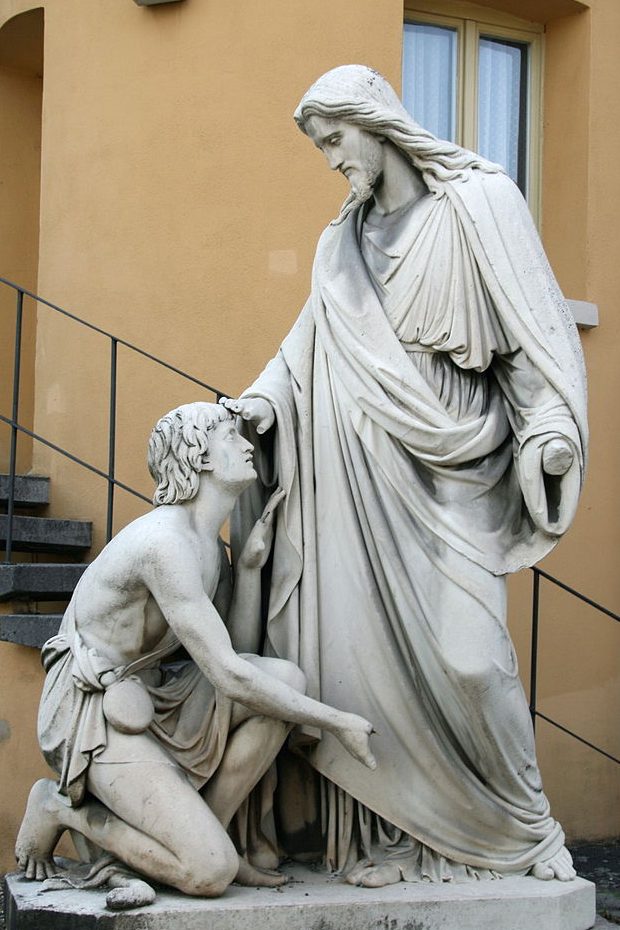
Jesus healing blind Bartimaeus by Johann Heinrich Stöver, 1861. St John’s Church, Hesse, Germany

Assuming Blindness

Behind everything we believe and talk about, there are pre-suppositions or assumptions. The disciples had an assumption about blindness: its sin – not just a result of living in a fallen world, but personal sin. That is, an individual sinner whom we can point the finger to. The disciples demonstrated they were just as blind as the physically blind man.

Jesus had a clear and concise response to that assumption: nobody is at fault here, nobody. Which, to me, begs the question:

Have you considered that your thoughts are subjective, not objective?

Too many people treat their thoughts, ideas, and beliefs as if they were pure gospel truth (which is probably why they feel justified in assuming they are always right and are arbiters of truth!). Reality check: You, nor I, have the corner on truth. Jesus is the truth, not anybody else.

Healing Blindness

Since Jesus is the way, the truth, and the life, he has the power and authority to heal, making the blind to see. Sin wasn’t the issue; the true issue was an opportunity to showcase the gracious work of God. So, Jesus healed the man’s eyes so that he could see again. Healing is not a one-size-fits-all, which is why Jesus did something unique with the blind man, and then gave specific instructions on what to do.

Therefore, we must not assume that we know how a healing is supposed to happen. There’s no codifying a particular process or prayer in order to leverage God into performing one.

Investigating Blindness

The religious leaders always seem to have a problem about something. They, like the disciples, assumed sin was at the core of the man’s blindness. The leaders were befuddled that a sinner like Jesus (who doesn’t keep the Sabbath properly) could ever heal another sinner (a blind man). That’s a conundrum they couldn’t live with, and so, the questions kept getting heaped on the poor guy who was healed.

The religious leaders were trying to make sense out of what they thought was a nonsensical situation. It’s only nonsensical to them because they didn’t have any good sense to begin with. Their interaction with the healed man, and then with Jesus, only demonstrated their profound lack of awareness resulting in spiritual blindness.

Remaining in Blindness 

Many of the religious leaders, heretics in the early church, and spiritual phonies of today are not deliberately trying to deceive or lead others astray; they think they are doing the right thing when they are actually not. 

An eye-opening reality I discovered when I first studied church history is that the early heresies, condemned at church councils, were doctrines promoted by men who were not evil – they were just sincerely misguided. The heretics believed they were helping the church better understand the nature of God and Christ. However, they were unaware and blind to the actual nature of their teachings. 

Back when I wrote my master’s thesis in nineteenth century American Religious History, I read hundreds of sermons from southern preachers before the American Civil War. They had a “biblical” defense of Black chattel slavery. Many of them were influential pastors of large churches who led many people to Christ, that is, white people. Yet, at the same time, they were blind to how they slammed the door of God’s kingdom in the faces of Black folk, were complicit in slaveholder abuse, and fueled antagonisms between North and South.

Churches and Christians may be unaware and blind to how they keep people out of God’s kingdom by saying God’s grace is for all, and then avoid certain people; by having explicit written statements or rules that exclude people from service; or by binding people to human traditions and practices instead of Holy Scripture.

Our Eyes

“The eye is the lamp of the body. If your eyes are healthy, your whole body will be full of light. But if your eyes are unhealthy, your whole body will be full of darkness. If then the light within you is darkness, how great is that darkness! (Matthew 6:22-23, NIV)

In the ancient world, the eye represented what you fixed your gaze on, or what your focus was. In our culture, we could replace the word “eye” with the word “goal.” The word “body” represents the entirety of one’s life.  So, we might interpret Christ’s words in this way: 

A goal is the focus of a life. If your goals are good, your whole life will be full of proper focus. But if your goals are bad, your whole life will be full of blindness. If then, the focus within you is only really blindness, how great is that darkness!

If goals and dreams are toward earthly treasure, one will blindly move in that direction and have misplaced values. Today’s Gospel story portrays the need to be self-aware as individual Christians and as a church. We can choose to:

  1. Be open to new information
  2. Entertain the notion that you might be wrong
  3. Embrace a full range of knowing (head, heart, and gut)
  4. Allow the light of Christ to shine on every person and each situation
  5. Stick to your experience of others and events
  6. Consider how your words and actions affect others
  7. Keep accountable to others and ask for feedback

Monitoring ourselves and our own emotional landscape will help us to become aware of what’s happening inside us. And then, in turn, having our eyes opened enables us to truly see others and be aware of their needs.

The Light of the World (John 8:12-19)

Jesus spoke to the Pharisees again. “I am the light of the world,” he said. “Whoever follows me will have the light of life and will never walk in darkness.”

The Pharisees said to him, “Now you are testifying on your own behalf; what you say proves nothing.”

“No,” Jesus answered, “even though I do testify on my own behalf, what I say is true, because I know where I came from and where I am going. You do not know where I came from or where I am going. You make judgments in a purely human way; I pass judgment on no one. But if I were to do so, my judgment would be true, because I am not alone in this; the Father who sent me is with me. It is written in your Law that when two witnesses agree, what they say is true. I testify on my own behalf, and the Father who sent me also testifies on my behalf.”

 “Where is your father?” they asked him.

“You know neither me nor my Father,” Jesus answered. “If you knew me, you would know my Father also.” (Good News Translation)

Light has many uses and a lot of facets to it. The sun’s light gives life; without it we wouldn’t survive. In the form of a fixture or flashlight, it illumines the way so that we can function. The gift of light allows us not to remain in darkness.

The Son, Jesus, is also the Light which gives life. Throughout Holy Scripture, light represents awareness and deliverance; it represents God’s ability to guide us and save us. Jesus helps us find our way in this world.

The Apostle John talked a great deal about light in his Gospel and Epistles:

The Word was the source of life, and this life brought light to people. The light shines in the darkness, and the darkness has never put it out. (John 1:4-5, GNT)

Jesus said, “The light will be among you a little longer. Continue on your way while you have the light, so that the darkness will not come upon you; for the one who walks in the dark does not know where he is going. (John 12:35, GNT)

Now the message that we have heard from his Son and announce is this: God is light, and there is no darkness at all in him. If then, we say that we have fellowship with him, yet at the same time live in the darkness, we are lying both in our words and in our actions. But if we live in the light—just as he is in the light—then we have fellowship with one another, and the blood of Jesus, his Son, purifies us from every sin. (1 John 1:5-7, GNT)

Light is life, and Jesus, as the Light of the World, is eternal life.

As our Light and our Life, Jesus fulfills the prophetic role, as described by the prophet Isaiah:

“I, the Lord, have called you and given you power
    to see that justice is done on earth.
Through you I will make a covenant with all peoples;
    through you I will bring light to the nations.” (Isaiah 42:6, GNT)

As people of the Light, we are to let that light shine in the darkness so that others can also find direction and deliverance:

“You are like light for the whole world. A city built on a hill cannot be hid. No one lights a lamp and puts it under a bowl; instead it is put on the lampstand, where it gives light for everyone in the house. In the same way your light must shine before people, so that they will see the good things you do and praise your Father in heaven.” (Matthew 5:14-16, GNT)

Not everyone, of course, buys into this distinctively Christian way of seeing things – which is why it’s important for all Christians and Churches everywhere to be characterized by the Light and not by the darkness.

Humanity is a strange alchemy of both light and dark, hopefulness and hopelessness, awareness and ignorance, love and hate. We must acknowledge the light, bring it out, let it shine. Hiding the light only gives the dark forces of this world an opportunity to grip people in the shadows of guilt and shame.

Light must be respected. Long exposure to the sun brings a nasty sunburn to the skin. Being drawn to the fire’s light will also get you burnt if you get too close. And some light masquerades as good when it really isn’t.

False apostles lie about their work and disguise themselves to look like real apostles of Christ. Well, no wonder! Even Satan can disguise himself to look like an angel of light! So it is no great thing if his servants disguise themselves to look like servants of righteousness. In the end they will get exactly what their actions deserve. (2 Corinthians 11:13-15, GNT)

The deception typically happens whenever one lacks awareness of their own light, or forgotten, like a misplaced sock under the bed. Then, there’s no means by which to discern the bogus righteousness.

There are many ways of becoming more self-aware and recognizing the light of Christ, such as:

  • Keep a daily journal. Answer for yourself questions like, “What did you do well today?” “What didn’t go so well?” “Why?” and “How will you be and do things differently next time?”

“If I don’t write to empty my mind, I go mad.” Lord Byron (1788-1824)

  • Debrief with others about your experiences. Merely interrogating yourself all the time leads to twisted thinking.

“We do not learn from experience…we learn from reflecting on experience.” John Dewey (1859-1952)

  • Fight evil. Read books. Meditatively read Scripture. Reading not only helps one to become more knowledgeable and well-rounded, but it also builds empathy and emotional intelligence.

“To read without reflecting is like eating without digesting.” Edmund Burke (1729-1797)

  • Practice gratitude. Giving thanks illumines the path. A critical spirit makes others small and limits your own spiritual eyesight. So, be gracious, all the time, every day, no matter what.

“Gratitude, like faith, is a muscle. The more you use it, the stronger it grows.” Alan Cohen

O Lord, your Word is a lamp to our feet and a light to our path. Give us grace to receive your truth in faith and love, and strength to follow on the path you set before us; through Jesus Christ, Amen.

Keep Your Conscience Clear (Acts 24:10-23)

When the governor motioned for him to speak, Paul replied:

“I know that for a number of years you have been a judge over this nation; so I gladly make my defense. You can easily verify that no more than twelve days ago I went up to Jerusalem to worship. My accusers did not find me arguing with anyone at the temple or stirring up a crowd in the synagogues or anywhere else in the city. And they cannot prove to you the charges they are now making against me. 

However, I admit that I worship the God of our ancestors as a follower of the Way, which they call a sect. I believe everything that is in accordance with the Law and that is written in the Prophets, and I have the same hope in God as these men themselves have, that there will be a resurrection of both the righteous and the wicked. So I strive always to keep my conscience clear before God and man.

After an absence of several years, I came to Jerusalem to bring my people gifts for the poor and to present offerings. I was ceremonially clean when they found me in the temple courts doing this. There was no crowd with me, nor was I involved in any disturbance. 

But there are some Jews from the province of Asia, who ought to be here before you and bring charges if they have anything against me. Or these who are here should state what crime they found in me when I stood before the Sanhedrin—unless it was this one thing I shouted as I stood in their presence: ‘It is concerning the resurrection of the dead that I am on trial before you today.’”

Then Felix, who was well acquainted with the Way, adjourned the proceedings. “When Lysias the commander comes,” he said, “I will decide your case.” He ordered the centurion to keep Paul under guard but to give him some freedom and permit his friends to take care of his needs. (New International Version)

Without exception, everyone has a conscience. It is our internal moral compass, an intangible guidance system.

Conscience is humanity’s hard-wired epistemic sense of knowing what and what not to do, beyond the five senses. The still small voice inside us continually gives discernment that transcends objective facts – even though we may not be able to articulate or explain why we know something is right or wrong.

Our conscience keeps us from being morally empty, bereft of direction, and aimless in this world. Paying attention to our conscience serves us quite well. The conscience is the angel on our shoulder, directing us to do and be better; it is the inner compunction to live a beautiful, good, and ethical life.

By allowing the conscience to chart for us a course forward, we can then avoid inaction in the face of stress, as well as immoral words and actions. The conscience tempers our inbred fight-or-flight syndrome so that we might respond wisely to adverse situations. 

The Apostle Paul, as was usual with him, was in a pickle. Yet, Paul never seemed to be shaken with circumstances which most of us would probably consider so distressing as to fall into despair.

In today’s New Testament lesson, Paul is in custody. While standing trial before Governor Felix, Paul used the opportunity to give a clear and rather relaxed testimony to his Christian faith. 

I suggest that the Apostle was able to give a cogent apologetic for his life and ministry – not because he was trying to get off the hook or because he thought it was his duty – but because of his well-attuned inner compass. That inner guidance system led him to say:

“I have committed myself to maintaining a clear conscience before God and with all people.” (Acts 24:16, CEB)

Statue of St. Paul in St. Peter’s Square, the Vatican, Rome

Living with an awareness of the conscience, and carefully listening to it, creates the ability to speak from that place of insight.

There’s no need to do all sorts of mental gymnastics or spin-doctoring. Although Paul gave a clear defense of his actions and attitudes, he did it without having an insecure defensiveness. Because of his conscience, he could articulate truth and steer clear of white lies and propping-up his ego.

I also suggest that the Apostle Paul’s effective engagement with others came from his God-given inner conscience. So, I wonder: 

  • How might my life be different if I shared the same concern as Paul to always have my conscience clear before both God and others? How might the world be different if this was a dedicated commitment?
  • What would happen if I sought to continually be in dialogue with my conscience and make decisions based on that connection? And what if I consistently brought before God the musings and inklings of my conscience?

The human conscience is not static but dynamic. It can be strong or weak. If it doesn’t get regular use, the conscience withers, eventually becomes calcified, and results in a hardening of the heart.

The following are just a few ways of gaining a healthy conscience and keeping it clear and clean:

Acknowledge

Make an acknowledgment of God. The Lord gave us an internal conscience of law and also an external code of law. They are both meant to operate together. The conscience needs to be formed from God’s revelation, that is, God’s written and natural laws; and then, we live life as God intends. 

The conscience is like a law written in the human heart. And it will show whether we are forgiven or condemned. (Romans 2:15, CEV)

“Conscience is like God’s herald and messenger; it does not command things on its own authority, but commands them as coming from God’s authority, like a herald when he proclaims the edict of the king. This is why conscience has binding force.”

St. Bonaventure

Let us draw near to God with a sincere heart and with the full assurance that faith brings, having our hearts sprinkled to cleanse us from a guilty conscience and having our bodies washed with pure water. (Hebrews 10:22, NIV)

Affirm

Let your own good deeds and the works of others be affirmed. Have realistic expectations. The lack of affirmation slowly and imperceptibly poisons the soul and infects the conscience.

“I give thanks to God, whom I serve with a clear conscience, as my ancestors did. I thank him as I remember you always in my prayers night and day.” (2 Timothy 1:3, GNT)

Ask

Petition God for help. Pray for divine resources to assist you. Divine wisdom guides human affairs. Divine authority governs human community. Divine love gives shape to the human conscience.

Pray for us. Our consciences are clear, and we always try to live right. (Hebrews 13:18, CEV)

Allow

Let other people into your life, whether Christian, or not. Sharing thoughts and ideas, feelings and emotions, concerns and celebrations, are all a path toward a healthier spirit, a better awareness of self and others, and a stronger conscience.

If someone who isn’t a believer asks you home for dinner, accept the invitation if you want to. Eat whatever is offered to you without raising questions of conscience. (But suppose someone tells you, “This meat was offered to an idol.” Don’t eat it, out of consideration for the conscience of the one who told you. It might not be a matter of conscience for you, but it is for the other person.). (1 Corinthians 10:27-28, NLT)

Acquire

Develop the necessary spiritual skill set of wisdom and holiness to feed the conscience. Let grace be the primary teacher.

We can say with confidence and a clear conscience that we have lived with a God-given holiness and sincerity in all our dealings. We have depended on God’s grace, not on our own human wisdom. That is how we have conducted ourselves before the world, and especially toward you. (2 Corinthians 1:12, NLT)

Pay attention to your conscience. Keep it clean and clear. It’s there to serve you well. So, let it.

Gracious God, you provide everything we need for life and godliness in this world. Help me to keep my conscience clear in all my words and actions; and keep it tender toward your will so that, through me, others might experience through the life-giving message of Jesus Christ, in the power of the Holy Spirit. Amen.