The Plan Comes Together (Genesis 24:10-52)

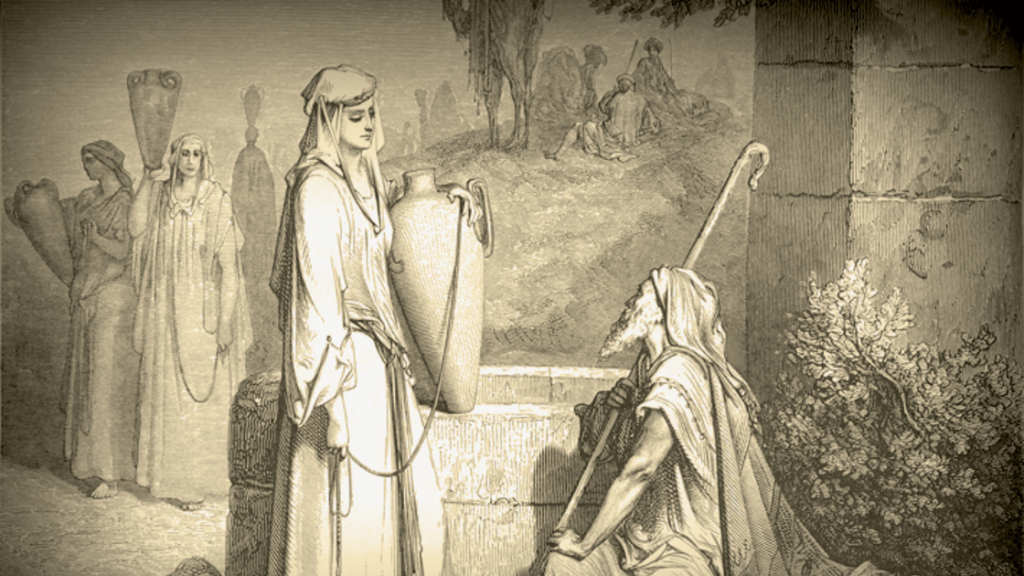
Rebekah and Abraham’s servant, an engraving by Gustave Dore (1832-1883)

Reading Holy Scripture is important. And the way we read it is significant. For the past several years, I have personally made it a practice to always read from the Bible out loud. There is something deeply powerful and impactful about the experience of reading aloud God’s Word.

I also try and read Scripture carefully and slowly. I deliberately make choices about my tone and inflexion, paying attention to which words are emphasized. I try to communicate as best I can the spirit and intent of the words.

I encourage you today to read aloud (and listen to) today’s Old Testament lesson. Take your time. Read it at your own pace. Notice which words you tend to accent, and what the Spirit may be saying to you in the reading…

Soon after that, the servant loaded ten of Abraham’s camels with valuable gifts. Then he set out for the city in northern Syria, where Abraham’s brother Nahor lived.

When he got there, he let the camels rest near the well outside the city. It was late afternoon, the time when the women came out for water. The servant prayed:

You, Lord, are the God my master Abraham worships. Please keep your promise to him and let me find a wife for Isaac today. The young women of the city will soon come to this well for water, and I’ll ask one of them for a drink. If she gives me a drink and then offers to get some water for my camels, I’ll know she is the one you have chosen and that you have kept your promise to my master.

While he was still praying, a beautiful unmarried young woman came by with a water jar on her shoulder. She was Rebekah, the daughter of Bethuel, the son of Abraham’s brother Nahor and his wife Milcah. Rebekah walked past Abraham’s servant, then went over to the well, and filled her water jar. When she started back, Abraham’s servant ran to her and said, “Please let me have a drink of water.”

“I’ll be glad to,” she answered. Then she quickly took the jar from her shoulder and held it while he drank. After he had finished, she said, “Now I’ll give your camels all the water they want.” She quickly poured out water for them, and she kept going back for more, until his camels had drunk all they wanted. Abraham’s servant did not say a word, but he watched everything Rebekah did, because he wanted to know for certain if this was the woman the Lord had chosen.

The servant had brought along an expensive gold ring and two large gold bracelets. When Rebekah had finished bringing the water, he gave her the ring for her nose and the bracelets for her arms. Then he said, “Please tell me who your father is. Does he have room in his house for me and my men to spend the night?”

She answered, “My father is Bethuel, the son of Nahor and Milcah. We have a place where you and your men can stay, and we also have enough straw and feed for your camels.”

Then the servant bowed his head and prayed, “I thank you, Lord God of my master Abraham! You have led me to his relatives and kept your promise to him.”

Rebekah ran straight home and told her family everything. Her brother Laban heard her tell what the servant had said, and he saw the ring and the bracelets she was wearing. So Laban ran out to Abraham’s servant, who was standing by his camels at the well. Then Laban said, “The Lord has brought you safely here. Come home with me. There’s no need for you to keep on standing outside. I have a room ready for you in our house, and there’s also a place for your camels.”

Abraham’s servant went home with Laban, where Laban’s servants unloaded his camels and gave them straw and feed. Then they brought water into the house, so Abraham’s servant and his men could wash their feet. After that, they brought in food. But the servant said, “Before I eat, I must tell you why I have come.”

“Go ahead and tell us,” Laban answered.

The servant explained:

I am Abraham’s servant. The Lord has been good to my master and has made him very rich. He has given him many sheep, goats, cattle, camels, and donkeys, as well as a lot of silver and gold, and many slaves. Sarah, my master’s wife, didn’t have any children until she was very old. Then she had a son, and my master has given him everything. I solemnly promised my master that I would do what he said. And he told me, “Don’t choose a wife for my son from the women in this land of Canaan. Instead, go back to the land where I was born and find a wife for my son from among my relatives.”

I asked my master, “What if the young woman refuses to come with me?”

My master answered, “I have always obeyed the Lord, and he will send his angel to help you find my son a wife from among my own relatives. But if they refuse to let her come back with you, then you are freed from your promise.”

When I came to the well today, I silently prayed, “You, Lord, are the God my master Abraham worships, so please lead me to a wife for his son while I am here at the well. When a young woman comes out to get water, I’ll ask her to give me a drink. If she gives me a drink and offers to get some water for my camels, I’ll know she is the one you have chosen.”

Even before I had finished praying, Rebekah came by with a water jar on her shoulder. When she had filled the jar, I asked her for a drink. She quickly lowered the jar from her shoulder and said, “Have a drink. Then I’ll get water for your camels.” So I drank, and after that she got some water for my camels. I asked her who her father was, and she answered, “My father is Bethuel the son of Nahor and Milcah.” At once I put the ring in her nose and the bracelets on her arms. Then I bowed my head and gave thanks to the God my master Abraham worships. The Lord had led me straight to my master’s relatives, and I had found a wife for his son.

Now please tell me if you are willing to do the right thing for my master. Will you treat him fairly, or do I have to look for another young woman?

Laban and Bethuel answered, “The Lord has done this. We have no choice in the matter. Take Rebekah with you; she can marry your master’s son, just as the Lord has said.” Abraham’s servant bowed down and thanked the Lord. (Contemporary English Version)

How was your experience in reading this story out loud? What did the Spirit bring to you through it? Will you share your experience with us?…


Pay Attention to the Word (2 Peter 1:16-21)

For we did not follow cleverly devised stories when we told you about the coming of our Lord Jesus Christ in power, but we were eyewitnesses of his majesty. He received honor and glory from God the Father when the voice came to him from the Majestic Glory, saying, “This is my Son, whom I love; with him I am well pleased.” We ourselves heard this voice that came from heaven when we were with him on the sacred mountain.

We also have the prophetic message as something completely reliable, and you will do well to pay attention to it, as to a light shining in a dark place, until the day dawns and the morning star rises in your hearts. Above all, you must understand that no prophecy of Scripture came about by the prophet’s own interpretation of things. For prophecy never had its origin in the human will, but prophets, though human, spoke from God as they were carried along by the Holy Spirit. (New International Version)

The Bible is a set of living documents. It breathes with a revitalizing and reliable message about Jesus Christ.

Rather than being merely an ancient book to be displayed as some sort of museum artifact on a coffee table, Holy Scripture has demonstrated amazing resilience of use and pertinence throughout the ages.

Millions of people have discovered it’s riches; and have found the Bible’s message of knowing Christ and him crucified, died, risen, and coming again as their hope and salvation. Indeed, God’s Word to people is a gracious revealing of God to humanity so that all persons may reconnect with divinity.

The earthly ministry of Christ had eyewitnesses and earwitnesses. The witness above all witnesses was the Most High who audibly affirmed Jesus with a voice from heaven:

“This is my dearly loved Son, who brings me great joy.” (Matthew 3:17, NLT)

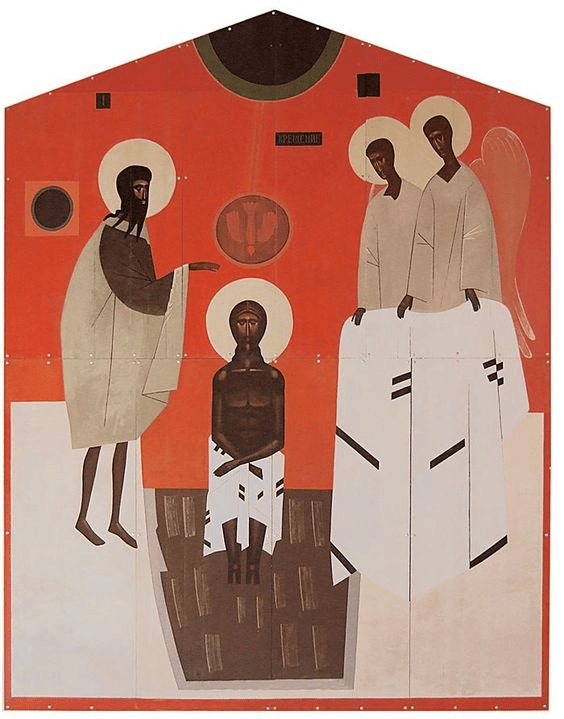
Baptism of Christ, by Vitaly Melnichuk, 2009

Christianity is a religion of the book. Scripture unites us with believers across the world and throughout history. The Bible is to the Christian what weights and barbells are to a bodybuilder. 

The people of God need Holy Scripture, God’s Word, in order to spiritually grow and become mature. Christian character formation cannot truly occur apart from the continuous repetitions of reading the text of Scripture, and letting it build strength into the muscles of the soul.

Scripture is a powerful unifying force within the life of God’s people. We may not all explain every Bible verse in exactly the same way (hence the many different Christian traditions) but believers share a common desire to honor, apply, and obey God’s Word. Ultimately, a passion to listen, talk about, and apply God’s Word brings believers in Jesus together, rather than separates us. 

Perhaps because the average American household today has at least three or four Bibles, we take for granted the availability of God’s Word. It is always at our fingertips, on our smartphones and computers. Yet, because it is always present and available, we may let the busyness and business of life keep us from paying attention to it. 

A commitment to reading and listening to Holy Scripture ought not be done quickly or mechanically, and certainly not half-heartedly. For the Word to penetrate and seep into our souls, we must take the time to listen carefully and slowly.

A first century rabbi, Akiva, once noticed a tiny stream trickling down a hillside, dripping over a ledge on its way toward the river below. Below was a massive boulder. The rock bore a deep impression. The drip, drip, drip of water over the centuries had hollowed away the stone. Rabbi Akiva commented, “If mere water can do this to hard rock, how much more can God’s Word carve a way into my heart of flesh?”

Water flowing over a rock, all at once, leaves it unchanged. It is the slow but steady impact of each small droplet, year after year, decade after decade, that completely reforms the stone.

O how we desire quick answers to our questions! Yet we must take the time to prayerfully listen and reflect on God’s Word and allow it to do it’s work on us and in us. Truth is revealed over many days, months, and years. Big splashes aren’t usually God’s way of doing things. Instead, the slow drip of careful study, contemplative prayer, and meditative reflection, day after day, year after year, shapes us and spiritually forms us into the likeness of Christ.

Thus, a patient, humble, and teachable spirit is necessary. Sometimes the Bible is not apparently relevant. We oftentimes need others to help us and to encourage one another to stick with reading and learning, even when we aren’t sure about what it is saying. 

Rightly interpreting Scripture happens in community, both in present local churches and small groups and in the community of saints who have gone before us. It doesn’t occur in isolation.

Always an appropriate response to hearing God’s Word is to address and the problems of others and the issues of our day. That’s because God is not just concerned about you and me, but about other people, as well. 

What do you suppose would happen if we all committed to carefully reading and listening and meditating, even memorizing God’s Word on a daily basis? Would it transform our worship? Make a difference in our relationships? Change how we do life together?

Attention, people of God and of the Book! God is our God, the One and only!

Love the Lord your God with your whole heart:

Love God with all that is in you; love the Lord with all you’ve got! 

Write these foundational commands I’ve given you on your hearts. Get them inside of you. Then, get them inside your children. 

For this to happen, talk about God’s Word at home when you are eating supper together and when you are working or playing with each other. Start your day with God’s Word when you get up in the morning and end your day with God’s Word when you go to bed at night. 

Put God’s Word on your refrigerator and your car’s dashboard; have it on your smartphones and let it be available to you anywhere and anytime. Use every opportunity you have to incessantly chatter about God’s Holy Word.

(Deuteronomy 6:4-9, contemporary paraphrase)

Pay attention to the Word made flesh and the written Word proclaimed. It makes all the difference.

Our Great Physician, Your Word is like alcohol – when poured on an infected wound, it burns and stings, but only then can it kill germs. If it doesn’t burn, it doesn’t do any good. 

Father, we are all hungry baby birds this morning. Our heart-mouths are gaping wide, waiting for you to fill us. A cold wind seems to have chilled us. Wrap us in the blanket of your Word and warm us up. 

Lord, we find your Word like cabbage. As we pull down the leaves, we get closer to the heart. And as we get closer to the heart, it is sweeter.

–Daily Prayers of Haitian Christians, translated by Eleanor Turnbull (1924-2020) missionary to Haiti for over 50 years

Psalm 119:17-32 – Examine the Wonders of God’s Instructions

Psalm 119:17-24, Common English Bible

ג Gimel

Be good to your servant while I live,
    that I may obey your word.
Open my eyes that I may see
    wonderful things in your law.
I am a stranger on earth;
    do not hide your commands from me.
My soul is consumed with longing
    for your laws at all times.
You rebuke the arrogant, who are accursed,
    those who stray from your commands.
Remove from me their scorn and contempt,
    for I keep your statutes.
Though rulers sit together and slander me,
    your servant will meditate on your decrees.
Your statutes are my delight;
    they are my counselors.

ד Daleth

I am laid low in the dust;
    preserve my life according to your word.
I gave an account of my ways and you answered me;
    teach me your decrees.
Cause me to understand the way of your precepts,
    that I may meditate on your wonderful deeds.
My soul is weary with sorrow;
    strengthen me according to your word.
Keep me from deceitful ways;
    be gracious to me and teach me your law.
I have chosen the way of faithfulness;
    I have set my heart on your laws.
I hold fast to your statutes, Lord;
    do not let me be put to shame.
I run in the path of your commands,
    for you have broadened my understanding. (New International Version)

The biblical psalms are one of my favorite places in the whole of Holy Scripture. I especially like Psalm 119 because it reminds me that I am not only saved from something, but I am also saved to something.

Genuine and real deliverance comes so that we can be free to love and serve God with our whole being. And Psalm 119 is there to help us know how to do just that.

Psalm 119 stretches for 176 verses as an acrostic to the Hebrew alphabet. Each Hebrew letter has its own 8 verse stanza, with each of those verses beginning with that letter. Unfortunately, of course, we lose this insight through translation.

One of the reasons the psalm was organized this way is because it was meant to be learned and memorized. In fact, the entire psalter was meant for public consumption – to be engrafted into the soul and hidden in the heart.

The wonders of Psalm 119 are, overall, a paeon of reverence and praise of God’s law. That’s because the Lord’s commands and instructions are an extension of the divine character. Laws of mercy and holiness are given to the people because God is merciful and holy.

Grace and law are not antithetical. They go together like a hand in a glove and rely upon each other. The hand of grace is what fills the glove of the law, and together, they extend divine help and direction to people in this fallen world of ours.

The heartfelt prayer of the psalmist is that the Lord would open his eyes so that he could see the wonders contained within God’s divine instructions for humanity.

“Open my eyes so I can truly see
the marvelous things in your law.”

Psalm 119:18, NET

This is a prayer for us, as well. Those who desire to please the Lord and walk in the way of God are continually seeking awareness of the divine all around them, insight into others, and understanding of self.

It is one thing to read the Bible, but it’s another thing altogether to understand it. The psalmist is asking for God to intervene on his behalf and remove anything and everything that would inhibit his ability to understand and discern God’s words and actions.

Insight, understanding, and application to life comes from dwelling in the Word. It is a process. A daily crumb will neither do to satiate our physical hunger nor our spiritual appetite.

Going days, even weeks, without ingesting God’s instructions will only lead to spiritual emaciation. It harms us and helps no one. Instead, we need to feed on Holy Scripture and savor every bite. Like the cow, we need to slowly chew and ruminate on Scripture so that it can be fully digested and become part of us.

I have memorized large chunks of the Bible over the years. The main reason my memory can call up so much Scripture is that I have read it, and continue to read it, over and over again. Even though I’ve read the Old Testament about one-hundred times and the New Testament in the neighborhood of three-hundred times, I still gain insight and understanding, seeing new and wondrous things.

I truly believe the Bible is an inexhaustible source of sage instruction and a continual fountain of wisdom. I’ll spend an eternity in heaven examining God’s Word and will never reach the height, depth, length, and breadth of it’s incredible, massive, and glorious precepts.

I am a strong advocate of straightforward readings of Scripture, over and over again. Although I encourage looking at devotionals, commentaries, and reflections (like this blog!) to help and encourage us, nothing can replace our constant and continual reading of the Bible.

The biblical Book of Psalms is the Church’s prayerbook. All 150 of them are meant to be used for every sort of life circumstance. Whether discouraged or anxious, joyful or confident, the psalms encompass the full range of the human condition – and Psalm 119 lets us know how central God’s instructions are to the life of God’s people.

So, read today’s psalm… several times. Let Scripture do it’s marvelous and wondrous work within you.

Blessed Lord, you caused all Holy Scriptures to be written for our learning. Help us so to wisely hear, read, mark, learn, and inwardly digest them so that by our patient reading of your holy Word, we may embrace and ever hold fast the blessed hope of everlasting life, which you have given us in our Savior Jesus Christ.

Psalm 90 – Of God and Humanity

Lord, you have been our help,
    generation after generation.
Before the mountains were born,
    before you birthed the earth and the inhabited world—
    from forever in the past
    to forever in the future, you are God.

You return people to dust,
    saying, “Go back, humans,”
    because in your perspective a thousand years
    are like yesterday past,
    like a short period during the night watch.
You sweep humans away like a dream,
    like grass that is renewed in the morning.
True, in the morning it thrives, renewed,
    but come evening it withers, all dried up.
Yes, we are wasting away because of your wrath;
    we are paralyzed with fear on account of your rage.
You put our sins right in front of you,
    set our hidden faults in the light from your face.
Yes, all our days slip away because of your fury;
    we finish up our years with a whimper.
We live at best to be seventy years old,
    maybe eighty, if we’re strong.
But their duration brings hard work and trouble
    because they go by so quickly.
    And then we fly off.
Who can comprehend the power of your anger?
    The honor that is due you corresponds to your wrath.
Teach us to number our days
    so we can have a wise heart.

Come back to us, Lord!
    Please, quick!
    Have some compassion for your servants!
Fill us full every morning with your faithful love
    so we can rejoice and celebrate our whole life long.
Make us happy for the same amount of time that you afflicted us—
    for the same number of years that we saw only trouble.
Let your acts be seen by your servants;
    let your glory be seen by their children.
Let the kindness of the Lord our God be over us.
    Make the work of our hands last.
    Make the work of our hands last! (Common English Bible)

The Bible is first and foremost a collection of books about God. Even though Scripture’s pages are filled with the fame and foibles of humans, nevertheless, the biblical drama unfolds because of the Lord. Holy Scripture is, indeed, a self-revelation of God.

There are times we get too focused on ourselves – our fears, inadequacies, weaknesses, failures – and lose sight of just how huge God really is. Today’s psalm helps reorient us back toward the grand Sovereign of the universe. There is a decidedly theistic worldview espoused and embedded in the psalm. It is a cosmology dominated by the immensity and largeness of a Creator God who is pictured as completely in control of all creation.

Let’s face it: Our lives are a weird and complex concoction of fear and joy that can combust at any time. We swing from high to low, and low to high. If we are on an even keel, its only because we are currently in the middle of swaying to one extreme or the other. Even introverts are familiar with this – it just happens to take place mostly inside their vast inner world, instead of on the outside for all to see.

So, we all need the grand vision of God in this psalm to anchor us through the unpredictable vicissitudes of life. Before the mountains were brought forth, or the earth was formed, from everlasting to everlasting the Lord is God. 

The transcendent God, although high and above everything in all creation, is not at all aloof from humanity; the Lord of the universe is also imminently close. God is near enough to know both our outward iniquities as well as our secret sins. Nothing gets by God. The Lord always knows the score.

The proper and appropriate response to such a God is to exclaim along with the psalmist to teach us to number our days so that we may get a heart of wisdom. Whenever we appropriate a biblical worldview, we learn to measure our days and live consistently moral lives with wholeness and integrity. 

This is why a regular regimen of the psalms is important to us, so that we will continually have before us the basic nature and character of God. And, as we do so, we cannot help but reflect God’s glory and contribute to human flourishing on this earth and the care of all creation.

Lord God, almighty and everlasting Father, we rejoice in your greatness and power, your gentleness and love, your mercy and justice. Enable us by your Spirit to honor you in our thoughts, words, and actions, and to serve you in every aspect of our lives, through Jesus Christ our Lord. Amen.