A Reality Check (Hebrews 10:1-4)

The law is only a shadow of the good things that are coming—not the realities themselves. For this reason it can never, by the same sacrifices repeated endlessly year after year, make perfect those who draw near to worship. Otherwise, would they not have stopped being offered? For the worshipers would have been cleansed once for all and would no longer have felt guilty for their sins. But those sacrifices are an annual reminder of sins. It is impossible for the blood of bulls and goats to take away sins. (New International Version)

Sometimes, we silly people confuse the sign for the real deal. It’s important to distinguish between the two. We discern the difference all the time when it comes to more mundane affairs.

People generally know that looking at a movie poster is not watching the actual film; that wearing a string of cheap pearls is only mimicking the real and expensive ones; or that sitting in a doctor’s waiting room isn’t the same thing as being in the appointment.

However, when it comes to our religion, we seem to blur the lines between sign and substance. Praying a “sinners prayer” or making a profession of faith isn’t the same as growing, maturing, following, and living a committed Christianity.

Knowing some Christian lingo and/or going with the flow of cultural Christianity doesn’t necessarily mean that Christ’s words and ways are being followed.

And today’s New Testament lesson is a reminder, and not a guilt trip, that the law points to the actual substance of religious life – and is not life itself.

The laws surrounding the old system of animal sacrifice were never meant to be an end in itself. It pointed forward to the real deal and was, therefore, completely inadequate to bring deliverance from sin, death, and hell to anyone.

The very fact that sacrifices needed to be repeated year and after year demonstrated that they were ineffectual in saving a person. Rather, those sacrifices were designed to cause the worshiper to long for a sacrifice to end all sacrifices – to anticipate that the sin issue would be settled once and for all.

The only thing the sacrifices did was remind people they were sinners in need of a savior. Just as a slap on the hand is grossly inadequate for handling a murderer, so offering an animal was never going to do the trick in taking care of divine justice.

And besides, God has never been pleased with a bunch of sacrifices anyway. So, what is God really pleased with? The Lord is pleased with a heart devoted to obedience and fealty to Jesus Christ; God cares about inner attitudes and dispositions of the spirit which are inclined toward righteousness, holiness, mercy, humility, and justice for all.

Sacrifices, in and of themselves, have no power; they are like a toothless lion who couldn’t bite into you if he tried. The way to set things right is through the once for all mighty sacrifice of the Son – an offering to end all offerings.

God doesn’t want a checklist of daily sacrifices, any more than a spouse only wants supper on the table at night, or a paycheck every month. It’s nice but falls short of the full scope of marital interactions and relations. A marriage built on law won’t stand. It needs real flesh and blood relationship, complete with a devoted heart, sincere attitudes, and loving words and actions.

Since Christ has ably and permanently taken care of the sin issue, what sort of impact ought that to have on the Christian’s life? What kind of people are we to be?

To begin listing things to do is to go back to law and fail to grasp the gospel. And that’s where many churches and believers get tripped up and miss the grace of God altogether. Observing rules of cultural Christian activities or holding to some accepted Christian norms isn’t going to cut it.

Christ’s Sermon on the Mount by Jorge Cocco Santángelo

Jesus described the sort of people who go beyond ritual regulations and rules to embrace the true spirit and end of the law:

“You’re blessed when you’re at the end of your rope. With less of you there is more of God and his rule.

“You’re blessed when you feel you’ve lost what is most dear to you. Only then can you be embraced by the One most dear to you.

“You’re blessed when you’re content with just who you are—no more, no less. That’s the moment you find yourselves proud owners of everything that can’t be bought.

“You’re blessed when you’ve worked up a good appetite for God. He’s food and drink in the best meal you’ll ever eat.

“You’re blessed when you care. At the moment of being ‘care-full,’ you find yourselves cared for.

“You’re blessed when you get your inside world—your mind and heart—put right. Then you can see God in the outside world.

“You’re blessed when you can show people how to cooperate instead of competing or fight. That’s when you discover who you really are, and your place in God’s family.

“You’re blessed when your commitment to God provokes persecution. The persecution drives you even deeper into God’s kingdom. (Matthew 5:3-10, MSG)

That describes folk who have embraced faith as the fulfillment of law. It’s a summary of the law’s intended purpose and end.

So, let’s worship Christ; and not some caricature of him. Maybe carefully reading through the entire book of Hebrews in one sitting will help.

Blessed God, purify your people by your abiding presence. Enlighten the minds of your people with the light of your good news. Bring wandering souls to an awareness and knowledge of Jesus Christ; and those who are walking in the way of life, keep them steadfast to the end. Guard those who are strong and prosperous from forgetting you. Increase in us your many gifts of grace and make us all fruitful in good works for the sake of Christ in the power of the Holy Spirit. Amen.


John 10:11-21 – The “Good” Shepherd

Jesus, the Good Shepherd, by P. Solomon Raj (1921-2019)

“I am the good shepherd. The good shepherd lays down his life for the sheep. When the hired hand sees the wolf coming, he leaves the sheep and runs away. That’s because he isn’t the shepherd; the sheep aren’t really his. So, the wolf attacks the sheep and scatters them. He’s only a hired hand and the sheep don’t matter to him.

“I am the good shepherd. I know my own sheep and they know me, just as the Father knows me and I know the Father. I give up my life for the sheep. I have other sheep that don’t belong to this sheep pen. I must lead them too. They will listen to my voice and there will be one flock, with one shepherd.

“This is why the Father loves me: I give up my life so that I can take it up again. No one takes it from me, but I give it up because I want to. I have the right to give it up, and I have the right to take it up again. I received this commandment from my Father.”

There was another division among the Jews because of Jesus’ words. Many of them said, “He has a demon and has lost his mind. Why listen to him?” Others said, “These aren’t the words of someone who has a demon. Can a demon heal the eyes of people who are blind?” (Common English Bible)

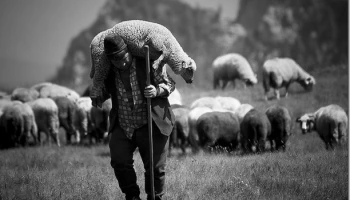
Many people in today’s urban and suburban world are completely unfamiliar with sheep and shepherds. So, when it comes to picturing Jesus as the good shepherd, idyllic scenes might come to mind, full of green meadows and pastoral landscapes, where there is perfect peace and rest, at all times.

Having been raised in rural Midwest America, I can confidently say there is little romanticism to the life of shepherds and sheep. Sheep eat a lot. They’ll eat just about anything that’s growing out of the ground. Think about how you would feel if you ate copious amounts of plants…. Lots of gas, trips to the bathroom, and stink.

That’s how it is with sheep. They continually poop and the smell is downright awful. A lot of a shepherd’s daily work is helping sheep deal with all the gas inside them. Sheep are easily prone to bloating from excess gas. This isn’t just an uncomfortable situation for a sheep; it’s an emergency life-and-death scenario. The shepherd must continually be vigilant to the sheep and take care of such circumstances immediately and carefully.

Taking care of sheep is dangerous, difficult, and tedious work. Historically, shepherds were rough characters, constantly on the move to find lush pastures for the flock’s voracious appetite. They had to deal with both animal and human predators looking for an easy meal. Being mostly outdoors, even at night, led to their reputation as drinkers – keeping up a consistent nip of spirits to remain warm. And, of course, they smelled bad.

So, when Jesus described himself as the “good shepherd,” this was anything but a pleasing picture for people in the ancient world. The closest equivalents to our modern day might be for Jesus to say, “I am the good migrant worker,” or the “good carny” (carnival employee).

Anyone or any profession in which we might deem a person in that line of work as of dubious character – that is precisely how a shepherd, and their work, were viewed by ancient people. It’s often the low-wage workers of society who get down and dirty. Because of their work, they get a suspicious and contemptuous reputation. Remarkably, Jesus unabashedly aligned himself with such people.

And yet, it is the discounted professions and the dismissed people from which we must pay attention; God is probably at work in their midst.

The despised Samaritan gained the label of “good” by Jesus for giving himself fully to save a stranger. Jesus puts the same adjective in front of shepherd. Whereas no one in polite society would use “good” for shepherd, Jesus labels himself as the Good Shepherd who lays down his life for the sheep.

Jesus, this incredible figure who puts good and shepherd together, also goes out of his way to bring other sheep into his fold. Since Christ identifies himself as a stinky lowly shepherd, he has no problem connecting with everyone. After all, when one is already low, there’s no looking down on another.

People everywhere, no matter their station in life, can hear the voice of Jesus speaking to them when they, too, are low enough to be able to listen.

The Good Shepherd by He Qi

Jesus, the Good Shepherd, is also the sacrificial lamb. In laying down his life he takes it up again (John 10:17). And when we participate in that dying and rising, when we eat the bread and drink the cup of salvation, we know he abides in us(1 John 3:24). Remaining in Christ with our Good Shepherd means, we, too, lay down our lives:

This is how we’ve come to understand and experience love: Christ sacrificed his life for us. This is why we ought to live sacrificially for our fellow believers, and not just be out for ourselves.

If you see some brother or sister in need and have the means to do something about it but turn a cold shoulder and do nothing, what happens to God’s love? It disappears. And you made it disappear.

My dear children, let’s not just talk about love; let’s practice real love. This is the only way we’ll know we’re living truly, living in God’s reality. (1 John 3:16-18, MSG)

Community is messy. People are stinky. Stepping into another’s life is rarely picturesque or idyllic. Yet, it’s at the same time elegant and aromatic. For we discover that our old ideas of beauty are obsolete. We gain a new spiritual sense which is redolent with the fragrance of Christ.

O God, Shepherd of all your people, deliver us from all troubles, worries and cares that assail us so that we may always do what is pleasing in your sight, and remain safe in the care of our Good Shepherd, Jesus Christ our Lord. Amen.

Leviticus 19:9-18 – Be a Good Neighbor

When you reap the harvest of your land, do not reap to the very edges of your field or gather the gleanings of your harvest. Do not go over your vineyard a second time or pick up the grapes that have fallen. Leave them for the poor and the foreigner. I am the Lord your God.

Do not steal.

Do not lie.

Do not deceive one another.

Do not swear falsely by my name and so profane the name of your God. I am the Lord.

Do not defraud or rob your neighbor.

Do not hold back the wages of a hired worker overnight.

Do not curse the deaf or put a stumbling block in front of the blind but fear your God. I am the Lord.

Do not pervert justice; do not show partiality to the poor or favoritism to the great but judge your neighbor fairly.

Do not go about spreading slander among your people.

Do not do anything that endangers your neighbor’s life. I am the Lord.

Do not hate a fellow Israelite in your heart. Rebuke your neighbor frankly so you will not share in their guilt.

Do not seek revenge or bear a grudge against anyone among your people but love your neighbor as yourself. I am the Lord. (New International Version)

All of these Old Testaments commands to the ancient Israelites are a development and expansion upon the basic core Ten Commands or Words given by God to Moses.

Those core commands are based in the character of God. That same character is to be the normal daily lived experience of God’s people.

The Levitical instructions are a fleshing-out of God’s basic commands for a specific people in their particular social, economic, and historical situation.

Although we need not, as modern folk, strictly observe the commands, as they are culturally constructed, we very much need to fulfill the ethics and morality which are behind the specific instructions.

Today’s Old Testament lesson has to do with being a good neighbor – a person who conscientiously lives in community with others and pays attention to the collective needs and wants of everyone. It is to live into God’s overarching ethic for the common good of all persons.

A commitment to community life needs good neighbors. They are characterized by the following virtues:

Sacrifice

Israel was chiefly an agrarian society. So, when the season of harvest came, the workers gleaning the fields were to only go over it once. That way, the poor and less fortunate could come behind and pick up what the workers missed or dropped.

Any landowner who instructed the workers to keep working until they got every scrap of grain or fruit was being cruel to the poor. Merciful and generous owners would, conversely, instruct the workers to leave a bit behind and not get everything.

Since God sacrifices on behalf of humanity, so we, too, are to make sacrifices which benefit the common good of all persons in the community.

Live a life filled with love, following the example of Christ. He loved us and offered himself as a sacrifice for us, a pleasing aroma to God. (Ephesians 5:2, NLT)

A sacrificial spirit, not a self-indulgent one, is what God is looking for in a good neighbor.

Honesty

Cheating, lying, stealing, and deceit have absolutely no place in the kingdom of God. Instead, honest dealings with others, always being above board in all matters, is of upmost importance to God.

Witnesses in court are expected to speak the truth without falsehood. Business dealings are to have accurate weights and measures. Integrity and trustworthiness are the building blocks of any good society.

Since God is truth, so we, too, are to live into truth through being honest in all we say and do.

Have nothing to do with a false charge and do not put an innocent or honest person to death, for I will not acquit the guilty. Do not accept a bribe, for a bribe blinds those who see and twists the words of the innocent. (Exodus 23:7-8, NIV)

An honest spirit, not a thieving one, is what God is looking for in a good neighbor.

Fairness

In the ancient world, and still in many parts of the world today, workers were paid at the end of the day for their day’s work. Bosses who withheld expected wages till the next day were quite literally depriving a family of their supper.

For those who are not able to do a solid day’s work, such as the blind and the handicapped, it’s bad enough to simply ignore them, because God is attentive to their plight. That situation is exacerbated exponentially, whenever someone or a group of people, decide to make such persons’ lives even harder than they already are.

Since God is fair in all dealings, so we, too, are to extend fairness to all without any prejudice or favoritism.

The Lord watches to see if we are fair or if we cheat others. (Proverbs 16:11, CEV)

A fair spirit, not an exploitive one, is what God is looking for in a good neighbor.

Justice

Unequal treatment is about as far from God as one can get. Being concerned only about those with similar political views, economic interests, or spiritual inclinations is a gross practice of injustice. It denies the ethic of the common good of all in favor of the common good of some.

Since God is just in all things, so we, too, are to uphold biblical justice for our fellow humanity, no matter who they are or where they come from.

Never deprive foreigners and orphans of justice. And never take widows’ clothes to guarantee a loan. (Deuteronomy 24:17, GW)

A spirit of justice, not injustice, is what God is looking for in a good neighbor.

Love

Hate is the inevitable result of holding onto anger through nursing a grudge and holding onto bitterness. It fails to speak up and speak out.

Love, however, assertively addresses anger and seeks to make things right in a calm and concerned way. Love attacks problems, not people.

Since God is love, so we, too are to love one another.

Dear friends, let us love one another, for love comes from God. (1 John 4:7, NIV)

Don’t let evil get the best of you; get the best of evil by doing good. (Romans 12:21, MSG)

A spirit of love, not a hateful vengeful one, is what God is looking for in a good neighbor.

A good neighbor is one who seeks the common good of all persons because God is good, all the time, and always does what is right, just, and fair.

Gracious God and Father, in a world of fear and suspicion, teach us that love is the only means to conquer fear.

Loving Lord Jesus, Son of God, in a world full of anger and frustration, teach to overturn the tables and tear down the fences which turn away the hungry and homeless; and to practice hospitality without prejudice.

Blessed Holy Spirit of God, in a world of indifference and ignorance, teach us wisdom, to be caring of one another, and to protect one another.

Blessed Holy Trinity, the God whom we serve, help us to know the peace that steals gently in through quiet acts of kindness, just as peace is always within you as one God, now and forever. Amen.

John 13:1-17, 31b-35 – Maundy Thursday

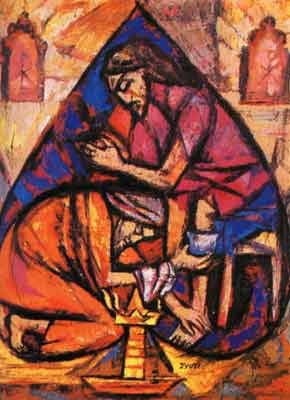
Jesus Washes Peter’s Feet

It was now the day before the Passover Festival. Jesus knew that the hour had come for him to leave this world and go to the Father. He had always loved those in the world who were his own, and he loved them to the very end.

Jesus and his disciples were at supper. The Devil had already put into the heart of Judas, the son of Simon Iscariot, the thought of betraying Jesus. Jesus knew that the Father had given him complete power; he knew that he had come from God and was going to God. 

So, he rose from the table, took off his outer garment, and tied a towel around his waist. Then he poured some water into a washbasin and began to wash the disciples’ feet and dry them with the towel around his waist. 

He came to Simon Peter, who said to him, “Are you going to wash my feet, Lord?”

Jesus answered him, “You do not understand now what I am doing, but you will understand later.”

Peter declared, “Never at any time will you wash my feet!”

“If I do not wash your feet,” Jesus answered, “you will no longer be my disciple.”

Simon Peter answered, “Lord, do not wash only my feet, then! Wash my hands and head, too!”

Jesus said, “Those who have taken a bath are completely clean and do not have to wash themselves, except for their feet. All of you are clean—all except one.” (Jesus already knew who was going to betray him; that is why he said, “All of you, except one, are clean.”)

After Jesus had washed their feet, he put his outer garment back on and returned to his place at the table.

“Do you understand what I have just done to you?” he asked. “You call me Teacher and Lord, and it is right that you do so, because that is what I am. I, your Lord and Teacher, have just washed your feet. You, then, should wash one another’s feet. I have set an example for you, so that you will do just what I have done for you. I am telling you the truth: no slaves are greater than their master, and no messengers are greater than the one who sent them. Now that you know this truth, how happy you will be if you put it into practice!…

Jesus said, “Now the Son of Man’s glory is revealed; now God’s glory is revealed through him. And if God’s glory is revealed through him, then God will reveal the glory of the Son of Man in himself, and he will do so at once. My children, I shall not be with you very much longer. You will look for me; but I tell you now, what I told the Jewish authorities, ‘You cannot go where I am going.’ 

“And now I give you a new commandment: Love one another. As I have loved you, so you must love one another. If you have love for one another, then everyone will know that you are my disciples.” (Good News Translation)

We all need love. 

Without love, relationships devolve into silent standoffs and destructive triangles. The world ceases to spin on its axis. 

But with love, all things are beautiful, personal relations have meaning and joy, and all seems right and just in the world.

This wonderful love, however, comes with a great cost. 

Because we live in a broken world filled with pride and arrogance, greed and avarice, hate and envy, we are victims of loveless, faceless, and unjust systems. 

We need Love to rescue and redeem us from the muck and crud of injustice. 

It’s as if we are constantly walking knee deep through icky sludge so thick that we can barely get anywhere. 

We need saving…. We need Jesus.

Christians everywhere around the world are journeying through Holy Week, the most sacred time of the year for followers of Christ. When we consider Holy Week, many are familiar with Good Friday and certainly Easter, but Maundy Thursday? 

On this day the church remembers the last evening Jesus shared with his disciples in the upper room before his arrest and crucifixion. 

The experiences in the upper room were highly significant because this was the last teaching and modeling that Jesus gave before facing the cross. Jesus was deliberate in communicating exactly what was important to him: Love one another.

Maundy Thursday marks three important events in Christ’s Last Supper with his disciples: 

  • The washing of the disciples’ feet (the action of loving service)
  • The instituting of the Lord’s Supper (the remembrance of loving sacrifice)
  • The giving of a “new” commandment to love one another (the mandate of a loving system). 

For Jesus, the last night with his disciples was all about love, God’s love. On that fateful night, having loved his disciples for the past three years, Jesus showed them the full extent of his love by taking the posture of a servant and washing each and every one of the disciples’ feet, including Judas. 

After demonstrating for them a totally humble service, Jesus said, “I have set you an example that you should do as I have done for you.”

Jesus Christ loves me just as I am, and not as I should be. 

Christ loves me even with my dirty stinky feet, my inconsistent half-hearted commitment to him, and my pre-meditated sin. 

Not only did Jesus wash the disciples’ feet; he also lifted the cup of wine and boldly asserted: 

“Take this and divide it among you.  For I tell you I will not drink again of the fruit of the vine until the kingdom of God comes.”  And he took the bread, gave thanks and broke it, and gave it to them, saying, “This is my body given for you, do this in remembrance of me.”  In the same way, after the supper he took the cup saying, “This cup is the new covenant in my blood, which is poured out for you.” (Luke 22:17-20, NIV)

Because of these words from Jesus, the church throughout the world, for the past two millennia, have practiced this communion so that we might have the redemptive events of Jesus pressed firmly into both our minds and our hearts by means of the visceral and common elements of bread and wine. 

We are to not just know about Jesus – we are to experience being united with him.

Having washed the disciples’ feet and proclaimed to them the meaning of his impending death, Jesus gave them a clear commandment: “A new command I give you: Love one another. As I have loved you, so you must love one another.  By this everyone will know that you are my disciples if you love one another.”

Love one another, insisted Jesus, through imitation of his humble service. We represent Christ on this earth when we carefully, diligently, and persistently practice love. 

Although love was by no means a new concept for the disciples, in the form and teaching of Jesus love was shown with four distinctions: 

  1. A new model of love: Jesus
  2. A new motive of love, that Christ first loved me
  3. A new motivator to help us love, the Holy Spirit
  4. A new mission, the evangelization of the world, utilizing the power of Christ’s love to accomplish it

Maundy Thursday is a highly significant day on the Church Calendar – one which deserves to be observed. It’s an opportunity to remember the important words and actions of Jesus on our behalf.

In Christ, we allow love to characterize our life together as we proclaim God’s love in both word and deed. A watching world will only take notice and desire to be a part of our fellowship if we are deeply and profoundly centered in the love of God in Christ. This is the reality that Maundy Thursday brings to us.

God of love, you have given us a new command to love each other. Help us to show that love in our care of creation, to all nations and ethnicities, in our communities and neighborhoods, through the Church everywhere, and with the persons closet to us and their needs. In all our thoughts, words, and actions may we be your servants and reflect your love, through our Savior, Jesus Christ, your Son, who lives and reigns with you and the Holy Spirit, one God, now and forever. Amen.