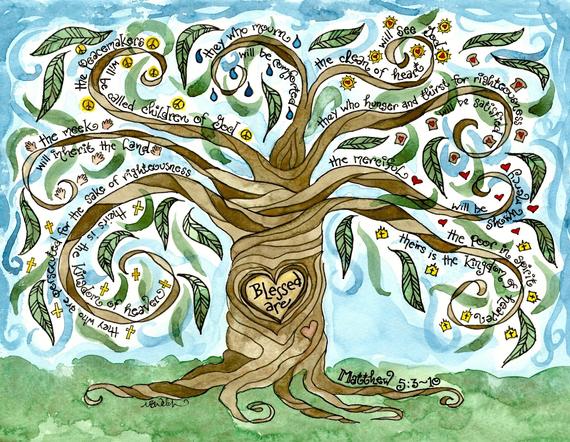
How To Live Well (Psalm 112:1-9)

By Stushie Art

Praise the Lord!
    Those who honor the Lord,
    who adore God’s commandments, are truly happy!
Their descendants will be strong throughout the land.
    The offspring of those who do right will be blessed;
    wealth and riches will be in their houses.
    Their righteousness stands forever.
They shine in the dark for others who do right.
    They are merciful, compassionate, and righteous.
Those who lend generously are good people—
    as are those who conduct their affairs with justice.
Yes, these sorts of people will never be shaken;
    the righteous will be remembered forever!
They won’t be frightened at bad news.
    Their hearts are steady, trusting in the Lord.
Their hearts are firm; they aren’t afraid.
    In the end, they will witness their enemies’ defeat.
They give freely to those in need.
    Their righteousness stands forever.
    Their strength increases gloriously. (Common English Bible)

To live well is to obey well. Well, that’s a thought! And a deep subject it is.

It’s a matter of whether we’ll take our cues for living from S. Hiney Wells or his brother, Russ T. Wells.

S. Hiney tells us this:

“Listen, my friends, the Lord’s commands are not made for drudgery. They’re how to be happy in this here life. Obeying what God says leads to blessings of family, security, contentment, and peace. God’s never failed to keep bacon in my frying pan, folks to help me out in a pinch, and a heap of hope for when I’m lower than a snake’s belly in a wagon rut.”

Russ T. tells us:

“Well, the world ain’t shiny at all. It’s all dark and covered in rust so thick you’d think nuthin’ good’s been used fer a coon’s age.”

S. Hiney responds: “Well, Russ T., there’s certainly a powerful lot of darkness everywhere; but that don’t mean there’s no light! Even a few little lightnin’ bugs helps us to see where we are in the night.”

Russ T. retorts: “Well, S. Hiney, them little bugs don’t help none when I’m brinin’ away in pickle barrel so full of vinegar that I don’t know whether I’m in the field or the henhouse.”

S. Hiney: “Well, now, fortunately we’ve got more than a few matches in our pockets. God’s own light shines so bright that it lights up the whole earth, a world-illuminating light that keeps every old fox away from the barn.”


Russ T.: “Well, that’d be mighty nice. But if that light’s so all-powerful, I ought to be able to see my hand in front of my face! All’s I see is a bunch o’ nasty weasels lurkin’ about, givin’ me a headache bigger than the Ozark Mountain Daredevils singin’ and playin’ on my tin roof while I’m tryin’ to sleep.”

S. Hiney: “Well, Russ T., I see it every time I lend money without any expectation of interest or return. I see it in my neighbor’s generous hand and sharing her prize winnin’ tomatoes and blue ribbon apple pies. And I mostly saw it with our dear mama’s teaching to “give until it’s gone, boys, not until it hurts,” rest her soul.

Russ T.: “I obeyed mama, bless her heart; she was one of the good ones. And I certainly didn’t wanna be on her bad side!”

S. Hiney: “Me, too. Her words of affirmation felt a lot better than those times when I was disobedient and found a willow switch on my behind! So, Russ T., were you happy listening to mama and doing what she said?”

Russ T.: “Well, now, I reckon I was. Things was a lot simpler and a lot less complicated when I listened to her. Whenever I didn’t, I felt like I was a polecat in the chicken house, like I didn’t much belong.”

S. Hiney: “My heart’s calculatin’ that your true love, the Lord God, is presently waitin’ on you to shake all that rust off so that he can give you a good shine on that soul of yours. But yer goin’ to have to listen, to obey what you hear, brother.”

Maybe because we tend to be all or nothing people, we often get hung up on either being perfect or being a failure. In reality, we are neither. We’re just simple folk trying to do our best in loving and serving the Lord with an obedient heart.

Christianity takes its cues in reading the psalms from Christ’s illumination. Jesus embodied the ideals of humanity, having neither material wealth nor actual physical descendants; yet he distributed gifts more generously than anyone ever did; and he has more spiritual progeny than anybody else.

Following in the way of Christ, we live in such a way that it is possible to be:

  • Poor and rich
  • Compassionate and competent
  • Gentle and shrewd
  • Gracious and tough
  • Giving and receiving
  • Faithful and doubting
  • Light and dark
  • Happy and sad
  • Vulnerable and powerful
  • Confident and scared
  • Brave and hesitant
  • Generous and just
  • Consistent and unpredictable
  • Mindful and forgetful
  • Weak and strong
  • Loving and questioning
  • Open to change and immovable

Living well means obeying well enough to see the best in others, seek the common good of everyone, and be resilient to deal with our personal foibles and the unforeseen pitfalls we sometimes experience.

What will you do when you’re in a pickle?

O God, whose blessed Son came into the world that he might destroy the works of the devil and make us children of God and heirs of eternal life: Grant that, having this hope, we may purify ourselves as he is pure; that, when he comes again with power and great glory, we may be made like him in his eternal and glorious kingdom; where he lives and reigns with you and the Holy Spirit, one God, for ever and ever. Amen.

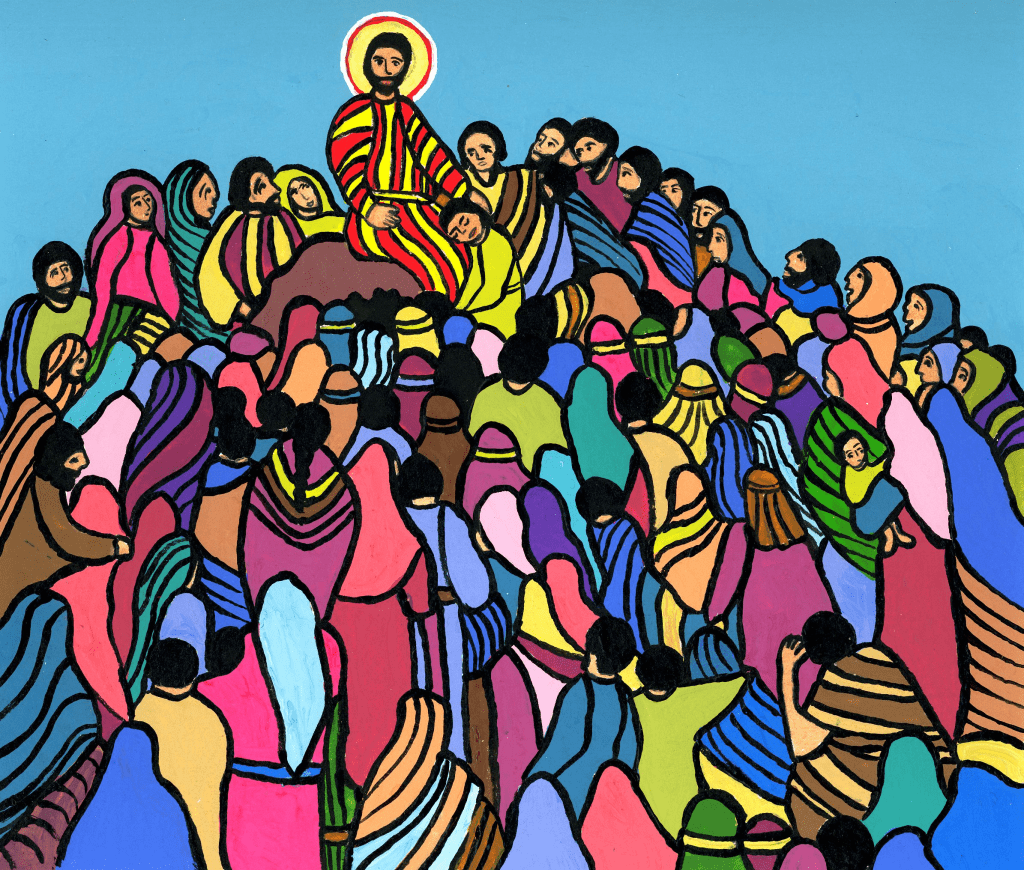
Christ’s Beatitudes (Matthew 5:1-12)

Sermon on the Mount by Gisele Bauche

When Jesus saw the crowds, he went up the mountain, and after he sat down, his disciples came to him. And he began to speak and taught them, saying:

“Blessed are the poor in spirit, for theirs is the kingdom of heaven.

“Blessed are those who mourn, for they will be comforted.

“Blessed are the meek, for they will inherit the earth.

“Blessed are those who hunger and thirst for righteousness, for they will be filled.

“Blessed are the merciful, for they will receive mercy.

“Blessed are the pure in heart, for they will see God.

“Blessed are the peacemakers, for they will be called children of God.

“Blessed are those who are persecuted for the sake of righteousness, for theirs is the kingdom of heaven.

“Blessed are you when people revile you and persecute you and utter all kinds of evil against you falsely on my account. Rejoice and be glad, for your reward is great in heaven, for in the same way they persecuted the prophets who were before you. (New Revised Standard Version)

God’s Law (The Ten Commandments) was given on a mountain. That Law was restated and reframed on a mountain by Jesus in his Sermon on the Mount.

I believe that arguably one of the most important and impactful portions of Holy Scripture are the Beatitudes of Jesus, which serve as the foundation to all of Christ’s teaching.

Christ’s Beatitudes are not simply a random collection of pithy phrases from Jesus on what constitutes approval and blessing from God. They intentionally build upon each other and describe the nature of true righteousness.

The Poor in Spirit

Spiritual poverty, not wealth, is the spiritual base to the Christian life. Most of the original crowd listening to Jesus thought they were on the outside of the kingdom, on the margins of true religion. But Jesus told them they have a place in God’s reign as poor and pitiable people.

To be “poor in spirit” is to be a spiritual beggar who recognizes they have nothing to offer God. It is seeing oneself, one’s sin, and one’s life as spiritually bankrupt apart from God.

Beggars have neither the leverage nor the ability to strike deals with anybody; and so, they do one thing: beg continually.

The proud person would never be caught begging for anything. Yet, the humble spiritual beggar constantly prays because they need God. They discern that without God there is no hope. The kingdom of heaven belongs to the penitent and not to the proud.

The Mourners 

Mourning is the emotional response of acknowledging one’s spiritual poverty. 

Grief and lament have a central place in Christian theology and life. To avoid it, work around it, or short-circuit its process is to refuse Christ; there is no righteousness apart from mourning over sin. Crying, weeping, and even intense tears are important and necessary.

To experience personal grief over one’s sins and the sins of the church and the world is a Beatitude of Jesus. You neither need position, power, privilege, nor pedigree to be a mourner. All can mourn. This is the door by which we enter the kingdom of God.

The Meek

A meek and gentle spirit is the result of realizing poverty of spirit and practicing lament.

At the heart of what it means to be meek is a spirit of non-retaliation. Whenever we are flat on our backs before God, there is no place to look but up. Thus, there is no ability to look down on others.

To be meek is to be broken and moldable before God. A meek person takes personal responsibility for their attitudes and actions. The meek have no need to retaliate, even when egregiously wronged, because they fully entrust themselves to God alone who judges the living and the dead.

Ironically, brokenness is the path to righteous wholeness.

The Hungry and Thirsty

Only those who know their poverty of spirit, personally grieve over sin, and are gentle, end up longing for righteousness.

The desire for righteousness is a recognition that without God I will not make it. I cannot be righteous without Jesus. Simply put, righteousness is a right relationship with God and others.

Those who hunger and thirst for God’s righteousness know they cannot make things right by themselves; they need God’s help.

If we think we can live most days of our lives without God, we do not yet know true righteousness. People who understand their great need for Jesus are easy to spot. They crave and devour God’s Word as their daily food; and they cannot stop blabbering on about Jesus.

There are three practices of living that arise from being filled with God’s righteousness: mercy, purity, and peacemaking. These Beatitudes cannot be conjured up by our own will; instead, they organically grow within us and are freely expressed because of what God is doing in our lives.

You cannot force them any more than you can force a stalk of corn to grow on your terms. Rather, you work with the unforced rhythms of God’s grace and allow righteousness to take root in you.

Down below in the soil, spiritual poverty, mourning, and humility germinate. Then, when the plant breaks the soil and flowers, it produces mercy, purity, and peace-making.

The Merciful 

Mercy begins with a heart that seeks to be generous; it is a loving response to someone or a group of people in misery. We accept them and help them because we ourselves have been there.

The merciful person looks for ways to come alongside others and help, rather than pile expectations and burdens on others without mentoring them in the ways of God.

The Pure In Heart

Purity also results from true righteousness. A stalk of corn might look good, but if you shuck it and it’s filled with worms, it’s not worth much. Legalistic righteousness is concerned to look good; it’s obsessed with performance, perfection, and possessions.

Conversely, the righteousness of God fills our hungry hearts and makes us pure and holy, set apart for good use.

The Peacemakers 

Those who make peace intentionally put themselves in the middle of trouble because they want to live righteously with the mercy and purity that God has provided for them.

Peace is realized through peacemakers. It seems we all desire peace, and yet, peacemakers are hard to come by. It’s a tough gig. To achieve peace, one must first be at peace with God and self – which is why we need the cross of Jesus Christ.

The Persecuted 

Living righteously, as presented by Jesus, tends to bring persecution; and the persecuted consider it a small price to pay for realizing God’s justice in the world.

Folks who are offended by even slight criticisms are usually the ones who are privileged and in power. They have not yet learned the ways of Jesus. Pettiness is nothing more than a sign of unrighteousness.

Yoking up with Jesus, following him, and living into his words and ways has always been risky and dangerous. The Beatitudes of Jesus are not characteristics that lead to power, prestige, or possessions, but likely just the opposite.

“The Beatitudes, spoken with the community of Jesus’ disciples in view, are paradoxes – the standards of the world are turned upside down as soon as things are seen in their right perspective, which is to say, in terms of God’s values, so different from those of the world. It is precisely those who are poor in worldly terms, those thought of as lost souls, who are truly fortunate ones, the blessed, who have every reason to rejoice and exult in their suffering. The Beatitudes are promises resplendent with the new image of the world and humanity inaugurated by Jesus.”

Pope Benedict XVI

Truly righteous persons become living Beatitudes; they are walking, talking blessings to the world. They abide with Christ and are witnesses to a subversive, yet wonderful, way of life, where the last are first and the greatest are the least.

O Lamb of God, that takes away the sins of the world, have mercy upon me.

O Lamb of God, that takes away the sins of the world, have mercy upon me.

O Lamb of God, that takes away the sins of the world, grant me your peace.

Psalm 1 – Two Different Ways

Oh, the joys of those who do not
    follow the advice of the wicked,
    or stand around with sinners,
    or join in with mockers.
But they delight in the law of the Lord,
    meditating on it day and night.
They are like trees planted along the riverbank,
    bearing fruit each season.
Their leaves never wither,
    and they prosper in all they do.

But not the wicked!
    They are like worthless chaff, scattered by the wind.
They will be condemned at the time of judgment.
    Sinners will have no place among the godly.
For the Lord watches over the path of the godly,
    but the path of the wicked leads to destruction. (New Living Translation)

Today’s psalm presents us with two differing ways we can choose to shape our lives: The way of the upright and virtuous, or the way of the unethical and depraved. 

The way of the right and just person leads to human flourishing and life – whereas the way of the wicked and unjust person leads to human degradation and death. 

Distinguishing between the righteous and the wicked is not always as easy as it looks.

Only at the end of the age, when the Day of Judgment comes, will we know for certain the righteous and the wicked.

The magisterial Reformer, Martin Luther, contrasted these two ways with his Heidelberg Disputation of 1518. Luther called the way of the wicked a theology of glory – and described the way of the righteous as the theology of the cross.

The cross of Christ, as expressed by Luther, is God’s attack on human sin. Christ’s death is central to Christianity, and one must embrace the cross and rely completely and totally upon Christ’s finished work on the cross to handle human sin. Through being crucified with Christ, we find the way to human flourishing and life. In other words, righteousness is gained by grace through faith in Christ.

Conversely, the theology of glory is the opposing way of the cross. For Luther, the wicked person, and the vilest offender of God, is not the person who has done all kinds of outward sinning and heinous acts. The worst of sinners do good works.

Specifically, the wicked person is the one who does all kinds of nice things – yet does them disconnected from God by wanting others to see their good actions. Another way of putting this: The wicked person is one who seeks to gain glory for self, rather than giving glory to God.

Our good works can be the greatest hindrance to righteousness.

It is far too easy to place faith in our good works done apart from God, rather than having a naked trust in Christ alone. And it is far too easy to do good things for the primary purpose of having others observe our goodness, rather than do them out of the good soil of being planted in God’s Word. 

The remedy for sin is the cross, and the sinner is one who lives apart from that cross, trusting in self so that people can recognize and give them their perceived due respect and accolades.

“It is impossible for a person not to be puffed by his good works unless he has first been deflated and destroyed by suffering and evil until he knows that he is worthless and that his works are not his but God’s.”

Martin Luther

We are not to avoid good works but do them from the good soil of being planted in the law of God and connected to the vine of Christ. When the psalmist uses the term “law” he is referring to Scripture as a whole, to all the acquired wisdom about how life is supposed to be lived in God’s big world.

The righteous are those who immerse themselves in the law; secretly rise early to meditate on God’s Word; privately pour over Scripture’s message and pray to put it into practice because they want to delight in God. Their fruit will be abundant and sweet.  

The wicked, however, are simply too busy to take note what the law says; only serve to be seen; and publicly desire to be recognized for their charity and works. Such works will not stand when Judgment Day comes.

You’re nothing but show-offs. You’re like tombs that have been whitewashed. On the outside they are beautiful, but inside they are full of bones and filth. (Matthew 23:27, CEV)

Truly righteous people have a humble sense that they could easily drift from God, if not staying connected and rooted in Jesus and the way of the cross. 

The wicked, in contrast, are like chaff – worthless, and not adding value to anything. They are arrogant and annoying – wanting all the attention that God rightly deserves. The wicked have nothing to contribute to God’s kingdom. They hinder the harvest of souls God is working toward with their irritating attitudes.

Generosity marks the righteous because God is generous. Grace defines the righteous because God is gracious.  Gentleness is the way of the righteous because Christ is gentle. Spiritual prosperity is the result of a righteous relationship cultivated with Jesus Christ. The Lord watches over the way of such persons.

The way of the wicked will perish.

We have sixteen prophetic books in the Old Testament, all given to a single message: Judgment is coming because of wickedness.  And the wicked turn out to be God’s covenant people, because they selectively did their good works to gain glory for themselves. They withheld the good they could have done because it did not add any value to their reputation or their personal goals.

God desires genuine spiritual growth for us. That will only happen if we avoid the theology of glory and embrace a theology of the cross – delighting in God and the law.

Every day, we have a choice to make: The way of connection and life, or the way of disconnection and death. 

Look here! Today I’ve set before you, life and what’s good versus death and what’s wrong. If you obey the Lord your God’s commandments that I’m commanding you right now by loving the Lord your God, by walking in his ways, and by keeping his commandments, his regulations, and his case laws, then you will live and thrive, and the Lord your God will bless you…. But if your heart turns away and you refuse to listen, and so are misled, worshipping other gods and serving them,I’m telling you right now that you will definitely die…. I have set life and death, blessing and curse before you. Now choose life—so that you and your descendants will live—by loving the Lord your God, by obeying his voice, and by clinging to him. That’s how you will survive and live long…. (Deuteronomy 30:15-20, CEB)

The idols of our hearts can so easily draw us away from God so that our own good works are done for an audience who will recognize and affirm. Instead, our daily choice must be to love God supremely and give God glory for everything good in our lives. 

What will you choose this day?

Psalm 1 – Choose Real Happiness

The truly happy person
    doesn’t follow wicked advice,
    doesn’t stand on the road of sinners,
    and doesn’t sit with the disrespectful.
Instead of doing those things,
    these persons love the Lord’s Instruction,
    and they recite God’s Instruction day and night!
They are like a tree replanted by streams of water,
    which bears fruit at just the right time
    and whose leaves don’t fade.
        Whatever they do succeeds
.

That’s not true for the wicked!
    They are like dust that the wind blows away.
And that’s why the wicked will have no standing in the court of justice—
    neither will sinners
    in the assembly of the righteous.
The Lord is intimately acquainted
    with the way of the righteous,
    but the way of the wicked is destroyed. (Common English Bible)

True happiness happens when we conform to disciplines of a good life and eschew practices that go against the grain of goodness. That statement might be a bit difficult to accept. Frankly, it is for me, and I wrote it.

You see, I’m not much of a conformity sort of guy. I like creatively doing my own thing, man. Bucking the system and questioning the rules is just something I do. Conformity tends to have a negative connotation with me – like a group of unthinking lemmings running off a cliff to their death.

Yet, the truth is that, although there is a wide range of creative choices we have for most everything, we as humans best function and discover happiness when we are in sync with our Creator. So, we can choose to ignore our foundational human hard-wiring, or we can live into it as the unique individuals we are.

Those two ways of shaping our lives are the path of the righteous and the path of the wicked. The way of the righteous leads to human flourishing, relational connection, and a vast spiritual life. Alternatively, the way of the wicked leads to human degeneration, disconnection from others, and spiritual death. It is to be out of sync with who we are as people.

Distinguishing between the righteous and the wicked is not always as easy as it looks. Only at the end of the age, when the Day of Judgment comes, will we know for certain the righteous and the wicked.

The magisterial Reformer of the sixteenth-century, Martin Luther, framed the two opposing ways as the theology of the cross and the theology of glory. The cross of Christ is G-d’s attack on human sin. Through being crucified with Christ, we find the way to human flourishing and life. It is the narrow road of grace.

A theology of glory is seeking to be radically independent – to rely primarily, perhaps even exclusively, on our own laurels and personal way of doing things. Although these might appear to be outwardly fine, they feed and water themselves from a wicked stream, devoid of grace.

Whenever we place our complete trust in self and forsake faith in something or someone outside of ourselves, it is a highway to the grave.

It is far too easy to place faith in our good works and to do good so that others will observe our goodness, rather than doing them out of the good soil of being planted in ancient and wise instruction.

Embracing tried and true practices of righteousness; delighting in G-d’s law; meditating on sound instruction; privately pouring over the large body of wisdom we have available to us; and diligently seeking to put it all into action is the way of good people who shall surely realize human happiness. They will yield gracious fruit. They will know blessing.

Joyful are people of integrity,
    who follow the instructions of the Lord.
Joyful are those who obey his laws
    and search for him with all their hearts.

Psalm 119:1-2, NLT

Serving only to be seen; seeking public accolades and personal recognition as a sole motivator; and disrespecting others to prop up individual respect is the way of the wicked. They don’t bother to consult the ancient ways of happiness. Instead, they pridefully believe they know what is best.

“You’re like manicured grave plots, grass clipped and the flowers bright, but six feet down it’s all rotting bones and worm-eaten flesh. People look at you and think you’re saints, but beneath the skin you’re total frauds.” (Matthew 23:27-28, MSG)

Abundance, generosity, gentleness, and grace marks the righteous because G-d is abundantly gracious and generous. Jesus is the gentle shepherd who mercifully and lovingly leads anxious sheep to the quiet pastures of settled happiness. Indeed, the Lord watches over the way of the righteous.

Only looking out for number one, stinginess, withholding good, hoarding, and angry criticism identifies the wicked. They have judgment in their future because they add no value to the great needs of humanity. Unhappiness is their lot.

We have choices. We can choose conformity to established patterns of godly instruction and happiness – or we can choose to rely solely on our own ingenuity and/or brawn to eke out a morsel of satisfaction.

Choose wisely, my friends.

O Holy Wisdom, direct us on your path. Make us worthy of your teachings and open our hearts to accept your embrace, that we may serve you in peace and grace. Amen.