Some Wise Warnings (Proverbs 6:6-23)

Go to the ant, you sluggard!
    Consider her ways and be wise.
Which, having no guide,
    overseer, or ruler,
provides her bread in the summer,
    and gathers her food in the harvest.

How long will you sleep, O sluggard?
    When will you arise out of your sleep?
Yet a little sleep, a little slumber,
    a little folding of the hands to sleep—
so will your poverty come upon you like a stalker,
    and your need as an armed man.

A wayward person, a wicked man,
    walks with a perverse mouth.
    He winks with his eyes,
    he signals with his feet,
    he motions with his fingers;
    perversity is in his heart,
    he devises mischief continually, he sows discord.
Therefore his calamity will come suddenly;
    in a moment he will be broken without remedy.

These six things the Lord hates,
    yes, seven are an abomination to him:
        a proud look,
        a lying tongue,
        and hands that shed innocent blood,
        a heart that devises wicked imaginations,
        feet that are swift in running to mischief,
        a false witness who speaks lies,
        and he who sows discord among brethren.

My son, keep your father’s commandment,
    and do not forsake the instruction of your mother.
Bind them continually upon your heart,
    and tie them around your neck.
When you go, they will lead you;
    when you sleep, they will keep you;
    and when you awake, they will speak with you.
For the commandment is a lamp, and the law is light;
    and reproofs of instruction are the way of life. (Modern English Version)

A proverb is a short, pithy statement of experiential truth. In life, all things being equal, there are some predictable consequences to each decision and action we take.

To make idle, wicked, or adulterous decisions will result in disastrous outcomes – and the proverbial writer wants to help us steer clear of calamity. So, we have some sound and sage instruction which is meant for us to realize contentment and fulfillment in life and avoid the pitfalls of laziness, evil, and infidelity.

The Sluggard

We may typically think of the sluggard as a lazy person who just doesn’t want to work. That’s true, yet it runs even deeper and broader than that. A sluggard is someone always looking for the easy way out. Instead of persevering and being diligent in accomplishing large projects and demanding responsibilities, the sluggard tries to use their ingenuity to get the job done quickly.

The student who wants to take shortcuts, and doesn’t do the busywork of citing sources, or doing their due diligence in research, is a sluggard. The worker who cuts corners in order to move to another job they’d rather do, is a sluggard. The spouse who hastily buys some cheap flowers for their loved one from a street vendor, without even getting out of the car, is a sluggard. The minister who cuts and pastes some information from Google the night before teaching a lesson, is a sluggard.

And the results will likely be quite predictable: an “F” on the term paper; a punitive citation from the building inspector; the disappointment and anger from a wife; and the rebuke from a church. There’s no one to blame. All these sluggards will be out of a job and poverty will cozy up to them sooner than later.

What to do? Get some humility. Bend down and look at the busy ants. They work steadily, consistently, and carefully – and never lack.

The Wicked

The truly evil person enjoys creating chaos and upsetting folks through running their mouth off like a canon.

They get a kick out of poking the bear, sticking a hornets’ nest, and stirring the pot. And their chief means of doing it is their tongue. Damaging words are thrown about. Gaslighting, arguing, backbiting, slandering, and lying are the tools of their trade.

The wicked person might get what they want, in the short term; but in the long term, their end is sure. Brokenness and calamity will eventually catch up to them. They, like the sluggard, will have no one to blame for the consequences which overtake them; the ire of God will consume them.

What to do? Repent! Do a complete 180-degree turn from hubris to humility, lying to honesty, violent speech to encouraging words, disunity to harmony, separating to connecting, and from selfish behavior to working for the common good.

The Adulterer

The adulterer is one who is unfaithful. They make commitments and renege on them. The classic adulterer is one who cheats on their spouse and breaks their vow of marriage. Yet, there are various sorts of adultery that happen in this old fallen world.

The spiritual adulterer says they are committed to God, yet keep up a moonlighting affair with the world. The mental adulterer might never sleep with another, yet is committing deviant acts in their mind with others. The emotional adulterer gives a smooth line, yet is only trying to manipulate another into something the other person doesn’t want to do.

What to do? Come back to what you learned in childhood. Most parents, even if they fail to live up to their own instruction for their children, want what’s best for their kids. To nearly every adulterer, we can say, “I know your mama taught you better than that!”

Conclusion

An idle life, an evil tongue, and adulterous behavior will ultimately result in disaster, if left unchecked. The compiler of Proverbs is checking-in with us, making sure that we keep in sync with the good and beautiful way to live; and letting us know that the alternative to right living is some very calamitous consequences.

So, what will you choose?

Blessed and almighty God, take me to the place where I am saved from my pride and arrogance; where Christ’s humility becomes center-stage in my life; and where I’m lifting up clean hands and a pure heart in prayer. God and Parent of all, I bend my knee to receive truth; and I open my ears to receive counsel, and my heart to receive wisdom. Amen.

Leading Is Serving (Micah 3:1-4)

Then I said:

“Listen, leaders of Jacob, leaders of Israel:
    Don’t you know anything of justice?
Haters of good, lovers of evil:
    Isn’t justice in your job description?
But you skin my people alive.
    You rip the meat off their bones.
You break up the bones, chop the meat,
    and throw it in a pot for cannibal stew.”

The time’s coming, though, when these same leaders
    will cry out for help to God, but he won’t listen.
He’ll turn his face the other way
    because of their history of evil. (The Message)

The prophet Micah wasn’t speaking to the general population; he was specifically addressing leaders. Those in authority – whether religious, political, educational, or corporate – can be sometimes rather hard on the people they lead. Yet, most things rise or fall because of leadership, and not because of the people being led.

It’s one thing to be a Pastor and preach an angry sermon; a politician who spins the truth for their own advantage; a teacher who one day berates the students; or a boss who uncharitably chastises an employee; and it’s quite another thing for these behaviors to be habitual. A daily dose of leaders who view people as dumb sheep to fleece are eventually in for big trouble… from God!

Most leaders ascended to their position because they know what’s up and how to go about their business. They know the difference between right and wrong. But instead of viewing themselves as servants to the people, some leaders believe the people ought to be serving them. This sort of attitude comes out in snarky phrases, such as:

  • “If these idiots would only listen to me, and do what I tell them, we wouldn’t be in this mess!”
  • “How many times do I have to repeat myself!?”
  • “Excuses, excuses. That’s all I hear. They’re nothing but a bunch of lazy ungrateful people!”
  • “Leave your problems at home where they belong. We don’t talk about that stuff here!”
  • “What makes you think you can talk to me that way!?”
  • “It’s out of my hands. Not my responsibility.”
  • “It wasn’t like this in my generation. These young people just don’t want to do anything that’s hard. Back in my day I had to….”

The real problem, however, are the leaders themselves; they haven’t gotten out their own way to let the justice of God flow powerfully in them and through them to the benefit of everyone.

Having a leader who is attentive to basic human kindness, generous with words, and concerned for all under their authority is like a kiss on the lips. But a leader who only thinks of themselves is like a bad dream that won’t go away.

A society cannot survive without justice, that is, a concern for the common good of all persons – and coupled with systemic practices which reinforce that basic conviction. Some leaders have good hearts but bad organizational systems. Other leaders administrate well but have a hard time relating to people. We need both for justice to occur.

Once leaders get in a groove of justice, society flourishes. Yet, leaders need to be continually vigilant; their leadership can easily devolve into struggles to obtain and maintain power so that they can feel important and in control of things.

The Old Testament prophets, like Micah, used imaginative metaphors to make their case that injustice needed to be done away with. And they nearly always laid the burden of change on leaders. Leadership is meant to make things right, not wrong, and to help a group of people become better, not worse.

Justice is in every leader’s job description. It’s written on both the conscience and the heart in permanent marker.

When things go sideways, godly leaders first look at themselves, rather than reflexively blaming others. Typically, there is plenty of guilt to go around; yet the leader needs to bear the onus of the problem and begin addressing it by first looking within themselves.

It’s a leader’s responsibility to ensure that justice and freedom are established – and that there are no obstacles to all the people living successfully. Leaders are to be learners so that they may do good and create systems of good for everyone.

Stop doing wrong
    and learn to live right.
See that justice is done.
Defend widows and orphans
    and help the oppressed. (Isaiah 1:16-17, CEV)

Those who held authority in Micah’s day had gotten drunk on power and privilege; they openly used their authority to consume the poor and needy. Rather than empowering the underprivileged, the leaders snatched what little autonomy and resources the people possessed.

The good news is that there is a greater power operative in the universe than earthly leaders. A hard life caused by insensitive leadership will eventually give way to the Lord’s gracious and benevolent reign over all the earth.

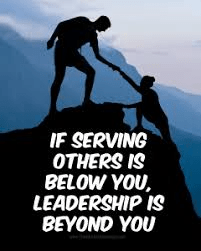
Until that time comes, we are to grow as leaders by seeking to be true and genuine servants.

Politicians are to pursue public service without prejudice and with a keen eye toward all classes of people;

Educators are to commit themselves to ensuring that learning happens with a variety of approaches, all pillowed with loving support;

Employers are to provide whatever is needed to make their employees successful at their jobs, including a safe and caring environment;

Religious leaders are to offer spiritual care and not spiritual judgment to all within their bounds of responsibility.

We all lead other people, whether or not we have the title or position as a leader. Therefore, we all must seek not to be served but to serve others. This is the way of justice and righteousness.

Gracious God and Leader of all: Help us to embrace the challenge and responsibility we have as leaders
to guide us to lead with integrity and common sense. Give us the wisdom to make intelligent decisions; the courage to make tough decisions; and the character to make right decisions. Embolden us to always be welcoming, inclusive, and open because of our Lord Jesus Christ, in whose name we pray. Amen.

A Parable On Being Right with God (Luke 18:9-14)

The Tax Collector and the Pharisee by Peter Gallen

To some who were confident of their own righteousness and looked down on everyone else, Jesus told this parable: “Two men went up to the temple to pray, one a Pharisee and the other a tax collector. The Pharisee stood by himself and prayed: ‘God, I thank you that I am not like other people—robbers, evildoers, adulterers—or even like this tax collector. I fast twice a week and give a tenth of all I get.’

“But the tax collector stood at a distance. He would not even look up to heaven, but beat his breast and said, ‘God, have mercy on me, a sinner.’

“I tell you that this man, rather than the other, went home justified before God. For all those who exalt themselves will be humbled, and those who humble themselves will be exalted.” (New International Version)

There’s a lot to observe in Christ’s parable for today. Notice six observations of the story….

1. We Cannot Make Ourselves Right with God

I’m convinced that most Gentile Christians, standing two millennia apart from Christ’s telling of this parable, are much too hard on the Jewish Pharisees: “Well, I’m certainly glad that I am not like the Pharisee in this story!” so many tell themselves. It seems to me the Pharisees get a bad rap because of our own predilection to justify ourselves.

After all, we can only really criticize something we are already familiar with.

A temptation which every individual and community faces is the seduction toward self-justification, instead of being justified by God.

Way back in the day, when I made treadmill belts for a living, I was in charge of quality control. It was my job to make sure that the quality department provided the shipping department with a finished product, free of defects, and could stand the test of continual use. I justified the belt as being a treadmill belt of integrity; the belt did not, nor could not, justify itself, hide or fix its flaws, or make itself right.

To think that a treadmill belt could justify itself is in the same sort of crazy that believes we can make ourselves right. No, it is God alone who justifies the sinner.

The paradox of Christ’s parable is that the real sinners are those who claim to be righteous, while the truly righteous are those who recognize they cannot justify themselves and need God to make them right.

2. We Need to Be Honest about the Right Thing

In order to hear the good news about God’s ability to justify and make right, we must also hear the bad news about why we need justification to begin with. An honest look into the mirror reveals that we have been hiding behind a cosmetic façade of self-justification.

Our illusions and delusions need to be confronted and shattered. Because only then can we receive grace and realize the peace and harmony of God’s justification.

Since God justifies, I don’t have to!

I don’t need to defend myself, make myself look better than I am, nor fool myself into believing that the false façade is the true self.

The parable of Jesus is a contrast between the Pharisee who justifies himself, and the tax collector who looks to God alone for his justification.

3. The Put-Together Guy Wants to Make Himself Right

Jesus uses a Pharisee as a character in the parable because the guy represented someone who everyone else looks up to as the model of a spiritual and religious person. Christ is inviting his hearers to look beyond the façade of what we see with our physical eyes.           

We need to use our spiritual eyes to notice below the surface. Look at the attitude. The smug self-justifying disposition is flat-out sin. What’s more, self-justification is a root of all sorts of sins.

Judging ourselves to be right means that others are wrong. That attitude creates division, separates people into bad and good, fosters disharmony, and is an affront to God. 

To try and obtain what is already provided by grace is plain old-fashioned sin.

4. We’re Obsessed with the Right Lines

Adam and Eve were told by God that they could eat from any tree in the garden but were given strict instructions not to eat of the tree of the knowledge of good and evil. (Genesis 2:15-17) So, why avoid that particular tree?

Because it was a tree which spiritually and socially blinds people. Adam and Eve ate from it and their eyes were “opened” to a different reality – which was actually a “closed” view of reality that changed the way humanity deals with one another. From that point forward, people began drawing lines down the middle and placing themselves on the “good” side while vilifying those on the other side, the “bad” side.

“Apple Picking,” the fall of Adam and Eve, by Vittorio Canta

Adam and Eve immediately began justifying their actions, their attitudes, and their behavior. (Genesis 3:8-13) Adam drew a line: “That woman, Eve, gave me the fruit; she’s on the other side; it’s her fault!” Eve drew a line: “The serpent made me do it; that wasn’t really me, I’m basically good….” And ever since, the quest of making ourselves right has never stopped….

Today, we draw all sorts of lines. A popular religious line is this: “We’re good; they’re bad. Our theology is right, everybody else’s is wrong. The Bible says….” (insert a kooky interpretation of Scripture, based in self-justification and separation of people into good and bad groups)

People draw class lines, race lines, gender lines, ethnic lines, economic lines. We want clean lines, vertical lines, horizontal lines, perpendicular lines, thick lines, thin lines, any kind of line; just give me a line! Let’s go line dancing. Maybe take an airline. There are offensive lines and defensive lines. By the way, what’s the line on the Packers? We even judge the lines themselves: Long lines, short lines, front lines, back lines, and DMV lines are clearly evil, right!?

Why are we so obsessed with drawing lines? So that we can take self-justifying sides. Violence, war, and most every other sin of the world comes from the original sin project of trying to make ourselves right: “I’m okay; you’re not.”

The Pharisee (really a representative of us all) drew a very clear line between himself and the despised sinful tax collector. Notice that self-justification always compares itself with others. Those who obsessively draw lines are compulsively concerned about other people; they believe they have a right to know what’s going on with them. They remain vigilant to keep the lines drawn and distinguish themselves from those on the other side.

5. God Is On the Other Side of the Right Line

The Pharisee found that every time he drew a line, God was on the other side with the “sinners.” That makes perfect biblical sense. If God alone justifies sinners and makes them right; and if Jesus identifies with them in his life, death, and resurrection; then God is to be found on the other side of our line-drawing.  

A self-justified person sees no need for God’s justification. Therefore, God is not on their side; God is on the other side, justifying sinners by making them right.

6. The Unraveled Guy Wants To Be Made Right

“O God, Be Merciful To Me, A Sinner,” by Ronald Raab

The tax collector’s only concern was for God to show him mercy because he is a sinner. In contrast to the proud attitude of the Pharisee, the tax collector, a sinner by anyone’s definition, humbled himself and sought justification from God alone.

  • Justification by God makes us right and:
  • Lifts the curse upon humanity and reverts everything back to its original design. (Revelation 22:1-5)
  • Erases the lines. (Romans 4:7-8)
  • Restores our souls are and strengthens our faith. (Acts 16:5; Romans 4:20)
  • Enables us to rest in Christ’s finished work. (John 19:28-30)
  • Does not condemn us. (Romans 8:1-2)
  • Eliminates comparisons because Christ is sufficient for us. (Colossians 2:13-14)
  • Replaces the anxiety and fear about how we look to others with the contentment and satisfaction of God’s love in Christ. (1 John 4:16-18)

Conclusion

Self-justification separates us from people and creates distance and division. But God’s justification connects people in love and crosses the arbitrary lines created by others.

The bad news: Many religious folk, when confronted with their self-justifying attitudes, do not change. Instead, they label the person as bad and place the offending person on the other side of their line so that they can maintain their façade of righteousness.

The good news: Jesus can be found on the other side of the line because justification is a gift. Yet, until we go to him, outside our little camp, we will continue in vain to make ourselves look good and be on the right side of everything while making others look bad.

The good and the right is to humbly – and with much flavor – cry out to God for mercy because only the Lord can save us from our plight.

Lord Jesus Christ, Son of God, have mercy on me, a sinner. 

Lord Jesus Christ, Son of God, have mercy on me, a sinner. 

Lord Jesus Christ, Son of God, have mercy on me, a sinner, and grant me your peace.

Just and right God, by your mercy we were created, and by your mercy you redeemed us through your Son, the Lord Jesus. Your mercy is the light by which all people – both sinner and saint – return to you. Your divine justice and your divine mercy exist together so that you refuse to punish us as we deserve.

Lord Jesus, it was not enough for you to take on our humanity; you died for us as well. So, we humbly and gratefully receive your gracious deliverance from sin, death, and hell. Amen.