Jesus Intervenes (Matthew 19:23-30)

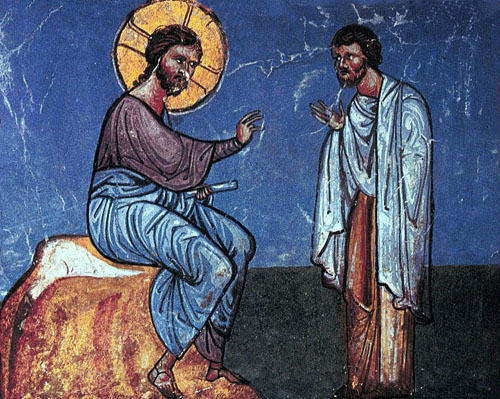
Orthodox depiction of Jesus and the rich young ruler

Then Jesus said to his disciples, “I assure you that it will be very hard for a rich person to enter the kingdom of heaven. In fact, it’s easier for a camel to squeeze through the eye of a needle than for a rich person to enter God’s kingdom.”

When his disciples heard this, they were stunned. “Then who can be saved?” they asked.

Jesus looked at them carefully and said, “It’s impossible for human beings. But all things are possible for God.”

Then Peter replied, “Look, we’ve left everything and followed you. What will we have?”

Jesus said to them, “I assure you who have followed me that, when everything is made new, when the Human One sits on his magnificent throne, you also will sit on twelve thrones overseeing the twelve tribes of Israel. And all who have left houses, brothers, sisters, father, mother, children, or farms because of my name will receive one hundred times more and will inherit eternal life. But many who are first will be last. And many who are last will be first. (Common English Bible)

We all have a chronic struggle and relapse with some besetting shortcomings. And we compulsively do them even though they harm us.

Whether it’s an addiction (alcohol, illicit drugs, etc.) or things we don’t readily notice as addictive (gossip, food, shopping) we need to be weaned off our damaging obsessions. In Holy Scripture, the most pervasive and compulsive vice is the addiction to wealth and money.

Everyone has their own unique tussle with money. If our initial knee-jerk reactions to money issues is to think of someone else (“I don’t have as much money as…” or, “So-and-so really has a problem with this…”) then this is what we call denial. Truth be told, all of us offer some disclaimer about how our trust is not in paychecks, bank accounts, and material stuff. For me, money buys books, of which my voracious appetite is never satiated.

Even people who truly have little money and scant resources can have an addiction to money. They think about money and wish for it to an unhealthy degree, as if wealth is the thing that will make them happy. Folks in denial rarely have any idea how much they harm others, themselves, and even God. In fact, the consistent witness of the early church fathers is that the sheer accumulation of stuff is the same as stealing from the poor.

Sometimes, because of denial, people need an intervention – and to be jolted back to their senses. Intervention is a gift. Someone cares enough to intervene. Yet, many interventions don’t work because the person can walk away and refuse to change.

Jesus performed an intervention with a rich young man (literally, a twenty-something). The young man was obsessed with wealth and money, but didn’t see it. He thought of himself as godly and spiritual. It’s really a sad story because the rich man walked away unchanged by his encounter with Jesus. He failed to see himself as desperately needing to change. He held to his denial. (Matthew 19:16-22)

Jesus and the Rich Young Man by Chinese artist, 1879

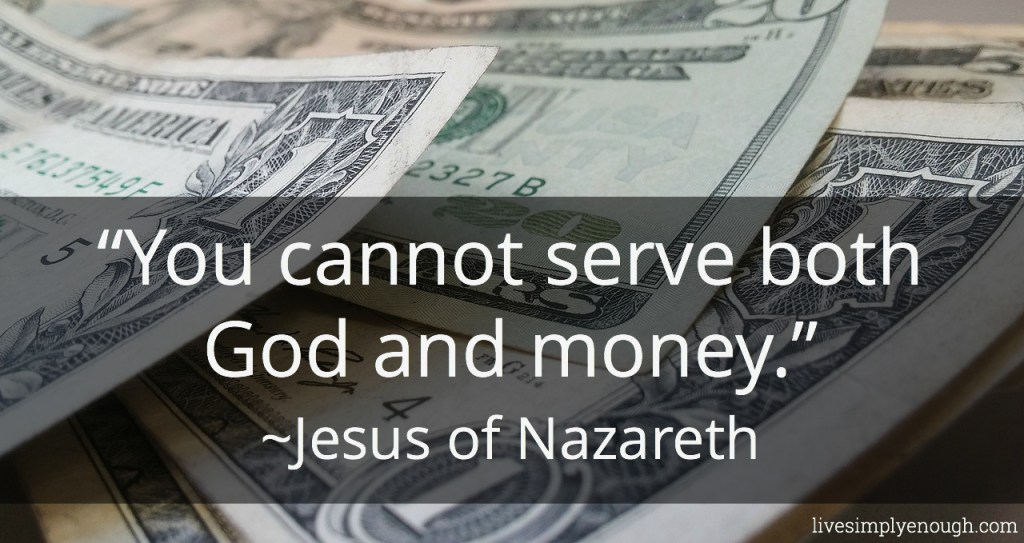
Jesus exposed the rich young man’s divided loyalties of trying to serve both God and money. He would have to choose between the two masters. And this is our choice, as well.

God wants an undivided heart and loyal allegiance. Jesus is looking for those who are poor in spirit and recognize their great need for God, rather than believing they are okay and just need to add a little Jesus to their lives. God wants spiritual beggars who understand their desperate situation and do not practice denial by sugar-coating their actual spiritual state.

Just like an addict who either cannot or will not give up the addiction, the rich young man would not give up his disordered love for money and possessions. So, Jesus intervened. Christ doesn’t ask everybody to do exactly as he called the rich young man to do. For example, Jesus asked neither the wealthy Zacchaeus to do it, nor the disciple Peter to sell his fishing business.

However, Jesus does ask all of us to do what seems impossible and let God meet our needs.

Christ had the original come-to-Jesus-meeting with his disciples in debriefing about his conversation with the rich man. If it is so impossible and so difficult for a rich person to be saved because his wealth gets in the way, who then can be saved, the disciples wondered? We cannot save or redeem ourselves. We need grace. We need help.

So serious is Jesus about this business of genuine discipleship, about what it really takes to follow God, that he repeated himself using a colorful illustration: It’s easier for a camel to go through the eye of a needle than for a rich man to enter the kingdom of God. 

Jesus wants us, who have lots of stuff, bank accounts, and money to see ourselves in the illustration. Only the discouraged, the hopeless, and the helpless will see their absolute need for grace and will seek the miracle of salvation Jesus offers.

Peter, always the big mouthpiece for the disciples, blurts out that they have left everything to follow Jesus. So, what then will there be for the disciples? What’s in it for me?

We may avoid the idol of money only to find ourselves with the idol of pride. Twentieth-century theologian, Reinhold Niebuhr, once said that a person had to achieve a great deal of good to be able to commit the sin of pride.

Yet, grace always has the last word. Jesus gives grace and assures us of reward even when we are stinkers by asking prideful questions. 

“The promise of a hundredfold recompense does not seem to square with experience. Usually those who for the testimony of Christ are deprived of parents or children and other relatives, or their marriage partners, or have lost all their money, do not recover but struggle out their life in lonely and deserted exile and in poverty. But I reply that if anyone rightly assesses God’s grace by which he alleviates the miseries of His children he will confess that is to be preferred to all the riches of this world.”

John Calvin

The first step in facing any harmful compulsion is to be honest about it – without telling our story in a way that makes us look surprisingly good so that others are pleased with us.

Life is about following Jesus. To follow Jesus, we must not be in denial. Perhaps the best way to express our faith is to tell someone about our obsessions to compulsively work in order to feel better and pad our savings; or that we are afraid to charitably give because we worry about the future; or that we love to buy things we don’t really need, so that we’ll feel better.

An honest awareness of our compulsions sometimes causes us to feel awful about ourselves. We may disparage ourselves for always screwing up, never saying “no” to others, or feeling unable to stop the anxiety.

Yet, grace abundantly overwhelms any and all addictions, shortcomings, and pride when it comes money or anything else. God has unlimited patience with people; Jesus never tires of inviting us to follow him. God’s love and acceptance is not based on our screw-ups, but on Christ’s forgiveness through the cross.

Allow the words of Jesus to sink deep into your life so that you ooze the grace of God in your life.

Camels cannot pass through the needle’s eye by means of dieting, positive thoughts, or luck. It happens not because the camel can squeeze through the narrowness of the needle’s eye but because there is a wideness in God’s mercy.

God’s grace will pull you through. Unlike the rich young man, once you hear and understand that piece of delightful news, you do not walk away sad but with boundless joy.

God of wisdom, help me in the mess of my finances; in my fear of taking charge of the resources entrusted to my care; in my preference for ignorance  over honest acknowledgment of the ways I use and fail to use my wealth; in my anxiety over debt, and in all the pressures of my financial life.  

Help me to take one step at a time toward honoring you through my use of money and honoring others from whom I buy and borrow. Make me humble to seek counsel, grateful for my abundance, prudent with my limited means, and patient with myself as I seek to be a better steward of all you have given me. Amen.

Mark 10:17-22 – Jesus Intervenes

Eastern Orthodox mural of Jesus and the rich man

As Jesus started on his way, a man ran up to him and fell on his knees before him. “Good teacher,” he asked, “what must I do to inherit eternal life?”

“Why do you call me good?” Jesus answered. “No one is good—except God alone. You know the commandments: ‘You shall not murder, you shall not commit adultery, you shall not steal, you shall not give false testimony, you shall not defraud, honor your father and mother.’”

“Teacher,” he declared, “all these I have kept since I was a boy.”

Jesus looked at him and loved him. “One thing you lack,” he said. “Go, sell everything you have and give to the poor, and you will have treasure in heaven. Then come, follow me.”

At this the man’s face fell. He went away sad because he had great wealth. (New International Version)

We are all addicts. 

We all have our own sin addictions which keep us stuck in guilt and shame.

We may not all struggle with the same sin. Yet we all have some besetting sin(s) that we must be weaned off of. The most pervasive addiction found in Holy Scripture is neither substance abuse nor alcohol – it is the addiction to wealth and money.

Maybe your initial response was of someone else, besides yourself: “I don’t have as much money as____” or, “So-and-so has a real problem with that!” Those statements are what we call, in terms of addiction, denial. 

In truth, all of us are in some sort of denial about how much we really trust in paychecks, bank accounts, investments, and owning material stuff. I’m no exception. I own more books than I’ll be able to read in a lifetime, and yet, I tend to believe I don’t have enough of them.

Even the poor can have an addiction wealth and money by thinking about it and wishing for it to an unhealthy degree, as if wealth is the thing that will ultimately make them happy.

People in denial rarely have any idea how much they are hurting others, themselves, and God.  In fact, the consistent witness of the early church fathers is that the sheer accumulation of stuff is the same as stealing from the poor. 

Because of denial, people need an intervention. They need to be jolted back to their senses. Intervention is a gift. Someone cares enough about the person to intervene. Yet, interventions don’t always work. The person can choose to walk away and refuse to change.

Jesus did a gracious intervention with a rich young man. The man was addicted to wealth and money, but he didn’t see it. In fact, he thought he was quite godly and spiritual. It’s a sad story because the man walks away untransformed by his encounter with Jesus and did not accept the gracious invitation to follow the Lord. 

Chinese depiction of Jesus and the rich man, 1879

The man simply did not see himself as hopeless and desperately needing to change. He held to his denial.

The man approached Jesus with a question: “What must I do to inherit eternal life?” Whereas I would probably get all excited about being asked a question like this and launch into some long-winded gospel answer, Jesus immediately picked up on the attitude and the need behind the question. 

What must I do to get? It’s almost as if the man wants to acquire eternal life like he would acquire wealth. “I am a successful businessman with plenty of money, and a respected citizen with lots of wealth – now I want to be a success with God, as well.” 

The question may have been sincere, yet it was misguided. Eternal life is not spiritual real estate for an upwardly mobile person to acquire and possess. The man seems to believe he can purchase eternal life, as if everyone has their price, even God. “After all,” he may have been reasoning, “I have gotten everything else in life, so why not obtain eternal life?”

Jesus questioned the question. He went after the underlying assumption of doing something good to obtain eternal life. The fact of the matter is that the man cannot do anything. He can’t because only God is good. Jesus points him to God by changing the action from getting to entering. And he changed the language from a market acquisition to entering into a journey.

Jesus was inviting the man to walk with him.

Eternal life is a journey of faith in the God who is good, and not a transaction to get it. And, we too, must be careful not to treat eternal life as if it were a transaction, as if we must get a person to sign on the dotted line through a “sinner’s prayer” or some other formula that will seal the deal for eternal life. 

Instead, eternal life is a walk of obedience with God and his commands.

Jesus responded to the rich man with the Ten Commandments, specifically the ones which focus on human relationships. Jesus wanted him to realize that the path into the kingdom of God and eternal life goes through and not around how we treat our fellow human beings.

Christ and the Rich Young Ruler by Heinrich Hofmann, 1889

The Lord sought to expose the impossibility of continuing in life on the rich man’s terms. The guy just could not imagine what he might be lacking. So, Jesus helped him out. Christ gave him some major interventional language…. Sell. Give. Follow.

Sell everything. Give to the poor. Come, follow me.

One cannot simply add Jesus to their life, like adding a new car or a new fishing rod. Rather, one’s heart must change in order to accommodate real, genuine eternal life. 

Jesus offered the rich man someone to be, rather than something to get

It’s one thing to give from what you have; it’s another thing to surrender your life and all you have. 

In the New Testament Gospels, there are no easy conversations with Jesus. He gets personal in every encounter and gets under everybody’s skin. Christ doesn’t settle with superficial small talk when there are people whose hearts are little more than idol factories. 

Jesus never leaves us alone, because there is always the invitation to “Come, follow me.”

Christ exposed the wealthy man’s divided loyalties – he was trying to serve both God and money. But he would have to choose between the two. 

And that is our choice, as well. 

The question for us is not, “Am I completely devoted to money?” Instead, the question from our Gospel story today is, “Am I trying to serve God while maintaining a moonlighting job with the world?” 

God wants from us an undivided heart; the Lord desires absolute allegiance.

Jesus is looking for those who are poor in spirit, who recognize their great need for God – instead of believing that they are okay and just need to add a little Jesus to their lives. 

God is looking for spiritual beggars who understand their desperate situation and don’t practice denial by sugar-coating their actual spiritual state.

Like a drunkard who won’t give up his vodka; like a sex addict who won’t give up strip clubs or emotional affairs; or like a workaholic who just can’t come home; the rich man would not give up his disordered love for money and possessions. 

So, Jesus did an intervention. 

The Lord Jesus didn’t ask everybody to do exactly as he called the rich man to do. He didn’t ask the very wealthy Zacchaeus to do it, and he didn’t tell Peter to sell his fishing business. 

But Jesus does tell us to do something which seems impossible. Yet, where the impossible exists, so exists grace.

Blessed Lord, you have taught us that all our doings without loving generosity are worth nothing. Send your Holy Spirit and pour into our hearts your gift of love, the true bond of peace and of all virtues, without which whoever lives is counted dead before you. Grant this for the sake of your only Son Jesus Christ, who lives and reigns with you, in the unity of the Holy Spirit, one God, now and forever. Amen.

Matthew 19:16-22 – An Intervention by Jesus

Armenian Orthodox depiction of Jesus and the rich young man.

Just then a man came up to Jesus and asked, “Teacher, what good thing must I do to get eternal life?”

“Why do you ask me about what is good?” Jesus replied. “There is only One who is good. If you want to enter life, keep the commandments.”

“Which ones?” he inquired.

Jesus replied, “‘You shall not murder, you shall not commit adultery, you shall not steal, you shall not give false testimony, honor your father and mother,’ and ‘love your neighbor as yourself.’”

“All these I have kept,” the young man said. “What do I still lack?”

Jesus answered, “If you want to be perfect, go, sell your possessions and give to the poor, and you will have treasure in heaven. Then come, follow me.”

When the young man heard this, he went away sad, because he had great wealth. (NIV)

Sin is addictive. Since we are all sinners, we are therefore all addicts. We do not all struggle with the same sin but we all have some besetting sin(s) we must be weaned off of, whether it is what we typically think of as addiction (alcohol, substance abuse, smoking, pornography, gambling) or things we don’t readily notice as addictive (gossip, food, shopping, social media, Netflix). The most pervasive and addictive sin found in Holy Scripture is the addiction to wealth and money.

It would be easy to think of others rather than we ourselves when it comes to the topic of money. “I don’t have as much money as…” or, “So and so really has a problem with this…” perhaps betrays our own denial of having an inordinate concern with wealth. The truth be told, it is likely that all of us are in some sort of denial about how much we really trust in paychecks, bank accounts, and stuff. Even people who truly have little money and few resources can compulsively think about wealth and wish for riches to an unhealthy degree, as if possessing more is the thing that will make them happy.

Persons in denial rarely realize how much they are hurting others, themselves, and God. In fact, the consistent witness of the early church fathers is that the sheer accumulation of stuff is the same as stealing from the poor. The great preacher from antiquity, St. John Chrysostom, plainly declared:

“Not to share our own wealth with the poor is theft from the poor and deprivation of their means of life; we do not possess our own wealth, but theirs.”

Sometimes, because of denial, people need an intervention – to be jolted back to their senses. Intervention is a gift.  Someone cares enough to intervene. Yet, interventions do not always work. The person may walk away and refuse to see themselves as they are.

Jesus performed an intervention with a rich young man (literally, a twenty-something). The man was addicted to wealth and money, but he failed to see it. In fact, he thought of himself as godly and spiritual. It is a sad story because the man walked away untransformed by his encounter with Jesus and did not follow him.

Because of his riches, the young man did not see himself as hopeless and desperately needing to change, and so, held to his denial.

Today’s Gospel lesson is not merely an ancient story. It is our story, as well. Whereas I would get all excited about being asked a question like, “What good thing must I do to get eternal life?” and launch into proclaiming the good news, Jesus, however, immediately picked up on the attitude and thought behind the question. 

What must I do to get?  It is almost as if the man wants to acquire eternal life like he would acquire wealth.  “I am a successful businessman, and respected citizen,” the young man might have reasoned, “and now I want to be a success with God, as well.” However sincere the question may have been, it is misguided. Eternal life is not spiritual real estate for an upwardly mobile twenty-something to acquire and possess. It seems he believed he could purchase eternal life, as if everyone has their price, even God.

Jesus questioned the question by going after the underlying assumption that the man could do something good to obtain eternal life. He could not because only God is good. So, Jesus changed the action from getting to entering; and changed the language from a market acquisition to entering a journey. In short, Jesus was inviting the man to walk with him.

Eternal life is a journey of faith in the God who is good, and not a transaction to leverage obtaining what I want.

We must be careful to avoid the topic of eternal life as if it were a contractual arrangement, as if getting a person to sign on the dotted line through a “sinner’s prayer” or some other formula will seal the deal. Because life with God is a walk of obedience to divine commands.

The rich guy wanted to know which commands to obey. Jesus then quoted the second table of the Ten Commandments, the ones which focus on human relationships. Jesus wanted him to see that the entrance to God’s kingdom goes through and not around how we treat our fellow human beings.

Simple straightforward observance of commands has its limits; it cannot provide genuine life. The rich man seemed to be looking for some extraordinary command. After all, he could do it, no matter what the price was.  The man, in his materialistic worldview, was confused. “What resources could I possibly lack?” he wondered.  So, Jesus straight up told him: Sell everything. Give to the poor. Then, come, follow me.

The young twenty-something needed to shift how he thought about being godly. Jesus is a person, not a commodity one can simply add to a portfolio.

Jesus mercifully offered the man a new way of being, not doing.

Through the conversational back and forth, Jesus exposed the rich man’s divided loyalties of trying to serve both God and money. He would have to choose between the two. And, I will add, this is our choice, as well. The issue is not whether we are completely devoted to money, or not. The question is: Are we trying to serve God while maintaining a moonlighting job with the world? 

God wants an undivided heart with complete allegiance. Jesus is scouting for the poor in spirit, who recognize their great need for God – spiritual beggars who understand their desperate situation and do not sugar-coat their spiritual state.

Like an alcoholic who needs sobriety, or a sex addict who needs purity, or a workaholic who needs to stop and go home, the rich young man needed to give up his inordinate love for money and possessions. So, Jesus did an intervention. Keep in mind that Jesus did not ask every rich person to do exactly as he called this young man to do, i.e. Zacchaeus to give everything away, or for Peter to sell his fishing business.

We must face our own compulsions, obsessions, and addictions surrounding money and wealth. Perhaps the best way to grow our faith is to tell a trusted person that you compulsively work in order to feel better, or that you are afraid to give because you worry about the future, or that you love to buy things you don’t really need.

I also want to do a check-in with you right now. With your self-awareness regarding money and stuff, do you feel horrible about yourself?  Do you beat yourself up for screwing up and succumbing to the money master? Grace is the final word on everything. God has unlimited patience with us and never tires of inviting us to follow him. Praise the Lord that divine love and acceptance is not based on our screw-ups but on the cross of Christ.

Camels cannot pass through the eye of a needle through dieting, concentrating harder, or getting lucky. Yet, it can happen, not because the camel can squeeze through the narrowness of the needle’s eye but because there is a wideness in God’s mercy.

Grace will pull you through. And unlike the rich young man, once you hear and understand that piece of delightful news, you do not walk away sad. You bound away with eternal joy.

O Lord, giver of life and source of freedom, I know that all I have received is from your hand. You call us to be stewards of your abundance, the caretakers of all you have entrusted to us. Help us to always use your gifts wisely and teach us to share them generously. May our faithful stewardship bear witness to the love of Jesus Christ in our lives. Amen.

Matthew 19:23-30 – Come-to-Jesus Meeting

Jesus and the Rich Young Man by Chinese artist, 1879

Then Jesus said to his disciples, “Truly, I tell you, it is hard for someone who is rich to enter the kingdom of heaven. Again, I tell you, it is easier for a camel to go through the eye of a needle than for someone who is rich to enter the kingdom of God.” 

When the disciples heard this, they were greatly astonished and asked, “Who then can be saved?” 

Jesus looked at them and said, “With man this is impossible, but with God all things are possible.” 

Peter answered him, “We have left everything to follow you! What then will there be for us?” 

Jesus said to them, “Truly I tell you, at the renewal of all things, when the Son of Man sits on his glorious throne, you who have followed me will also sit on twelve thrones, judging the twelve tribes of Israel. And everyone who has left houses or brothers or sisters or father or mother or wife or children or fields for my sake will receive a hundred times as much and will inherit eternal life. But many who are first will be last, and many who are last will be first. (NIV) 

We all have a chronic struggle and relapse with some besetting shortcomings. We compulsively do them even though they harm us. Whether it is what we typically think of as addiction (alcohol, illicit drugs, etc.) or things we don’t readily notice as addictive (gossip, food, shopping) we need to be weaned off our damaging obsessions.

In Holy Scripture, the most pervasive and compulsive vice is the addiction to wealth and money. 

We all have our own unique tussle with money. If our initial knee-jerk reactions to money issues is to think of someone else (“I don’t have as much money as…” or, “So and so really has a problem with this…”) then this is what we call denial. The truth be told, all of us offer some disclaimer about how our trust is not in paychecks, bank accounts, and material stuff. For me, money buys books, of which my voracious appetite is never satiated.  

Even people who truly have little money and scant resources can have an addiction to money by thinking about it and wishing for it to an unhealthy degree, as if wealth is the thing that would make them happy. Folks in denial rarely have any idea how much they harm others, themselves, and even God. In fact, the consistent witness of the early church fathers is that the sheer accumulation of stuff is the same as stealing from the poor. 

Orthodox icon of Jesus and the rich young man

Sometimes, because of denial, people need an intervention. They need to be jolted back to their senses.  Intervention is a gift. Someone cares enough to intervene. Yet, many interventions do not work because the person can walk away and refuse to change. 

Jesus performed an intervention with a rich young man (literally, a twenty-something).  The young man was obsessed with wealth and money, but he did not see it. He thought of himself only as godly and spiritual. It is really a sad story because the man walked away unchanged by his encounter with Jesus. He failed to see himself as desperately needing to change. He held to his denial. (Matthew 19:16-22) 

Jesus exposed the young man’s divided loyalties of trying to serve both God and money. He would have to choose between the two. This is our choice, as well. God wants an undivided heart and loyal allegiance. Jesus is looking for those who are poor in spirit and recognize their great need for God, rather than believing they are okay and just need to add a little Jesus to their lives. God wants spiritual beggars who understand their desperate situation and do not practice denial by sugar-coating their actual spiritual state. 

Just like an addict who either cannot or will not give up the addiction, the rich young man would not give up his disordered love for money and possessions. So, Jesus did an intervention. Christ does not ask everybody to do exactly as he called the rich young man to do. For example, Jesus asked neither the wealthy Zacchaeus to do it, nor the disciple Peter to sell his fishing business. However, Jesus does ask all of us to do what seems impossible and let God meet our needs. 

Christ had the original come-to-Jesus-meeting with his disciples in debriefing about his conversation with the rich man. If it is so impossible and so difficult for a rich person to be saved because his wealth gets in the way, who then can be saved, the disciples wondered? 

We cannot save or redeem ourselves. We need grace. We need help. 

So serious is Jesus about this business of genuine discipleship, about what it really takes to follow God that he repeats himself using a colorful illustration: “it is easier for a camel to go through the eye of a needle than for a rich man to enter the kingdom of God.”  Jesus wants us, who have lots of stuff, bank accounts, and so money to see ourselves in the illustration. Only the discouraged, the hopeless, and the helpless will see their absolute need for grace and will seek the miracle of salvation Jesus offers. 

Peter, always the big mouthpiece for the disciples, blurts out that they have left everything to follow Jesus. So, what then will there be for us? What’s in it for me? We may avoid the idol of money only to find ourselves with the idol of pride. Twentieth-century theologian, Reinhold Niebuhr, once said that a person had to achieve a great deal of good to be able to commit the sin of pride. 

Yet, grace always has the last word. Jesus gives grace and assures us of reward even when we are stinkers by asking prideful questions.  John Calvin commented on the rewards mentioned by Jesus: “The promise of a hundredfold recompense does not seem to square with experience. Usually those who for the testimony of Christ are deprived of parents or children and other relatives, or their marriage partners, or have lost all their money, do not recover but struggle out their life in lonely and deserted exile and in poverty. But I reply that if anyone rightly assesses God’s grace by which he alleviates the miseries of His children he will confess that is to be preferred to all the riches of this world.” 

The first step in facing any harmful compulsion is to be honest about it – without telling our story in a way that makes us look surprisingly good so that others are pleased with us. Rather, it is about following Jesus. To follow Jesus, we must not be in denial.  Perhaps the best way to express our faith is to tell someone about our obsessions to work compulsively to feel better and pad our savings, that we are afraid to charitably give because we worry about the future, or that we love to buy things that you don’t really need to feel better. 

An honest awareness of our compulsions sometimes causes us to feel awful about ourselves. We might beat ourselves up for always screwing up, never saying “no” to others, or feeling unable to stop the anxiety. Grace abundantly overwhelms all addictions, shortcomings, and pride when it comes money or anything else.  God has unlimited patience with his people; he never tires of inviting us to follow him. 

God’s love and acceptance is not based on our victories or screw-ups, but on Christ’s forgiveness through the cross. 

Let the words of Jesus sink deep into your life so that you ooze the grace of God in your life. Camels cannot pass through the needle’s eye through dieting, positive thoughts of belief, or luck. It happens not because the camel can squeeze through the narrowness of the needle’s eye but because there is a wideness in God’s mercy. God’s grace will pull you through. Unlike the rich young man, once you hear and understand that piece of delightful news, you do not walk away sad but with boundless joy. 

God of wisdom, help me in the mess of my finances; in my fear of taking charge of the resources entrusted to my care; in my preference for ignorance  over honest acknowledgment of the ways I use and fail to use my wealth; in my anxiety over debt, and in all the pressures of my financial life.  Help me to take one step at a time toward honoring you through my use of money and honoring others from whom I buy and borrow.  Make me humble to seek counsel, grateful for my abundance, prudent with my limited means, and patient with myself as I seek to be a better steward of all you have given me. Amen.