Nehemiah 8:1-12 – Word and Worship

Ezra Reads the Law to the People by Bernadette Lopez

All the people came together as one in the square before the Water Gate. They told Ezra the teacher of the Law to bring out the Book of the Law of Moses, which the Lord had commanded for Israel.

So, on the first day of the seventh month Ezra the priest brought the Law before the assembly, which was made up of men and women and all who were able to understand. He read it aloud from daybreak till noon as he faced the square before the Water Gate in the presence of the men, women and others who could understand. And all the people listened attentively to the Book of the Law.

Ezra the teacher of the Law stood on a high wooden platform built for the occasion. Beside him on his right stood Mattithiah, Shema, Anaiah, Uriah, Hilkiah and Maaseiah; and on his left were Pedaiah, Mishael, Malkijah, Hashum, Hashbaddanah, Zechariah and Meshullam.

Ezra opened the book. All the people could see him because he was standing above them; and as he opened it, the people all stood up. Ezra praised the Lord, the great God; and all the people lifted their hands and responded, “Amen! Amen!” Then they bowed down and worshiped the Lord with their faces to the ground.

The Levites—Jeshua, Bani, Sherebiah, Jamin, Akkub, Shabbethai, Hodiah, Maaseiah, Kelita, Azariah, Jozabad, Hanan and Pelaiah—instructed the people in the Law while the people were standing there. They read from the Book of the Law of God, making it clear and giving the meaning so that the people understood what was being read.

Then Nehemiah the governor, Ezra the priest and teacher of the Law, and the Levites who were instructing the people said to them all, “This day is holy to the Lord your God. Do not mourn or weep.” For all the people had been weeping as they listened to the words of the Law.

Nehemiah said, “Go and enjoy choice food and sweet drinks, and send some to those who have nothing prepared. This day is holy to our Lord. Do not grieve, for the joy of the Lord is your strength.”

The Levites calmed all the people, saying, “Be still, for this is a holy day. Do not grieve.”

Then all the people went away to eat and drink, to send portions of food and to celebrate with great joy, because they now understood the words that had been made known to them. (NIV)

God’s Holy Word is central to worship. Since the Bible is God’s self-revelation, it makes sense to gather in worship which is saturated with Scripture. The proclamation of God’s Word is important because it is a means of knowing God and teaches us how to live.

The ancient Israelites were taken into captivity from their home in Jerusalem to Babylon. Nehemiah became the king’s cupbearer (a servant who fills wine cups for royalty). Years later, Nehemiah heard about the condition of Jerusalem and determined to do something about it. The walls were broken down and the people were without leadership. Because of his relationship to the king and God’s sovereign working on the king’s heart, Nehemiah returned from exile in Babylon to Jerusalem to rebuild the wall. 

Ezra was a scribe (a copier of the Scriptures), a priest, and a teacher of the Law of Moses (the first five books of the Old Testament). Together, Ezra and Nehemiah were like God’s dynamic duo, renewing the worship of God. It was a time of revival, in which the Israelites found new life around God’s Word.

Renewal, revival, and reformation happen when God’s revelation is carefully and faithfully read, listened to, and acted upon. Life change occurs through Holy Scripture, as we come to understand and apply it to all our circumstances and relationships.

Ezra arrived in Jerusalem first, fourteen years before Nehemiah. At that time, morality was low, and the spiritual condition of the people was unhealthy. Yet, as Ezra prayerfully taught them God’s Word, over time they began to respond.

The rebuilding of the wall under Nehemiah’s leadership was a direct result of the spiritual foundation Ezra had built through the Word of God. After the wall was finished, it was time to hear the entire Book of the Law read aloud. 

Imagine and picture your entire community gathering early in the morning in a park or large space, staying till noon doing nothing but listening to Scripture being read, with various local pastors taking their turn reading and making the meaning clear. All the while the people are responding in worship, tears, and celebration…. If this seems far-fetched for today, it also seemed that way to most people in Nehemiah’s day.

Holy Scripture is a powerful unifying force within the life of God’s people. We may not explain every Bible verse the same way; and the riffraff might attempt to magnify differences and minimize a common confession of faith around Scripture. However, a universal desire to honor, apply, and obey God’s Word draws us closer together rather than separates us.

A first century Jewish teacher, Rabbi Akiva, once noticed a tiny stream trickling down a hillside, dripping over a ledge on its way toward the river below. Below was a massive boulder. The rock bore a deep impression. The drip, drip, drip of water over the centuries had hollowed away the stone. Rabbi Akiva commented, “If mere water can do this to hard rock, how much more can God’s Word carve a way into my heart of flesh?” He realized that if the water had flowed over the rock all at once, the rock would have been unchanged. It was the slow steady impact of each droplet, year after year, that completely reformed the stone.

We oftentimes want quick answers to our questions without taking the time to prayerfully listen and reflect on the Word of God. Yet, God tends to reveal truth over days, months, and years, as we read and discuss Scripture. Through the slow drip of study, prayer, and reflection, day after day, year after year, God shapes and spiritually forms us.

The people in today’s story were responsive, both vocally and physically. They shouted “Amen!” (literally, “yes, may it be so!”)  and raised their hands. Word and worship always go together. 

The people were submissive, bowing in worship (literally, “to prostrate oneself”). True worship listens attentively to God’s Word and surrenders to the Lord. It is an act of humility, pledging to act upon what is heard.

The people were teachable, attentively listening to the Levite priests explain Scripture. Sometimes the Bible is not apparently relevant. We need others to help us, and the patience to stick with it, even when we are not sure about what it is saying. Interpreting Scripture (hermeneutics) typically happens in community, not isolation, which is why small groups of people interacting on the Bible’s message is significant.

The people mourned and wept. Hearing the Word illumined their failures and disobedience. When we look intently into Scripture, we see divine faithfulness and human disloyalty; God’s compassion and our selfishness; the Lord’s holiness and people’s fickle nature.

Awareness of truth causes grief and distress over personal sin and the sin of the world. Yet, there is mercy and forgiveness. Grace washes away guilt and shame and brings restoration. God’s Word both slays us and gives us new life.

In ancient Israel, every Jewish boy had the first five books of the Old Testament memorized by age twelve. The goal was to have Torah internalized and known so that it influenced every situation and every relationship of their lives.

Ezra and Nehemiah were only reinstituting what their ancestors had done:

Moses said, “Gather the people together—men, women, children, and the foreigners living among you—so they can listen well, so they may learn to live in holy awe before God, your God, and diligently keep everything in this Revelation. And do this so that their children, who do not yet know all this, will also listen and learn to live in holy awe before God.” (Deuteronomy 31:12-13, MSG)

Joshua said, “Never stop reading The Book of the Law. Day and night, you must think about what it says.” (Joshua 1:8, CEV) 

David said, “I have hidden your Word in my heart, that I might not sin against you.” (Psalm 119:11, NLT)

The practice of personal and public worship through God’s Holy Word continued with the New Testament writers:

Paul said, “All Scripture is inspired by God and is useful for teaching, for reproof, for correction, and for training in righteousness so that everyone who belongs to God may be proficient, equipped for every good work.” (2 Timothy 3:16-17, NRSV)

“God means what he says. What he says goes. His powerful Word is sharp as a surgeon’s scalpel, cutting through everything, whether doubt or defense, laying us open to listen and obey. Nothing and no one are impervious to God’s Word. We can’t get away from it—no matter what.” (Hebrews 4:12-13, MSG)

Jesus, quoting the Law, said, “It is not just bread that keeps people alive. Their lives depend on what God says.” (Matthew 4:4, ERV, Deuteronomy 8:3)

We need God’s Word because we need God. It is a delight and a duty to learn the Scriptures so that we can know God and know God’s will.

God Almighty, your statutes are wonderful; therefore, I obey them. The unfolding of your words gives light; it gives understanding to the simple. I open my mouth and pant, longing for your commands. Turn to me and have mercy, as you always do to those who love your name. Direct my footsteps according to your word; let no sin rule over me. Redeem me from the oppression of men, that I may obey your precepts. Make your face shine upon your servant and teach me your decrees. Amen. (Psalm 119:129-135)

Ezekiel 37:1-14 – “Speaking to Dry Bones”

Welcome, friends!  May you discover fresh hope and encouragement today.  Click the video below as we meet virtually and in spirit with one another.

I pray that your experience of God will become full, sustained, and fresh through this dry season of Lent and of the world’s predicament.  Click “Come Alive” (Dry Bones) sung by Lauren Daigle and speak to the dry bones in your valley.  Grace to you now and always.  Amen.

Speaking to Dry Bones

I saw a great many bones on the floor of the valley, bones that were very dry.  He [God] asked me, “Son of man, can these bones live?”  –Ezekiel 37:2-3

Ezekiel dry bones
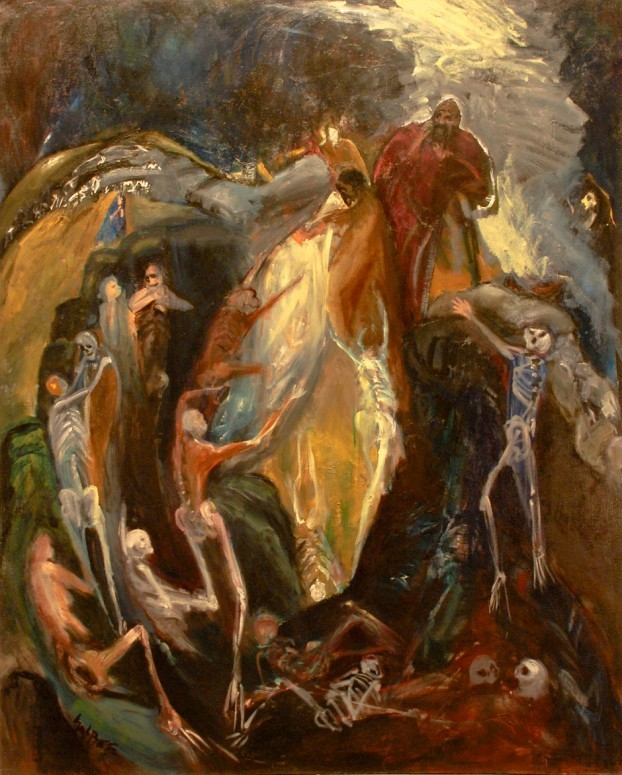
Ezekiel and the Valley of Dry Bones by Richard McBee

Folks around the world are quickly developing a new common language, becoming familiar with and using terms like social distancing, quarantine, shelter at home, and abundance of caution.  Our collective situation may easily create anxiety, and, so, parch our souls and leave our spirits dry.

There is, however, a God who can breathe new life into us and move us to renewed ways of thought and emotion.  The Old Testament prophet Ezekiel’s vision is a promise and a hope of resurrection, of revival.  No matter what our situation or who we are, we are all a displaced people – cast out of Eden and in need of restoration.  We, along with the ancient Israelites for whom he addressed, are in exile and long to return to our true home with God.  Along with St. Augustine we declare:

St Augustine quote

There are dry bones lying around – parched places in need of being reinvigorated.  Maybe you are experiencing the dry bones of hopelessness and despondency.  Maybe you are in a dark night of the soul where all of life seems like one shadowy oblivious hole.  Maybe you are wondering if God is really listening or is there at all because of the dry bones around you.  One thing for sure: Everything is upside-down right now; it is different.  At the first of the year, we didn’t see these current circumstances happening to us.  And, yet, these difficult times have much to teach us.

Let me share with you a “dry bones” experience from my own life.  Fifteen years-ago me and my family were in a car accident.  I was traveling on a highway in rural Iowa, and a small car on a gravel road blew through the stop sign without even slowing down.  There was nothing I could do.  I plowed into the rear quarter panel of the oncoming car, and it literally spun like a top off the highway and came to a stop.  Both the driver and his passenger were not injured.

Two of my three daughters were in the very back seat of our minivan (which I had just bought only a month before) with my wife and dog as front seat passengers.  The minivan was totaled.  My girls were not harmed.  However, my wife tore her shoulder’s rotator cuff protecting the dog and had an agonizing surgery to repair it.  My lower back was injured, yet, not in a way which surgery could repair it.  To this day I live with a kind of constant low-level aggravation of my spine.  Most days it’s not bad, maybe one or two on the pain scale.  On a bad day, I can barely walk across the room and need a cane to get around.

I have played the scene of the accident in my mind hundreds of times.  I have thought time and again about what I could have done to prevent it.  Honestly, there was no way to avoid it.  I thought about the fact that if we just would have left a minute earlier or a minute later from my parents’ house from where we were visiting, all would be fine.  Yet, I know that kind of thinking is a fool’s errand.  I have pondered every possible scenario in my head and have gotten nowhere.

It also took me awhile to forgive the young man who was driving the other car.  He changed my life, and not in a good way.  Although his insurance took care of everything and he was sorrowful about the incident, I was understandably angry for a long time.  I did, over time, come to the point of forgiving him.

Through the years I have learned to live with the limitations imposed on me.  I have now accepted the low-level aggravation of my back as part of my life.  On occasion, I sometimes can’t help but think of how my life would be today if I hadn’t been in that stupid accident.

About five years ago I was doing my usual routine morning prayers.  And God brought the accident to my mind.  I said to God, “Lord, we’ve been through this accident hundreds of times together.  I don’t want to think about it anymore.  Why are you bringing this up now?”

I’m not sure I really wanted an answer, but God brought it up because he knew I was finally ready to get his perspective on the accident.  Out of the hundreds of times I went over that accident in my mind, the one perspective I never took was that of the young man – the other driver.  God invited me to take a distinct viewpoint from the other driver.  So, I did.  I know that intersection like the back of my hand, so it wasn’t a hard exercise.

I imagined putting myself in the driver’s seat of his car.  I’m driving down the gravel road not paying attention to the fact that a stop sign is coming up.  I blow through the sign onto the highway and right in front of a minivan who slams on the brakes just enough to crush the rear quarter panel.  I spin out like a top and come to rest only a few feet from a huge Iowa grain elevator….

grain elevator

For the first time in my life I finally understood from a very different perspective.  God had a divine appointment for me that day.  You see, if I had not come along just when I did, that young man and his girlfriend would have blown through the stop sign and struck the grain elevator.  The impact would have killed them both instantly.

Suddenly, my attitude changed 180 degrees.  Previously, I had always thought about myself and my family.  I always considered my hardship and my change of life.  Now, I saw that God sent his servant to save two lives that day.  Had I not struck the young man’s car, causing him to spin and come to a rest unharmed, two people would have died.

From that time forward, every time my back acts up and effects how my life is lived, I’m reminded that it is a very small price to pay for the lives of two human beings.  God had me speak to the dry bones; and, the result was a revival of new thoughts and emotions.  This was such a dramatic change of thought and heart for me that it felt like a resurrection.

The biblical meaning of “repentance” is literally to have a change of mind – to see a different perspective.  The Bible invites us to view our lives with new lenses.  Our hurts and our pains, our sorrows and our sufferings, our changes and our limitations, are all part of something much bigger that God is doing in the world.  We are not always privy to his plans and purposes.  And, yet, God’s Word challenges us to take a perspective of the world, of humanity, and of ourselves that is counter to how we often think and feel.

It is a very small thing, right now in the admonitions to stay at home, to remain where we are.  Taking a mere one-sided view from my own perspective will bring frustration.  To see it from another angle as a temporary inconvenience, even with some permanent effects, which will save lives is a divine viewpoint.  To put it another way: We are speaking to dry bones.

Stay Home Save Lives

We might think and feel that we will be able to pursue God better without danger or hardship – that somehow difficulty is not to be part of the Christian life.  The dry bones exist, however, as an opportunity for God to give life.  That’s why Alexander Solzhenitsyn’s reaction to his exile in a Soviet labor camp in Siberia was to bless it, because it was there that, he said:

“I discovered that the meaning of earthly existence lies not, as we have grown used to thinking, in prospering, but in the development of the soul.”

God not only gives life; he restores life.  And this is an important truth to know and remember in the inevitable dry times of our lives.  God is not only a helper; he reanimates us from spiritual rigor mortis to lively resurrection through breathing on us.  And he does this for a reason.  Jesus came to his disciples after his resurrection and said, ‘“Peace be with you!  As the Father has sent me, I am sending you.’  And with that he breathed on them and said, ‘Receive the Holy Spirit’” (John 20:20-21).  In other words, God resuscitates us for a purpose, so that we might be a blessing to the world.  Faith is not only a possession to keep, but a gift to give.  We glorify God in loving one another and loving the world as Jesus did.  God could have resurrected the bones without Ezekiel’s being a part of it.  Instead, the LORD used Ezekiel and had him participate in the revival by speaking to the bones.

Such a challenge to speak to the dry bones may seem overwhelming to us.  What do you do when your life is upended, even shattered – when such a profound change comes to you that it is impossible for your life to be as it was?  The questions and commands of God seemed totally absurd to Ezekiel, speaking to dead dry bones.  Maybe we ought to operate more in the realm of the absurd than in the realm of the safe routine.  Maybe we ought to expect our faith to be exercised and look for God to breathe new life into the dead and decaying.  To believe that something, someone, or even myself can change is to have internalized this amazing story of dry bones living again.

Our self-imposed graves cannot hold us because God is among us.  What we need more than anything in this world and in the church is a genuine heaven-sent, Spirit-breathed, glorious reanimation in which God sends his grace and raises the dead.

2 Chronicles 34:1-7

            Josiah started out as a boy king.  Evidently, he had some good training because by the time he became a teenager, Josiah was raring and ready to exercise his kingship in the best sense of leadership.  After generations of kings before him who followed other gods, Josiah committed himself fully to Israel’s one true God.  And, as a twenty-year old king, he showed the real muster of his reign.
 
            Josiah took charge to do what was right in the eyes of God – no matter the consequences.  He did not just worship God, but aggressively took active steps to rid his kingdom of all the false gods that permeated the land.  Josiah did not stick his toe in the water to test what the response might be to removing a high place of Baal or an Asherah pole; he jumped right in and put his entire kingship on the line.  All of the power brokers who were dealing in false gods could not have been happy about this turn of events in Judah.  But any kind of pushback did not prevent Josiah from doing what was right in the eyes of the Lord by eradicating idol worship.
 
            Josiah’s clear sense of purpose led him to do the things he did.  He had a direction from God in order to lead people back to God.  This is not only an ancient purpose; God is still in the kingdom business of bringing all of his creation back under his rule and reign.  It still remains the purpose of God’s people to lead others, caught in the web of idolatry, back to the one true God.  Like the ancients before us, there is still a need to exercise courage and confidence in following God by making disciples who will worship him alone.  Reconnecting with our overarching purpose in life is quite necessary in order to take bold steps of faith in this idolatrous world.


            Holy God, you alone are the Sovereign of the universe.  Expose the things in my life that I might be trusting in other than you.  Wean me away from evil, and bend my heart and mind to truth and good.  Help me to be aggressive in my Christian walk so that I will follow Jesus Christ in the power of the Holy Spirit, leading others to faith along the way.  Amen.