Bread from Heaven (Exodus 16:27-35)

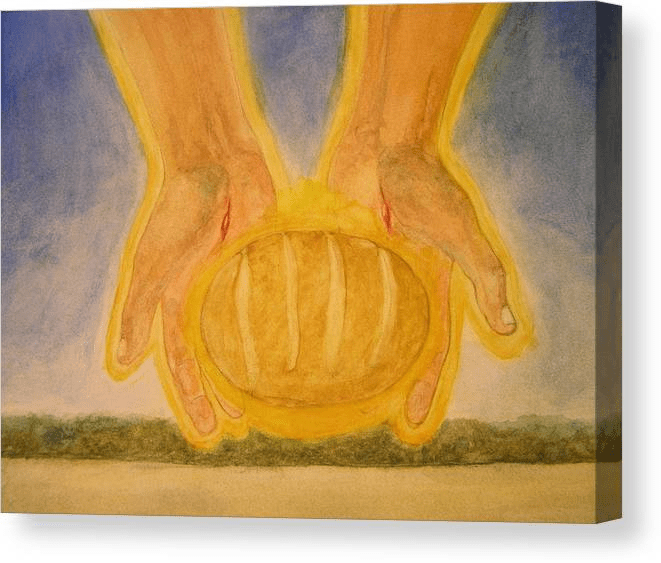
Bread From Heaven, by Nigel Wynter

On the seventh day some people went out to gather food, but they didn’t find any. The Lord said to Moses, “How long will you refuse to do what I have commanded and instructed you to do? Remember: The Lord has given you this day of rest as a holy day. That’s why he gives you enough food on the sixth day for two days. On the seventh day stay in your place—no one is to go out. Everyone, stay where you are.” So the people never worked on the seventh day of the week.

The Israelites called the food manna. It was like coriander seeds. It was white and tasted like wafers made with honey.

Moses said, “This is what the Lord has commanded: Take two quarts of manna to be kept for your descendants. This way they will see the food that I gave you to eat in the desert when I brought you out of Egypt.”

Moses said to Aaron, “Take a jar, put two quarts of manna in it, and put it in the Lord’s presence to be kept for your descendants.” Aaron put the jar of manna in front of the words of God’s promise to be kept there, as the Lord commanded Moses.

The Israelites ate manna for 40 years until they came to a place to settle. They ate manna until they came to the border of Canaan. (God’s Word Translation)

“What is it?” is the quite literal meaning of the word manna. And the answer is: It is bread from heaven.

The manna was food for the Israelite people in their 40 years of sojourning through the desert. There is also an implicit question surrounding this bread: What to do with it? Well, of course, you eat it. But, before eating it, there are issues and instructions about the manna’s arrival and collection.

The special food, only graciously given to this particular group of cantankerous people, appeared in the mornings for six days a week, not seven, and only had a shelf life of one day, with the exception of the singular Sabbath day each week.

There is a time to go out and gather, and there is a time to stay put and eat; a time to work, and a time to rest. The lack of wisdom in timing could cost you not only a meal, but also your overall sense of paying attention to God’s commands.

It is the fool who spurns the relationship between events, that is, the space between when the Lord speaks and when humanity responds. Our human responsibility is dependent upon Divine sovereignty. Ignoring the voice of God, or simply failing to listen out of present anxieties or fears, will nearly always result in a skewed response-ability.

Yes, indeed, we all have very legitimate needs for cuisine, clothing, companionship, care, and compassion. If these vital needs go unmet, we are undone and shall die. Yet, there is also the question of how we will go about getting those very important and basic needs met – and many people, having not listened well to the instructions about life, will go about attempting to meet those needs in illegitimate ways.

Trying to satisfy legitimate needs through illegitimate means ends up eroding the soul, compromising character, and searing the conscience. It’s inevitable that such a person will grumble and complain, projecting on God the evil that is, in reality, residing within the human heart.

Whenever folks go out and try to gather what isn’t there, they have lost their way and their very real needs will not really be met, at all.

This is why humans need remembrances – to have reminders of what time it is and what’s important to do and not do, to seek the appropriate paths of living well, and to avoid the pitfalls of dead end trails.

One purpose of Sabbath is to remember – to recall the great story of deliverance and never forget where we came from, so that we will continually have before us where we are going.

I Am the Bread of Life, by Joseph Matar

The Christian remembers the saving and redemptive events of Jesus by coming to the Table. We gather together to ingest bread from heaven, to partake of the Bread of Life. For those who choose to carefully listen and pay attention, the words of Christ will not only speak life into our weary selves, but shall also shape how we go about getting our needs met and satisfied:

The people began to murmur in disagreement because he had said, “I am the bread that came down from heaven….”

But Jesus replied, “Stop complaining about what I said. For no one can come to me unless the Father who sent me draws them to me, and at the last day I will raise them up. As it is written in the Scriptures, ‘They will all be taught by God.’ Everyone who listens to the Father and learns from him comes to me….

“I tell you the truth, anyone who believes has eternal life. Yes, I am the bread of life! Your ancestors ate manna in the wilderness, but they all died. Anyone who eats the bread from heaven, however, will never die. I am the living bread that came down from heaven. Anyone who eats this bread will live forever; and this bread, which I will offer so the world may live, is my flesh.”

Then the people began arguing with each other about what he meant. “How can this man give us his flesh to eat?” they asked.

So Jesus said again, “I tell you the truth, unless you eat the flesh of the Son of Man and drink his blood, you cannot have eternal life within you. But anyone who eats my flesh and drinks my blood has eternal life, and I will raise that person at the last day. For my flesh is true food, and my blood is true drink. Anyone who eats my flesh and drinks my blood remains in me, and I in him. I live because of the living Father who sent me; in the same way, anyone who feeds on me will live because of me. I am the true bread that came down from heaven. Anyone who eats this bread will not die as your ancestors did (even though they ate the manna) but will live forever.” (John 6:41-58, NLT)

Consider well, then, where and how you will find the sustenance of the soul, love, and in what ways you will listen to the words of Jesus and gather them for your next meal. Will you hoard your heaven-sent food, or will you share?

O God, our Provider and Sustainer, we who are many are one body in Christ, for we all share in the one bread. Refresh, strengthen, and preserve us as we journey in this life, in the name of Jesus Christ. Amen.

I Will Give You Rest (Exodus 33:7-23)

Now Moses used to take a tent and pitch it outside the camp some distance away, calling it the “tent of meeting.” Anyone inquiring of the Lord would go to the tent of meeting outside the camp. And whenever Moses went out to the tent, all the people rose and stood at the entrances to their tents, watching Moses until he entered the tent. As Moses went into the tent, the pillar of cloud would come down and stay at the entrance, while the Lord spoke with Moses. Whenever the people saw the pillar of cloud standing at the entrance to the tent, they all stood and worshiped, each at the entrance to their tent. The Lord would speak to Moses face to face, as one speaks to a friend. Then Moses would return to the camp, but his young aide Joshua son of Nun did not leave the tent.

Moses said to the Lord, “You have been telling me, ‘Lead these people,’ but you have not let me know whom you will send with me. You have said, ‘I know you by name and you have found favor with me.’ If you are pleased with me, teach me your ways so I may know you and continue to find favor with you. Remember that this nation is your people.”

The Lord replied, “My Presence will go with you, and I will give you rest.”

Then Moses said to him, “If your Presence does not go with us, do not send us up from here. How will anyone know that you are pleased with me and with your people unless you go with us? What else will distinguish me and your people from all the other people on the face of the earth?”

And the Lord said to Moses, “I will do the very thing you have asked, because I am pleased with you and I know you by name.”

Then Moses said, “Now show me your glory.”

And the Lord said, “I will cause all my goodness to pass in front of you, and I will proclaim my name, the Lord, in your presence. I will have mercy on whom I will have mercy, and I will have compassion on whom I will have compassion. But” he said, “you cannot see my face, for no one may see me and live.”

Then the Lord said, “There is a place near me where you may stand on a rock. When my glory passes by, I will put you in a cleft in the rock and cover you with my hand until I have passed by. Then I will remove my hand and you will see my back; but my face must not be seen.” (New International Version)

Moses was perhaps the most humble person who ever lived on the earth (Numbers 12:3), which is why he and God had such an intimate friendship together. But Moses was also a workaholic who tended to carry the world on his shoulders. (Exodus 18:1-27)

Good old Moses, bless his heavy heart, kept finding himself in over his head with all sorts of people problems and conflicts. And so, Moses almost seems perpetually stressed. It reminds me of an old episode of the original “Bob Newhart Show” in which Bob, a psychologist, becomes exasperated and blurts out, “Why do these people always have to come to me with their stupid problems!”

The Lord, infinitely patient with people, simply let Moses know that all he really needed was the divine presence, to rest fully in God being with him.

This is precisely what we all need to be reminded of almost every day. God is with us. The Lord’s presence is continually alongside us. And sometimes, we must get away from it all for a while, so that we can rest and gain some fresh perspective on life and who’s really in charge of everything.

Consider just a few of the many verses in Holy Scripture which reinforce God’s call to rest:

Observe the day of rest as a holy day. This is what the Lord your God has commanded you. (Deuteronomy 5:12, GW)

Only in God do I find rest;
    my salvation comes from him.
Only God is my rock and my salvation—
    my stronghold!—I won’t be shaken anymore. (Psalm 62:1-2, CEB)

The promise to enter the place of rest is still good, and we must take care that none of you miss out. (Hebrews 4:1, CEV)

Jesus said, “Come to me, all of you who are tired from carrying heavy loads, and I will give you rest.” (Matthew 11:28, GNT)

Scriptural rest is neither discretionary nor a luxury; a biblical sabbath rest is a vital necessity. It’s both lovingly encouraged and divinely commanded. 

And it is not simply a vacation in which we fill up our time with sightseeing and/or doing a lot of activities so that we end up needing a vacation from our vacation. Instead, the invitation to rest is initiated, given, and ordained by God. 

One morning I set aside a four-hour block to get away, rest, and pray. I’ll be honest that I came into it with a personal agenda of what I wanted God to do. I had my list of prayer items and my thoughts of how I believed God should work. Silly me.

It did not take long into my forceful striving toward God, that I was on a misguided adventure in missing the point. Somehow, in my desire to see all kinds of prayer requests answered, I lost sight of God’s presence and resting in it, enjoying it.

In our daily work-a-day world we poke and prod, we push, cajole, and finagle to move forward and get our way on all kinds of things. To separate ourselves from our typical routine takes something of a withdrawal, and it isn’t easy. This is likely why so many folks are tired, cranky, and negative – because they find all kinds of reasons to not rest.

Compulsions for performance and perfection are bandits, stealing our rest. We want to do everything right – to pray right, talk right, be right and live right – instead of coming to God like a little child. To rest means to relinquish all our plans and agendas to God for a time and connect to the reality of God’s presence.

Spiritual and biblical rest only “works” when we realize we don’t have it all together – that we are helpless and need to pull away and experience God’s glory. 

Maybe this old fallen world continues in its many dysfunctions because God’s people have not yet learned the necessity of faithful rest and trusting in the very presence of God, who is full of glory, now and forevermore. Amen.

There’s a Price to Pay (Leviticus 26:34-46)

At that time, while it is devastated and you are in enemy territory, the land will enjoy its sabbaths. At that time, the land will rest and enjoy its sabbaths. During the whole time it is devastated, it will have the rest it didn’t have during the sabbaths you lived in it.

I will bring despair into the hearts of those of you who survive in enemy territory. Just the sound of a windblown leaf will put them to running, and they will run scared as if running from a sword! They will fall even when no one is chasing them! They will stumble over each other as they would before a sword, even though no one is chasing them!

You will have no power to stand before your enemies. You will disappear among the nations—the land of your enemies will devour you. Any of you who do survive will rot in enemy territory on account of their guilty deeds. And they will rot too on account of their ancestors’ guilty deeds.

But if they confess their and their ancestors’ guilt for the wrongdoing they did to me, and for their continued opposition to me—which made me oppose them, so I took them into enemy territory—or if their uncircumcised hearts are humbled and they make up for their guilt, then I will remember my covenant with Jacob. I will also remember my covenant with Isaac. And my covenant with Abraham.

And I will remember the land. The land will be absent of them and will be enjoying its sabbaths while it lies devastated, free of them. They will be making up for their guilty deeds for no other reason than the fact that they rejected my regulations and despised my rules. 

But despite all that, when they are in enemy territory, I will not reject them or despise them to the point of totally destroying them, breaking my covenant with them by doing so, because I am the Lord their God. But for their sake I will remember the covenant with the first generation, the ones I brought out of Egypt’s land in the sight of all the nations, in order to be their God; I am the Lord.

These are the rules, regulations, and instructions between the Lord and the Israelites that he gave through Moses on Mount Sinai. (Common English Bible)

Disobedience has a price. Within God’s household, the Lord isn’t some geriatric or decrepit deity who let’s the kids run around and do whatever the heck they want. Instead, God has certain rules so that the children can grow and thrive within loving boundaries. The fences aren’t there in order to be a divine killjoy; rather, the rules and boundaries exist for the flourishing and enjoying of life.

The price of disobedience is brokenness and devastation. To continually buck our basic design as humans will eventually catch up to us. If we eat with impunity, spending copious amounts of time consuming food, we’ll one day collect a host of heart-related issues and diseases. If we drive the car and never maintain it through regular oil changes and inspections, someday it will break down, perhaps permanently.

And if we live our lives without punctuating our weeks with needed rest – and use the land as if it were an infinite resource – then everything will eventually go awry and not work or produce like it should. That’s not God being mean, as if the Lord is to blame; it’s us being stupid, not practicing our God-given wisdom.

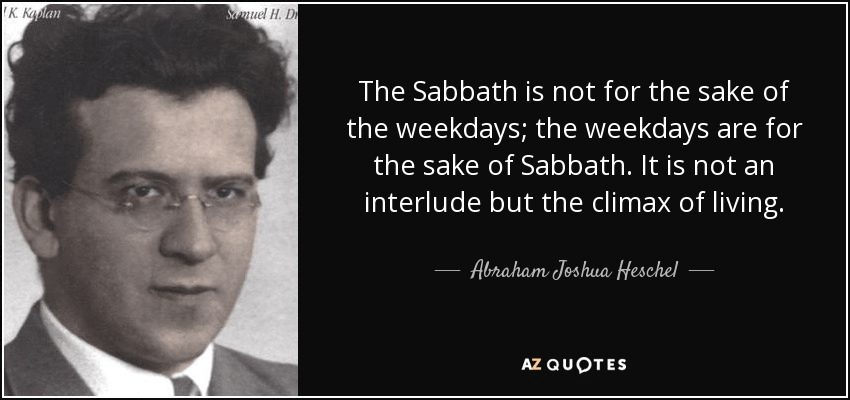
“Because we do not rest, we lose our way.”

Wayne Muller

Everything and everyone needs rest. It’s vital to us, just as much as water to drink and air to breathe. So, if we ignore it, we’ll pay the price of our neglect.

Sabbath was built into the universal scheme of things because it’s necessary. Our bodies neither work right nor live right without regular sabbath rests. It’s not optional. Try telling your body that you’re too busy to go to the bathroom and see how that works out for you. Sooner than later, you’re going to have to submit, or there will be a hefty price to pay.

If we stray from wise ways of living, or even stubbornly refuse to obey, there’s hope; we won’t be left to wallow in our own foolishness. Grace is too big and strong for any of our puny human backsliding. The Lord is always ready and willing to receive the humble and penitent heart.

God’s expertise is in restoration; the Lord gives a new lease on life to people who could never do it themselves. In fact, from a New Testament perspective, God even goes so far as to pay the price of human waywardness with his own Son.

A loving God ensures that all of creation will have what it needs to survive and thrive. An unloving god turns a blind eye to it all. If we don’t learn to play well with the creation around us, we’ll be called into the house and not be allowed to be outside for quite some time.

We are meant to practice good self-care, be good caregivers for others, and concern ourselves with caring for all creation.

So, pay the price of caring for self, others, and the land. Accept and submit to the rhythms of life which are required to live well. You’ll be glad you did because the alternative may be something a whole lot harder.

Creator God, you made the goodness of the land, the riches of the sea and the rhythm of the seasons; as we thank you for your gracious providing may we cherish and respect this planet and its peoples, through Jesus Christ our Lord. Amen.

Take the Path of Peace (Zechariah 1:1-17)

Michelangelo’s depiction of the prophet Zechariah, Sistine Chapel, Rome

In the eighth month of the second year of Darius, the word of the Lord came to the prophet Zechariah son of Berekiah, the son of Iddo:

“The Lord was very angry with your ancestors. Therefore tell the people: This is what the Lord Almighty says: ‘Return to me,’ declares the Lord Almighty, ‘and I will return to you,’ says the Lord Almighty. Do not be like your ancestors, to whom the earlier prophets proclaimed: This is what the Lord Almighty says: ‘Turn from your evil ways and your evil practices.’ But they would not listen or pay attention to me, declares the Lord. Where are your ancestors now? And the prophets, do they live forever? But did not my words and my decrees, which I commanded my servants the prophets, overtake your ancestors?

“Then they repented and said, ‘The Lord Almighty has done to us what our ways and practices deserve, just as he determined to do.’”

On the twenty-fourth day of the eleventh month, the month of Shebat, in the second year of Darius, the word of the Lord came to the prophet Zechariah son of Berekiah, the son of Iddo.

During the night I had a vision, and there before me was a man mounted on a red horse. He was standing among the myrtle trees in a ravine. Behind him were red, brown and white horses.

I asked, “What are these, my lord?”

The angel who was talking with me answered, “I will show you what they are.”

Then the man standing among the myrtle trees explained, “They are the ones the Lord has sent to go throughout the earth.”

And they reported to the angel of the Lord who was standing among the myrtle trees, “We have gone throughout the earth and found the whole world at rest and in peace.”

Then the angel of the Lord said, “Lord Almighty, how long will you withhold mercy from Jerusalem and from the towns of Judah, which you have been angry with these seventy years?” So the Lord spoke kind and comforting words to the angel who talked with me.

Then the angel who was speaking to me said, “Proclaim this word: This is what the Lord Almighty says: ‘I am very jealous for Jerusalem and Zion, and I am very angry with the nations that feel secure. I was only a little angry, but they went too far with the punishment.’

“Therefore this is what the Lord says: ‘I will return to Jerusalem with mercy, and there my house will be rebuilt. And the measuring line will be stretched out over Jerusalem,’ declares the Lord Almighty.

“Proclaim further: This is what the Lord Almighty says: ‘My towns will again overflow with prosperity, and the Lord will again comfort Zion and choose Jerusalem.’” (New International Version)

God hulking-out isn’t something you want to see repeated, insisted the prophet.

Zechariah directed his message to the Jews returning from their exile in Babylon. He reminded them that their parents and forebears had been called to repent and return to the Lord. They didn’t. Hence, the Babylonian exile. Big hint from the prophet to the people: Don’t ever do that again. Things will get angry, large, and green if you do.

Zechariah’s generation was being given a chance: To live into God’s covenant and law; to hold fast onto their identity as God’s people.

The people listened to the prophet. They expressed their repentance and a desire to turn from past evil ways and embrace the ways of the Lord. And the returning exiles also acknowledged and accepted God’s judgment. The returning exiles understood that, as a people, they deserve the consequences to centuries of neglecting justice, mercy, and humility.

Every generation of believers must learn from the past. Not only do they need to receive the teachings and traditions of those who went before them, but each generation must also struggle with how to put that teaching and tradition into practice.

The past needs to be squarely faced and deliberately pulled into the present. That is the way a genuine hope is born, giving direction for the future. In other words, old words and ways from the past need new experiences in the present; only by doing this will there be guidance.

Bring in your kingdom so that your will is done on earth as it’s done in heaven. (Matthew 6:10, CEB)

Today’s Old Testament lesson includes the first of eight night visions from the prophet Zechariah. The gist of the first prophetic oracle is a message of assurance and comfort: God will restore. The Lord will renew.

Divine intervention is about to happen in the rebuilding of the temple – a physical example of the spiritual reality that is happening. Just as the ancient temple was being restored for new generations of worshipers, so the people were being renewed to be an example of piety and fidelity to God for millennia to come.

Peace and prosperity will again be realized.

Throughout Scripture, trees are a symbol of a thriving and flourishing life. The myrtle tree is a sign of God’s promise to bring new life, branching out to spread into the next generations. Like all trees, the myrtle needs plenty of moisture when young. Yet, it is distinctive in that the myrtle tree can tolerate drought, grow despite limited soil, and remain hardy when it becomes mature.

Your anger lasts a little while,
but your kindness lasts
    for a lifetime.
At night we may cry,
but when morning comes
    we will celebrate. (Psalm 30:5, CEV)

“Tolerate,” “grow,” and “remain” are anything but passive words. People are more than mere observers. “Repent” and “return” and “renew” are verbs. There is a great deal of activity to do. A divine/human cooperation needs to occur. On God’s end, even the angels get involved in the action. What’s happening here is both heavenly and earthly business.

Relational dynamics between God and God’s people are to be a dialogue and not a one-sided monologue. The Lord and the present generation are to demonstrate for future peoples how peace is actually realized and enjoyed.

The Vision of Zechariah, by Unknown artist, c.1300 C.E., Sicily

Like all biblical visions, Zechariah’s is not readily understandable. Nobody is sure about what the symbolism is behind the vision’s horses. Yet, I’ll venture to say that it’s the colors which are significant: red is the color of action; brown is a color of stability and fertility; and white represents purity and holiness. Red, brown, and white mixed together creates a beige color.

Beige is an earthy and dependable color. It’s an inherently welcoming and calming color, offering warmth and symbolizing harmony and comfort. Together, with the horses we have a representation of strength, stability, and structure. They are signs of peace and rest, of God’s shalom.

Spiritual wholeness, moral integrity, relational harmony, and settled peace don’t just magically happen. 

For the Christian, peace was bought at a price – the blood of Jesus. (Colossians 1:20)

Peace must be both passively received and actively pursued. (Ephesians 4:3)

Practices of peace need to be engrafted into our lives so that we might daily experience it. (Romans 14:13-15:7)

The name “Zechariah” is a Hebrew word meaning, “God remembered.” God has not forgotten divine promises. 

The time has come to take hold of the vision God had from the very beginning to walk with humanity in continual fellowship and happiness in the garden, a place of abundant growth, beauty, and health – a place of peace and rest.

The happiest, fully rested, and most peaceful people and nations on earth continually find a steady stream of joy in their families, their rituals/traditions, and their religion.

To find joy and happiness in life is to find peace and rest. And peace is something to be shared, to be passed onto others.

“The peace of Christ be with you.”

“And also with you.”

Such ritual words and practices are reminders of continually returning to the Lord and finding simplicity and satisfaction in Jesus.

In observing and celebrating the Lord’s Table, we find our penultimate remembrance of how peace was achieved, as well as our supreme participation in the triune God.

Perhaps, then, peace and prosperity will extend their tree-like branches over the earth and into the next generations.

Grace to you and peace from God our Father and the Lord Jesus Christ.

Peace before us,
Peace behind us,
Peace under our feet.

Peace within us,
Peace over us,
Let all around us be peace.

Christ before us,
Christ behind us,
Christ under our feet.

Christ within us,
Christ over us,
Let all around us be Christ. – a Navajo Prayer