A Desert Spirituality (Mark 1:9-15)

In those days Jesus came from Nazareth of Galilee and was baptized by John in the Jordan. And just as he was coming up out of the water, he saw the heavens torn apart and the Spirit descending like a dove upon him. And a voice came from the heavens, “You are my Son, the Beloved; with you I am well pleased.”

And the Spirit immediately drove him out into the wilderness. He was in the wilderness forty days, tested by Satan, and he was with the wild beasts, and the angels waited on him.

Now after John was arrested, Jesus came to Galilee proclaiming the good news of God and saying, “The time is fulfilled, and the kingdom of God has come near; repent, and believe in the good news.” (New Revised Standard Version)

40 Days of Desert

We are in the season of Lent in the Christian Year. Beginning with Ash Wednesday, Christians take a forty-day journey, leading to Holy Week and Easter. Jesus spent forty days in the desert being tempted by Satan. So, the Church remembers this event with the season of Lent.

This is the season in which many Christians give focus to the temptations we face on a regular basis. We intentionally practice spiritual disciplines, such as fasting, and give up something for six weeks, so that we might become aware of our attachments to other things and how much we rely on them, instead of trusting God.

It was important for Jesus to be in the desert; and it’s necessary for us, as well. Jesus retraced the steps of the ancient Israelites, who wandered in the desert for forty years before entering the Promised Land. The people needed to re-connect with God, after having failed in their faith. Trust had to be strengthened and developed before they could be ready to receive God’s promises.

Jesus accomplished what others did not: He faced down the devil and overcame temptation in the desert. 

The forty days were a necessary preparation for the upcoming three years of ministry that would culminate in Christ’s death, burial, and resurrection. Before any of that could happen, Jesus had to experience the desert.

We, like Jesus, need a desert spirituality. The desert forms us into followers of Jesus by learning to overcome temptation, so that we will not be shaped into followers of Satan. God desires to strengthen our faith, and facing down the temptations of Satan are crucial to our spiritual development.

For Christians, the desert becomes the gymnasium where we are broken down through the stress of temptation, so that we might become spiritually stronger in our faith. Without this kind of spiritual training, we become vulnerable to Satan’s accusations, and easy prey to his temptations.

Christ’s Desert

After the baptism of Jesus, the Spirit flung him into the desert. There was real danger in the desert, wild animals and all. Yet, put in that situation and having come through it, Jesus was able to deal with the crafty pursuits of Satan to distract him from his mission. 

Throughout the Gospel of Mark, after tossing demons out of people, Jesus commanded the unclean spirits not to tell anyone who he was. Part of what was going on, is that Satan wanted to tempt Jesus to gain fame and power through popularity and accolades. But that was not the way of Jesus. He was not going to bring in the kingdom of God through the avenues of careful marketing and brand recognition.

Another practice of Jesus throughout his ministry was to seek places for solitude and prayer. The needs Jesus daily faced were large and vast and never ended. Yet, he resisted working without any rest or guidance in prayer. 

A temptation could have been to please people and never get away to pray. Yet, through solitude and prayer, Jesus connected with his Father; he moved from place to place proclaiming the good news of God’s rule and reign. Jesus did not succumb to the temptation to settle in one place and build a petty kingdom of his own, apart from the Father.

As Jesus walked the countryside telling people of repentance and faith, he often spoke in parables that were designed to foster thought and reflection. Jesus was not duped by the temptation to always be black and white about everything, merely giving the bottom line of his teaching to people. 

Christ did not teach in order to get immediate results, or to let people know which side he was on concerning the issues of the day. Instead, Jesus was about the business of building something permanent that would far outlast his short three years of ministry.

Because of the desert, and through his Father’s affirmation, Jesus lived a unique three years on this earth that has never been equaled before or since.

Our Desert

Years ago, I went on a leadership retreat in the Canadian wilderness. We were so far out in the sticks that we needed special first aid training before leaving, because if someone got severely injured it would be hours before he could receive any medical attention. There was no cell phone service, no towns, no anything except mile after square mile of wilderness. 

We were continually vigilant to not attract bears. The wilderness can be a dangerous place. One day, we were each dropped off on our own personal islands for an entire day, alone. Being face to face with yourself can be hard to deal with, which is what a desert experience does – it exposes the idols of our hearts and the ways in which we are tempted.

A person does not need to be in the Canadian wilderness or in the actual desert to experience the effects of desert life. The Holy Spirit has a way of throwing us into the desert through a change of circumstance, so that we will exercise our spiritual muscles and get in spiritual shape. 

The top three temptations that people face on a daily basis are: 

  1. Worry and anxiety
  2. Procrastination and putting things off
  3. Gossip and other sins of the tongue 

So, how do we face down those temptations and retrace our steps back to the path of God? Here are some lessons I have learned in my own desert experiences:

  1. Know your weaknesses. Know yourself, and the temptations directed at you. The three I just mentioned all come from a tendency toward perfectionism. We worry about the future, of not saying or doing something perfectly. So, we procrastinate for fear of screwing up and not being perfect. And we gossip to others about their faults and weaknesses because it maintains the illusion that our perfectionism is intact, at least as compared to others. Perfectionism is slavery. For freedom Christ has set us free. Stand firm, therefore, and do not submit again to a yoke of slavery. (Galatians 5:1, NRSV)
  2. Understand the importance of timing. When are you at your weakest, and vulnerable to temptation? What triggers you to sin? Whenever kids act up, we first wonder if they are tired or hungry or have some other need. It’s the same with us. Carrying sleep debt, skipping meals, or eating junk food because we are in a hurry, will set us up for temptation. Elijah faced down four-hundred prophets of Baal, then fell apart when one woman, Jezebel, went after him. He needed food and rest. Discipline yourselves; keep alert. Like a roaring lion your adversary the devil prowls around, looking for someone to devour. (1 Peter 5:8, NRSV)
  3. Look to God and others. Don’t rely solely on your own willpower; or believe that you can resist temptation all by yourself, all the time. Even Jesus looked both to his Father and his disciples. Then Jesus went with them to a place called Gethsemane, and he said to his disciples, “Sit here while I go over there and pray.” He took with him Peter and the two sons of Zebedee and began to be grieved and agitated. Then he said to them, “My soul is deeply grieved, even to death; remain here, and stay awake with me.” And going a little farther, he threw himself on the ground and prayed, “My Father, if it is possible, let this cup pass from me, yet not what I want but what you want.” Then he came to the disciples and found them sleeping, and he said to Peter, “So, could you not stay awake with me one hour? Stay awake and pray that you may not come into the time of trial; the spirit indeed is willing, but the flesh is weak.” (Matthew 26:36-41, NRSV)
  4. Have a plan. Flying by the seat of your pants will not always work. The clever see danger and hide, but the simple go on and suffer for it. (Proverbs 22:3, NRSV) One of the ways I personally resist temptation is by having a daily plan of worshiping God, praying, and reading Scripture at set times throughout the day. For me, it’s significant to have more than a few minutes of “quiet time” in the morning.
  5. Overcome evil with good. Do not be overcome by evil, but overcome evil with good. (Romans 12:21, NRSV) Applying this to the top three temptations people face, that means worriers will love their enemy and pray for those who persecute. For the procrastinator, it means to take intentional steps of faith and risk, being real and vulnerable with others through accountable relationships. For the gossip, they will seek to speak words of encouragement that build others up.
  6. Know that you are never alone. Angels attended Jesus. Even the Son of God was not on his own.  Whatever you are facing is likely not unique to you. Others face it, too. Our brothers and sisters throughout the world are undergoing the same kind of problems when they seek to walk with Christ.

Let the desert shape and strengthen your faith. If the Holy Spirit has thrown you into a dry place, then instead of bucking the situation and complaining about it, learn all you can about resisting temptation so that you can come out the other end a stronger, more faithful follower of Jesus Christ. 

May it be so, to the glory of God.

A Real Change of Life (Matthew 12:43-45)

“When an evil spirit leaves a person, it goes into the desert, seeking rest but finding none. Then it says, ‘I will return to the person I came from.’ So it returns and finds its former home empty, swept, and in order. Then the spirit finds seven other spirits more evil than itself, and they all enter the person and live there. And so that person is worse off than before. That will be the experience of this evil generation.” (New Living Translation)

Nature abhors a vacuum. A tilled plot of soil will be overtaken with weeds if nothing is planted and nurtured in the turned-over dirt. 

The pecking order of a brood of chickens cannot handle the death of the top hen without filling the position almost immediately. 

In the spiritual realm, the exorcising of a demon will not simply leave a person empty of evil – their life will be filled with something in its place.

Jesus told a story about a man who was delivered from an unclean (evil) spirit. It’s a powerful and simple narrative on the necessity of true repentance, that is, on what a real change of life is like. 

Genuine freedom is more than getting rid of something bad and destructive; the evil must be replaced with something good and useful. In other words, biblical repentance, a true transformation of a person, is both a turning away from ungodliness and an embrace of righteousness.

We are delivered from evil so that we can start living into right and peaceful relationships, as God intends for us.

For example, the Apostle Paul exhorted the Ephesian believers to not only stop stealing but also to get a job and start sharing with others. They were not only to stop lying and using their tongues for gossip and slander and start using their words to speak truth that builds up others. (Ephesians 4:25-32)

The spiritual principle is the same as the nature principle: A empty vacuum will always be filled. The man who did not fill his life with God ended up having a problem with evil seven times greater than when he started. If anything, or anyone, is emptied of its unhealthy elements and practices, it is imperative that the hole be immediately filled with healthy disciplines for life.

Whether dealing with addictions, bad habits, or any kind of evil influence, a two-pronged approach is needed for its eradication. We expel the evil by replacing it with godliness. 

For example, the man struggling with pornography or adultery must not only stop the behavior but take up the mantle of being a champion for women’s issues; or the woman who has no healthy boundaries and allows herself to be used and abused must not only separate from the problem or person but adopt her identity in Christ as a precious child of God and enforce righteous limitations. 

These examples are not meant to be simplistic answers to complex situations. Rather, they illustrate why so many people do not experience freedom and continue to have even greater enslavement to their passions and sufferings. Freedom is realized through replacing old practices with new disciplines that directly attack the old.

We all have needs. How we get those needs met is often a mixed bag of both legitimate and illegitimate ways. In a perfect world, everyone would be aware of their needs and be able to express them to one another without shame, anxiety, or anger. Since we live on a blemished fallen planet, we end up trying to meet our needs indirectly through hustling for love, hoarding resources, and controlling others – all harmful ways which destroys souls and relationships.

In order to focus on meeting our needs in a wise and healthy manner, we must take a step beyond ending a toxic relationship, cutting up a credit card, or saying “no” to another responsibility. We often get into our mess to begin with because we are out of touch with ourselves and our needs. We need affection and encouragement, and there is no shame in needing this. We need security and safety, and there is no problem in acquiring this. There are some things we need to control, and that is okay.

If we fail to address our needs, we might do the necessary work of deliverance, then turn right around and become worse off than before by filling the empty place of our lives with:

  • Being all things to all people, as if we were the Messiah.
  • Being successful so that we stay ahead of being needy.
  • Pulling inside ourselves and trusting nobody.
  • Distancing from our needs and pretending they are not there.
  • Being continually vigilant so that we are never hurt that way again.
  • Keeping a positive spin on everything, as if there is no negative stuff in the world.
  • Challenging other’s opinions and behaviors to keep the focus off our needs.
  • Becoming a wallflower so that we can never be the brunt of someone else’s vitriol or evil.

Instead, we can let Jesus fill the emptiness with love, purpose, peace, joy, attention, and grace. Christ is the Savior who delivers us from evil, and the Holy Spirit is the Sanctifier who carefully applies the work of salvation to our lives. When our hearts and minds are full of God, there is no place for the demons to get in.

True change and transformation equally forsakes evil and embraces righteousness; replaces the unhealthy with the healthy; jettisons the illegitimate and seeks the legitimate; and puts away unnecessary suffering and pursues peace and joy in the Spirit.

O God, I no longer want to live with saying I’m sorry and going right back to the old pig slop of sin. I cannot change on my own. I need Jesus to both take away the sin and give me a new life of living for him. Help me to make choices that put to death the old way of life, and the courage to live into my forgiveness in the power of the Holy Spirit. Amen.

The Second Woe Upon the Earth (Revelation 9:13-21)

The sixth angel sounded his trumpet, and I heard a voice coming from the four horns of the golden altar that is before God. It said to the sixth angel who had the trumpet, “Release the four angels who are bound at the great river Euphrates.” And the four angels who had been kept ready for this very hour and day and month and year were released to kill a third of mankind. The number of the mounted troops was twice ten thousand times ten thousand. I heard their number.

The horses and riders I saw in my vision looked like this: Their breastplates were fiery red, dark blue, and yellow as sulfur. The heads of the horses resembled the heads of lions, and out of their mouths came fire, smoke and sulfur. A third of mankind was killed by the three plagues of fire, smoke and sulfur that came out of their mouths. The power of the horses was in their mouths and in their tails; for their tails were like snakes, having heads with which they inflict injury.

The rest of mankind who were not killed by these plagues still did not repent of the work of their hands; they did not stop worshiping demons, and idols of gold, silver, bronze, stone and wood—idols that cannot see or hear or walk. Nor did they repent of their murders, their magic arts, their sexual immorality or their thefts. (New International Version)

In an apocalyptic vision of God’s judgment at the end of time, the Apostle John saw seven angels with seven trumpets. Each blast of the horn brought ever increasing levels of destruction upon the earth. The final three trumpets are also described as the three woes. (Revelation 8:2-6, 13)

The Sixth Trumpet (Second Woe)

The sixth angel sounded the sixth trumpet, which was also the second woe pronounced on the world. Four angels are released from their place of restraint. Whereas the invasion of locusts in the fifth trumpet (first woe) came from the pit of hell, the next invasion comes from the east, from the outskirts, that is, outside the Roman Empire.

The terrible angels go out to kill a third of all humanity. They lead a massive destructive force that overwhelms the earth. The incredible army looks something like centaurs, being horse and rider in one. And out of their mouths come fire, smoke, and sulfur. These are three plagues which brings death to a third of humanity.

The Response to the Second Woe’s Invasion

John records the human response to the divine judgment unleashed upon humanity with the four angels and their three plagues. In reality, it’s actually a lack of response; there is no change of heart and no repentant attitude from anyone. The awful devastation does nothing to elicit any sort of self-reflection, public awareness of sin, or reconsideration of ways by those left alive.

The Apostle records that the rest of the people, after going through such a traumatic time, keep up their worship of demons and their idolatry. They continue to murder, carouse, and steal, as if nothing had happened.

What’s more, John’s graphic and disturbing vision – from it’s very beginning – does not record a single person turning away from their evil ways. The surviving inhabitants of the earth act like old Pharaoh in Egypt during the days of Moses and the exodus; their hearts are hard, and they are not about to change.

What It Means For Us

A big question for us as contemporary people, two-thousand years removed from John’s apocalyptic vision is this: Do the judgments contained in the book of Revelation have any relevance for us today?

Some might dismiss all of this as weird historical story that nobody can really understand, so we might just as well put it aside as belonging in the past. Others grew up hearing “fire and brimstone” sermons from Revelation that did nothing for them other than help them decided that they never want to be in a church again and listen to a sinner about how sinful everybody is.

Although I do not condone hellfire preaching that does little more than make people feel bad, I do believe these difficult judgment chapters in the book of Revelation have something to say to us which we would do well to hear.

  • If we dig in and want what we want, without considering anyone else or even God, then we really cannot expect blessing either in this life or the life to come.
  • If and when disaster or destruction happens – and afterwards go on our merry way as if nothing even occurred – then we have come under divine judgment.
  • If we purposely stick our heads in the sand, and intentionally avoid what is happening around us in this world, then it will not go well for us in the end.
  • If we become angry, and nurse the grudge to the point of becoming hateful and unloving, then the hardness of heart will not recognize God’s visitation when it comes.
  • If we hurt and harm others without any remorse, or make excuses for bad behavior when called out on it, then we are no better than the unrepentant mass of humanity in the book of Revelation.

There is coming a time when it will be too late. The Day of the Lord will come. There will be a final judgment. But if you are reading this, there is obviously still time. Spiritual procrastination only leads to destruction. Spiritual attention to the here-and-now leads to life. What will you do “Today?”

Our Father who is in heaven,

uphold the holiness of your name.

Bring in your kingdom

so that your will is done on earth as it’s done in heaven.

Give us the bread we need for today.

Forgive us for the ways we have wronged you,

just as we also forgive those who have wronged us.

And don’t lead us into temptation,

but rescue us from the evil one. Amen.

The Example of John the Baptist (Matthew 14:1-12)

John the Baptist preaching, by George Maurice Cloud (1909-1973)

At that time Herod the ruler heard the news about Jesus. He said to his servants, “This is John the Baptist. He’s been raised from the dead. This is why these miraculous powers are at work through him.” Herod had arrested John, bound him, and put him in prison because of Herodias, the wife of Herod’s brother Philip.

That’s because John told Herod, “It’s against the law for you to marry her.”

Although Herod wanted to kill him, he feared the crowd because they thought John was a prophet. But at Herod’s birthday party Herodias’ daughter danced in front of the guests and thrilled Herod. Then he swore to give her anything she asked.

At her mother’s urging, the girl said, “Give me the head of John the Baptist here on a plate.” Although the king was upset, because of his solemn pledge and his guests he commanded that they give it to her. Then he had John beheaded in prison. They brought his head on a plate and gave it to the young woman, and she brought it to her mother. But John’s disciples came and took his body and buried it. Then they went and told Jesus what had happened. (Common English Bible)

John the Baptist’s murder is not only an ancient story; it’s also a story about our contemporary world – a world of power, sex, and intrigue. Times may change, but people across the ages do not. Humanity is fundamentally the same in every century. And the world is still the world, no matter the historical time. 

The contrast between King Herod and John the Baptist supply us with two types of people who exist throughout every age of humankind, offering us the choice of which way we will go with our lives. The story illustrates for us the reality of living in a fallen world as a devout person.

The Herod in today’s Gospel lesson was a son of Herod the Great, the one who killed all the male babies when Jesus was born in order to try and get rid of any rival king (Matthew 2:1-18). King Herod is displayed in the narrative as a tragic and pathetic figure who is ruled by his own lusts. He seems too proud and wimpy to admit he made a rash promise. He killed a man just to save face with his guests at a party.

This a Jerry Springer worthy family drama: The Herod family was rich, proud, and downright violent. They tended to marry within their own clan to hold their power and possessions for themselves. Herodias married her uncle Herod Philip; Salome was their daughter.

Later, Salome married Philip the tetrarch, half-brother to Herod Philip. Through marriage, Salome became both aunt and sister-in-law to her mother. Then the Herod in our story married Herodias, who had been married to Herod’s half-brother, Herod Philip. Having fallen in love with Herod Antipas, Herodias divorced Herod Philip to marry Herod Antipas.

Sheesh, nothing quite like complicated family drama.

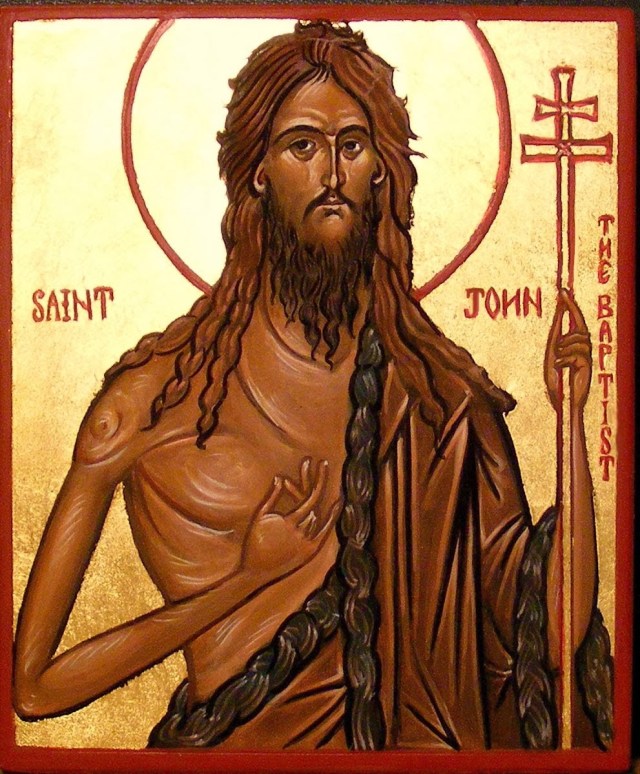
Orthodox icon of John the Baptist

Into this violation of Old Testament marriage laws (the Herod’s were Jewish) came John who made no bones about the fact this was not right (Leviticus 18:16, 20:21). Herodias nursed a grudge against John for speaking out against her and Herod’s choices.

Hell, hath no fury like a woman’s scorn, and when Herodias found an opportunity to get rid of John, she coached her daughter into asking for John the Baptist’s head on a platter. Herod, too insecure to take back his ridiculous promise and look like a fool, consented to the execution of John.

In contrast to all this tragic theater is John the Baptist. John was a messenger of God and a preacher of repentance. As one who was preparing the way for Jesus, his message was simple and to the point: Repent, for the kingdom of God is near.

John got into trouble and lost his life because he spoke truth to power by meddling in the life of King Herod and his family. The Herod’s were the political establishment of the day, and John did not temper his words when dealing with them.

There is a refreshing integrity about John. He was always the same, no matter where he was, and no matter who the people were around him. In contrast to Herod, John was bold, courageous, confident, unafraid, and secure enough in his relationship with God to engage in ministry without thought to the consequences. 

John was unconcerned for what others might think of him, if he proclaimed truth in the public square, and it ended up costing him his life.

John the Baptist Rebuking Herod, by Giovanni Fattori (1825-1908)

The story of John the Baptist’s death speaks about the hostility of this world. And it prefigured and foreshadowed the death of Jesus:

  • Like John, Jesus was executed by the civil authorities.
  • Herod, like Pilate after him, hesitated to execute and was swayed by the crowd.
  • Herodias, like the chief priests toward Jesus, finally got her way through scheming and manipulation.
  • John’s disciples came and took his body and buried it, just like Joseph of Arimathea and Nicodemus did for Jesus.

These stories, on the surface, appear to be only gloom and doom. Yet, there is a message of hope and joy. The absurd is working out itself in deliverance from sin, death, and hell. Through death, Jesus conquered death. We now have no fear of death; its sting has been taken away. Without fear of death, we have no reason to fear life with its troubles and tribulations.

The fork in the road is between the way of John or Herod. It’s a values-based decision. If worth is derived from what we do, what we have, and/or other’s opinion of us, we will likely identify more with Herod and his choices. If there is a preoccupation with hoarding power and control, this is the path of Herod. 

Conversely, if the ultimate value is in knowing Christ crucified and the power of his resurrection, then we identify with John as our spiritual ancestor. If security and worth is derived from being in Christ, then there is boldness to speak truth to power and give grace to the powerless.

Herod saw no further than his immediate needs and safety; he failed to discern his own heart. Because of his spiritual blindness, Herod did not look away from himself and look to God. Faith in Jesus comes when persons look away from themselves and look to Christ who holds the power to free all from spiritual bondage.

Consider the example of John the Baptist. He consistently sought to do the will of God as best as he understood it. Together with all God’s people past and present, we declare that God is with us, the kingdom of God is near, and the love of Christ brings faith and hope.

Almighty God, through your providence John the Baptist was wonderfully born and was sent to prepare the way of your Son, our Savior, by the preaching of repentance. Lead us to repent according to his preaching and, after his example, constantly to speak the truth, boldly to rebuke vice, and patiently to suffer for truth’s sake; through Jesus Christ your Son, our Lord, who is alive and reigns with you, in the unity of the Holy Spirit, one God, now and forever. Amen.