
Revelation 3:1-6 – Remember, Hold On, and Change

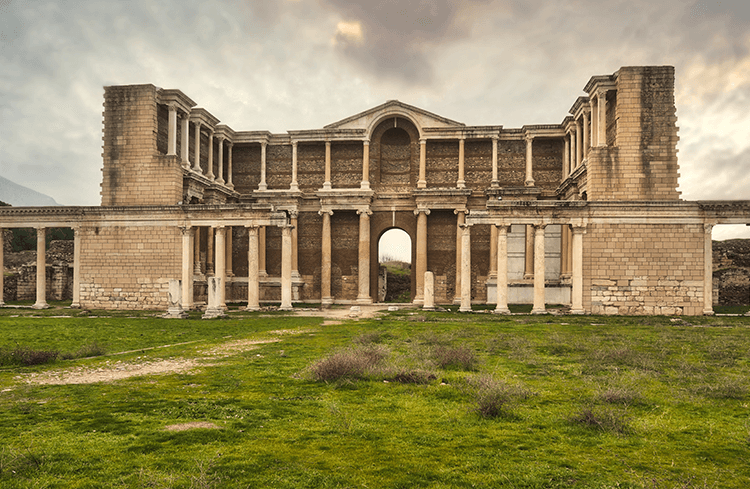
Ruins in the ancient city of Sardis (present day Sart, Turkey)

Write this to the angel of the church in Sardis:

These are the words of the one who holds God’s seven spirits and the seven stars: I know your works. You have the reputation of being alive, and you are in fact dead. Wake up and strengthen whatever you have left, teetering on the brink of death, for I’ve found that your works are far from complete in the eyes of my God. So, remember what you received and heard. Hold on to it and change your hearts and lives. If you don’t wake up, I will come like a thief, and you won’t know what time I will come upon you. But you do have a few people in Sardis who haven’t stained their clothing. They will walk with me clothed in white because they are worthy. Those who emerge victorious will wear white clothing like this. I won’t scratch out their names from the scroll of life but will declare their names in the presence of my Father and his angels. If you can hear, listen to what the Spirit is saying to the churches. (Common English Bible)

Many Christians reflexively think of good old Apostle Paul when it comes to biblical epistles (letters) to churches. Yet, contained within the first three chapters of Revelation are seven succinct letters to seven different churches. These letters are short and packed with a punch – and they don’t come from Paul.

What makes these short bursts of exhortation so powerful is that they come from Jesus himself. Yes, that Jesus – the Lord Jesus Christ, the head of the church. So, it seems to me that Christ’s observations about the church ought to carry more weight than anybody else’s thoughts.  

Christ was concerned about how far the church was from completing the work of God. So, he gave a pointed admonition, almost like a parent trying to awaken a teenager in the morning. “Wake up!” said Jesus because he found the church’s obedience incomplete and lacking strength. If this were the Apostle Paul talking, he would likely have framed it this way: “You have sinned and fallen short of the glory of God.” (Romans 3:23)

Our Lord went directly to the heart of the church’s life… and it’s death. The stark reality is that these statements from Jesus remain penetrating and relevant for today’s church.

So, what is to be done about the situation of spiritual deadness in the church? 

Jesus did not leave the church hanging but in a few compact words let them know exactly what they are to do to remedy their spiritual malady: Remember. Hold on. Change. Keep the memory of sound instruction alive, always adjusting the life of the church to it. The Christian term for this is “repentance.”

Sometimes, if not many times, we may tend to forget the things we need to remember and remember the things we must forget. We are to follow God in a pattern of remembering and forgetting. God has said:

I wipe away your sins because of who I am. And so, I will forget the wrongs you have done. (Isaiah 43:25, CEV)

I will forgive their wrongdoing and never again remember their sins. (Jeremiah 31:34, CEB)

I will forget their sins and never again remember the evil they have done. (Hebrews 10:17, ERV)

Concerning those who have wronged us, we are to emulate God’s grace, mercy, and kindness through forgiveness. To “forget” does not mean performing a personal lobotomy but simply not to hold an offense against another by continually bringing it to mind. On the other hand, God remembers divine promises made to people. Likewise, we are to constantly bear in mind what God has put before us to remember:

For I received from the Lord what I also handed on to you, that the Lord Jesus on the night when he was betrayed took a loaf of bread, and when he had given thanks, he broke it and said, “This is my body that is for you. Do this in remembrance of me.” In the same way he took the cup also, after supper, saying, “This cup is the new covenant in my blood. Do this, as often as you drink it, in remembrance of me.” For as often as you eat this bread and drink the cup, you proclaim the Lord’s death until he comes. (1 Corinthians 11:23-26, NRSV)

We need an abiding remembrance of the Lord Jesus, the very person who spoke to the church hundreds of years ago. It is in those times when we become distressed that we must center our memory on Christ:

We must focus on Jesus, the source and goal of our faith. He saw the joy ahead of him, so he endured death on the cross and ignored the disgrace it brought him. (Hebrews 12:2, GW)

Remembering Jesus Christ sets us on the path to fulfilling the work of God and completing that which has been given us to do. This is precisely why I choose to follow the Christian Year and remember time by having it centered around the life and ministry of Jesus.

Always think about Jesus Christ. He was brought back to life and is a descendant of David. This is the Good News that I tell others. (2 Timothy 2:8, GW)

I have been a constant example of how you can help those in need by working hard. You should remember the words of the Lord Jesus: “It is more blessed to give than to receive.” (Acts 20:35, NLT)

Let us remember together in prayer:

Awesome Lord Jesus, your words penetrate to the core my being. Strengthen me by the continuing presence of yourself through the Holy Spirit so that my every thought, word, and deed is done in your holy Name. Kindle in my heart a vision of your love and shine the light of your victory over sin, death, and hell over this dark world. Continually take me to yourself. Keep me in your wounds and mindful of your presence so that I shall fulfill all the will of God for my life through your divine enablement. Amen.

Confess and Believe

Welcome, friends, to this Christian season of Lent. Holy Scripture graciously communicates that everyone who believes in their heart, with a faith which bubbles up and come pouring out of the mouth, shall be saved. Click the videos below, and let us consider God’s grace to us in Jesus Christ…

Pastor Tim Ehrhardt, Romans 10:8b-13

Forgive those things we have done, O God,
which have caused you sadness,
and those things we should have done
that would have brought you joy.
In both we have failed
ourselves,
and you.
Bring us back to that place
where our journey began,
when we said that we would follow
the way that you first trod.
Lead us to the Cross
and meet
us there. Amen.

Psalm 51:1-17 – Ash Wednesday

Have mercy on me, God, according to your faithful love!
    Wipe away my wrongdoings according to your great compassion!
Wash me completely clean of my guilt;
    purify me from my sin!
Because I know my wrongdoings,
    my sin is always right in front of me.
I’ve sinned against you—you alone.
    I’ve committed evil in your sight.
That’s why you are justified when you render your verdict,
    completely correct when you issue your judgment.
Yes, I was born in guilt, in sin,
    from the moment my mother conceived me.
And yes, you want truth in the most hidden places;
    you teach me wisdom in the most secret space.

Purify me with hyssop and I will be clean;
    wash me and I will be whiter than snow.
Let me hear joy and celebration again;
    let the bones you crushed rejoice once more.
Hide your face from my sins;
    wipe away all my guilty deeds!
Create a clean heart for me, God;
    put a new, faithful spirit deep inside me!
Please don’t throw me out of your presence;
    please don’t take your holy spirit away from me.
Return the joy of your salvation to me
    and sustain me with a willing spirit.
Then I will teach wrongdoers your ways,
    and sinners will come back to you.

Deliver me from violence, God, God of my salvation,
    so that my tongue can sing of your righteousness.
Lord, open my lips,
    and my mouth shall proclaim your praise.
You don’t want sacrifices.
    If I gave an entirely burned offering,
    you wouldn’t be pleased.
A broken spirit is my sacrifice, God.
    You won’t despise a heart, God, that is broken and crushed. (Common English Bible)

Ash Wednesday is an ancient holy day on the Church Calendar. It marks the beginning of the season of Lent—a time of penitence, discipline, and renewal.

We are reminded of our mortality, we confess our sins, and we experience forgiveness through Christ’s death and resurrection. The “imposition of ashes” is a central part of Ash Wednesday observances, whereby the penitent worshiper receives ashes on the forehead in the sign of the cross.

In Holy Scripture, ashes serve both as a symbol of mortality and as a sign of mourning and repentance. But neither sin nor death is the final word. So, we also have confidence and gratitude that Christ has conquered death, and nothing can separate us from the love of God, which is in Jesus, our Lord.

Today, on this Ash Wednesday, the appropriate posture of the devout Christian is prayer. Specifically, prayers of confession of our great and many sins, shortcomings, and moral failures. 

This might sound negative and a major downer. Yet, to not look evil square in the face and call it out for what it is, is at best denial, and at the worst allowing a bitter seed of unforgiveness to gestate in the depths of your soul. 

It seems to me there is no better way to confront the darkness within than with using the ancient prayer book of the Old Testament Psalms. I encourage you to pray Psalm 51 out loud and slowly, with a generous amount of emotional flavor – even, and especially, if you don’t feel like it. 

Pray the ancient psalm over more than once, and perhaps several times punctuated throughout the day today. In doing so, you will be joining the faithful across this entire big world who today offer to God a prayer of subversion against the blackness on this earth.

Holy God, as the season now turns to Lent, we pray that you will guide us in the days ahead.  As we journey with Jesus, give us an abiding sense of your presence, an unguarded sense of ourselves, and an awareness of the needs of this world.

Loving God, as we are marked with the ashes of earth, we bring before you the frailty of our very human lives:  our fragile health; the uncertainty of our plans; the changing nature of our relationships. Grant us patience in suffering and healing from our ills. Give us, in equal measure, humility and hope in our pursuits. Bind us in love that is constant, yet able to change according to the needs and circumstances before us.

Just God, you call us to action; to bring freedom to the oppressed; to care for those in need; to lift the burdens of others. We ask you to increase our courage and our will to work for the peace you envision and desire. We pray for an end to warfare and conflict, accepting our call to be peacemakers. We pray for an end to hunger and homelessness, knowing we are called to share with others and show hospitality. We pray for an end to false righteousness, evil speech, and shallow faith in our lives, in the church, in our public life, and among all the nations.

Eternal God, we pray your kingdom will come in fullness; that what is perishable will be raised imperishable; that death itself will be swallowed up in victory; through Jesus Christ, our Savior and Lord. Amen.

1 Samuel 24:1-22 – How to Handle An Enemy

David and Saul in the Cave by James J. Tissot (1836-1902)

After Saul returned from pursuing the Philistines, he was told, “David is in the Desert of En Gedi.” So, Saul took three thousand able young men from all Israel and set out to look for David and his men near the Crags of the Wild Goats.

He came to the sheep pens along the way; a cave was there, and Saul went in to relieve himself. David and his men were far back in the cave. The men said, “This is the day the Lord spoke of when he said to you, ‘I will give your enemy into your hands for you to deal with as you wish.’” Then David crept up unnoticed and cut off a corner of Saul’s robe.

Afterward, David was conscience-stricken for having cut off a corner of his robe. He said to his men, “The Lord forbid that I should do such a thing to my master, the Lord’s anointed, or lay my hand on him; for he is the anointed of the Lord.” With these words David sharply rebuked his men and did not allow them to attack Saul. And Saul left the cave and went his way.

Then David went out of the cave and called out to Saul, “My lord the king!” When Saul looked behind him, David bowed down and prostrated himself with his face to the ground. He said to Saul, “Why do you listen when men say, ‘David is bent on harming you’? This day you have seen with your own eyes how the Lord delivered you into my hands in the cave. Some urged me to kill you, but I spared you; I said, ‘I will not lay my hand on my lord, because he is the Lord’s anointed.’ See, my father, look at this piece of your robe in my hand! I cut off the corner of your robe but did not kill you. See that there is nothing in my hand to indicate that I am guilty of wrongdoing or rebellion. I have not wronged you, but you are hunting me down to take my life. May the Lord judge between you and me. And may the Lord avenge the wrongs you have done to me, but my hand will not touch you. As the old saying goes, ‘From evildoers come evil deeds,’ so my hand will not touch you.

“Against whom has the king of Israel come out? Who are you pursuing? A dead dog? A flea? May the Lord be our judge and decide between us. May he consider my cause and uphold it; may he vindicate me by delivering me from your hand.”

When David finished saying this, Saul asked, “Is that your voice, David my son?” And he wept aloud. “You are more righteous than I,” he said. “You have treated me well, but I have treated you badly. You have just now told me about the good you did to me; the Lord delivered me into your hands, but you did not kill me. When a man finds his enemy, does he let him get away unharmed? May the Lord reward you well for the way you treated me today. I know that you will surely be king, and that the kingdom of Israel will be established in your hands. Now swear to me by the Lord that you will not kill off my descendants or wipe out my name from my father’s family.”

So, David gave his oath to Saul. Then Saul returned home, but David and his men went up to the stronghold. (New International Version)

Sometimes reconciliation is neither possible nor wise.

King Saul was unstable. Although initially appreciative of David’s service, Saul became jealous. And that jealousy eventually grew into suspicion, then paranoia.

It became so bad that David had to flee and went on the run. Saul was convinced David wanted his kingship, so he hunted him like an animal. He wanted him out of the limelight and out of the way – permanently.

There are times in everyone’s life that another person actively and intentionally seeks to do us harm. How do we handle such a situation? How might we respond in a way that gives us peace of mind?

David continually had enemies throughout his life. And the vast number of those who opposed him, did so despite the fact that David didn’t deserve it.

“We retaliate instead of reflect, and we burn hot in the flames of revenge rather than cool our heels in the pool of patience.”

Craig D. Lounsbrough

Saul came looking for David with an army five-times the size of David’s rag-tag group of men. Yet, Saul had no idea that he had ambled into being a sitting duck.

What would you do in that kind of situation?

Picture the person who gives you the most grief. Maybe they purposely speak bad about you or try and oppose you at any opportunity. Perhaps there is a boss or someone in authority who seeks to undermine you every chance they get.

And now, the tables are turned. You have the chance to publicly put them in their place. You can put an end to the madness. What are you going to do?

In David’s situation, his men made the logical assumption that God ordained the turn of events. So, go ahead and off Saul. Become the king. After all, God already told you that you would be king. Now he’s giving you the opportunity. It’s right there. Take it, man.

“Retaliation is a dog chasing its tail.”

Libba Bray

But David didn’t take advantage of having the upper hand. He didn’t kill Saul because he was convinced it wasn’t the right thing to do. In fact, David felt terrible for even considering the idea. He wasn’t going to take matters into his own hands.

So, David left it in the hands of God. Since God anointed him as the next king, David reasoned, then God would make it happen. He didn’t need to do God’s job for him. David’s theological perspective was this: God is my defender; God will take care of me; God will judge another’s sinful behavior.

Today’s Old Testament lesson is a story in the importance and necessity of non-retaliation. What’s more, it’s a lesson in treating all people with respect, even if they don’t seem to deserve it, at all.

This lesson in no way infers that we sit idly by and refuse to hold another accountable for their actions. It just means we aren’t the judge, jury, and executioner.

Once Saul realized he had been a sitting duck, he repents… or does he? He admits to his wrong, even emotionally reacts to it. But here’s the bottom line to all overtures of repentance: It must result in a change of attitude and behavior. And Saul didn’t offer that.

So, the story ends pretty much as it began. There’s no reconciliation because there’s no true repentance on the part of Saul. The disturbed and paranoid king ends up continuing his murderous pursuit of David. *Sigh*

Folks like Saul have no intention of changing. They only want to hold onto their power and control. They’re only happy if others are giving them accolades and kudos. And if they’re not getting recognition, there’s hell to pay.

Beware of false repentance. Don’t be fooled by a person who has a pervasive pattern of self-interest, then, all of a sudden, feels sorry. It’s likely they’re doing that because they don’t have the upper hand – and they desperately want it back.

More importantly, don’t play their game. Instead, live by the ethics of God’s kingdom. You’ll be glad you did.

O God: Give me strength to live another day. Let me not turn coward in the face of its difficulties. Let me not lose faith in other people. Keep me sweet and sound of heart, in spite of ingratitude, treachery, or meanness. Preserve me from harm and keep me from harming others. Help me to keep my heart clean, and to not become disheartened by the evil of others. Open wide the eyes of my soul that I may see the good in everything. Inspire me with the spirit of joy and gladness and make me a conduit of your blessing to others, in the name of the strong Deliverer, our Lord and Savior, Jesus Christ. Amen.
