1 Samuel 24:1-22 – How to Handle An Enemy

David and Saul in the Cave by James J. Tissot (1836-1902)

After Saul returned from pursuing the Philistines, he was told, “David is in the Desert of En Gedi.” So, Saul took three thousand able young men from all Israel and set out to look for David and his men near the Crags of the Wild Goats.

He came to the sheep pens along the way; a cave was there, and Saul went in to relieve himself. David and his men were far back in the cave. The men said, “This is the day the Lord spoke of when he said to you, ‘I will give your enemy into your hands for you to deal with as you wish.’” Then David crept up unnoticed and cut off a corner of Saul’s robe.

Afterward, David was conscience-stricken for having cut off a corner of his robe. He said to his men, “The Lord forbid that I should do such a thing to my master, the Lord’s anointed, or lay my hand on him; for he is the anointed of the Lord.” With these words David sharply rebuked his men and did not allow them to attack Saul. And Saul left the cave and went his way.

Then David went out of the cave and called out to Saul, “My lord the king!” When Saul looked behind him, David bowed down and prostrated himself with his face to the ground. He said to Saul, “Why do you listen when men say, ‘David is bent on harming you’? This day you have seen with your own eyes how the Lord delivered you into my hands in the cave. Some urged me to kill you, but I spared you; I said, ‘I will not lay my hand on my lord, because he is the Lord’s anointed.’ See, my father, look at this piece of your robe in my hand! I cut off the corner of your robe but did not kill you. See that there is nothing in my hand to indicate that I am guilty of wrongdoing or rebellion. I have not wronged you, but you are hunting me down to take my life. May the Lord judge between you and me. And may the Lord avenge the wrongs you have done to me, but my hand will not touch you. As the old saying goes, ‘From evildoers come evil deeds,’ so my hand will not touch you.

“Against whom has the king of Israel come out? Who are you pursuing? A dead dog? A flea? May the Lord be our judge and decide between us. May he consider my cause and uphold it; may he vindicate me by delivering me from your hand.”

When David finished saying this, Saul asked, “Is that your voice, David my son?” And he wept aloud. “You are more righteous than I,” he said. “You have treated me well, but I have treated you badly. You have just now told me about the good you did to me; the Lord delivered me into your hands, but you did not kill me. When a man finds his enemy, does he let him get away unharmed? May the Lord reward you well for the way you treated me today. I know that you will surely be king, and that the kingdom of Israel will be established in your hands. Now swear to me by the Lord that you will not kill off my descendants or wipe out my name from my father’s family.”

So, David gave his oath to Saul. Then Saul returned home, but David and his men went up to the stronghold. (New International Version)

Sometimes reconciliation is neither possible nor wise.

King Saul was unstable. Although initially appreciative of David’s service, Saul became jealous. And that jealousy eventually grew into suspicion, then paranoia.

It became so bad that David had to flee and went on the run. Saul was convinced David wanted his kingship, so he hunted him like an animal. He wanted him out of the limelight and out of the way – permanently.

There are times in everyone’s life that another person actively and intentionally seeks to do us harm. How do we handle such a situation? How might we respond in a way that gives us peace of mind?

David continually had enemies throughout his life. And the vast number of those who opposed him, did so despite the fact that David didn’t deserve it.

“We retaliate instead of reflect, and we burn hot in the flames of revenge rather than cool our heels in the pool of patience.”

Craig D. Lounsbrough

Saul came looking for David with an army five-times the size of David’s rag-tag group of men. Yet, Saul had no idea that he had ambled into being a sitting duck.

What would you do in that kind of situation?

Picture the person who gives you the most grief. Maybe they purposely speak bad about you or try and oppose you at any opportunity. Perhaps there is a boss or someone in authority who seeks to undermine you every chance they get.

And now, the tables are turned. You have the chance to publicly put them in their place. You can put an end to the madness. What are you going to do?

In David’s situation, his men made the logical assumption that God ordained the turn of events. So, go ahead and off Saul. Become the king. After all, God already told you that you would be king. Now he’s giving you the opportunity. It’s right there. Take it, man.

“Retaliation is a dog chasing its tail.”

Libba Bray

But David didn’t take advantage of having the upper hand. He didn’t kill Saul because he was convinced it wasn’t the right thing to do. In fact, David felt terrible for even considering the idea. He wasn’t going to take matters into his own hands.

So, David left it in the hands of God. Since God anointed him as the next king, David reasoned, then God would make it happen. He didn’t need to do God’s job for him. David’s theological perspective was this: God is my defender; God will take care of me; God will judge another’s sinful behavior.

Today’s Old Testament lesson is a story in the importance and necessity of non-retaliation. What’s more, it’s a lesson in treating all people with respect, even if they don’t seem to deserve it, at all.

This lesson in no way infers that we sit idly by and refuse to hold another accountable for their actions. It just means we aren’t the judge, jury, and executioner.

Once Saul realized he had been a sitting duck, he repents… or does he? He admits to his wrong, even emotionally reacts to it. But here’s the bottom line to all overtures of repentance: It must result in a change of attitude and behavior. And Saul didn’t offer that.

So, the story ends pretty much as it began. There’s no reconciliation because there’s no true repentance on the part of Saul. The disturbed and paranoid king ends up continuing his murderous pursuit of David. *Sigh*

Folks like Saul have no intention of changing. They only want to hold onto their power and control. They’re only happy if others are giving them accolades and kudos. And if they’re not getting recognition, there’s hell to pay.

Beware of false repentance. Don’t be fooled by a person who has a pervasive pattern of self-interest, then, all of a sudden, feels sorry. It’s likely they’re doing that because they don’t have the upper hand – and they desperately want it back.

More importantly, don’t play their game. Instead, live by the ethics of God’s kingdom. You’ll be glad you did.

O God: Give me strength to live another day. Let me not turn coward in the face of its difficulties. Let me not lose faith in other people. Keep me sweet and sound of heart, in spite of ingratitude, treachery, or meanness. Preserve me from harm and keep me from harming others. Help me to keep my heart clean, and to not become disheartened by the evil of others. Open wide the eyes of my soul that I may see the good in everything. Inspire me with the spirit of joy and gladness and make me a conduit of your blessing to others, in the name of the strong Deliverer, our Lord and Savior, Jesus Christ. Amen.

Genesis 33:1-17 – Reconciled

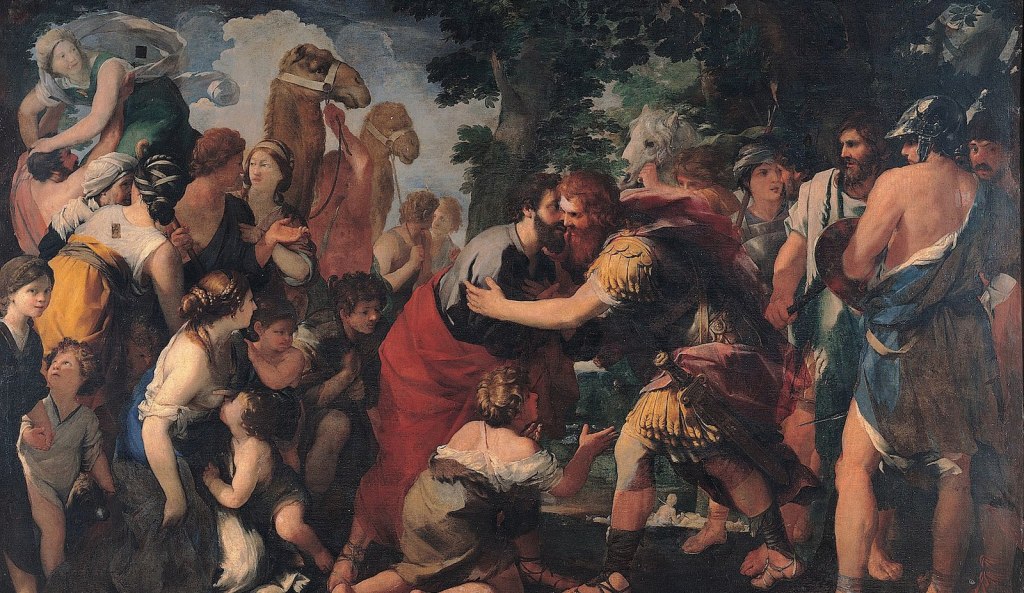
Meeting Between Jacob and Esau by Italian painter Bottalla Raffaellino (1613-1644)

Later that day Jacob met Esau coming with his four hundred men. So, Jacob had his children walk with their mothers. The two servant women, Zilpah and Bilhah, together with their children went first, followed by Leah and her children, then by Rachel and Joseph. Jacob himself walked in front of them all, bowing to the ground seven times as he came near his brother.

But Esau ran toward Jacob and hugged and kissed him. Then the two brothers started crying.

When Esau noticed the women and children he asked, “Whose children are these?”

Jacob answered, “These are the ones the Lord has been kind enough to give to me, your servant.”

Then the two servant women and their children came and bowed down to Esau. Next, Leah and her children came and bowed down; finally, Joseph and Rachel also came and bowed down.

Esau asked Jacob, “What did you mean by these herds I met along the road?”

“Master,” Jacob answered, “I sent them so that you would be friendly to me.”

“But, brother, I already have plenty,” Esau replied. “Keep them for yourself.”

“No!” Jacob said. “Please accept these gifts as a sign of your friendship for me. When you welcomed me and I saw your face, it was like seeing the face of God. Please accept these gifts I brought to you. God has been good to me, and I have everything I need.” Jacob kept insisting until Esau accepted the gifts.

“Let’s get ready to travel,” Esau said. “I’ll go along with you.”

But Jacob answered, “Master, you know traveling is hard on children, and I have to look after the sheep and goats that are nursing their young. If my animals travel too much in one day, they will all die. Why don’t you go on ahead and let me travel along slowly with the children, the herds, and the flocks. We can meet again in the country of Edom.”

Esau replied, “Let me leave some of my men with you.”

“You don’t have to do that,” Jacob answered. “I am happy, simply knowing that you are friendly to me.”

So, Esau left for Edom. But Jacob went to Succoth, where he built a house for himself and set up shelters for his animals. That’s why the place is called Succoth. (Contemporary English Version)

Repentance includes more than saying sorry. It also involves admitting wrong and making things right. Turning from erroneous thinking and forsaking past hurtful actions, lays the groundwork for an earnest attempt at reconciliation. 

For example, the Christian does more than a simple acceptance and acquiescence of Jesus, as if merely adding a bit of Christ to life will dash it up and make it better. Rather, we are invited into the very life of Christ. This life turns us upside-down and inside-out in a new and radical allegiance.

Repentance and reconciliation are a way of life. They are necessary skills requiring development through continual practice and use.

Broken relationships are the stuff of life. So, we need gracious approaches to deal with them so that bitterness does not take root in our souls. Connection and peace between two people are a beautiful thing. They bring emotional health, spiritual wholeness, and life enrichment.

From the get-go, twin brothers Jacob and Esau in the Old Testament book of Genesis had a contentious relationship. Their relations became so bad that Esau had homicidal ideation toward his brother. Neither Esau nor Jacob handled things well. Jacob ended up leaving, finding a wife, growing a family, and becoming wealthy.

Twenty years passed before they came together again.

Jacob, knowing he was about to meet his brother, had an encounter with God. It changed his identity from the old deceiver to the new Israel (Genesis 32:22-31).  In a demonstration of his new identity as Israel, Jacob worked at making amends for his old cheating ways. He sought to give the blessing he had stolen from his brother.

Jacob understandably had some dread in meeting Esau. He had connived and manipulated to take the family birthright and blessing from his brother. Fresh from wrestling with God, Jacob demonstrated a newfound courage and humility. He offered Esau respect, gifts, and honor – reversing his past pattern of disrespect, stealing, and dishonor.

True repentance is making things right. Merely having feelings of remorse is not repentance. To repent involves genuine sorrow; an earnestness to make restitution and reconciliation; an indignation over what happened; and, perhaps most importantly, a deep concern for the person(s) harmed by our wrongdoing (2 Corinthians 7:8-11).

The reconciliation between the brothers was a surprise. Jacob was not expecting Esau’s response. It seems Jacob was bracing for the worse, which explains his high anxiety before the encounter.

Esau’s gracious response was an answer to Jacob’s prayer.  For Jacob, seeing Esau’s face was like seeing the face of God. In fact, he saw both faces and lived! Jacob likely would not have seen his brother’s face until he had first seen God’s. His divine experience prepared the way for the human encounter.

We all experience times when relationships unravel and need to be mended. Jacob procrastinated for twenty years before working at reconciliation with his brother. What made the difference for Jacob was trusting God, who always works out divine promises, despite our human foibles. 

May you know and experience the God who reconciles and restores, and in so doing, extend that same earnestness to others.

Merciful God, I confess that I have sinned against you and against others through my own fault by thought, word and deed in things done and left undone. Especially I confess that I have _____.  I therefore repent; for these and all my sins I am terribly sorry and pray for forgiveness. I firmly intend to make amends and seek for help. I ask for strength to serve you in newness of life through Jesus Christ, my Lord, in the power of your Holy Spirit. Amen.

Nehemiah 9:26-31 – Judgment and Grace

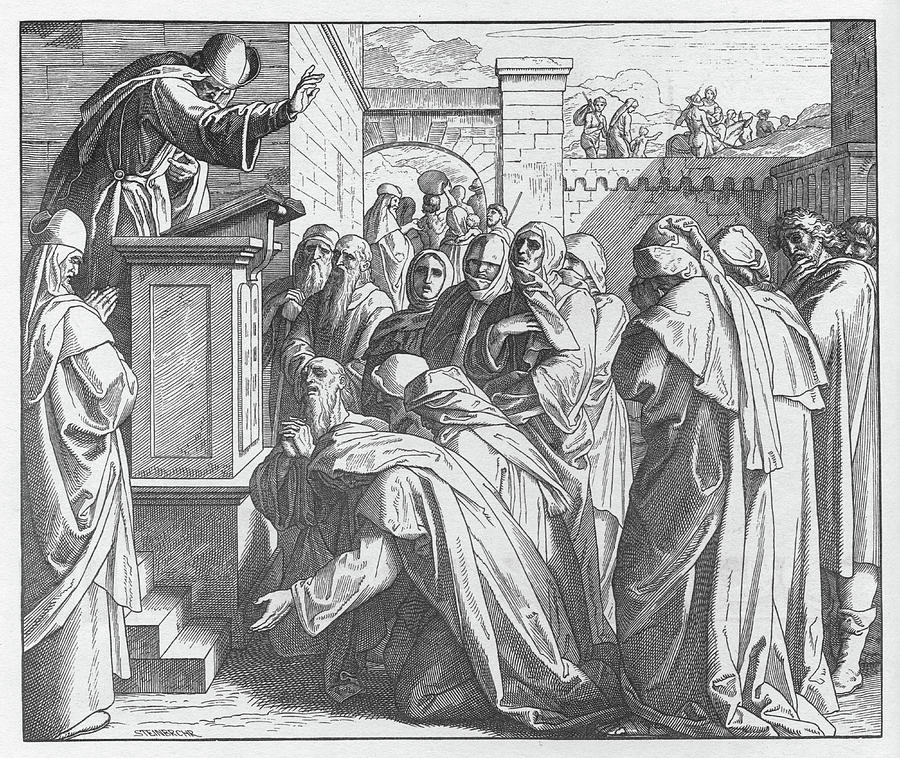
“Repentance of the People” by German painter Julius Schnoor von Carolsfeld (1794-1872)

But despite all this [God’s blessings] they were disobedient and rebelled against you. They turned their backs on your Law, they killed your prophets who warned them to return to you, and they committed terrible blasphemies. So, you handed them over to their enemies, who made them suffer. But in their time of trouble, they cried to you, and you heard them from heaven. In your great mercy, you sent them liberators who rescued them from their enemies.

But as soon as they were at peace, your people again committed evil in your sight, and once more you let their enemies conquer them. Yet whenever your people turned and cried to you again for help, you listened once more from heaven. In your wonderful mercy, you rescued them many times!

You warned them to return to your Law, but they became proud and obstinate and disobeyed your commands. They did not follow your regulations, by which people will find life if only they obey. They stubbornly turned their backs on you and refused to listen. In your love, you were patient with them for many years. You sent your Spirit, who warned them through the prophets. But still, they wouldn’t listen! So once again you allowed the peoples of the land to conquer them. But in your great mercy, you did not destroy them completely or abandon them forever. What a gracious and merciful God you are! (New Living Translation)

Much of the Old Testament is a rhythmic pattern of God’s judgment and grace. The storyline often goes something like this: 

God makes promises and gives commands. 

People get stubborn, refuse to listen, and disobey. 

God responds with judgment. 

People cry out in their distress.

God gives grace and fulfills divine promises. 

People enjoy, then get stubborn again…. 

The promise of God always involves judgment and grace. Proclaiming only a message of judgment without grace brings despair, death, and hell; there is no hope. Speaking only of grace apart from judgment is oxymoronic – it doesn’t exist because there is no need for grace if there is no judgment; grace is an undeserved mercy given freely by God in the face of our stubborn obstinate selves.

Nehemiah chapter nine is a beautiful prayer of confession. Having heard the Word of God proclaimed, the people released their obstinacy; they realized exile occurred because of their own stubborn refusal to listen to God. So, they repented. 

“Fallen man is not simply an imperfect creature who needs improvement: he is a rebel who must lay down his arms.”

C.S. Lewis

The ancient Jewish people acknowledged their checkered past of ignoring God’s prophets, and they bellied-up and took ownership of their past choices. And God was faithful. Even though the city of Jerusalem had been overtaken and the people sent into exile, God brought them back and the broken wall was rebuilt.

It’s never too late to turn from a past filled with poor decisions, broken relationships, and spiritual disobedience. The time of confession is available, and the time is now. God’s grace always overwhelms our dubious past. 

The appropriate response to today’s Old Testament lesson is to spend some time in confession to God. This chapter, along with Nehemiah chapter one, are good places to begin with understanding just what to say to God. 

For the Christian, confession ought always to conclude with accepting the grace available to us in Christ. 

Today is a new day and a new Christian Year. Let it be a life with the love of Jesus implanted in your heart. As we enter the Advent season, allow that love of Christ to gestate within your soul. Anticipate the birth. Look forward to the Nativity. Long for Christmas and the inbreaking of God to this earth.

Holy Lord, in this time of Advent, we confess we often are distracted by the season’s busyness, by the stress of commitment, and even by putting our own traditions ahead of the true meaning of Christmas. We confess we also often prefer being sentimental to being sacrificial.

Forgive us for all the times we have missed seeing You in our midst, for all the times we have doubted Your presence, and for all the times we have failed to hold the holidays as holy days. Pour peace into our lives and let us be bearers of Your peace to others. Remind us that this is a season of waiting and preparation for the greatest Gift of all. In the holy Name of our Savior, Jesus, we pray. Amen.

2 Kings 23:15-25 – Repent, Renew, and Reform

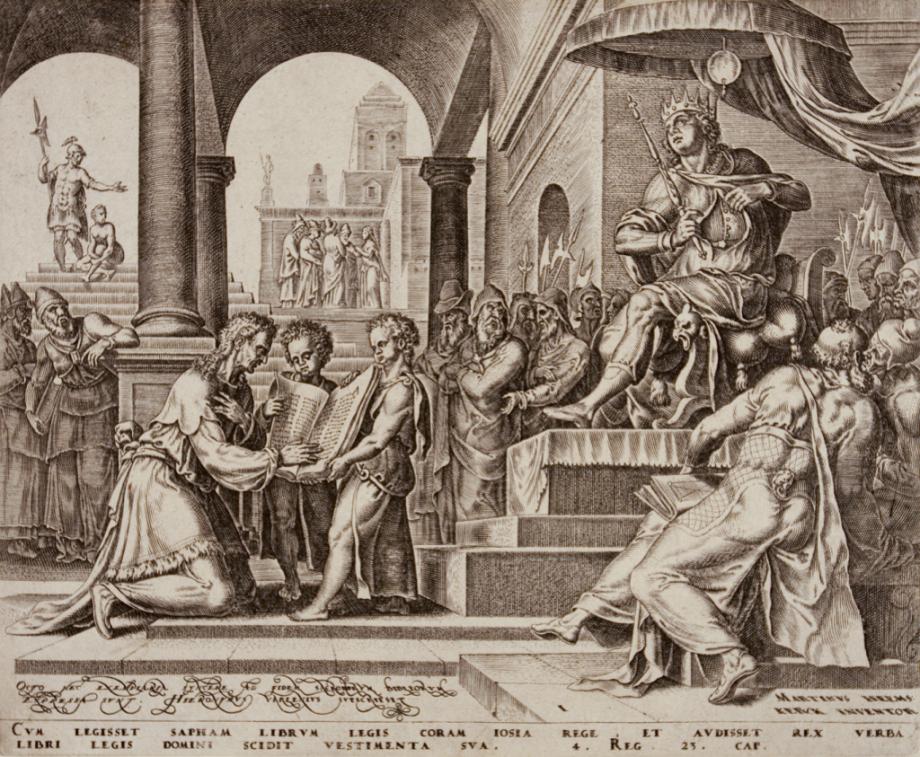
The Book of the Law, Read to King Josiah by Dutch artist Maerten van Heemskerck, c.1569

The king smashed all the altars to smithereens—the altar on the roof shrine of Ahaz, the various altars the kings of Judah had made, the altars of Manasseh that littered the courtyard of The Temple—he smashed them all, pulverized the fragments, and scattered their dust in the Valley of Kidron. The king proceeded to make a clean sweep of all the sex-and-religion shrines that had proliferated east of Jerusalem on the south slope of Abomination Hill, the ones Solomon king of Israel had built to the obscene Sidonian sex goddess Ashtoreth, to Chemosh the dirty-old-god of the Moabites, and to Milcom the depraved god of the Ammonites. He tore apart the altars, chopped down the phallic Asherah-poles, and scattered old bones over the sites. Next, he took care of the altar at the shrine in Bethel that Jeroboam son of Nebat had built—the same Jeroboam who had led Israel into a life of sin. He tore apart the altar, burned down the shrine leaving it in ashes, and then lit fire to the phallic Asherah-pole.

As Josiah looked over the scene, he noticed the tombs on the hillside. He ordered the bones removed from the tombs and had them cremated on the ruined altars, desacralizing the evil altars. This was a fulfillment of the word of God spoken by the Holy Man years before when Jeroboam had stood by the altar at the sacred convocation.

Then the king said, “And that memorial stone—whose is that?”

The men from the city said, “That’s the grave of the Holy Man who spoke the message against the altar at Bethel that you have just fulfilled.”

Josiah said, “Don’t trouble his bones.” So, they left his bones undisturbed, along with the bones of the prophet from Samaria.

But Josiah hadn’t finished. He now moved through all the towns of Samaria where the kings of Israel had built neighborhood sex-and-religion shrines, shrines that had so angered God. He tore the shrines down and left them in ruins—just as at Bethel. He killed all the priests who had conducted the sacrifices and cremated them on their own altars, thus desacralizing the altars. Only then did Josiah return to Jerusalem.

The king now commanded the people, “Celebrate the Passover to God, your God, exactly as directed in this Book of the Covenant.”

This commanded Passover had not been celebrated since the days that the judges judged Israel—none of the kings of Israel and Judah had celebrated it. But in the eighteenth year of the rule of King Josiah this very Passover was celebrated to God in Jerusalem.

Josiah scrubbed the place clean and trashed spirit-mediums, sorcerers, domestic gods, and carved figures—all the vast accumulation of foul and obscene relics and images on display everywhere you looked in Judah and Jerusalem. Josiah did this in obedience to the words of God’s Revelation written in the book that Hilkiah the priest found in The Temple of God.

There was no king to compare with Josiah—neither before nor after—a king who turned in total and repentant obedience to God, heart and mind and strength, following the instructions revealed to and written by Moses. The world would never again see a king like Josiah. (The Message)

The Book of the Law Found, Unknown artist, 1913

To say that King Josiah cleaned house is a significant understatement. Having found the Book of the Law, which was lost for generations deep within the temple, Josiah took its words to heart and set about a campaign of reformation like no king before him. 

Indeed, Josiah was determined to restore and implement the Law in the life of the nation of Judah. His zeal knew no bounds. Josiah was doggedly relentless and actively radical in returning the Jews to the true worship of Yahweh.

Josiah did more than reinstitute the Passover and other festivals of the Lord. The king first upended the alternative pagan worship which had become embedded in Judah like a death-dealing cancer. Josiah surgically removed it with ruthless precision. 

King Josiah made ashes out of Asherah poles; put pagan priests out of business permanently; and did away with everything contrary to the worship of the One true God, including spiritual mediums, household gods, and sacrificial high places. In order to turn his heart fully to God, he did away with all competing gods.

Repentance, renewal, and reformation requires a two-fold process: 1) Turning away from what is false; and 2) Turning toward what is true.

Turning from spiritually unhealthy ways of living – without turning to God – is merely a half repentance. Furthermore, turning to God – without turning one’s back on damaging lifestyles – is a form of denial and is dangerous. 

We are to put off the old clothes of spiritual insensitivity and social injustice. We are to put on the new clothes of righteousness and peace. We are to forsake the old inner person of shame in order to embrace the new life of freedom and joy. 

There needs to be a radical removal of sin, so as to replace it with what is just and right. And, keep in mind, that none of this is pretty or romantic. Repentance and renewal is a messy ugly process of dispelling darkness and letting light shine. It is not for the faint of heart.

Where to begin? Make a fierce, brutally honest spiritual inventory of your life. No one can turn from something they are not really aware of. So, create in your schedule some time in the week to connect with God and do the following: 

  • Identify some areas for change, then list the obstacles to turning away from them (e.g., fear, despair, financial repercussions, etc.). Face those obstacles honestly and forthrightly. 
  • Form a rudimentary plan to forsake the old ways and embrace new paths of righteousness. This is only a beginning. Let God take that process and direct it in redemptive and purifying ways.

Holy God, you are jealous for your own glory. Today, I decide to identify and put away all that is contrary to your righteousness and will for my life. And I choose to turn to you with all my heart. In body, soul, and spirit I belong to you. Amen.