‘Tis the Season For Praise (Psalm 148)

By Stushie Art

Praise the Lord!
Praise the Lord from the heavens;
    praise him in the heights!
Praise him, all his angels;
    praise him, all his host!

Praise him, sun and moon;
    praise him, all you shining stars!
Praise him, you highest heavens
    and you waters above the heavens!

Let them praise the name of the Lord,
    for he commanded and they were created.
He established them forever and ever;
    he fixed their bounds, which cannot be passed.

Praise the Lord from the earth,
    you sea monsters and all deeps,
fire and hail, snow and frost,
    stormy wind fulfilling his command!

Mountains and all hills,
    fruit trees and all cedars!
Wild animals and all cattle,
    creeping things and flying birds!

Kings of the earth and all peoples,
    princes and all rulers of the earth!
Young men and women alike,
    old and young together!

Let them praise the name of the Lord,
    for his name alone is exalted;
    his glory is above earth and heaven.
He has raised up a horn for his people,
    praise for all his faithful,
    for the people of Israel who are close to him.
Praise the Lord! (New Revised Standard Version)

By Bible Art

God is sovereign – which means that the Lord has complete power, dominion, and authority over everything that exists. God has supremacy because the Lord is the Creator God, the One who brought all things into existence.

Ideally, God and all creation exist harmoniously together. People coexist with God and recognize the Lord’s sovereignty through offering praise, adoration, and thanksgiving to the Lord.

That is what today’s psalm calls us to do, especially in this season of Christmastide. Christians are to offer their praise to God, despite whatever circumstances may be happening in their lives, and around them.

The psalmist was not telling people to simply forget their sorrows. He was exhorting everyone, including all creation, to praise the Lord in the middle of their distress.

When Christ was born, circumstances were not good for the Jews in Judea. Roman occupation had a firm authoritative hold upon them. Throughout their history, Jews have been often marginalized and oppressed. They know what suffering is.

Even though Christianity is a sizable world religion, Christians in many parts of the world today experience ostracization and discrimination. Christians everywhere are not immune to world events with situations like dictators, disasters, and diseases.

Yet, there is always an opportunity for praise to God. And the psalmist summons the faithful to do so. Praise and adoration of God shape us and form us spiritually, so that, even if we do not feel like doing it, the very act of offering the praise trains our spirits to bend in a good direction.

We could simply give-in to the status quo of things through constant complaining; or keep offering our woes. But that doesn’t negate the importance of praise.

Today we have the opportunity (and responsibility) to praise God for the incarnation of Christ. To remember that God loved us enough to become one of us. To adore the Christ child, and choose to give thanks, even though there might be oppression all around us.

We can celebrate, along with all creation, the nature of God and the Lord’s good purposes for humanity and all the earth. Adverse situations may stop us from many things we want to do, yet no circumstance can ever prevent us from praising God for divine attributes and divine sovereignty.

All of creation praises God by being exactly what God created it to be. A tree doesn’t try and be a star in the sky. It simply takes root and grows, branching out and becoming a haven for many creatures. Squirrels do what squirrels do, just like flowers, rocks, wind and weather do what they do.

It’s us people who tend to go rogue and try to be something or someone we’re not.

We can best praise God by living as God created us to live. We were designed to live in a divine/human cooperation of caring for all creation. We best exist alongside God by being good stewards of all that God has given to us – including the earth, our families and neighborhoods, and especially ourselves.

Praise is the job description of everything which exists. We will do that well as we honor our mandate to care, and not to harm; to serve others, and not be self-serving.

All things are connected on this planet. The ecosystems of the earth, and the economies of people, are all meant to live in harmony with each other, so that all of creation is blessed.

You and I have a sacred trust of relating well with each other, and everything around us.

The human condition is one of ongoing ups and downs. We experience a full range of tragedy, division, and hardship; along with joy, wonder, and happiness. In all things, no matter what, we are called to praise the Lord.

Each of us needs to find that place and that way of orienting and reorienting ourselves to what is important and why we are here.

For me, that happens whenever I hug my dear wife. Sometimes, I even go out in my backyard and hug my oak tree. The very act of hugging helps ground me to what is here and real, what is important and necessary.

If we can but touch one another, not just literally, but with well-placed words and helpful actions, then we can recall why harmony with all things is so important.

I’m in no way saying this is easy. It isn’t. There are many days when either the world seems as if it is a big collective ball of grumpy; or you yourself can hardly do the barest of responsibilities.

Yet, we can still find a way to praise, to be grateful, to offer what little care there may be to give.

Because it’s not so much about the amount of what we do, but rather how we are able to do it. A smidge of something done with love is infinitely better than lots of accomplishment without any care behind it.

The holidays are some of the hardest days for some folks. Christmas and the New Year are associated with grief for various reasons. It can bring isolation, not connection. The last thing such a person may want to do is praise the Lord, especially with a community of folks. And yet, that may just be the best activity.

There is no one-dimensional way of praising God; our offerings to the Lord can be multi-faceted. It can be achieved according to what we have to offer, and why we are offering it. It will not look the same for everyone.

Whatever you really need to do for an offering of praise this year, then do it. It’s okay if it’s a bit avant-garde, or off the beaten path. You are, after all, talking to a guy who hugs trees, for God’s sake.

Maybe this is the time to re-establish an old tradition that has fallen by the wayside. It could be the right opportunity to pick up that old musical instrument or to stretch your voice in singing again.

The exhortation we have from the psalmist is to praise. How you go about it, is up to you, my friend.

May almighty God, who sent his Son to take our nature upon him, encourage you in this holy season, scatter the darkness of sin, and brighten your heart with the light of his holiness. And may the blessing of God – Father, Son, and Spirit – be upon you and remain with you forever. Amen.

Anyone Can Change (Jonah 3:1-10)

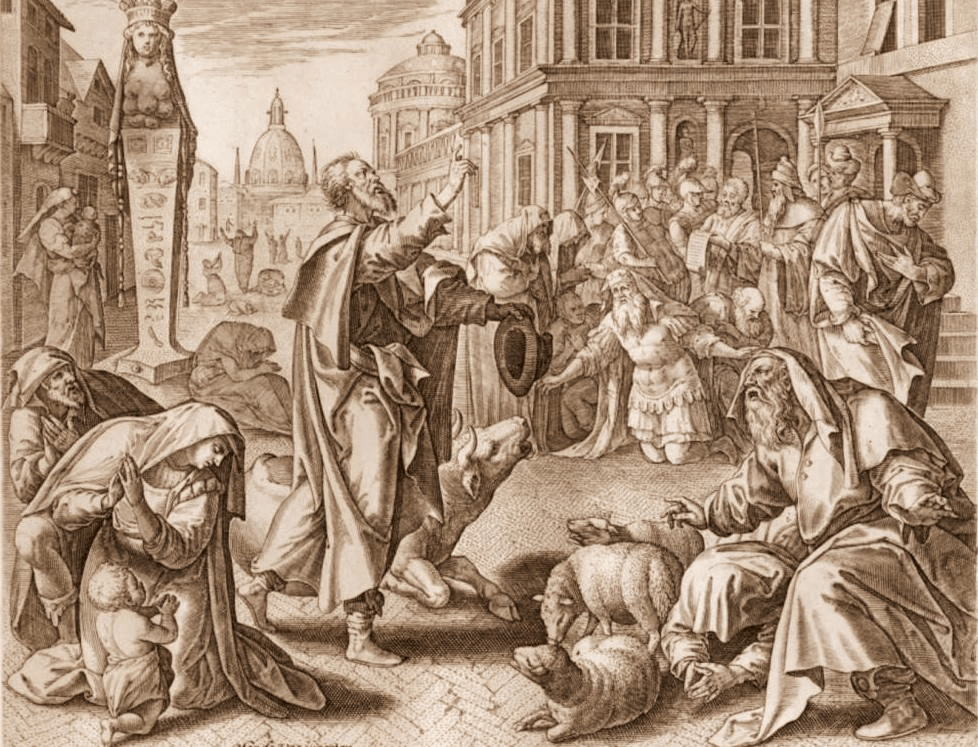
Print of Jonah preaching to the Ninevites and their repenting, by Philip Galle 1547–1612 

The Lord’s word came to Jonah a second time: “Get up and go to Nineveh, that great city, and declare against it the proclamation that I am commanding you.” And Jonah got up and went to Nineveh, according to the Lord’s word. (Now Nineveh was indeed an enormous city, a three days’ walk across.)

Jonah started into the city, walking one day, and he cried out, “Just forty days more and Nineveh will be overthrown!” And the people of Nineveh believed God. They proclaimed a fast and put on mourning clothes, from the greatest of them to the least significant.

When word of it reached the king of Nineveh, he got up from his throne, stripped himself of his robe, covered himself with mourning clothes, and sat in ashes. Then he announced, “In Nineveh, by decree of the king and his officials: Neither human nor animal, cattle nor flock, will taste anything! No grazing and no drinking water! Let humans and animals alike put on mourning clothes, and let them call upon God forcefully! And let all persons stop their evil behavior and the violence that’s under their control!” He thought, Who knows? God may see this and turn from his wrath, so that we might not perish.

God saw what they were doing—that they had ceased their evil behavior. So God stopped planning to destroy them, and he didn’t do it. (Common English Bible)

Anyone can turn around, even the nastiest of people.

Lent (the Christian season lasting six weeks from Ash Wednesday to Easter Sunday) is the ideal time of year to change, to turn around, to repent — to return to God and re-focus our lives.

The season of Lent is something like a forty-day trial run in changing your lifestyle and letting God change your heart. Repentance is the key that unlocks the soul’s ability to connect with God. To repent means to stop going in one direction and start going in another one. It makes all the difference in the orientation of our souls. 

Repentance leads to a real change of direction, a complete re-orientation of life. The evidence of such a change is this:

  • Owning up to the problem and confronting it
  • An eagerness to make things right
  • Indignation over what has been done or said
  • A desire and energy to do what is best for those we have wronged
  • A willingness to accept whatever consequences that might result from the offense

There’s nothing romantic about repentance; it’s typically messy, usually ugly, and often painful. Yet, there must be suffering before glory. Trying to take repentance out of the equation is to eviscerate life and leave our souls vacuous and empty.

Sometimes, we may not even realize we need to repent because we get caught up in the drama of whatever we’re doing – school, relationships, family, church, or work. Our lives can become filled with distractions that take us away from the spiritual life and the need to change.

But our soul knows it’s empty. And so, often unaware, we try to fill the vacuum with meaningless stuff, busywork, and mindless activities. What we’re really doing is running from real life and from God. 

We need to connect with the Divine; we need repentance. The Ninevites instinctively knew what to do; they fasted, prayed, and changed their ways. If a group of people who were experts at human torture and abuse could know this and intentionally pay attention to God, then how much more ought we to connect with what is most important?

Godly sorrow brings repentance that leads to salvation and leaves no regret.

2 Corinthians 7:10, NIV

Throughout Holy Scripture, whenever people were confronted with divine realities, they were completely undone; they began to see their own sin for what it truly is. 

When the Apostle Peter saw the Lord Jesus in his immensity and power through a miraculous catch of fish he fell at Jesus’ knees and said, “Go away from me, Lord; I am a sinful man.” (Luke 5:8) 

When the Apostle John had a vision of Jesus Christ in all his glory, and heard his voice, he fell at the Lord’s feet as though dead. (Revelation 1:12-17)

When the prophet Ezekiel had a vision of God and saw the appearance of God’s glory, he fell facedown. (Ezekiel 1:25-28) 

Even Daniel, perhaps the most righteous prophet and person of all time, saw a vision of God in all his glory, he fell prostrate with his face to the ground, totally overwhelmed with God’s holiness and human sinfulness. (Daniel 8:15-18)

We must put ourselves in a position to hear God so that we can turn from all the obstacles that prevents us from experiencing life as it is meant to be lived. And the all the things which hinder us from repenting are legion:

  • inattention to God’s words and God’s creation
  • constant and prolonged preoccupations and daydreams that prevents availability to God
  • lack of sleep and good health habits that dulls the spiritual senses and prevents awareness of God
  • a paucity of spiritual practices and disciplines that would put us in a position to experience God

Let us, then, take a lesson from the repenting Ninevites and pay attention to God. For God is calling, yet we do not hear him. So, let’s put ourselves in a position to hear the message of God; identify the things that grieve God’s heart; and repent.

God has gone out of the way to reach us so that we can change for the better. And anyone, no matter who they are, can experience it – even a terribly sinful nation of people.

What will you do with this grace?

Almighty and everlasting God, the One who freely pardons all who repent: Redeem and renew every penitent heart with your infinite mercy and grace, forgiving all our sins, and cleansing us from an evil conscience. Amen.

2 Kings 23:15-25 – Repent, Renew, and Reform

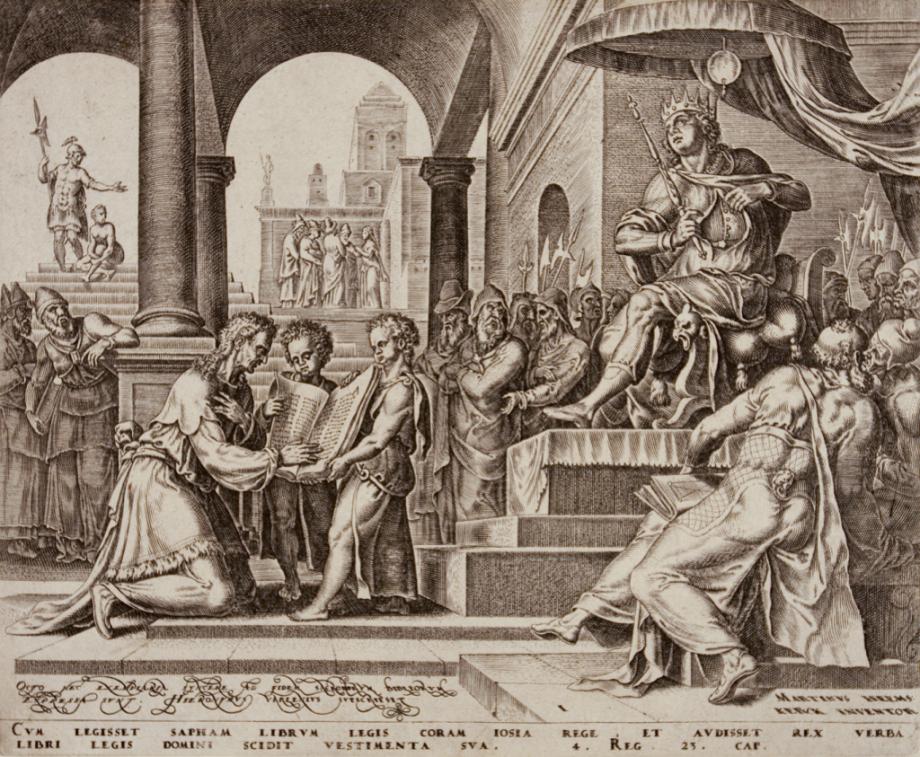
The Book of the Law, Read to King Josiah by Dutch artist Maerten van Heemskerck, c.1569

The king smashed all the altars to smithereens—the altar on the roof shrine of Ahaz, the various altars the kings of Judah had made, the altars of Manasseh that littered the courtyard of The Temple—he smashed them all, pulverized the fragments, and scattered their dust in the Valley of Kidron. The king proceeded to make a clean sweep of all the sex-and-religion shrines that had proliferated east of Jerusalem on the south slope of Abomination Hill, the ones Solomon king of Israel had built to the obscene Sidonian sex goddess Ashtoreth, to Chemosh the dirty-old-god of the Moabites, and to Milcom the depraved god of the Ammonites. He tore apart the altars, chopped down the phallic Asherah-poles, and scattered old bones over the sites. Next, he took care of the altar at the shrine in Bethel that Jeroboam son of Nebat had built—the same Jeroboam who had led Israel into a life of sin. He tore apart the altar, burned down the shrine leaving it in ashes, and then lit fire to the phallic Asherah-pole.

As Josiah looked over the scene, he noticed the tombs on the hillside. He ordered the bones removed from the tombs and had them cremated on the ruined altars, desacralizing the evil altars. This was a fulfillment of the word of God spoken by the Holy Man years before when Jeroboam had stood by the altar at the sacred convocation.

Then the king said, “And that memorial stone—whose is that?”

The men from the city said, “That’s the grave of the Holy Man who spoke the message against the altar at Bethel that you have just fulfilled.”

Josiah said, “Don’t trouble his bones.” So, they left his bones undisturbed, along with the bones of the prophet from Samaria.

But Josiah hadn’t finished. He now moved through all the towns of Samaria where the kings of Israel had built neighborhood sex-and-religion shrines, shrines that had so angered God. He tore the shrines down and left them in ruins—just as at Bethel. He killed all the priests who had conducted the sacrifices and cremated them on their own altars, thus desacralizing the altars. Only then did Josiah return to Jerusalem.

The king now commanded the people, “Celebrate the Passover to God, your God, exactly as directed in this Book of the Covenant.”

This commanded Passover had not been celebrated since the days that the judges judged Israel—none of the kings of Israel and Judah had celebrated it. But in the eighteenth year of the rule of King Josiah this very Passover was celebrated to God in Jerusalem.

Josiah scrubbed the place clean and trashed spirit-mediums, sorcerers, domestic gods, and carved figures—all the vast accumulation of foul and obscene relics and images on display everywhere you looked in Judah and Jerusalem. Josiah did this in obedience to the words of God’s Revelation written in the book that Hilkiah the priest found in The Temple of God.

There was no king to compare with Josiah—neither before nor after—a king who turned in total and repentant obedience to God, heart and mind and strength, following the instructions revealed to and written by Moses. The world would never again see a king like Josiah. (The Message)

The Book of the Law Found, Unknown artist, 1913

To say that King Josiah cleaned house is a significant understatement. Having found the Book of the Law, which was lost for generations deep within the temple, Josiah took its words to heart and set about a campaign of reformation like no king before him. 

Indeed, Josiah was determined to restore and implement the Law in the life of the nation of Judah. His zeal knew no bounds. Josiah was doggedly relentless and actively radical in returning the Jews to the true worship of Yahweh.

Josiah did more than reinstitute the Passover and other festivals of the Lord. The king first upended the alternative pagan worship which had become embedded in Judah like a death-dealing cancer. Josiah surgically removed it with ruthless precision. 

King Josiah made ashes out of Asherah poles; put pagan priests out of business permanently; and did away with everything contrary to the worship of the One true God, including spiritual mediums, household gods, and sacrificial high places. In order to turn his heart fully to God, he did away with all competing gods.

Repentance, renewal, and reformation requires a two-fold process: 1) Turning away from what is false; and 2) Turning toward what is true.

Turning from spiritually unhealthy ways of living – without turning to God – is merely a half repentance. Furthermore, turning to God – without turning one’s back on damaging lifestyles – is a form of denial and is dangerous. 

We are to put off the old clothes of spiritual insensitivity and social injustice. We are to put on the new clothes of righteousness and peace. We are to forsake the old inner person of shame in order to embrace the new life of freedom and joy. 

There needs to be a radical removal of sin, so as to replace it with what is just and right. And, keep in mind, that none of this is pretty or romantic. Repentance and renewal is a messy ugly process of dispelling darkness and letting light shine. It is not for the faint of heart.

Where to begin? Make a fierce, brutally honest spiritual inventory of your life. No one can turn from something they are not really aware of. So, create in your schedule some time in the week to connect with God and do the following: 

  • Identify some areas for change, then list the obstacles to turning away from them (e.g., fear, despair, financial repercussions, etc.). Face those obstacles honestly and forthrightly. 
  • Form a rudimentary plan to forsake the old ways and embrace new paths of righteousness. This is only a beginning. Let God take that process and direct it in redemptive and purifying ways.

Holy God, you are jealous for your own glory. Today, I decide to identify and put away all that is contrary to your righteousness and will for my life. And I choose to turn to you with all my heart. In body, soul, and spirit I belong to you. Amen.