Joshua 4:14-24 – The Importance of Visual Reminders

That day the Lord brought honor to Joshua before all Israel. They respected him all his life, just as they had respected Moses.

The Lord told Joshua, “Instruct the priests carrying the ark of the covenantal laws to come up from the Jordan.” So, Joshua instructed the priests, “Come up from the Jordan!” The priests carrying the ark of the covenant of the Lord came up from the middle of the Jordan, and as soon as they set foot on dry land, the water of the Jordan flowed again and returned to flood stage.

The people went up from the Jordan on the tenth day of the first month and camped in Gilgal on the eastern border of Jericho. Now Joshua set up in Gilgal the twelve stones they had taken from the Jordan. He told the Israelites, “When your children someday ask their fathers, ‘What do these stones represent?’explain to your children, ‘Israel crossed the Jordan River on dry ground.’ For the Lord your God dried up the water of the Jordan before you while you crossed over. It was just like when the Lord your God dried up the Red Sea before us while we crossed it.He has done this so all the nations of the earth might recognize the Lord’s power and so you might always obey the Lord your God.” (New English Translation)

On my hospital office desk, where I can see it every day, is a scapular. “Scapular” is the Latin word for “shoulders.” A scapular typically consists of two small pieces of cloth, a few inches in size, which has a religious image on one, and a message on the other. There are two bands of cloth connecting the message or image.

The wearer places one square on the chest, rests the bands on each shoulder and lets the second square drop down the back. Worn by some Catholic faithful, the scapular serves to remind the believer of their commitment to live a Christian life.

The particular scapular I have in my possession was given to me by a patient when I was first starting out as a hospital chaplain. I was called to the room of a dying patient. He was afraid of death. So, we conversed together for an hour about his life, his fears, and his devotion to faith. At the end of the conversation, the patient took off the scapular he was wearing, which states, “Whosoever dies wearing this Scapular shall not suffer eternal fire.”
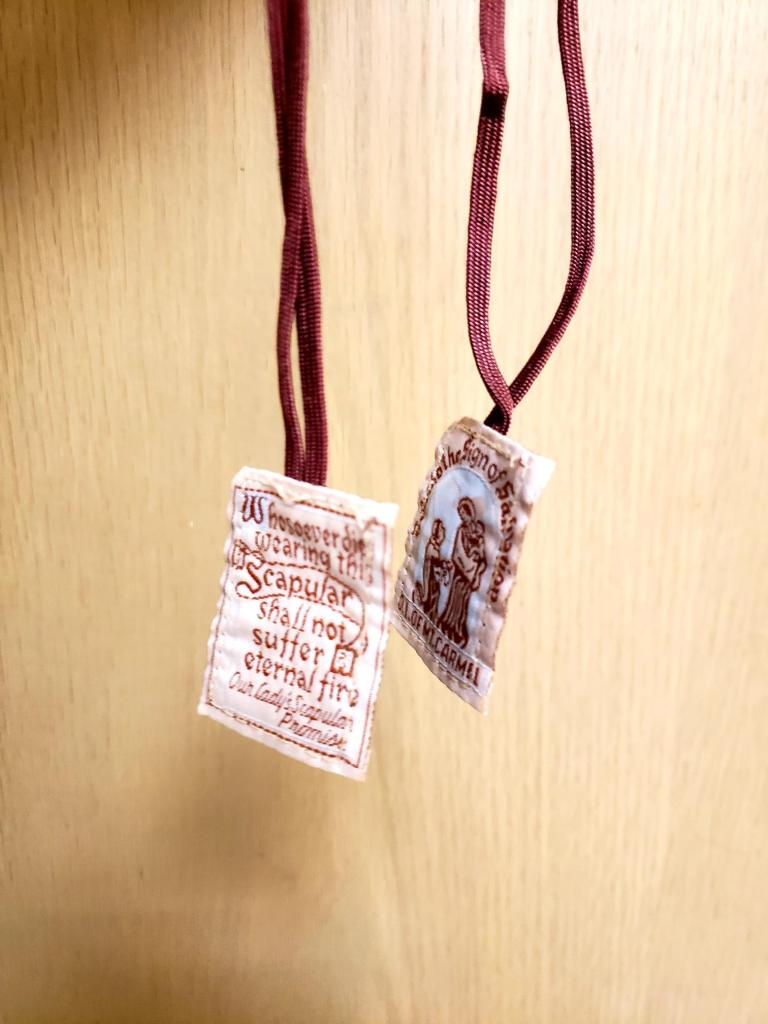
Regardless of what you think about scapulars and the particular message on this one, most important to me is what the patient said next with tears in his eyes: “I’ve worn this scapular every day for the past forty years. Here, I want you to have it. I don’t need it anymore. I am no longer afraid of death.”

The patient died. But he died at peace with God and without fear. I keep his scapular on my desk as a constant reminder of why I am a hospital chaplain, and how important the work I do is. Anytime I get discouraged or have a hard day, when I return to my office, the scapular reminds and reorients me that the spiritual care of patients is a privileged and sacred responsibility.

The ancient Israelites were finally ready to enter the Promised Land. The twelve tribes miraculously crossed the Jordan River on dry ground. God had stopped the water from flowing. After everyone crossed over, the river went back to flowing again.

Joshua, their leader, instructed people from each tribe to take a large stone from the river and place them in a heap for two didactic reasons:

1) To educate future generations inside Israel that God kept the promise to bring them into a land of abundance; and

2) To educate those outside Israel that God is mighty.

It’s important that we all have a continual awareness of why we are here on this earth and what our purpose is. Our history is significant and needs to be remembered.

Yet, there are many families and faith communities in which the children know little about how God worked in their parents’ lives, not to mention the many previous generations. Having tangible reminders of God’s past actions helps everyone remember. 

Just as people ask me about why I have a scapular on my desk, so having reminders of God’s grace in prominent visible places serves to aid all ages of folks to ask why those mementos are there.

It is good to have visual reminders of faith and the faithful people who influenced us around our homes, places of work, and communities so that others may discover and know the redemptive acts of God, that the Lord keeps promises.

Almighty God, we praise and magnify your holy Name for all your servants who have finished their course in faith and patience. May we remember them and their service well. We humbly pray that, at the day of resurrection, we and all who are members of the mystical body of your Son may be set on his right hand, and hear his most joyful voice: “Come, you who are blessed by my Father, inherit the kingdom prepared for you from the foundation of the world.” Grant this, O merciful Father, for the sake of Jesus Christ, our only Mediator and Advocate. Amen


Deuteronomy 11:18-21 – Leave a Spiritual Heritage

You shall put these words of mine in your heart and soul, and you shall bind them as a sign on your hand and fix them as an emblem on your forehead. Teach them to your children, talking about them when you are at home and when you are away, when you lie down and when you rise. Write them on the doorposts of your house and on your gates, so that your days and the days of your children may be multiplied in the land that the Lord swore to your ancestors to give them, as long as the heavens are above the earth. (New Revised Standard Version)

Remember God’s Law

The book of Deuteronomy is a farewell address by Moses to the Israelites. Moses was about to die. The Israelites were about to enter the Promised Land. So, Moses restated God’s law and called the people to remember all that God had done. He exhorted the people to communicate the law and their heritage to the next generations. If God’s Word and God’s ways are continually observed, then the people would prosper in the land.

The overarching command and call to the people is to love God with everything they have and everything they are. God’s people are to have a total commitment of mind, body, emotions, and spirit to the law of God. Each ability and gift, and all that makes a person a person, is to have its clear direction and orientation toward loving God through obeying God’s commands.

Talk About God’s Word

The love of God is meant to become a habit in the normal daily rhythms of life. And we are told how to do that:  impress God’s commands in the family; talk about them at home; talk about them when you are out and about; talk about them in the morning and the evening; even write them out and have them before you continually.  The entire day is an opportunity to love God by talking about God’s Word.

The privilege of discussing God’s Word doesn’t need to be forced or awkward. Yet, it is something which needs some intention and purpose to it. Most people like talking about things which are important to them. If someone is really into classic cars, he does not have to try and force a conversation about it because it just comes out of him. Because they go to car shows, maybe own a classic car that they are continually tinkering with, and read up on car magazines, a discussion about the subject is quite natural to them.

So, then, the best way to live into God’s law is to spend time with God through regular Bible reading, focused and earnest prayer, conversing with others, and taking advantage of opportunities to learn and know about God.  For the Christian, talking about Jesus is meant to be organic, springing from a heart which loves God and observes God’s law.

Discuss God with Family

When it comes to family, we don’t need to be an expert on God or the Bible. We just need a willingness and a curiosity to ask questions. Typically, when raising my girls, most of our conversations at the table centered around one question I would ask. We discussed it, talked about it, and mulled it over. Sometimes it was a deep theological question. At other times, it was a practical question. My wife and I often had others share a meal with us, so I usually asked our guests to tell their God story or participate with us in the question. If they were not Christian, I would ask them what they thought about Jesus, and why.

God loves it when we have conversation in the home around biblical teaching. God also loves it when we have discussions in public. Some Orthodox Jewish persons still to this day wear a “phylactery” on their foreheads – a small box with little Scripture passages inside of it – testifying to their value of the written Word.

I’m not sure that’s what Moses had in mind when he talked about binding God’s commands on the forehead and tying them as symbols on the hands. Much of the Hebrew language is metaphorical, speaking about concrete things as a way of communicating something intangible. So, I wonder if the big idea here is simply to be open about faith and love for God and the law.

Keep Tangible Reminders of Scripture

Although I don’t believe we have to take these verses quite so literally, there is, however, something to be said for keeping Holy Scripture in front of us, continually, to remember divine commands and promises. It’s good to write some Bible verses and place them on your bathroom mirror, the dash of your car, in your pants pocket, or anywhere you will see them on a regular basis. It’s a practical way of remembering to observe all that God has commanded.

Physical reminders of significant spiritual events can help us keep God’s Word in our lives. When the Israelites experienced God in some significant way, they built an altar. For example, when they approached the Jordan River to enter the land, God caused the water to stop flowing so that they could cross over. Here is what happen next: 

Joshua erected a monument, using the twelve stones that they had taken from the Jordan. And then he told the People of Israel, “In the days to come, when your children ask their fathers, ‘What are these stones doing here?’ tell your children this: ‘Israel crossed over this Jordan on dry ground.’

“Yes, God, your God, dried up the Jordan’s waters for you until you had crossed, just as God, your God, did at the Red Sea, which had dried up before us until we had crossed. This was so that everybody on earth would recognize how strong God’s rescuing hand is and so that you would hold God in solemn reverence always.” (Joshua 4:20-24, MSG)

Passing the spiritual baton and leaving a heritage for future generations is a sacred trust. The best way for that to happen is within the home, talking about God and Scripture as a daily routine, as well as freely conversing about spirituality in public.

Pass Faith to the Next Generation Church

Hopefully, God and Jesus get talked about in the church! There are several ways churches can impress God’s Word to younger generations: 

  1. Train them to lead.  Adults do not have to do everything in the church. Every generation can be empowered to engage in ministries on a regular basis. Everyone needs a mentor to do anything well – which means taking others with us along the journey of ministry so they can both shadow and participate.
  2. Empathize with young people and young families. That means avoiding criticism. It’s easy for older generations to be critical about millennials – their lack of involvement, or how they live their lives. They don’t need our criticism; they need our help. To have empathy means we recognize they’re just trying to do the best they can in a crazy world. A world, I might add, which is quite different than the one many of us grew up in. This is an extremely competitive world, requiring more energy and drive than previous generations. Being a student today is not like being a student when I was a kid.  Being a young parent is not the same today as it once was. Today’s family structure is completely changed; what we think of as a traditional family only makes up 7% of the American population. The stance to take on this is not to criticize, but to encourage and help.
  3. Take Jesus’ message seriously.  Discussion, conversation, questions, and mutual sharing are the ways Jesus developed his followers, and it is a way we can reach younger generations. Dialogue goes a lot further than just telling others what they should believe and do.
  4. Adopt a young person, or a young family. If you consider yourself part of an older generation, seriously consider taking a younger person or even family under your wing who is not related to you. Invite them to a meal, read these verses, and discuss them together. Commit to praying for them daily for a set period.
  5. Look for ways to support children, teens, and young families. Prioritizing younger generations means they don’t have to do everything our way. Rather, it means we will listen to what they need in loving God and building into their own kids’ lives.
  6. Be great neighbors. Discuss, teach, empower, and develop young people without criticism into good neighbors who engage their local community by addressing issues with great love and lots of compassion.

There are certainly more ways to engage. The idea here is that we think about how to embody the teaching we have in Deuteronomy by passing on God’s love and God’s Word. Where will you start? Is there a way that resonates with you?  If you are a younger generation, who are some people you believe could be helpful to you? Let’s work together to realize God’s Word springing to life!

Psalm 34:1-10, 22 – Taste and See That the Lord is Good

Welcome, friends! Click the video below and let us consider how God’s goodness comes to us.

And let us worship together with heartfelt thanksgiving.

May the peace of God stand guard over all your thoughts and feelings in Jesus Christ through the comfort of the Holy Spirit. Amen.

Joshua 4:1-24

            I like coffee.  I like coffee mugs.  I like buying a coffee mug from places I visit.  Although it drives my wife nuts, the mugs serve as a continual reminder of a certain place or event I have experienced.  As we journey with the Israelites in the Old Testament book of Joshua, we experience with them the significant places and events of their taking the Promised Land.  God did a miraculous work by causing the Jordan River to congeal so that the Israelites could cross over on dry ground in entering the land.  Once they were across to the other side, God instructed them to take twelve stones, one for each tribe, and pile them up together.
 
            The purpose of the heap of twelve stones is made clear in the text and had a twofold purpose:  to educate future generations in the reality that God kept his promise to bring them into a land of abundance; and, to educate those outside Israel that God is mighty.
 
            Oftentimes children do not know about how God has worked in the past through their parents.  Mom and Dad may not have been intentional about communicating how God’s grace has influenced them.  But having tangible reminders of God’s past actions not only serves to help us remember, but enables children to know what God has done in their family.  Just as people ask me about why I have certain coffee mugs, so having reminders of God’s grace in prominent visible places serves to aid kids to ask why those reminders are there.
 
            If we do not have such reminders around our house or places of work, it would good for us to think through how to begin having remembrances of grace so that others may know that God is mighty and that he keeps his promises.
            Lord God, I want to experience your miraculous work in my life.  And I want my children, my friends, and my co-workers to know the grace of God in Christ through what you have done.  May my life serve as a great testimony of your mighty work.  Amen.