Keep Wisdom Close (Proverbs 7:1-4)

By Carole Hénaff

My child, keep my words
    and store up my commandments with you;
keep my commandments and live;
    keep my teachings as the apple of your eye;
bind them on your fingers;
    write them on the tablet of your heart.
Say to wisdom, “You are my sister,”
    and call insight your intimate friend. (New Revised Standard Version)

Out of all the words I hear come out of people’s mouths in a day, I don’t think I’ve ever heard someone say something like “Wisdom is my sister.” Indeed, I would argue that wisdom is in short supply these days.

The thing about wisdom is that many people – if they consider wisdom at all – tend to overemphasize one aspect of it over another. For wisdom to truly be wisdom, there must be both a solid body of knowledge and a practical understanding of how to implement learned information into one’s lived daily experience.

The concept of wisdom is truncated whenever one only focuses on book learning and information; or if one solely homes in on individual practice without any instruction.

A truly wise person has a teachable spirit about them, while at the same time, is willing to take the time necessary for action, and reflection on those actions, doing them again and again with learned and helpful information.

If someone tells you something, without any solid evidence to back up their statements, then you are likely hearing a bunch of foolishness, and not wisdom. What’s more, if they are all words and no action, there’s probably nothing worth listening to.

Without a robust evidence-based understanding of a subject, we become vulnerable to every Tom, Dick, and Harry who comes along and makes claims we’d like to hear. Even if it’s a blatant lie, apart from wisdom, we may suck up the bogus information like the bottom of a chocolate shake.

The presence of wisdom is an invitation for all simpletons to come, learn, and get rid of the simplistic ignorance of small personal opinions. Wisdom gives us a rudder to steer the ship of our life; and a map to provide us with direction.

If we eat at wisdom’s table, we shall fill ourselves with abundant life and satisfaction. Then, we will be able to overlook the baloney sandwich of stupidity for the T-bone steak of knowledge.

Wisdom is very much needed in times of temptation. Therefore, the more we are attentive to attaining a sage life, the more we will be able to withstand temptation’s onslaught when it comes to us.

The Teacher of Proverbs makes it clear that none of this is optional nor some sort of suggested teaching. Our Old Testament lesson for today is adamant that we pay attention to these admonitions. The verb “keep” is an inescapable exhortation.

Keeping the Teacher’s commands near to us, as if they were a close relative, is imperative to successful daily living.

Becoming proficient in the ways of the soul is important because the soul thrives on wisdom. Wisdom is soul food. This means we will attend to the small things which keeps our soul engaged and fed.

Carrying out our ordinary activities with mindfulness and a desire to learn is an artful practice which puts us in a position to soak up the wisdom around us.

The emptiness that so many people complain of comes, in part, from ignoring the small things. It puts wisdom way off of our radar. In other words, things like loneliness, boredom, and dissatisfaction come from ignoring one’s soul. The consequence is that wisdom is kept at a distance, and foolishness is allowed to come in and have run of the house.

What’s more, a life out of balance between introverted reading and extroverted activity puts us off kilter, not knowing what direction we ought to go. In this state, we’ll likely never find God’s will in any given situation.

We know we are growing in wisdom whenever loving another becomes more fulfilling than understanding that person.

If we seek wisdom so that we can be free of complexity, confusion, and all mystery, then we’ll never attain it. Instead, we’ll be the wise guy in the room and not the wise sage. Love will be off our radar, and so, wisdom shall be out of reach.

Developing wisdom is no easy endeavor; it’s hard, and requires steadfast commitment. The difficulty of it typically lies in implementing wise choices. That’s because we will inevitably come to a point where discernment tells us that we must let go of something.

And that something we need to let go is our own petty world that we have created. Only when we have made room can we accept a new world order which revolves around wisdom and doing what we can for the common good of all creation.

O God of love, you are the true sun of the world, evermore risen and never going down: We pray you to shine in our hearts and drive away the darkness of sin and the mist of error. We pray that we may, this day and all our lives long, walk without stumbling in the way you have prepared for us, which is Jesus Christ our Lord; who lives and reigns with you and the Holy Spirit, one God in glory everlasting. Amen.

Beginnings and Endings

Forest Sunset, by James Naughton

I’ve always thought it strange that we have New Year’s celebrations on January 1 at midnight when the year begins. The year hasn’t even happened yet, and we’re celebrating it. I understand celebrating a live birth and all the possibilities of a new baby in a family; but having worldwide blowouts about an upcoming New Year just strikes me as weird.

For some reason, we don’t celebrate the year we’ve just lived. We “take a look back” at the significant events and happenings. But there’s certainly no party around it. I suppose it’s because a lot of terrible things happen in a year. Yet, a lot of good things happen, too, that we could center some joy around.

What I’m getting at, in a round about way, is that we humans don’t do well with endings. And then we quickly become discouraged with our new beginnings – likely because we put little to no thought and preparation into how important and necessary our endings really are.

This is yet another roundabout way of saying that I (and we together) are experiencing something of an ending. For the past 1,750 days, I have provided a daily reflection upon a text from Holy Scripture. And those reflections haven’t been just a few sentences of devotional drivel, nor a measly daily crumb. I’ve written thousand-word-posts which I believe have been thoughtful and truly reflective on the text and our human condition.

However, all things must end. And this is my last post – at least for a while. I won’t be posting every day, as I’ve done for nearly 5 years! Yet, in order for me to have a proper new beginning of my own (one that I neither wanted nor asked for) I must let go of my daily blog posts.

Although I have been blogging for the past 15 years, I started doing the daily reflections at the beginning of COVID, as a way of remaining connected with my then church congregation, and with others. My thought was to give up doing it every day, once things got back to some sort of normalcy – whatever the heck that is.

Yet, when the masks initially came off and we all began seeing one another again, I found that the daily routine of writing biblical reflections had gotten into my spiritual bones. I was no longer simply writing for others; I was writing for myself. It buoyed my own faith to rise early in the morning and put some intentional focus upon crafting some scriptural thoughts on the Bible.

But that is no longer possible. My life can no longer sustain the practice. I intend to keep up the occasional post of maybe once a week. I might not even be able to do that. It might be once or twice a month. I don’t yet know.

Yet, what I do know is that I want to take the opportunity to celebrate the reality that I spent 1,750 straight days writing and posting impactful blog posts! Many of you were gracious to send me private notes of appreciation and encouragement. I especially treasure the ways some of you explained your story of how your own relationship with God has been helped.

When you boil down life to its essence, all any of us really have is our stories. Behind every event, each encounter, and all of the numbers which get crunched and the stuff that gets done and achieved, there is a story.

Stories bring just as much healing to us as modern medicine and surgeries. And they encourage, inspire, and change us in ways we cannot imagine.

The Bible, at its core, is a collection of stories. It seems God has created us as story-driven people, and so, in order to reveal something of God’s personhood and nature, we were given a grand and unfolding story of redemption.

I love reading and meditating on Holy Scripture, mainly because I love the Holy God of whom I belong and gladly serve.

I’ll continue writing the occasional post, but I will miss the daily meetings I’ve had with the Lord and with you in these past few years. Thank you for your faith, and for listening to God’s Word. What’s more, you can always avail yourselves of the nearly 2,700 blog posts on the website.

I pray that we all may learn to end things well, so that we might begin new things with some needed wisdom, humility, and grace.

May you live this day compassionate of heart, gentle in word, gracious in awareness, courageous in thought, and generous in the love of God through Jesus Christ our Lord and in the strength of the Holy Spirit. Amen.

On a Time Out (Exodus 2:11-15)

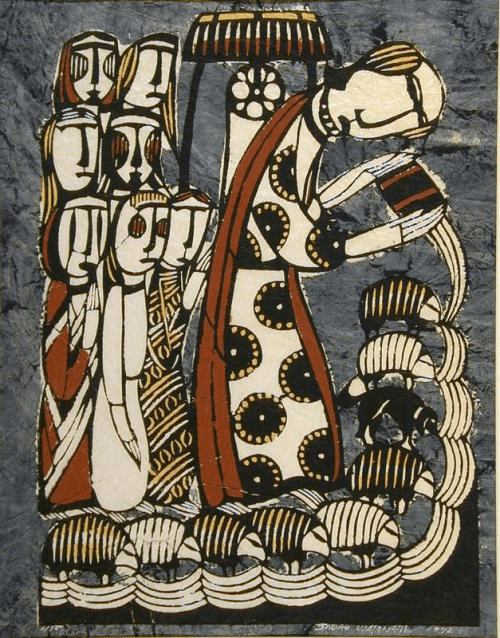
Moses in Midian, by Japanese artist Sadao Watanabe, 1972

One day, after Moses had grown up, he went out to where his own people were and watched them at their hard labor. He saw an Egyptian beating a Hebrew, one of his own people. Looking this way and that and seeing no one, he killed the Egyptian and hid him in the sand. The next day he went out and saw two Hebrews fighting. He asked the one in the wrong, “Why are you hitting your fellow Hebrew?”

The man said, “Who made you ruler and judge over us? Are you thinking of killing me as you killed the Egyptian?” Then Moses was afraid and thought, “What I did must have become known.”

When Pharaoh heard of this, he tried to kill Moses, but Moses fled from Pharaoh and went to live in Midian, where he sat down by a well. (New International Version)

Faith is dynamic, not static. It flows and moves, waxes and wanes, strengthens and weakens. Faith isn’t like a kitschy trinket you buy in a quaint downtown shop, and then place it as a nice object in a prominent place of your house or office. Rather, faith is much more subjective, like taking an adventure down some whitewater rapids, not quite knowing what’s going to happen.

Moses needed to learn how to make healthy decisions of faith, just like the rest of us. Just because we stand at this point in history and can look back at what a religious titan he was, doesn’t mean that Moses was always a paragon of faith and patience. In fact, quite the opposite.

An eighty year old Moses became the human agent of God’s deliverance of the Israelites from the Egyptians, after a forty year stint in the backside of the desert. This tells us that it took him awhile to mature into being the sort of leader God wanted to bring God’s people out of slavery. 

Even though the forty year old Moses may have had a sense that the Israelites needed freedom from slavery and acted on that sense by killing a ruthless Egyptian, his method, maturity, and misplaced timing were off.

There is a time for everything, said the Teacher of wisdom (Ecclesiastes 3:1). Wisdom – the ability to apply faith to concrete situations with appropriate forms – is often in the timing of things. To know when to speak and when to listen, when to act and when to wait, is an important facet of faith. 

The ancient Israelites were slaves in Egypt for a long time, 400 years. Moses knew they were suffering, and he acted in “good faith.” Yet, it was not yet time, and it was a rash action, in killing the Egyptian. Eventually, the Jewish cry of suffering arose to God, and God heard them, remembering the divine covenant. 

Questions of why God did not act sooner, or use Moses earlier, is information that is only privy within God, and likely will not be answered satisfactorily for us, this side of heaven.

In order to develop a strong and wise faith – with an opportune sense of timing – we need to rely on God. Trusting in ourselves, our own efforts, and our own gauge of how things ought to proceed, will usually not end well. We may, like Moses, find ourselves taking a “time out” from God in obscurity until we learn to wait on him.

Some might think of a “time out” as being negative, even punitive, such as giving a time out to a toddler because of naughtiness, or calling a time out in sports because the team is playing poorly. However, a time out can also be a positive experience. The following are some advantages of the “time out:”

Reflect

Little did Moses know at the time, but he would have the next 40 years to reflect on his life and actions in Egypt. Reflection is important. It gives us a chance to step back, learn from what happened, and adjust for the next time we experience a similar situation. Taking this time acts like a mirror, enabling us to gain some clarity on what we’ve said and done.

So I reflected on all this and concluded that the righteous and the wise and what they do are in God’s hands, but no one knows whether love or hate awaits them. All share a common destiny—the righteous and the wicked, the good and the bad, the clean and the unclean, those who offer sacrifices and those who do not. (Ecclesiastes 9:1-2, NIV)

Refocus

Upon taking the time to reflect, it then provides us with the opportunity to refocus our efforts with wisdom. To refocus means to come back around in giving close attention and concentration on what’s most important to us. The desire of Moses was admirable in being concerned about his fellow Israelites. He just went too far and needed to fix his eyes on the Lord and how to best go about freeing them.

We must focus on Jesus, the source and goal of our faith. He saw the joy ahead of him, so he endured death on the cross and ignored the disgrace it brought him. (Hebrews 12:2, GW)

Renew

Reflecting on the past and refocusing in the present are not quite enough to get us back in the game of life. We also need renewal. To be renewed involves fresh commitment to the things we have learned. I believe it’s best to renew our commitments with some sort of ritual, because rituals help us psychologically and spiritually to launch into the focused endeavors ahead of us. That’s why athletes always have a short ritual of breaking their huddle before returning to the contest.

Don’t be conformed to this world, but be transformed by the renewing of your mind, so that you may prove what is the good, well-pleasing, and perfect will of God. (Romans 12:2, WEB)

Return

A “time out” is designed to be temporary. Eventually, a “time in” happens. We get back in the game. We return to what we were doing, hopefully with a better understanding and grasp of what needs to happen and how to go about it.

In the fullness of time, the Apostle Paul said to the Galatians, Jesus came, born of a woman, born under law, to redeem those under the law (Galatians 4:4-5). God knows what he’s doing, even though it might seem like the Lord is sometimes slow to act. Yet, God sees, and God delivers – and does it according to divine timing.

If we live, we live for the Lord; and if we die, we die for the Lord. So, whether we live or die, we belong to the Lord. For this very reason, Christ died and returned to life so that he might be the Lord of both the dead and the living. (Romans 14:8-9, NIV)

Redeeming God, you control all things, including the clock. Give me wisdom so that my sense of timing might reflect your will and your way, through Jesus Christ, your Son, who with you and the Holy Spirit reign supremely as one God, now and forever. Amen.

Psalm 39 – Being Honest with God

I promised I would watch my steps
    so as not to sin with my tongue;
    promised to keep my mouth shut
    as long as the wicked were in my presence.
So I was completely quiet, silent.
    I kept my peace, but it did no good.
    My pain got worse.
My heart got hot inside me;
    while stewing over it, the fire burned.
Then I spoke out with my tongue:
    “Let me know my end, Lord.
    How many days do I have left?
    I want to know how brief my time is.”
You’ve made my days so short;
    my lifetime is like nothing in your eyes.
        Yes, a human life is nothing but a puff of air! Selah

Yes, people wander around like shadows;
    yes, they hustle and bustle, but pointlessly;
        they don’t even know who will get the wealth they’ve amassed.
So now, Lord, what should I be waiting for?
        My hope is set on you.
Deliver me from all my sins;
    don’t make me some foolish person’s joke.
I am completely silent; I won’t open my mouth
    because you have acted.
Get this plague of yours off me!
    I’m being destroyed by the blows from your fist.
You discipline people for their sin, punishing them;
    like a moth, you ruin what they treasure.
        Yes, a human life is just a puff of air! Selah

Hear my prayer, Lord!
    Listen closely to my cry for help!
Please don’t ignore my tears!
    I’m just a foreigner—
        an immigrant staying with you,
        just like all my ancestors were.
Look away from me
    so I can be happy again
    before I pass away and am gone. (Common English Bible)

God is big. The Lord is big enough to hear whatever is on our hearts. It really does no one any good to have pretense with God. The psalmist initially thought he had to hold back in speaking with God:  He was silent and held his peace with God. However, his distress grew worse.

The psalmist, David, finally opened up. He went on to speak openly and honestly to God, with flavorful expression, about what was really on his heart and mind.

Sometimes we may mistakenly believe we need to be guarded with God – that somehow we should treat the Lord of the universe like we do with other people – coy, hesitant, keeping a respectable distance in conversation.  Maybe that ought to occasionally happen with other people, but it is silly to approach God in such a manner. With God, we ought to be brutally honest about how we are really doing and how we are actually feeling. 

If we desire to move mountains and have God work powerfully in and through us, then we need to acknowledge and admit there is a mountain smack in front of our faces.

I’m quite sure God has heard it all from people in the long millennia of human existence. The Lord isn’t going to be surprised by any of our thoughts and words. So, why hide them? 

It may be a radical thought for some that we can say anything to God and express our deepest emotions to the Lord who desires to listen. God wants to help us journey in this pilgrimage of faith we are on. For that to happen, we must be up front about our current location and how we are doing.

Like everything in life, honesty is a skill to be developed and utilized. Being honest with ourselves and the Lord involves the following:

Acknowledging both the good and the bad.

Shying away from the shadowy places of our hearts will never resolve the icky-ness we may feel inside. Neither will peace come only by focusing on our screw-ups and bad traits. There is both bad and good within us all, and so, we need to hold them both together, recognizing the tension. The better we accept this reality, the sooner we can walk the path of faith with patience and confidence. Both prayers of confession and praise help us keep the good and the bad in mind.

Giving some time and space, daily, to reflect.

Debrief with yourself about your day or events within the day. What did you do well? What could you have improved? Is there anything you will do differently next time? How might you engraft this kind of reflection into your daily prayers?

Admitting your mistakes and when you need help.

Only a person who admits their mistakes can learn from them and correct them. This is a necessary part of spiritual growth and development. Faith cannot be properly formed if we don’t face up to our own reality. Blaming others only causes us to take the focus off our own needs. Failure and admitting need is to be human. Asking for assistance requires humility and courage – qualities we all possess if we will access them.

Paying attention to your emotions.

David, the psalmist, did it. He was aware of his emotions, acknowledged them, and expressed them to God. Our feelings are not some necessary evil. Rather, they are important to our faith and well-being. All emotions exist as signs for us to pay attention to something, whatever it is.

Listening to the gut.

You and I can learn the difference between an impulsive reaction and an intuitive response. The gut level instinct we possess is our conscience giving us insight. Avoiding this important epistemic ally usually results in a lack of self-awareness and poor decision-making. However, listening to the spiritual whispers within can serve us well.

Reading a psalm every day.

The psalms are emotional. They are also, obviously, biblical. Therefore, emotions are godly. A daily regimen of reading at least one psalm out loud can have the effect of bringing our mind, spirit, and emotions into alignment so that they are not disparate parts inside us.

God of the Ages, you are above all and know all things. Hear my prayer, O Lord, and give ear to my cry; hold not your peace at my tears.  I am a sojourner with you, a guest, like all my forefathers. Look away from me, that I may smile again, before I depart and am no more!  My hope is in you; without your abiding presence I am nothing. Maranatha, come, Lord Jesus. Amen.