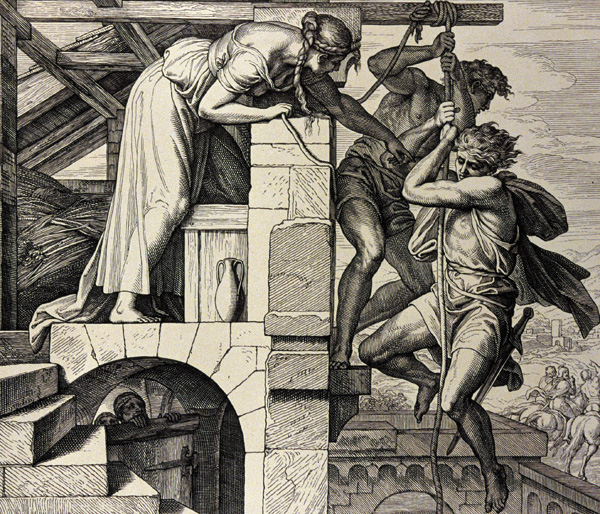
Consider Rahab (Joshua 2:15-24)

Rahab the harlot helps the Israelite spies escape from Jericho

So she [Rahab] let them [the Israelite spies] down by a rope through the window, for the house she lived in was part of the city wall [of Jericho]. She said to them, “Go to the hills so the pursuers will not find you. Hide yourselves there three days until they return, and then go on your way.”

Now the men had said to her, “This oath you made us swear will not be binding on us unless, when we enter the land, you have tied this scarlet cord in the window through which you let us down, and unless you have brought your father and mother, your brothers and all your family into your house. If any of them go outside your house into the street, their blood will be on their own heads; we will not be responsible. As for those who are in the house with you, their blood will be on our head if a hand is laid on them. But if you tell what we are doing, we will be released from the oath you made us swear.”

“Agreed,” she replied. “Let it be as you say.”

So she sent them away, and they departed. And she tied the scarlet cord in the window.

When they left, they went into the hills and stayed there three days, until the pursuers had searched all along the road and returned without finding them. Then the two men started back. They went down out of the hills, forded the river and came to Joshua son of Nun and told him everything that had happened to them. They said to Joshua, “The Lord has surely given the whole land into our hands; all the people are melting in fear because of us.” (New International Version)

A drama unfolded as the Israelites began entering and taking the Promised Land. Joshua, their leader, secretly sent two men as spies to look over the land and check out the prominent city of Jericho. The spies left and ended up in the house of a harlot named Rahab. They hid there because it had been found out they were in the city.

Rahab was able to divert and send away the pursuers who were looking for the spies, telling them that the men left, and that they should leave and go catch them. But she had actually hid them on the roof of her house.

Rahab took the spies into her home because she realized and affirmed that God was giving the land to the Israelites. Everyone in the city had heard the stories of how the Lord brought them out of Egyptian slavery and into the land of Canaan. In an insightful and beautiful confession of faith, Rahab told them:

“I know that God has given you the land. We’re all afraid. Everyone in the country feels hopeless. We heard how God dried up the waters of the Red Sea before you when you left Egypt, and what he did to the two Amorite kings east of the Jordan, Sihon and Og, whom you put under a holy curse and destroyed. We heard it and our hearts sank. We all had the wind knocked out of us. And all because of you, you and God, your God, God of the heavens above and God of the earth below.” (Joshua 2:8-11, MSG)

The men promised to show Rahab and her family mercy when they came to take the city, just as she had shown them grace in the face of trouble. So, today’s Old Testament lesson picks up the story from that point, as she sends the spies safely on their way.

That Rahab, a prostitute, is the heroine of the story is no accident or anomaly. Her profession of faith is central to the drama. She was living in the city wall, which is reflective of her status as being on the margins of society. And having strange men in her home would not have been weird in her neighborhood. It also made it rather easy to get the spies out of the city when trouble was brewing.

Most importantly, however, Rahab – the ultimate outsider in society – becomes the consummate insider. It is astonishing that a Gentile woman of disrepute has a story about her, and even told from her perspective – and not from the point of view of an Israelite man.

Rahab’s bold assertion of faith is both sincere and linked to God’s promise that the Israelites would take the land. Rahab is Exhibit A of the kind of person that inherits the kingdom of God. Rahab’s faith, not her works or reputation, is what spared her life and spared her from judgment.

Please ponder and consider that truth for a bit. Sit with it if you must – the reality that Rahab was judged neither by the spies nor God.

In far too many quarters of the Christian (and broadly religious world) judgment instead of mercy is levied to persons like Rahab. If there is anyone who should have a non-judgmental presence toward “sinners” it is Christians. And, if there is any institution which ought to consistently, both personally and through policy, display unflagging grace and forsake judgment, it is the Church.

Yet, unfortunately, as many have experienced, the Church has often fallen short of the glory of God’s grace in Christ by condemning people of ill repute. Perhaps we all need to rethink what faith truly is: not a checklist of doctrinal beliefs to sign-off on but a confident and bold action based solidly in the promises of God.

Knowing what those promises are, and living our lives appropriately in consideration of them, is the kind of faith that pleases God. Those who attempt to be judge, jury, and executioner need not apply as followers of God.

Genuine righteousness is never earned; it is given by the compassionate grace of God. So, lay hold of God’s promise of grace and mercy with gusto! Let the gracious God, who is full of steadfast love, affect the way we live our lives. Believe with a bold biblical belief that God always does what God has decreed and proclaimed to do.

Lord God, the gracious, almighty, and Holy One of all: I may have not always lived my life well, yet I trust you today that you can and will deliver me from all my troubles because you are with me. May your Holy Spirit give me the gift of faith to believe in such a way that forever impacts how I live my life in service to you and for the common good of all persons – no matter who they are. Amen.

James 2:14-26 – Faith Is Active

My brothers and sisters, what good is it if people say they have faith but do nothing to show it? Claiming to have faith can’t save anyone, can it? Imagine a brother or sister who is naked and never has enough food to eat. What if one of you said, “Go in peace! Stay warm! Have a nice meal!”? What good is it if you don’t actually give them what their body needs? In the same way, faith is dead when it doesn’t result in faithful activity.

Someone might claim, “You have faith and I have action.” But how can I see your faith apart from your actions? Instead, I’ll show you my faith by putting it into practice in faithful action.It’s good that you believe that God is one. Ha! Even the demons believe this, and they tremble with fear. Are you so slow? Do you need to be shown that faith without actions has no value at all? 

What about Abraham, our father? Wasn’t he shown to be righteous through his actions when he offered his son Isaac on the altar? See, his faith was at work along with his actions. In fact, his faith was made complete by his faithful actions. So, the scripture was fulfilled that says, Abraham believed God, and God regarded him as righteous. What is more, Abraham was called God’s friend. So, you see that a person is shown to be righteous through faithful actions and not through faith alone.

In the same way, wasn’t Rahab the prostitute shown to be righteous when she received the messengers as her guests and then sent them on by another road? As the lifeless body is dead, so faith without actions is dead. (Common English Bible)

There is a difference between intent and impact.

A person may have a sincere and heartfelt intention of wanting to see another have their needs met. Yet, if it is only that, there is no impact on actual offerings of resources, friendship, or help.

Genuine authentic faith is more than mere sentiment and head knowledge. Faith without works does not work. Conversely, a strong robust faith is active and is able to withstand adversity.

The rhetorical questions the Apostle James asked were meant to awake his readers to the reality that true faith is always active – and that inactive faith is not really faith at all.

In his letters to the churches, the Apostle Paul typically talked about the relationship between faith and works before a person converts to Christ, whereas the Apostle James emphasized the role of works after a profession of faith in Christ.

St. James was getting at the heart of how a believer in Jesus ought to live. And he did this by giving an illustration of the relationship between faith and works: If someone is in need and a person expresses a sentimental feeling, even if that feeling is sincere, without backing it up with action – the expression is merely an expression, nothing more. 

If a person asks you for something, give it to him. Don’t refuse to give to someone who wants to borrow from you.

Jesus (Matthew 5:42, NCV)

I once came home after a long day at work on a Valentine’s Day several years ago. I had picked up some flowers at a drive through flower shop. I walked into the door and handed my wife the flowers with an “I love you.”  Then, I sat down in a heap and turned on the television. My dear wife’s response was not so favorable to my sentimental overtures. I did not really put any thought or action behind Valentine’s Day, and she knew it. My words of “I love you” just did not sync with my actions. 

I learned from my experience. I redeemed myself the next year by winning a contest on a local radio station for a spouse’s best love note, and it got read on the air several times throughout the day for my lovely wife to hear. My commitment and actions nicely aligned so that when I said “I love you” at the end of that workday, there was no doubt about it.

Faith requires that actions sync with words. For example, when we say “I will pray for you” it needs to be more than an expression of concern – we need to spend the time and commitment it takes in praying for them.

Upholding justice with words (which is very important) but without translating that language into concrete action which truly helps others, ends up speaking into the wind.

Faith involves emotions yet ought not be limited by them. Faith can neither exist nor survive without deeds. Christian works are not an added extra to faith any more than breathing is an added extra to the body. Both faith and action is needed for the Christian life.

True faith is shown as the genuine article by how it acts in real life situations. Faith is more than a checklist of right beliefs to sign-off on, as if it were some fire insurance policy against hell.

“In God’s eyes our words have only the value of our actions.”

St. Ignatius of Loyola

Frankly, as a Pastor, I have heard some pretty lame justifications over the decades for failing to help others, giving to the poor, involving oneself in justice work, and just plain serving in the church, like, “I’m not wired that way,” “That’s not my gift,” “That’s what we pay you to do,” and the ever-prolific, “This church is not meeting my needs.”

Those in the habit of complaining, without an intent to boots-on-the-ground helping, do not yet have an active faith. Each person is to do their part in serving the common good of all. And we all suffer when that does not happen. Bifurcating faith and action leave us with a bogus faith. 

If faith without action is okay, then so is the entire demonic realm. The glimpses of Satan we get in the Bible lead me to think that the devil has the entire thing memorized and knows it quite well. Yet, knowledge puffs up, whereas love builds up. Information by itself is useless unless it is accompanied by gracious and loving action. (1 Corinthians 8:1)

Salvation is a term Christians are familiar with. In the Christian tradition, it refers to being saved from sin, death, and hell. Sanctification is another term most Christians recognize. It means “to become holy,” or, “to be set apart” for God. Sanctification is not an event but a process.

Whereas saving faith is a gift given without works, sanctifying faith requires a great deal of effort. A lot of energy is expended to live the Christian life. The late Dallas Willard used to often say, “Grace is not opposed to effort, it is opposed to earning. Earning is an attitude. Effort is an action.” 

The Apostle James dealt primarily with the sanctifying faith every Christian needs to exhibit. It’s as if we have been graciously granted a full-ride scholarship to a university (salvation) but now the real work begins (sanctification) to learn, grow, and obtain the degree.

Furthermore, just as a student will surely become discouraged at some point throughout their education and wonder if they ought to drop out, so the Christian will face tremendous adversity and challenge. Indeed, a lot of blood-sweat-and-tears goes into our spiritual studies so that our faith will be strengthened for a lifetime of active loving service.

“Each activity of daily life in which we stretch ourselves on behalf of others is a prayer in action.”

Richard Foster

For example, the Old Testament character Abraham was saved from an empty way of life in a pagan country and given a gift of grace to move to the country God would show him. Abraham did nothing to earn this favor.  God just chose him (Joshua 24:2-3).

Abraham sojourned as a pilgrim throughout the land God gave him, which mirrored his spiritual sojourning and learning to be a follower of God. Abraham faced a monumental test of faith when asked to sacrifice his son Isaac (Genesis 22:1-19).

Abraham’s faith was made complete by what he did. Testing of faith is necessary so that we become mature and complete, not lacking anything (James 1:3-4). The way for authentic faith to develop and grow is in the fiery trial of adversity and hardship. Spiritual maturation, holiness, and a well-rounded faith comes through suffering.

To press the significance of faith and works, the example of the Old Testament character Rahab is highlighted. Rahab was a prostitute who lived in the red-light district of Jericho. St. James was doing something profound and important – he took two extreme examples, one a giant of the faith, and the other an almost overlooked example of faith, to demonstrate we all are candidates for real faith.

Rahab’s faith and actions worked harmoniously. She genuinely believed the city of Jericho was going to be overcome by God’s judgment, and, so, she housed the visiting Israelite spies (Joshua 2:1-11).

Methinks we must expand our understanding of faith to include persons others might exclude. Some may be quick to judge those with dubious lives and backgrounds, as well as the poor and needy. We cannot sanitize Rahab as something other than what she was – and because of her faith she ended up being an ancestor of Jesus himself (Matthew 1:5).

From the standpoint of faith, Abraham and Rahab are on the same level. In Christ’s new egalitarian society, all are welcome, all have equality in God’s kingdom.

Holy and active God, I submit to the adversity you bring as my teacher, and I choose to find solace in your Word and Spirit. With the grace, enablement, and resources you give me, I freely give to others in need, through Jesus Christ my Lord. Amen.

James 2:17-26 – Faith Works

Isn’t it obvious that God-talk without God-acts is outrageous nonsense?

I can already hear one of you agreeing by saying, “Sounds good. You take care of the faith department; I’ll handle the works department.”

Not so fast. You can no more show me your works apart from your faith than I can show you my faith apart from my works. Faith and works, works and faith, fit together hand in glove.

Do I hear you professing to believe in the one and only God, but then observe you complacently sitting back as if you had done something wonderful? That’s just great. Demons do that, but what good does it do them? Use your heads! Do you suppose for a minute that you can cut faith and works in two and not end up with a corpse on your hands?

Wasn’t our ancestor Abraham “made right with God by works” when he placed his son Isaac on the sacrificial altar? Isn’t it obvious that faith and works are yoked partners, that faith expresses itself in works? That the works are “works of faith”? The full meaning of “believe” in the Scripture sentence, “Abraham believed God and was set right with God,” includes his action. It’s that weave of believing and acting that got Abraham named “God’s friend.” Is it not evident that a person is made right with God not by a barren faith but by faith fruitful in works?

The same with Rahab, the Jericho harlot. Wasn’t her action in hiding God’s spies and helping them escape—that seamless unity of believing and doing—what counted with God? The very moment you separate body and spirit, you end up with a corpse. Separate faith and works and you get the same thing: a corpse. (The Message)

True faith is shown as the genuine article by how it acts and responds in real life situations. 

Christians are saved for a purpose. Christian faith is much more than mere intellectual knowledge of Jesus Christ. We are to take our knowledge of Christ’s redemptive events and put it into daily practice.

There were folks in today’s New Testament lesson who were justifying a lack of action with statements such as, “I’m not wired that way,” “That’s not my gift,” “We pay our pastor to do the ministry,” “This church is not meeting my needs,” “Let the next generation deal with change.”

Anyone in the habit of complaining without doing anything to be part of the solution needs to get an active faith. Every believer in Jesus Christ is called to ministry. All Christians are gifted by God for service. And God expects us to use those gifts to build up the Body of Christ. The church suffers when we do not all participate with the abilities God has provided.

Faith apart from action is impossible. It’s like saying I can bench press 400lbs. just because I read about it in a muscle magazine; or, that I can produce corn just because I saw a farmer in a field. 

There are no atheistic demons. The glimpses of Satan we get in the Bible lead me to think he likely has the entire Bible memorized and knows it quite well. Knowledge, however, by itself, is useless.

The Great Blondin, walking a tightrope across Niagara Falls, 1859

In the nineteenth century, a famous tightrope walker from France, Charles Blondin, once strung a cable across Niagara Falls from the American side all the way to the Canadian side. Thousands of people watched him do his theatrics across the falls.  He walked back and forth, people applauding wildly. Then to further wow the crowds, he put a blindfold on and went back and forth. He also rode a bicycle back and forth, and then pushed a wheelbarrow back and forth.

As the story goes, while pushing the wheelbarrow back and forth, he called out to the crowd on one end, inquiring whether or not they thought he could successfully push the wheelbarrow across with a human being riding in the wheelbarrow. The crowd went berserk: “Sure you can. You’re remarkable. We believe in your abilities. You are the greatest.” On and on they went, to which Blondin responded, “Then someone volunteer. You come right up here, single file, form a line, and get in the wheelbarrow to prove your trust in my ability.” A deafening silence overtook the crowd. There were no takers.

Intellectual belief is one thing. It is quite another thing to place complete trust in Jesus Christ. Knowledge without an active commitment is about as helpful as a backseat driver.

Faith is a big word in Scripture and life. It encompasses the totality of how we come to Jesus Christ and how we live for him. So, when talking about faith, it is important to distinguish between saving faith and sanctifying faith. 

If we are fuzzy on our understanding and application of these two spiritual realities of salvation and sanctification, we will sleepwalk through life as zombies living in two different worlds of the living and the dead.

“Salvation” is a term used a lot in the church. In Christianity, it means to be delivered from sin, death, and hell.  Through the death and resurrection of Jesus, a person is “saved” by knowing about the work of Christ on the cross and trusting this has taken care of the sin issue once for all. 

Through repentance and faith in Jesus, there is salvation. A person cannot earn it, accomplish it, or buy it. Salvation is a gift that comes by faith in the person and work of Jesus. It is a one-time event of trust.

“Sanctification,” on the other hand, begins when we become believers in Jesus. The word means “to become holy,” or, “to be set apart for God.” Sanctification is not a singular event; it is a lifelong process. Whereas saving faith is a gift given to us without effort, sanctification requires much effort. We work, struggle, and expend lots of energy to live the Christian life. 

“Grace is not opposed to effort; it is opposed to earning. Earning is an attitude. Effort is an action. Grace, you know, does not just have to do with forgiveness of sins alone.”

Dallas Willard

When a student receives a college scholarship, it is a one-time event, granted to the student. She now possesses it and is able to attend school without trying to earn the money to pay for it. Yet, the scholarship was given for a reason – so that the student can now focus entirely on their studies and/or sport. The work is just beginning.  More blood, sweat, and tears will take place living into that scholarship than the student could ever imagine. It won’t be easy. It will consume the student’s waking hours for the next four years.

When the Apostle James talks about faith, he is primarily referring to sanctifying faith, to believers who already professed saving faith in Jesus. They were granted a full-ride scholarship in the kingdom of God. Now the work begins. And, just as a student will surely become discouraged at points throughout their education, wondering if they ought to drop out, so the Christian will face tremendous adversity and challenge in living the Christian life.  There is a lot of spiritual training and studies to do so that faith will be strengthened for a lifetime of service.

Abraham was saved from an empty way of life and given a gift of grace to move to a better country. Abraham did nothing to earn this favor. God just chose him, period. Abraham sojourned as a pilgrim throughout the land God gave him, which mirrored his spiritual sojourning and learning to be a follower of God.

Abraham’s faith was demonstrated by what he did. The way genuine faith develops and grows is in the fiery trial of adversity and hardship.

Christianity is not a matter of continual upward triumph; it is a downright hard work of faith development as we learn to be followers of Christ. Spiritual maturity happens through sanctifying faith by means of difficult life circumstances.

Rahab, a completely different person than Abraham, was a prostitute who lived in the red light district of Jericho. Abraham is a recognized giant of faith. Rahab is an almost overlooked example of faith. All of us likely fall somewhere in between these two people – graced and called by God to live into our sanctifying faith through continual spiritual exercise.

Rahab’s faith and actions worked together. She honestly believed the city of Jericho would experience God’s judgment, and, so, she housed the visiting Israelite spies.

Maybe we need to expand our understanding of faith to include people we might typically exclude. 

No one is outside the realm of faith. So, let’s not be quick to judge those with dubious lives and backgrounds, as well as the poor and needy. If we do not know their stories, or why and how they ended up in this station in life, we may make unwarranted assumptions, and turn our backs on the needy.

We must not sanitize Rahab as someone other than who she was – and because of her faith she ended up being an ancestor of Jesus himself.

Needy people are not dumb, clueless, helpless, or ignorant; they are resourceful and resilient. They need Jesus, too. Yes, people make choices, often bad ones. Yet, nobody says to themselves, “When I grow up I want to be a prostitute or maybe a porn star and live in a red light district with a pimp who abuses me and gets high on heroin.” 

People too often back into behaviors due to a lack of positive relational connections and just trying to survive whatever crisis is going on in their lives.  The church can be a social connection for them to become grounded in something other than their past experience.

God grants faith scholarships to the rich and the poor, from every race, ethnicity, and background imaginable across the entire earth.

From the standpoint of faith, Abraham and Rahab are on the same level. Neither of them did anything to receive God’s grace. And God does not grit his teeth to show favor – the Lord genuinely loves us – and sincerely loves and likes all kinds of people.

Saving faith means life is just beginning. True salvation produces good works. Both Abraham and Rahab, along with all God’s people throughout the ages, exhibit sanctifying faith by persevering through hardship and allowing God to grow their faith.

Therefore, submit to hardship. Find solace in God and Scripture. Pray and worship like you mean it. Lean into community. Keep your eyes of faith open to what the Lord is doing around you.

Faith works. So, embrace it. Enjoy it. Live into it and with it always.

Joshua 2:1-14 – The Faith of Rahab

Then Joshua son of Nun secretly sent two spies from Shittim. “Go, look over the land,” he said, “especially Jericho.” So, they went and entered the house of a prostitute named Rahab and stayed there.

The king of Jericho was told, “Look, some of the Israelites have come here tonight to spy out the land.” So, the king of Jericho sent this message to Rahab: “Bring out the men who came to you and entered your house, because they have come to spy out the whole land.”

But the woman had taken the two men and hidden them. She said, “Yes, the men came to me, but I did not know where they had come from. At dusk, when it was time to close the city gate, they left. I don’t know which way they went. Go after them quickly. You may catch up with them.” (But she had taken them up to the roof and hidden them under the stalks of flax she had laid out on the roof.) So the men set out in pursuit of the spies on the road that leads to the fords of the Jordan, and as soon as the pursuers had gone out, the gate was shut.

Before the spies lay down for the night, she went up on the roof and said to them, “I know that the Lord has given you this land and that a great fear of you has fallen on us, so that all who live in this country are melting in fear because of you. We have heard how the Lord dried up the water of the Red Sea for you when you came out of Egypt, and what you did to Sihon and Og, the two kings of the Amorites east of the Jordan, whom you completely destroyed. When we heard of it, our hearts melted in fear and everyone’s courage failed because of you, for the Lord your God is God in heaven above and on the earth below.

“Now then, please swear to me by the Lord that you will show kindness to my family, because I have shown kindness to you. Give me a sure sign that you will spare the lives of my father and mother, my brothers and sisters, and all who belong to them—and that you will save us from death.”

“Our lives for your lives!” the men assured her. “If you don’t tell what we are doing, we will treat you kindly and faithfully when the Lord gives us the land.” (NIV)

I personally know of many persons who struggle with the notion that persons of ill repute can exhibit any kind of faith. *Sigh* Methinks such persons ought to reread their Bibles with more acumen, for “sinners” of all kinds fill the pages of Holy Scripture.

In our Old Testament lesson for today, Rahab the prostitute not only displays faith; she displays the kind of belief that lands her in the great hall of faith in the New Testament:

Rahab, the prostitute, welcomed the Israelite spies like friends. And because of her faith, she was not killed with the ones who refused to obey. (Hebrews 11:31, ERV)

Rahab evidenced a confident and unwavering belief that God existed and would surely overtake her city of Jericho with a profession of faith which rivals any life-long pious believer:

“I know that the Lord has given you the land, and that dread of you has fallen on us, and that all the inhabitants of the land melt in fear before you.” (Joshua 1:9, NRSV)

Rahab’s bold assertion of faith is both sincere and linked to God’s promise that the Israelites would take the land. Rahab is Exhibit A of the kind of person that inherits the kingdom of God. Rahab’s faith, not her works or reputation, is what spared her life and spared her from judgment.

Please ponder and consider that truth for a bit. Sit with it if you must. Rahab was not judged by God or the spies. In far too many quarters of the Christian world, judgment instead of mercy is levied to persons like Rahab. If there is anyone who should have a non-judgmental presence toward “sinners” it is Christians. And, if there is any institution which ought to consistently, both personally and through policy, display unflagging grace and forsake judgment, it is the Church.

Yet, unfortunately, as many have experienced, the Church has often fallen short of the glory of God’s grace in Christ by condemning people of ill repute. *Sigh* Perhaps we all need to rethink what faith truly is: not a checklist of doctrinal beliefs to sign-off on but a confident and bold action based solidly in the promises of God.

Knowing what those promises are, and living our lives appropriately in consideration of them, is the kind of faith that pleases God. Those who attempt to be judge, jury, and executioner need not apply as followers of God.

Genuine righteousness is never earned; it is given by the compassionate grace of God. So, let us lay hold of God’s promise of grace and mercy with gusto! Let the gracious God, who is full of steadfast love, effect the way we live our lives. Let us believe with a bold biblical belief that God always does what has been decreed and proclaimed.

Lord God Almighty, I may have not always lived my life well, yet I trust you today that you can and will deliver me from all my troubles because you are with me.  May your Holy Spirit give me the gift of faith to believe in such a way that forever impacts how I live my life.  Amen.