Psalm 121 – My Help

Mountain landscape

I lift up my eyes to the hills—
    from where will my help come?
My help comes from the Lord,
    who made heaven and earth.

He will not let your foot be moved;
he who keeps you will not slumber.
He who keeps Israel
will neither slumber nor sleep.

The Lord is your keeper;
the Lord is your shade at your right hand.
The sun shall not strike you by day,
nor the moon by night.

The Lord will keep you from all evil;
he will keep your life.
The Lord will keep
your going out and your coming in
from this time on and forevermore. (NRSV)

This is my favorite psalm.  I have read and mulled it over so many times that it is almost second nature for me to draw from its rich theological statement about God when times are difficult.  This is a psalm designed for worship – to be used by God’s people through song and prayer.  A community without Psalm 121 near to its heart is a group of people in danger. Yet, with it, there is a continual sense of security, confidence, and hope.

Psalms are meant to be spoken aloud and repeated. So, here is another version:

I look to the hills!
Where will I find help?
It will come from the Lord,
who created the heavens
and the earth.

The Lord is your protector,
and he won’t go to sleep
or let you stumble.
The protector of Israel
doesn’t doze
or ever get drowsy.

The Lord is your protector,
there at your right side
to shade you from the sun.
You won’t be harmed
by the sun during the day
or by the moon at night.

The Lord will protect you
and keep you safe
from all dangers.
The Lord will protect you
now and always
wherever you go. (CEV)

This beautiful majestic psalm can be used for any and every occasion.  So, I often use it within hospital visits, counseling in a wide array of situations, and for my own personal edification.  It seems to me that one cannot possibly overuse this psalm.  The psalm was originally used for ascending the hill into Jerusalem, anticipating meeting with God.  Just like a lover who looks forward to meeting his beloved and thinking about how wonderful she is, so the psalmist looks with adoring affection on the God he is about to encounter.

I Lift My Eyes to the Hills

Here is yet another version of this wonderful psalm:

I look up to the mountains—
does my help come from there?
My help comes from the Lord,
who made heaven and earth!

He will not let you stumble;
the one who watches over you will not slumber.
Indeed, he who watches over Israel
never slumbers or sleeps.

The Lord himself watches over you!
The Lord stands beside you as your protective shade.
The sun will not harm you by day,
nor the moon at night.

The Lord keeps you from all harm
and watches over your life.
The Lord keeps watch over you as you come and go,
both now and forever. (NLT)

The psalm is rich with a theology of grace, watch care, and loving attention.  This is a God who is powerful and merciful, a God able to help and desiring to do so.  In a world which seems so often distant and unaffected by the divine, this is a psalm to utter repeatedly in every situation of life so that the truth of the Lord is grafted deep into the soul.  In each unwanted circumstance the psalm can be spontaneously used as an immediate prayer, and with every anticipated event it can provide the words to address the most pressing of needs.  Let the words resonate within you as people created in the image of God, connecting with him on both the cerebral and visceral levels of your life in this last version:

I will lift up my eyes to the hills—
From whence comes my help?
My help comes from the Lord,
Who made heaven and earth.

He will not allow your foot to be moved;
He who keeps you will not slumber.
Behold, He who keeps Israel
Shall neither slumber nor sleep.

The Lord is your keeper;
The Lord is your shade at your right hand.
The sun shall not strike you by day,
Nor the moon by night.

The Lord shall preserve you from all evil;
He shall preserve your soul.
The Lord shall preserve your going out and your coming in
From this time forth, and even forevermore. (NKJV)

 Amen.

Psalm 149 – Praise and Punishment

Church stained glass windows sword dividing

Praise the Lord!
Sing to the Lord a new song,
his praise in the assembly of the faithful.
Let Israel be glad in its Maker;
let the children of Zion rejoice in their King.
Let them praise his name with dancing,
making melody to him with tambourine and lyre.
For the Lord takes pleasure in his people;
he adorns the humble with victory.
Let the faithful exult in glory;
let them sing for joy on their couches.
Let the high praises of God be in their throats
and two-edged swords in their hands,
to execute vengeance on the nations
and punishment on the peoples,
to bind their kings with fetters
and their nobles with chains of iron,
to execute on them the judgment decreed.
This is glory for all his faithful ones.
Praise the Lord! (NRSV)

The initial question that arises with me is this: Is this a psalm of praise to the Lord, or an imprecatory psalm encouraging the punishment of the wicked? Well, perhaps the obvious answer is “yes.” I suppose what I am really struggling with is that out of all the one-hundred fifty psalms in the psalter, only this one has this unique combination of vocal praise and punishing action.

The psalm begins much like many psalms of praise but takes the unexpected turn of a call to a war-like operation to execute vengeance on enemies. I freely admit that I do not know quite what to make of this strange amalgam. I wonder along with the venerable Old Testament scholar Walter Brueggemann who said, “One cannot tell whether this is a responsibility to fend off oppressors or a temptation to gather imperial power.”

Perhaps my wrestling with this psalm is really the struggle with history itself. The Holy Scriptures do not shy away from the realism of its times and often offers historical events and human attitudes with unvarnished narratives. The Bible, and especially the psalmist, will not let us sanitize the past as some idyllic bygone era of divine drama to be envied. Instead, we receive the liberation of God’s people with all its harsh truth.

So, it could be that is why I also loathe seeing some mass market crosses which look ornately beautiful, as if Christ’s death was some pleasant affair. Deliverance from sin, death, and hell came at an awful price. Jesus absorbed all the foulness and degradation of a tortuous ignoble death. In other words, he was a bloody mess, publicly displayed for all to jeer at and be repulsed by.

What is more, for the Christian, perhaps the sagest approach to today’s psalm is unabashedly choosing to view it through Christocentric lenses. Christ is the strong man who has bound the ruler of this dark world with iron chains and secured our liberation from a hellish existence. And the Lord will return, the nations of the earth will be judged, and the faithful will reign with Christ forever.

Even if I read a bit too much into the psalm by interpreting it Christologically, it still leaves the intention of the imprecation open as to its true nature. In other words, the psalm simply does not tell us the trajectory of the curse which comes out of the praise. We are left to wonder in what kind of direction it goes. The Christian tradition of reading psalms and seeing Jesus in them might be our best guide.

Whichever way we choose to examine this unique psalm, the thing which we do know is that it unequivocally stands as a defiance of the nations and peoples of the earth who oppose the living God. Resistance to injustice, unrighteousness, and evil is encouraged by this psalm. The only ruler of this earth who has absolute power is God; and, anyone or any group which attempts to gain and grab such power for themselves is to be resisted. For the harsh reality of living on this created yet fallen earth is that violent and insolent people still desire total control and will do just about anything to get it and keep it.

Almighty and sovereign God, we, your people, ask in the Name of your most precious Son, Jesus Christ, our risen and ascended Lord, to look upon the good desires of your humble servants, and stretch forth the right hand of your power to be our defense against evil in all its insidious forms. And do not lead us into temptation, but deliver us from the evil one. For yours is the kingdom and the power and the glory forever. Amen.

Psalm 83:1-4, 13-18 – Against Evil

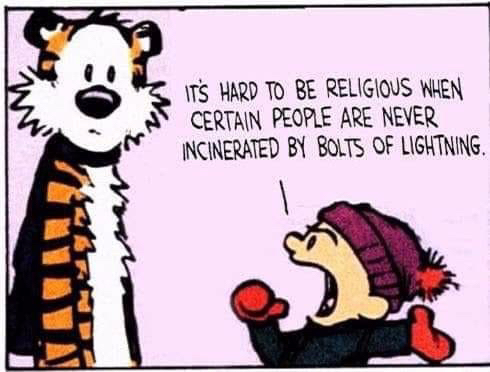
Calvin and Hobbes - imprecation

O God, do not be silent!
Do not be deaf.
Do not be quiet, O God.
Don’t you hear the uproar of your enemies?
Don’t you see that your arrogant enemies are rising up?
They devise crafty schemes against your people;
they conspire against your precious ones.
“Come,” they say, “let us wipe out Israel as a nation.
We will destroy the very memory of its existence….”

O my God, scatter them like tumbleweed,
like chaff before the wind!
As a fire burns a forest
and as a flame sets mountains ablaze,
chase them with your fierce storm;
terrify them with your tempest.
Utterly disgrace them
until they submit to your name, O Lord.
Let them be ashamed and terrified forever.
Let them die in disgrace.
Then they will learn that you alone are called the Lord,
that you alone are the Most High,
supreme over all the earth. (NLT)

The psalms are the church’s prayer book.  Many of the psalms are laments and many of them are worshipful songs of praise. Then there are the “imprecatory” (pronounced im-PRECK-a-tory) psalms.  To “imprecate” means to invoke evil upon someone; it is to pronounce a curse.  The reason for the imprecatory psalm is that it is not any person’s place to engage in revenge or retaliation.  Instead, for people who are genuinely caught in the cross-hairs of evil and have sinful persons dogging them, prayer is their most effective recourse.

Sometimes you must tell it like it is.  There is a time to do your best in putting up a good face and dealing with people who do not ever stop gossiping, slandering, and trying to get their way.

There is also a time to call such behavior “evil” and cry out to God for help.

There are many folks who consider imprecatory psalms a problem because of their detailed expressions of imprecation. Yet, such psalms refuse to put a positive spin on malevolent motives, wicked words, and destructive actions. Desperate people utter desperate prayers. Their unflinching sense of injustice will not allow them to sugarcoat the villainous plans of corrupt people. Evil is never toppled with tepid prayers from wimpy worshipers. Rather, nefarious agendas are thwarted in the teeth of specific, focused, and intense prayers directed with spiritual precision to the very core of diabolical forces.

We need not be shy about being real with God, even with praying imprecatory prayers.  There really are people in this world, maybe even in your own life, that have malicious intent against you or others.  Our job is not personal revenge, but to entrust ourselves to the God who fights for the poor, the oppressed, and the needy against the arrogant and the powerful.

Let your prayers reflect your life.

Along with psalms of praise lifted during times of celebration, so imprecatory psalms are not to be ignored but need to be uttered equally loud as prayers to almighty God in seasons of desperate evil. If you have a gut feeling deep down that wicked people are running amok, then use this psalm as a prayer against the darkness which seeks to envelop the earth.

Jesus Christ will build his church and the gates of hell shall not overcome it (Matthew 16:18). The picture Jesus portrayed is one of faithful believers equipped with righteousness and justice storming the gates of hell, not shying away from it. Baked within the Lord’s words were the promise that evil atrocities will not have the day – that God’s people will not be destroyed or overwhelmed because of demonic and satanic power.

There is a time to flee and then there is a time to engage. I am suggesting that the chief way of mitigating evil is to punch it in the mouth with imprecatory psalms prayed with righteous flavor and focused directly against the powers of this present darkness. Why prayer of all things in dealing with evil?…

For we do not wrestle against flesh and blood, but against principalities, against powers, against the rulers of the darkness of this age, against spiritual hosts of wickedness in the heavenly places. (Ephesians 6:12, NKJV)

Spiritual problems require spiritual implements to solve. And the tool of imprecatory psalms is a major way of not only pushing back the dark forces of this world but is the means of spiritual assertiveness against all forms of heinous acts and acerbic words from depraved people and evil systems.

God’s wrath is an expression of God’s love.

God is not okay with evil taking root in the lives and institutions of humanity. Prayer is our privilege of coming to the God who upholds justice and righteousness. For if God is for us, who can be against us?

God Almighty, may you hear me in the day of my trouble and send help from your holy sanctuary and strengthen my faith. Breathe your Holy Spirit into me and inspire me with a passion for goodness and truth, justice, and righteousness. Lord Jesus be present with me in your risen power and protect me from harm and from all that would hinder your healing presence in this world. You overcame the forces of Satan, redeemed the world, then ascended to the Father. May you be with me and within me; before me and behind me; on my right and on my left; above me and beneath me; and around me always. Amen.

Psalm 8 – The Majesty of It All

MilkyWay
The Milky Way

O Lord, our Sovereign,
how majestic is your name in all the earth!

You have set your glory above the heavens.
Out of the mouths of babes and infants
you have founded a bulwark because of your foes,
to silence the enemy and the avenger.

When I look at your heavens, the work of your fingers,
the moon and the stars that you have established;
what are human beings that you are mindful of them,
mortals that you care for them?

Yet you have made them a little lower than God,
and crowned them with glory and honor.
You have given them dominion over the works of your hands;
you have put all things under their feet,
all sheep and oxen,
and also the beasts of the field,
the birds of the air, and the fish of the sea,
whatever passes along the paths of the seas.

O Lord, our Sovereign,
how majestic is your name in all the earth! (NRSV)

This little psalm grounds us by dealing with ultimate questions of existence: Who am I?  Why do I exist?  What is the purpose of my life?

The answers to those questions are supremely important because we can lose sight of who we are and why we exist. If we were to peel back the layers of any random person’s life, we may find a deep sense of not belonging, of being in profound touch with their own mortality, and of having a disconnected sense of their personal role in the world. Many people have lost their original purpose of being a person and belonging to the human family in a way that makes a significant contribution to the world.

We live on a big planet, and that causes some people to feel quite small and wonder how they fit in. Gaping at such a large universe we may ask along with psalmist, “What are humans that you are mindful of them?”  This question forms the center of the psalm.  Hebrew poetry is typically arranged to have the front and the end of the poem point to the middle as its focus. So then, the psalmist purposely wrote this psalm so we would consider the great question of what God thinks of humanity within the scope of this exceptionally large universe.

To put this largeness in perspective, if the Milky Way galaxy were the size of the entire continent of North America, our solar system would fit in a coffee cup. Even now, two Voyager spacecraft are hurtling toward the edge of the solar system at a rate of 100,000 miles per hour. For thirty-five years they have been speeding away from Earth, having traveled 9 billion miles. When engineers beam a command to the spacecraft at the speed of light, it takes over 13 hours to arrive. Yet this vast neighborhood of our sun—in truth, the size of a coffee cup—fits along with several hundred billion other stars and their planets in the Milky Way, one of perhaps 100 billion such galaxies in the universe. To send a light-speed message to the edge of that universe would take 15 billion years.

Moraine Lake, Canada
Moraine Lake in Alberta, Canada

Out of the billions of galaxies in the universe, what is planet Earth that God should care about it?  Even on our planet there are billions of creatures. Yet, out of all those bugs, animals, fish, and birds, God has a special relationship with us, humanity, and cares for us deeply. God has even entrusted us with the responsibility to care for creation.  We are the only creatures who have the charge to steward all that God has created.  To put it another way, we, as people created in the image of God, have a job that is befitting of royalty, and it is more than a duty – it is a delight.

Furthermore, it is a godly and spiritual thing to engage in good creation care, whether it is properly feeding and caring for a pet, properly attending to relationships with grace and civility, or playing a crucial role in responsible land use.  Whatever it may be within this vast created world, God has entrusted to us this expansive Earth we live upon.  Literally everything in all creation is under our stewardship.

Out of all the creatures on earth, only people have been given the task of caring for every other created thing.  Only we as people have the self-awareness and perspective of the world which is needed to govern the world.  So, then, we can only find our true purpose and belonging in the stewardship of creation.  Care-giving is at the heart of being a person.

The glitch to this, and why so many lose their way, is that the world is still living under a curse due to the original fall of humanity into sin.  When we allow other dominions to supersede God’s dominion, then we have major problems.  When the power of money, or the significance of a position or job title, or the ability to do certain tasks is our basic identity and place of belonging, then we will likely succumb to anxiety. Other dominions cannot help us find our true God-given majesty as people created in God’s image.  Living any other way than being a proper steward of the world is beneath us because we have inherent dignity as God’s vice-regents over creation.

“There is no such thing as a small thing – only small things done with big love.” –Mother Teresa

That sentiment perfectly captures the vision of the psalmist – that all people are crowned with glory and honor and rule with God to do all the small things of life with a love that comes from our Creator.

Going forward, we have the possibilities of engaging in good stewardship of all that God has given us.  We can use our words in ways that care for others and build them up, rather than saying uncaring things which are not helpful.  We have the chance to be attentive to all the little things of life, whether gardening, building a bird house, working with diligence and care at our jobs, or keeping our community clean and its citizens healthy and happy, it is all important and has a significant place.

Let us, then, continually improve what we do, no matter what it is, so that it befits us as God’s people crowned with honor.  May this topsy-turvy year become one of joy and contentment, knowing the majesty we share with God as humans in his wondrous world.

Creator God, you make all things and weave them together in an intricate tapestry of life. Teach us to respect the fragile balance of life and to care for all the gifts of your creation. Guide by your wisdom those who have power and authority, that, by the decisions they make, life may be cherished, and a good and fruitful Earth may continue to show your glory and sing your praises. Almighty God, you have called us to tend and keep the garden of your creation. Give us wisdom and reverence for all your plants and animals who share this planet with us and whose lives make possible our own. Help us to remember that they too love the sweetness of life and join with us in giving you praise. Amen.