Psalm 125 – She Rocks!

The God Who Surrounds Us by Irv Davis

The people who trust in the Lord
    are like Mount Zion:
    never shaken, lasting forever.
Mountains surround Jerusalem.
    That’s how the Lord surrounds his people
    from now until forever from now!
The wicked rod won’t remain
in the land given to the righteous
    so that they don’t use their hands to do anything wrong.
Lord, do good to people who are good,
    to people whose hearts are right.
But as for those people who turn to their own twisted ways—
    may the Lord march them off with other evildoers!

Peace be on Israel! (CEB)

Psalms 120-134 comprise a collection of short songs of ascent meant to guide Jewish pilgrims in their communal trek up to the city of Jerusalem, and ultimately to the temple mount.  The rhythm of the pious ancient Israelites centered round particular festivals, seasons, and Sabbath. 

Taking the annual pilgrimage to the Holy City was an especially anticipated time of year.  This yearly cycle bolstered their faith and gave the people some needed spiritual stability. The sameness of the routine and the ritual helped to remind the faithful of the solid theology that God cannot be moved and will always be there.

One of the most fundamental of all truths about God is divine consistency and constancy, that the Lord is forever present with God’s people. If God seems or feels distant or inattentive, it comes not from a place of uncaring. as though absent, aloof, or not listening.  It simply means the Lord self-reveals on a divine timetable, not a human one. Our responsibility in the entire affair is to engage in consistent rhythms of spirituality that place us in a position to receive grace when God decides to give it.

Therefore, we must not despair but anticipate meeting with God, just as the Israelites of old looked forward and upward to their annual worship at the top of the mountain. 

God continually surrounds people, even when we do not always perceive it to be so. 

Basic sound theology, as we possess abundantly in the psalms, is neither gender specific nor gender neutral. To have a full orbed understanding of the God of the psalms means we use both male and female pronouns in our descriptions.

To limit God as an old white guy, or only as male, truncates a strong view of true divinity.

What I am suggesting here is that we avail ourselves of the full compliment of metaphors to present a more complete picture of God. Language is our vehicle in communication about the Lord, so let us use it to its entire extent to present the Lord in all his/her grandeur, majesty, holiness, and strength.

For example, as the psalmist likens God to a mountain chain surrounding Jerusalem, if we only picture this in our imaginations as a man, we have not quite got an integral picture. Although a muscular Christianity might provide us with an understanding of God’s sheer brute power, a maternal Christianity gives us a strength of provision, care, and protection from a different angle.

When Jesus came to Jerusalem, the city surrounded by mountains, he did not use a masculine metaphor to communicate to the people; he used a maternal one:

“O Jerusalem, Jerusalem, the city that kills the prophets and stones God’s messengers! How often I have wanted to gather your children together as a hen protects her chicks beneath her wings, but you wouldn’t let me.” (Matthew 23:37, NLT)

When the Apostle Paul wanted to communicate to the Thessalonian Church his deep concern for them, he went for the maternal metaphor:

We could have thrown our weight around as Christ’s apostles (like a man). Instead, we were gentle with you like a nursing mother caring for her own children (like a woman). We were glad to share not only God’s good news with you but also our very lives because we cared for you so much. (1 Thessalonians 2:7-8, CEB)

Indeed, in my culture when we want to convey the ultimate protective behavior of another, we describe them as a “mother bear.”

The gist of theology is this: God cannot be tied down or limited to gender, race, ethnicity, class, etc. The Lord is God, and we are not. Therefore, it is perfectly appropriate, and I daresay necessary, to use both male and female pronouns and metaphors in describing God because the Lord of the universe created both male and female in his/her image. (Genesis 1:26-27)

This is neither taking liberal license of the psalms nor emasculating them; it is merely pointing out that God is Spirit, and we worship her/him in spirit and in truth. And the truth is that he is the mountains surrounding us as a manly sentinel over our lives; and she is the mountain chain encircling us with protective care for whom nobody better mess with us.

May the Lord do good to us, as the manly Rock of our salvation as well as the feminine Fortress of our souls, protecting us with the care of both a father and a mother.

Ever-present God, there is no place where I can go where you are not.  Help me to so intuit your divine presence that it bolsters my faith and resilience for daily life in Jesus Christ.  Amen.

Psalm 128 – Blessed

The Lord will bless you 
    if you respect him 
    and obey his laws. 
Your fields will produce, 
    and you will be happy 
    and all will go well. 
Your wife will be as fruitful 
    as a grapevine, 
and just as an olive tree 
    is rich with olives, 
    your home will be rich 
    with healthy children. 
That is how the Lord will bless 
    everyone who respects him. 

I pray that the Lord 
    will bless you from Zion 
    and let Jerusalem prosper 
    as long as you live. 
May you live long enough 
    to see your grandchildren. 
    Let’s pray for peace in Israel! (CEV) 

There is a consistent connection between obedience and blessing. That is, in observing God’s ways, one will typically enjoy divine favor and approval.  

Keep in mind, however, this is not a math equation. Like 2+2=4 there are folks who expect a neat linear connection between their obedience and their blessing. In math theology, when a woman is unable to have children, or a child goes astray from their heritage, the parent concludes that they themselves must have been unfaithful to God’s law or are being punished. Conversely, with children who grow to be good citizens and respectful persons, the parents might conclude it was because of their superior observance to the spiritual life. 

In both cases, parents take too much credit, either for a child’s wandering or success. As for kids going astray, even God had prodigal children, so cut ourselves some slack. As for children who maintain faithfulness, a lot of factors went into who they are. I suppose it is only natural to quickly assume we have far more control of than we really do. 

This all cuts to the heart of biblical interpretation. If all Scripture is read literally, then we will likely see the Bible as a math equation where doing and saying the right things gets a predictable result of blessing. Yet, this mistakenly views promise and proverb as the same thing, and divine work with one person or group will be precisely the same for another. The wisdom literature of Scripture, which includes the psalms, were never designed as prescriptive decree but rather as the sage approach for work, worship, and family. 

Today’s psalm communicates the path of happiness coming through love and respect for God. It neither promises lots of kids, ensures money, nor guarantees smooth sailing. Rather, when one lives each day being cognizant and observant to center everything around the divine, then blessing and happiness will tend to follow. 

Blessings and benedictions are given to sustain us in hope and confidence. The best things in life usually come through faith and family. So, when we choose to walk with God and travel down the ethical road, then life becomes full of peace and prosperity – perhaps not always in the manner we expect, yet blessing, nonetheless. 

Humanity is hard-wired for blessing, for a steady diet of encouragement, acceptance, and approval from God and others. When this is withheld from us, unhappiness, even despair begins to settle. Giving and receiving blessing is at the heart of being fully human and alive. Our work and family life will likely be miserable if blessing is absent. Yet, with blessing, we have a sustainable form of happiness and enjoyment. 

Eternal God, by whose power we are created and by whose love we are redeemed, guide, strengthen, and bless us through your Spirit so that we may give ourselves to your service and live today in love to one another and to you, through Jesus Christ our Lord. Amen. 

Psalm 121 – My Help

Mountain landscape

I lift up my eyes to the hills—
    from where will my help come?
My help comes from the Lord,
    who made heaven and earth.

He will not let your foot be moved;
he who keeps you will not slumber.
He who keeps Israel
will neither slumber nor sleep.

The Lord is your keeper;
the Lord is your shade at your right hand.
The sun shall not strike you by day,
nor the moon by night.

The Lord will keep you from all evil;
he will keep your life.
The Lord will keep
your going out and your coming in
from this time on and forevermore. (NRSV)

This is my favorite psalm.  I have read and mulled it over so many times that it is almost second nature for me to draw from its rich theological statement about God when times are difficult.  This is a psalm designed for worship – to be used by God’s people through song and prayer.  A community without Psalm 121 near to its heart is a group of people in danger. Yet, with it, there is a continual sense of security, confidence, and hope.

Psalms are meant to be spoken aloud and repeated. So, here is another version:

I look to the hills!
Where will I find help?
It will come from the Lord,
who created the heavens
and the earth.

The Lord is your protector,
and he won’t go to sleep
or let you stumble.
The protector of Israel
doesn’t doze
or ever get drowsy.

The Lord is your protector,
there at your right side
to shade you from the sun.
You won’t be harmed
by the sun during the day
or by the moon at night.

The Lord will protect you
and keep you safe
from all dangers.
The Lord will protect you
now and always
wherever you go. (CEV)

This beautiful majestic psalm can be used for any and every occasion.  So, I often use it within hospital visits, counseling in a wide array of situations, and for my own personal edification.  It seems to me that one cannot possibly overuse this psalm.  The psalm was originally used for ascending the hill into Jerusalem, anticipating meeting with God.  Just like a lover who looks forward to meeting his beloved and thinking about how wonderful she is, so the psalmist looks with adoring affection on the God he is about to encounter.

I Lift My Eyes to the Hills

Here is yet another version of this wonderful psalm:

I look up to the mountains—
does my help come from there?
My help comes from the Lord,
who made heaven and earth!

He will not let you stumble;
the one who watches over you will not slumber.
Indeed, he who watches over Israel
never slumbers or sleeps.

The Lord himself watches over you!
The Lord stands beside you as your protective shade.
The sun will not harm you by day,
nor the moon at night.

The Lord keeps you from all harm
and watches over your life.
The Lord keeps watch over you as you come and go,
both now and forever. (NLT)

The psalm is rich with a theology of grace, watch care, and loving attention.  This is a God who is powerful and merciful, a God able to help and desiring to do so.  In a world which seems so often distant and unaffected by the divine, this is a psalm to utter repeatedly in every situation of life so that the truth of the Lord is grafted deep into the soul.  In each unwanted circumstance the psalm can be spontaneously used as an immediate prayer, and with every anticipated event it can provide the words to address the most pressing of needs.  Let the words resonate within you as people created in the image of God, connecting with him on both the cerebral and visceral levels of your life in this last version:

I will lift up my eyes to the hills—
From whence comes my help?
My help comes from the Lord,
Who made heaven and earth.

He will not allow your foot to be moved;
He who keeps you will not slumber.
Behold, He who keeps Israel
Shall neither slumber nor sleep.

The Lord is your keeper;
The Lord is your shade at your right hand.
The sun shall not strike you by day,
Nor the moon by night.

The Lord shall preserve you from all evil;
He shall preserve your soul.
The Lord shall preserve your going out and your coming in
From this time forth, and even forevermore. (NKJV)

 Amen.

Psalm 124 – Our Help

Our Help

If the Lord hadn’t been for us—
let Israel now repeat!—
if the Lord hadn’t been for us,
when those people attacked us
then they would have swallowed us up whole
with their rage burning against us!
Then the waters would have drowned us;
the torrent would have come over our necks;
then the raging waters would have come over our necks!

Bless the Lord
because he didn’t hand us over
like food for our enemies’ teeth!
We escaped like a bird from the hunters’ trap;
the trap was broken so we escaped!

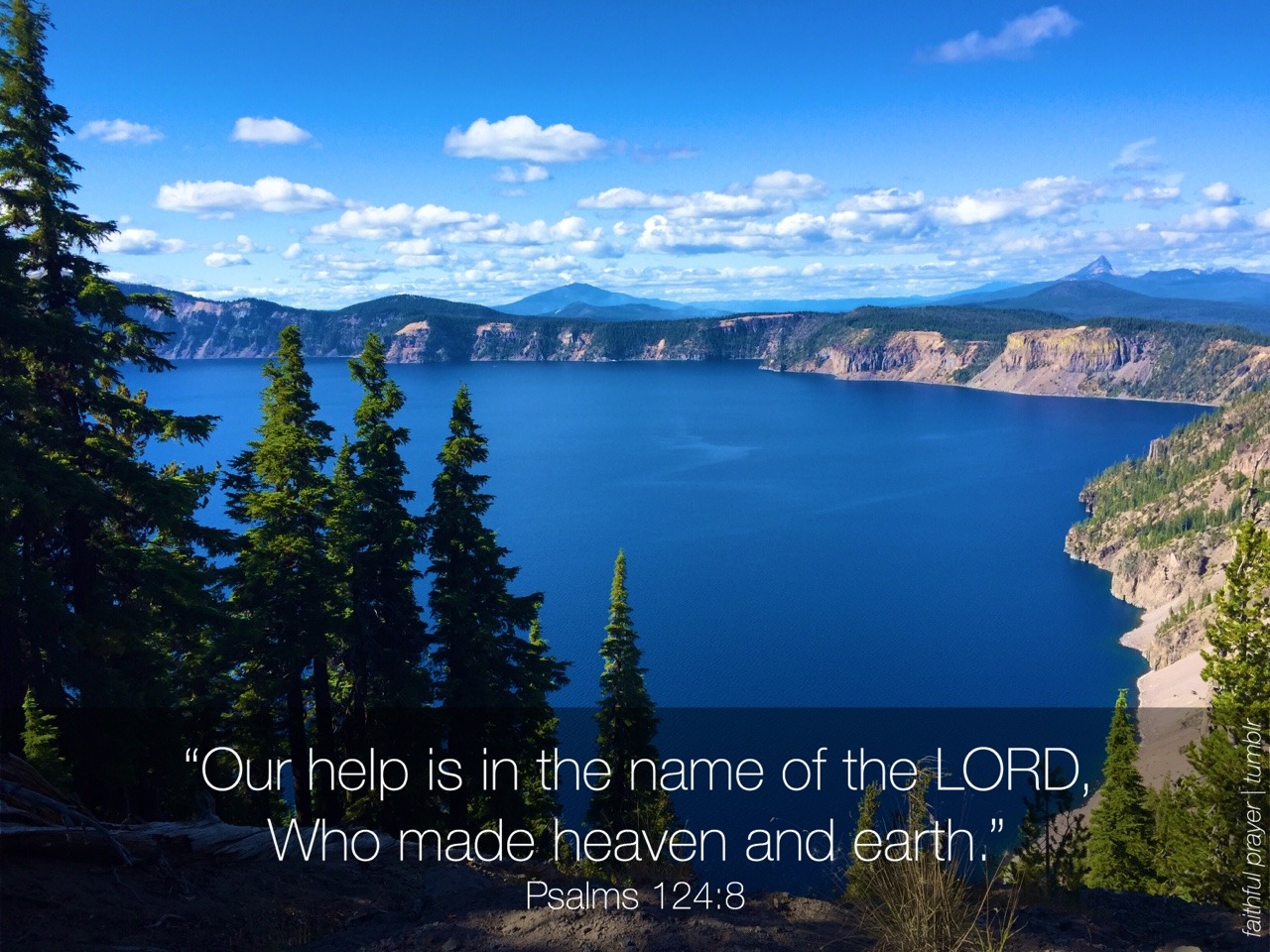
Our help is in the name of the Lord,
the maker of heaven and earth. (CEB)

“Our help is in the name of the Lord who made heaven and earth.”  These are the words for which I begin nearly every worship service in church.  It is a call to worship the God who is above all and sees all – and can do something about the adversity and trouble we face in the world.  When confronted with a new day, our attention needs some direction in the positive way of acknowledging God.

Our ultimate help is in the Lord.  Our fears about the future, our insecurities of what will happen, and our anxieties about all the upcoming stuff we must face can be transformed with the biblical perspective of acknowledging our need for God.  The Lord is our most prescient support.  That virtual meeting you have been dreading; that conversation you have been avoiding; or, that deadline that has been looming over your head; these and all situations can only find their proper perspective in light of the God who helps.

I am a believer in making daily affirmations of faith in God. That is, affirming the truth about God, even if I don’t feel like it, each and every day so that some solid robust theology is at the forefront of my mind, and the attributes of God sink firmly into my heart.  For faith does not simply come because of signing off on a checklist of beliefs.  Rather, faith arises as a response to the recognition that God is good – all the time – and that he helps those who look to him.

There are a lot of things we do not know: what will happen tomorrow; how a situation will shake out in the end; whether a relationship will flower or wither; and, a million other things which can weigh down our hearts with anxiety. However, there is one sure truth we can count on right now and for every minute into the future: God is with us. God’s ever-present help remains the constant ballast in a sea of changing circumstances.

Indeed, “If God is on our side, can anyone be against us?… I am sure that nothing can separate us from God’s love—not life or death, not angels or spirits, not the present or the future, and not powers above or powers below. Nothing in all creation can separate us from God’s love for us in Christ Jesus our Lord!” (Romans 8:31, 38-39, CEV)

Creator God, you are the ever-present One who provides everything I need for life and godliness.  I need your help today and everyday so that I can confidently do your will.  I stand with full assurance of faith because I serve the Lord Jesus, who is benevolent and always does what is right and just.  Amen.