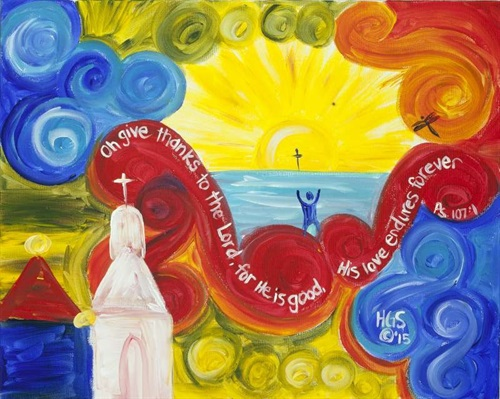
Share Your Story (Psalm 107:1-16)

Psalm 107, by Erin Beardemphl

O give thanks to the Lord, for he is good,
    for his steadfast love endures forever.
Let the redeemed of the Lord say so,
    those he redeemed from trouble
and gathered in from the lands,
    from the east and from the west,
    from the north and from the south.

Some wandered in desert wastes,
    finding no way to an inhabited town;
hungry and thirsty,
    their soul fainted within them.
Then they cried to the Lord in their trouble,
    and he delivered them from their distress;
he led them by a straight way,
    until they reached an inhabited town.
Let them thank the Lord for his steadfast love,
    for his wonderful works to humankind.
For he satisfies the thirsty,
    and the hungry he fills with good things.

Some sat in darkness and in gloom,
    prisoners in misery and in irons,
for they had rebelled against the words of God
    and spurned the counsel of the Most High.
Their hearts were bowed down with hard labor;
    they fell down, with no one to help.
Then they cried to the Lord in their trouble,
    and he saved them from their distress;
he brought them out of darkness and gloom,
    and broke their bonds apart.
Let them thank the Lord for his steadfast love,
    for his wonderful works to humankind.
For he shatters the doors of bronze
    and cuts in two the bars of iron. (New Revised Standard Version)

Every person of faith has a story, a testimony of God’s redeeming, saving, and loving deliverance from trouble. And each one of those stories is sacred and special; no one story is better or greater than another. There’s no need, therefore, to act like you’re taking a course in comparative storytelling – as if you don’t have nearly the spiritual testimony of someone else.

The fact of the matter is that there is no trouble like your own personal trouble. Although others can relate to elements of each of our stories, no one else knows what your own experience is like. The old black spiritual is right in saying. “Nobody knows the trouble I’ve seen. Nobody knows but Jesus.”

It’s important to have others empathize with us and help normalize the experience we are going through. It’s necessary to have another validate our emotions and affirm the feelings we’re feeling. And, even after that, there’s nothing quite like a compassionate and caring Being who intimately knows everything about your trouble, how you experience it, and steps-in according to perfect divine timing, to bring uplift, hope, and salvation.

There is such a Being. God. Yahweh. The Lord. Pure Goodness. Redeemer. Savior. And most of all, Lover who is infinite Love with a capital “L.”

Why am I so confident about such a Being as this? Did I take too much methadone? Am I only an old fart who still believes in God? Or perhaps, you think, I’m a weird sort of giddy about God because of the Bible. Well, yes, and no. Scripture – especially the Psalms – just happens to put into words my actual experience and emotions.

But I don’t much care about parsing out whether I’m a deluded metaphysician or a sappy magpie or whatever other label gets affixed to me. It just doesn’t matter – because every epistemic fiber of my lower case being resonates with the upper case Being who bestows steadfast love because that Being’s character is actually made up of Love. It’s as if God is the biggest ultimate Teddy Bear, stuffed with holy love for all creation.

And, what’s more, this God seems to specialize and enjoy paying attention to the least, the lost, and the lowly among us humans. I was once in such a deep, dark, dank, black hole of spiritual nothingness that I knew I could never get out of, that is, on my own. I needed deliverance, or there wouldn’t be any hope whatsoever.

Others have experienced something akin to wandering alone out in a desert spiritual wasteland with no water, no food, no nothing but oppressive heat and loneliness. And others have had the trouble of real flesh and blood people seeking to do them harm, both physically and mentally. Yet others felt like they were bereft of options on a plantation of slavery in which all they could do was work like animals just to survive another day.

What all these persons have in common is that they cried out to the Lord, the maker of heaven and earth. And most of them didn’t just do it once; some cried out until they had no voice and were too weak to even speak anymore.

God showed up. God also showed off. Not only was there deliverance, but there was also an upgrade. For me, it was not like Tim 2.0, but Tim 1,000.0 – a filling of divine grace that goes beyond mere words. Because of God’s grace and love in my own life, it has enabled me to tap into that storehouse of mercy and pray with spiritual confidence.

When my dear wife had a spine surgery several years ago and awoke from it unable to move her legs, I prayed. I asked for mercy. I pleaded for grace. And I did it for hours at the foot of her hospital bed. I remember that I stubbornly would not accept the fact that she could not move her lower body.  And I decided to stand there and pray until I got an answer from God.

Eventually, I prayed myself asleep. My wife woke me up sometime in the early morning the next day. She told me to pull back the covers and look at her right big toe…. She could give it an ever-small twitch. We called the nurse, who was so excited that she called everyone she could get a hold of.

With a dozen hospital staff huddled around the hospital bed, my wife proceeded to give that big toe a hearty move. The staff erupted with clapping, and I am not kidding when I say that we had a party with noise and shouts in a hospital room at 4am. Nobody cared we were going nuts. I certainly did not.

My friend, God is still in the business of answering prayer, of showing up and showing off.

Through the hard times, the good times, and the confusing times, the Lord is our constant ballast for all seasons of life, whether good or bad. And I love God for that abiding presence. I can also give testimony that through all of the adverse situations my wife and I have faced, we have learned to stop, be still, and find that all we ever wanted we already have, even when everything changes.

Psalm 107 lets us know that personal testimony expressed to the community is an important aspect of strengthening everyone’s faith. Our stories are important, and they are meant to be shared. The spiritual and emotional health of us all is at stake.

Accept, O Lord, our thanks and praise for all that you have done for us. We thank you for the splendor of the whole creation, for the beauty of this world, for the wonder of life, and for the mystery of love.

We thank you for the blessing of family and friends, and for the loving care which surrounds us on very side.

We thank you for setting us at tasks which demand our best efforts, and for leading us to accomplishments which satisfy and delight us.

We thank you also for the disappointments and failures that lead us to acknowledge our dependence on you alone.

Above all, we thank you for your Son Jesus Christ; for the truth of his Word and the example of his life; for his steadfast obedience, by which he overcame temptation; for his dying, through which he overcame death; and for his rising to life again, in which we are raised to the life of your kingdom.

Grant us the gift of your Spirit; that we may know you and make you known; and through your Spirit, at all times and in all places, may give thanks to you in all things. Amen.

The Redeemed and Responsive Soul (Psalm 107:1-7, 33-37)

O give thanks to the Lord, for he is good,
    for his steadfast love endures forever.
Let the redeemed of the Lord say so,
    those he redeemed from trouble
and gathered in from the lands,
    from the east and from the west,
    from the north and from the south.

Some wandered in desert wastes,
    finding no way to an inhabited town;
hungry and thirsty,
    their soul fainted within them.
Then they cried to the Lord in their trouble,
    and he delivered them from their distress;
he led them by a straight way,
    until they reached an inhabited town…

He turns rivers into a desert,
    springs of water into thirsty ground,
a fruitful land into a salty waste,
    because of the wickedness of its inhabitants.
He turns a desert into pools of water,
    a parched land into springs of water.
And there he lets the hungry live,
    and they establish a town to live in;
they sow fields and plant vineyards
    and get a fruitful yield. (New Revised Standard Version)

The responsive spirit

A soul full of spiritual abundance responds freely and organically to God with offerings of gratitude for divine rescue and redemption.

The spiritually responsive person is at peace, content, and able to love with a sensitivity to God because they have had their needs for safety, satisfaction, and relational connection fulfilled. So, as a result, they are able to:

  • worship joyfully and praise God
  • speak words of thanksgiving
  • be attentive to self-care and personal well-being
  • use their resources wisely, feeling capable and confident of making good decisions that bless both the church and the world
  • know they are secure in the loving hands of God

The reactive spirit

Conversely, a soul that is empty from spiritual deprivation reacts predictably and robotically to others with frustration and fear.

The spiritually reactive person seems perpetually upset and in chronic emotional pain, feeling rattled and worried most of the time. They do not reflexively look to the Lord. Their needs for safety, satisfaction, and relational connection have not been met. So, as a result, they are:

  • hypervigilant, on the lookout for the bad, which they are convinced is coming
  • focused narrowly with tunnel vision, having lost sight of the big picture
  • prone to overgeneralizing their negative experiences as being the only experiences they ever have
  • searching for continual stimulation, just to seem alive and feel something
  • insecure, wanting constant validation from others because they cannot give themselves any encouragement

So, what do you do when always feeling between a rock and a hard place, experiencing racing thoughts, being anxious more than not, feeling like an abandoned town in the Old West with nothing but tumbleweed moving down the street?

A redeemed soul

In your desperation, call out to God. The Lord can:

  • get you out in the nick of time and deliver you soul from trouble so that you can be grateful for divine love
  • put your feet walking on a wonderful road of grace that leads to a good place of transformation
  • meet your needs for freedom, contentment, and loving relational networks, so that your spirit is full of right relationships, purity, mercy, and peace

You can once again, or maybe for the first time, feel like:

  • A flowing river, instead of sunbaked mud
  • A fruitful orchard, instead of dry dead tree
  • A farmer with much grain and many animals, instead of a homeless person sitting on a pile of dung
  • A person loved and valued by God, instead of a waste of space, breathing air that others could have
  • A sheep who knows the shepherd is watching over them, instead of an insect that everyone steps on

Keep in mind, that the experience of blessing, the encounter of abundance, and the feeling of peace, is not like a simple math equation – as if God were a divine genie that you happened to find and got three wishes.

Rather, the fulfilling spiritual life involves a persistent faith, confident hope, and constant love. These come from God, and are accessed through humility. The proud person will not realize a life of faith, hope, and love, because they believe they already know what is best.

The humble admit their ignorance, their failings, their shame, their guilt, and their desperation.

Approaching God with humility doesn’t mean to heap deprecation and curses on oneself. It just means to be honest with where you are spiritually, emotionally, mentally, and physically. And to cry out for help, knowing you have nothing to offer in return.

In God’s economy, the currency is grace – and not some give-and-take, I’ll-scratch-your-back-if-you-scratch-mine sort of mentality. God’s steadfast love endures forever. God’s kingdom spins on the axis of grace.

The Lord is not a reactive God but a responsive God. The Lord responded to Israel’s cry for deliverance not just with food and drink, but with a city. God did not only meet the immediate needs of the ancient Israelites, for whom the psalmist is one, along with the original recipients; the Lord took care of their larger, long term needs. 

The people needed a place where they could settle down, raise their own crops and tend their own livestock, and have a dependable means of making a living. God satisfied this, and more, by giving them a city where they could settle, be safe, secure, and content.

God can do anything, you know—far more than you could ever imagine or guess or request in your wildest dreams. God does it not by pushing us around, but by working within us, the Spirit deeply and gently providing us with our deepest and greatest needs.

Blessed heavenly Father, you have filled the world with divine beauty: Open our eyes to behold your gracious hand in everything you have done, so that, rejoicing in all your creation, we may learn to serve you with gladness; for the sake of him through whom all things were made, your Son Jesus Christ, our Lord, who with you and the Holy Spirit are one God, now and forever. Amen.

Psalm 107:1-9, 43 – Let the Redeemed Say So

Psalm 107 by Hope Smith

O give thanks to the Lord, for he is good,
    for his steadfast love endures forever.
Let the redeemed of the Lord say so,
    those he redeemed from trouble
and gathered in from the lands,
    from the east and from the west,
    from the north and from the south.

Some wandered in desert wastes,
    finding no way to an inhabited town;
hungry and thirsty,
    their soul fainted within them.
Then they cried to the Lord in their trouble,
    and he delivered them from their distress;
he led them by a straight way,
    until they reached an inhabited town.
Let them thank the Lord for his steadfast love,
    for his wonderful works to humankind.
For he satisfies the thirsty,
    and the hungry he fills with good things….

Let those who are wise pay attention to these things
    and consider the steadfast love of the Lord. (New Revised Standard Version)

The psalmist encourages and invites us to consider God’s steadfast love (Hebrew “chesed”). In all truth, an eternity of pondering and discovering such love will never plumb the depths of the Lord’s faithful love.

Maybe there is so much hate, bitterness, and vitriol in this old fallen world because people don’t consider the God who is Love. After all, there isn’t much room for malicious anger whenever people are expressing gratitude.

We are divinely hard-wired to give and receive affirmation, gratitude, encouragement, and love. Doing the opposite of that throws a huge monkey wrench into our daily living. It’s not sustainable to live by criticism, ingratitude, judgmentalism, and hate. It goes against who we are as humans.

Instead, it is sage to acknowledge, appreciate, ponder, and express the great love of God for humanity. The Lord’s love never runs out – it is inexhaustible.

Many people have stories of wandering far from Love, stumbling in the darkness, and finding themselves in desperate straits. Like the prodigal son, they are found by the God who is Love. And instead of being chided for their herky-jerky life, they are given a prominent place in God’s kingdom.

Some of you wandered for years in the desert,
    looking but not finding a good place to live,
Half-starved and parched with thirst,
    staggering and stumbling, on the brink of exhaustion.
Then, in your desperate condition, you called out to God.
    He got you out in the nick of time. (Psalm 107:4-6, MSG)

Praise and thanksgiving become the reflexive practices of the folk who have returned home to God. And the psalmist calls us to speak out those stories of hope and deliverance.

Telling our spiritual stories to others is important – both for the storyteller, and also for those who listen. Together, the spiritual community of the redeemed becomes strengthened in their bonds of faith; and everyone is emboldened to share with others. 

Far too many Christians are reticent to talk about what God has done or is doing in their lives. Shame, embarrassment, or a host of other reasons might prevent us from being vulnerable enough to let others in on God’s deep work within.

We all likely have had the privilege of hearing another person share their heart and experience of hardship and God’s deliverance. It was uplifting, encouraging, and helpful. So, let’s not keep our stories to ourselves. Stories are meant to be told, not hidden. Bringing to light our faith journey is healing for all, as well as declaring that Jesus is the light of the world.

Author Frederick Buechner wrote a book several years ago entitled, “Telling Secrets.” Buechner tells of his own experience of keeping some stories inside and never letting them see the light of day. One of those stories was growing up with an alcoholic father and all the other stories that went along with that singular story.

It was only in finally telling the family secret of alcoholism that he discovered a better path forward to healing and blessing. He writes:

“What we hunger for perhaps more than anything else is to be known in our full humanness, and yet that is often just what we also fear more than anything else. It is important to tell at least from time to time the secret of who we truly and fully are because otherwise we run the risk of losing track of who we truly and fully are and little by little come to accept instead the highly edited version which we put forth in hope that the world will find it more acceptable than the real thing. It is important to tell our secrets, too, because it makes it easier for other people to tell us a secret or two of their own.”

Frederick Buechner, “Telling Secrets”

Buechner went on to say:

“My story is important not because it is mine, God knows, but because if I tell it, the chances are you will recognize that, in many ways, it is also your story. It is precisely through these stories in all their particularity, as I have long believed and often said, that God makes himself known to each of us more powerfully and personally. If this is true, it means that to lose track of our stories is to be profoundly impoverished not only humanly but also spiritually.”

Shame is like a vampire. It lives in the shadows, feeding upon secrets. But when our stories are told and see the light of day, the vampire of shame is destroyed by the bright rays of truth and vulnerability.

We then become open to genuine relationships without propping up a false self to pose for others. We place ourselves in a position to receive and give love. In other words, we can meaningfully connect with both God and others because we found our voice and told our story.

Great God of deliverance, I praise you that I have a story to tell of your grace and faithfulness. Help me to tell of your mercy in my life so that the name of Jesus will be exalted, and that your people might be built up in the faith.  Amen.

Psalm 107:1-3, 17-22 – The Steadfast Love of God

O give thanks to the Lord, for he is good;
    for his steadfast love endures forever.
Let the redeemed of the Lord say so,
    those he redeemed from trouble
and gathered in from the lands,
    from the east and from the west,
    from the north and from the south….

Some were sick through their sinful ways,
    and because of their iniquities endured affliction;
they loathed any kind of food,
    and they drew near to the gates of death.
Then they cried to the Lord in their trouble,
    and he saved them from their distress;
he sent out his word and healed them,
    and delivered them from destruction.
Let them thank the Lord for his steadfast love,
    for his wonderful works to humankind.
And let them offer thanksgiving sacrifices,
    and tell of his deeds with songs of joy. (NRSV)

I’ve always found it a bit curious that there are people who continually equate the God of the Old Testament as nothing but a vengeful and wrathful God, continually perturbed and upset, exasperated with us stupid little sinful people. Certainly, there are sections in Scripture dealing with God’s wrath and the divine action spurred from not being okay with injustice running amok on the earth. 

Everything God does comes from a place of love.

The Lord has never been okay with sin because it damages and destroys people who are meant for better things. Which is why, when people are in need and cry out to the Lord, God is there for them. 

Far more prevalent is the reality that the Old Testament is thickly populated with references to God’s “steadfast love.”  This is God’s covenant-keeping love. It is the kind of love that holds on and doesn’t let go. It’s the type of love that is tirelessly gracious, merciful, and kind. It is the love that has compassion on the needy and mercifully does something about their plight.

In today’s psalm, even when there were people sick and in distress because of their own doing, their own sin, and their own fault, God saved them from their mess. That, my friend, is precisely what God does – expertly delivers people with care and precision. 

So then, we truly need to get some robust theology to overwhelm and break those old nasty ideas about a fickle God who shakes his finger at us when we screw up and gives a big disappointed *sigh* over our dumb decisions. Just as the psalms steadily and persistently portray to us a God of abiding love, they also equally tell us of a God who is “slow to anger,” not going off the handle quickly. (Psalm 86:15, 103:8, 145:8)

Know deep in your soul that God shows steadfast love. 

God doesn’t tell us “I told you so” or “that’s what you get for sinning,” like some obnoxious and overzealous schoolgirl. Nope. God delivers and does it because of steadfast love. It flat out gives God pleasure to save and redeem wayward folk.

That’s why I believe people all over the world have learned to sing the praises of the God of the Bible. It’s why persons from every walk of life and every culture have found God as the great lover of humanity. Their overflowing response to such a loving God is singing, praising, thanking, and offering their lives to the great Lover of their souls.

If you or someone you know struggles with seeing God as capricious, indifferent, or angry, then I strongly urge a steady and daily diet of the psalms over the course of the next month. Call it an intervention of psalms. Reading just five psalms per day gets you through all one-hundred fifty of them in a month. More than that, pray the psalms. Allow them to give you a new perspective on the world, relationships, and self.

“God’s love is like when you sit in front of a fire in winter — you are just there in front of the fire. You don’t have to be smart or anything. The fire warms you.”

Desmond Tutu

This prolific reading of the psalms is not some new or weird thing. It has been around for an awfully long time. The daily recitation of the entire Book of Psalms was an early monastic custom, especially among the Desert Fathers of the 3rd and 4th centuries. By the time Saint Benedict came along with his Rule for monks (c.515 C.E.) many communities had settled on the weekly praying of the entire Psalter. As good old Benedict said, praying less than a full psalter a week betrays “extreme indolence and lack of devotion.”

That might seem over the top to modern readers, yet the big idea is that once the steadfast love of God from the psalms gets into your spiritual bloodstream, the praying and singing of the psalms becomes a delight. I can testify to that. Seems I cannot ever get enough of the psalms. Which really means I love the steadfast love of God!

The Psalms are, I believe, the fulcrum of the Holy Scriptures. They recite and reflect upon the historical acts of God in the Old Testament. They tell of the Lord’s continuing covenantal care for people. The Psalms express the full gamut of human emotion and spiritual devotion of the people of God. Reciting the Psalms aloud frequently puts us in good company with our spiritual ancestors in the faith.

So, what the heck are you waiting for? Go ahead. Read and recite today’s psalm over again and again. Let them do their gracious work in your spirit.

God of all that is good, your steadfast love has been shown to millions who find in you the desire of their hearts.  May I see your overflowing goodness, your steadfast love, and your infinite mercy operating in this broken world and in my needy heart; through your Son, my Savior, Jesus Christ, who with you and the Holy Spirit lives and reigns forever.  Amen.