Immortal God and Mortal Humanity (Psalm 90)

Digital artwork by Bruce Butler

Lord, you have been our dwelling place
    in all generations.
Before the mountains were brought forth
    or ever you had formed the earth and the world,
    from everlasting to everlasting you are God.

You turn us back to dust
    and say, “Turn back, you mortals.”
For a thousand years in your sight
    are like yesterday when it is past
    or like a watch in the night.

You sweep them away; they are like a dream,
    like grass that is renewed in the morning;
in the morning it flourishes and is renewed;
    in the evening it fades and withers.

For we are consumed by your anger;
    by your wrath we are overwhelmed.
You have set our iniquities before you,
    our secret sins in the light of your countenance.

For all our days pass away under your wrath;
    our years come to an end like a sigh.
The days of our life are seventy years
    or perhaps eighty, if we are strong;
even then their span is only toil and trouble;
    they are soon gone, and we fly away.

Who considers the power of your anger?
    Your wrath is as great as the fear that is due you.
So teach us to count our days
    that we may gain a wise heart.

Turn, O Lord! How long?
    Have compassion on your servants!
Satisfy us in the morning with your steadfast love,
    so that we may rejoice and be glad all our days.
Make us glad as many days as you have afflicted us
    and as many years as we have seen evil.
Let your work be manifest to your servants
    and your glorious power to their children.
Let the favor of the Lord our God be upon us
    and prosper for us the work of our hands—
    O prosper the work of our hands! (New Revised Standard Version)

All of the psalms are prayers. Most of them are prayers of David. Today’s psalm is a prayer of Moses.

Moses acknowledged and affirmed that God is eternal, and we humans are not. We are frail and in need of God. We are dependent upon God for health, hope, and happiness in life.

There are observations to notice in today’s Psalm lesson, that are then followed by prayerful petitions which arise from those observations.

First Observation: God Is Eternal

God is immortal. God has always been, and will always be. Therefore, the Lord’s rule and reign existed way before this world was ever created, and shall extend way beyond the lifespan of creation. God’s dwelling place is without beginning or end – which means that God isn’t going anywhere. That is a great comfort to me.

Second Observation: Humans Are Finite

Whereas God is immortal, we humans are mortal beings. We are creatures with limited time on this earth. We all eventually die. Everyone returns to the dust from which they came – which isn’t even a blink of an eye when compared to God’s eternal existence.

This isn’t meant to be a downer for us, but rather to help us. It is necessary to work within our limitations while living in this world. To live as if we are immortal has grave consequences (pun intended).

Third Observation: The World Is Broken

Our world is fundamentally messed up. Another way of saying this is that everything in creation is under a curse. Things are not as they should be. And that’s on us, not God. Because of our own human proclivity to sin, our world is beset with a great deal of suffering and toil.

Hopefully, in the best scenario, people learn to understand the brevity of life, and gain wisdom on how to live a humble, just, and good life with one another, and with their God.

Now notice the petitions which Moses offered to God, based upon the observations of God’s nature, human nature, and the world’s situation.

First Petition: Turn, O Lord!

Moses was pleading with God to turn away from divine judgment and wrath, which was more than deserved for a group of people who were chronically complaining and disobedient. Moses was well aware of all Israel’s sins, and was counting on the Lord’s mercy for God’s covenant people.

Second Petition: How long, O Lord?

Moses was asking one of those questions that we ask, knowing that he wasn’t really going to get an answer. Yet, in the asking, there is an understanding that human misery won’t go on forever. Our suffering is temporary.

In this petition of Moses, he was also calling for a change, for God to deal with the people in a different way. Moses wanted gladness to replace affliction, and the sufferings of this life to give way to the joy of living in a good world.

Third Petition: Prosper the work of our hands

This wasn’t a petition for God to simply make everyone healthy and wealthy. It was a focused prayer that God’s work and our human work would be one seamless activity. That is, this is a prayerful longing for what we do in our lives to completely synchronize with God’s law in this world we all inhabit together.

Whenever we sin, we cause damage, not prosperity. Yet, with a divine/human cooperative in which we acknowledge and affirm God’s sovereignty over our lives, and take up our own human responsibility, then humanity thrives and flourishes in the goodness we were meant to enjoy as God’s creatures.

Christian Observations

In Christianity, the immortal and invisible God comes to us in the mortal and visible life of Jesus. In Christ, the sovereignty of God and the responsibility of humanity is not only synchronized; it is perfectly united and harmonized so that there is deliverance from the power of evil and from God’s judgment.

God’s steadfast love is brought to us with skin on.

For the Christian, Jesus is the answer to the prayers and petitions of Moses. Christ is the prophet foretold by Moses who was to come:

I [Yahweh]will raise up for them [the Israelites] a prophet like you [Moses] from among their own people; I will put my words in the mouth of the prophet, who shall speak to them everything that I command. (Deuteronomy 18:18, NRSV)

The incarnation, life, ministry, crucifixion, death, resurrection, ascension, and glorification of Jesus Christ has dealt with the weeds and overgrowth of guilt and shame that has taken over the garden of this world.

In Christ, we can begin to hack through all the stuff, in order to see the beauty underneath all of the spiritual neglect which has occurred for so long.

May the grace of the Lord Jesus Christ, the steadfast love of God the Father, and the encouragement of the Holy Spirit be with you, now and forever. Amen.


Nonsensical Theology (Job 17:1-16)

The Nonsense #1, by Jacqueline Withers

My spirit is broken,
    my days are cut short,
    the grave awaits me.
Surely mockers surround me;
    my eyes must dwell on their hostility.

“Give me, O God, the pledge you demand.
    Who else will put up security for me?
You have closed their minds to understanding;
    therefore you will not let them triumph.
If anyone denounces their friends for reward,
    the eyes of their children will fail.

“God has made me a byword to everyone,
    a man in whose face people spit.
My eyes have grown dim with grief;
    my whole frame is but a shadow.
The upright are appalled at this;
    the innocent are aroused against the ungodly.
Nevertheless, the righteous will hold to their ways,
    and those with clean hands will grow stronger.

“But come on, all of you, try again!
    I will not find a wise man among you.
My days have passed, my plans are shattered.
    Yet the desires of my heart
turn night into day;
    in the face of the darkness light is near.
If the only home I hope for is the grave,
    if I spread out my bed in the realm of darkness,
if I say to corruption, ‘You are my father,’
    and to the worm, ‘My mother’ or ‘My sister,’
where then is my hope—
    who can see any hope for me?
Will it go down to the gates of death?
    Will we descend together into the dust?” (New International Version)

The biblical Book of Job is a troublesome story in more than one way. It not only reveals the grinding trouble of Job in losing nearly everything and everyone he had, but the story also presents some theological trouble for us.

Just when we may believe we have some understanding about how God operates in the world, the life of Job throws a theological monkey wrench into the whole thing.

Job was a righteous person, who did good in the world. He was happy and wealthy. And most people would attribute his earthly success to his spiritual piety. Yet, Job’s awful loss and suffering seem anything but a good, just, and right response from God.

Although Satan was behind all of Job’s trouble, the story makes it plain that it was God who let it all happen.

However, the Book of Job is not much concerned about God’s justice; rather, it is a story about a change in worldview. Job went from health, wealth, and happiness to sickness, poverty, and grief. It all happened quickly, one tragic event after another.

The beginning premise of the story is to question whether a privileged person in prosperity is devoted to God simply because of material and familial blessing. How would such a person look, act, and think, after having it all taken from him? Would he continue to be pious and faithful toward God, or not?

Job and his friends had the same worldview, theology, and outlook on things. But after what Job went through, a clear division opened in which the friends never budged from their views.

Yet, Job had an awakening. He saw and felt anarchy in the world. He experienced the putrid spiritual and emotional abscess of unimagined circumstances so bad that it made him wish he were never born.

Through it all, Job never lost his attachment and faithfulness to God. But he did lose his old view of the world.

Job saw firsthand that tidy theological systems of thought and belief are only that. If those systems cannot withstand the smack of worldly horror, then one needs a different system (and not a different God).

In the teeth of such misfortune, one cannot explain things in a nice neat linear fashion. In other words, bad things that happen to us don’t necessarily require repentance, condemnation, or punishment. That’s what Job’s friends believed needed to happen. But Job knew better.

A truism in life is that it’s hard to appreciate something you’ve never experienced.

You may have thoughts, opinions, and beliefs about marriage and child-rearing as an unmarried person without kids. But your world turns upside-down when those relationships become your daily reality and life. Old views become antiquated in the face of these real flesh-and-blood people.

And it’s also difficult for the privileged, the prosperous, and the well-positioned to appreciate the life of the underprivileged, the poor, and those without any power and authority in this world.

They, of course, have plenty of beliefs and opinions about how things ought to be, and what the disadvantaged among us need to do. But one cannot put themselves in their shoes, simply because the poor don’t even have shoes that the wealthy could put on.

In today’s society, it can also be difficult for the reasonably happy and optimistic among us to imagine what life is like for those whose daily reality is debilitating depression and chronic anxiety. What would happen if everything that made optimistic persons happy were completely taken away from them?

Whatever would happen, such a person’s world would never be the same again. Something would change within them. Their thoughts would be altered. There would be no going back to the status quo of things before.

Could Job, in his health and wealth, have appreciated the anguish of victims from senseless calamity? Could he have ever considered God as an enemy against him?

Maybe if one of Job’s friends had experienced terrible suffering, he himself would have responded with the established tidy worldview of telling him he needed to repent of his sin. After all, they were his friends for a reason – sharing their creed and convictions on life.

But horrible suffering opened a chasm between Job and his friends. Only Job alone knew that his disaster was undeserved – that he had done nothing against God.

Sometimes, all you and I can do in the midst of senseless and seemingly needless suffering, is to, like Job:

  • affirm our innocence and our integrity, even though no one understands
  • reaffirm our faith and commitment to God, even though what we are going through is confusing and makes no sense
  • awaken to the plight of others who go through hard things and need a friend who will truly listen and have compassion on us

Keep watch, dear Lord, with those who work, or watch, or weep this night, and give your angels charge over those who sleep. Tend the sick, Lord Christ; give rest to the weary, bless the dying, soothe the suffering, pity the afflicted, shield the joyous; and all for your love’s sake. Amen.

Trust vs. Trickery (Genesis 30:25-36)

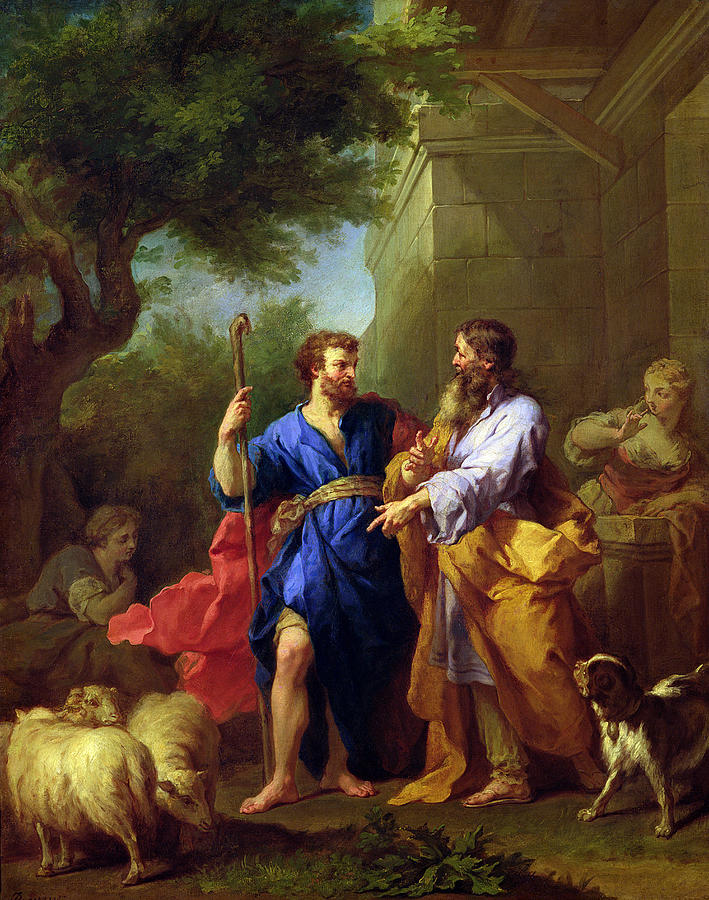
Jacob and Laban, by Pietro da Cortona (1596-1669)

After Joseph was born, Jacob said to Laban, “Release me from our agreement and let me return to my own country. You know how hard I’ve worked for you, so let me take my wives and children and leave.”

But Laban told him, “If you really are my friend, stay on, and I’ll pay whatever you ask. I’m sure the Lord has blessed me because of you.”

Jacob answered:

You’ve seen how hard I’ve worked for you, and you know how your flocks and herds have grown under my care. You didn’t have much before I came, but the Lord has blessed everything I have ever done for you. Now it’s time for me to start looking out for my own family.

“How much do you want me to pay you?” Laban asked.

Then Jacob told him:

I don’t want you to pay me anything. Just do one thing, and I’ll take care of your sheep and goats. Let me go through your flocks and herds and take the sheep and goats that are either spotted or speckled and the black lambs. That’s all you need to give me. In the future you can easily find out if I’ve been honest. Just look and see if my animals are either spotted or speckled, or if the lambs are black. If they aren’t, they’ve been stolen from you.

“I agree to that,” was Laban’s response. Before the end of the day, Laban had separated his spotted and speckled animals and the black lambs from the others and had put his sons in charge of them. Then Laban made Jacob keep the rest of the sheep and goats at a distance of three days’ journey. (Contemporary English Version)

Jacob left home by himself and went to his mother’s family. After twenty years away, he had two wives and twelve sons by four different women. He had worked for his father-in-law Laban for all that time – all to Laban’s advantage. During those twenty years, there was plenty of complicated and awkward family drama.

Now Jacob was ready to be done with all that. He wanted to move on and go back to the place of his family origin. But, of course, Laban had a good thing going and did not want Jacob to leave. So, he did his best to convince him to stay. Jacob was able to set his own terms. And there was some space put between his burgeoning family and his in-law’s.

But returning is a lot more difficult than leaving. When I left home as a young man I had all my worldly possessions in a ’74 Chevy Vega. And when I returned to the land of my origins, it was in a large rental truck with a wife a three kids. There was a lot of logistics involved, not to mention all the relationships we left.

For twenty years, Jacob and Laban did a weird relational dance. They were both tricky dudes, and were continually attempting to maneuver and outmaneuver the other. Yet, Jacob mostly got the brunt of unfairness.

In reality, Jacob owed Laban nothing. He had agreed to work for him fourteen years in total. But he could take nothing with him except his family – which would leave him with no means of support. And Laban was not about to give his son-in-law any support outside of his fatherly-in-law control.

Jacob came up with a strange set of terms concerning the flocks of sheep. Laban logically calculates that Jacob is unlikely to gain much profit from the plan, and can still keep the status quo going. So it becomes a done deal.

In a typical relational dynamic which they have become accustomed to, Laban himself sorts the flock, removes all the spotted and speckled sheep to a safe distance, and leaves Jacob with the rest.

So, if Jacob is to acquire any flock of his own, he needs to discover a way of breeding multicolored sheep from monochrome ones – a task which seems to be improbable if not impossible. But that’s exactly what Jacob does in the end, and that is yet the subject of another Old Testament lesson….

So, exactly what is today’s lesson? Life is anything but a nice, neat trajectory upwards toward achieving goals. Rather, life is a series of twists and turns, leading us to often take three steps forward and two steps backward in a herky-jerky sort of journey. Yet, behind it all, the Lord’s promises are still there, still in effect, still being worked out, in order to be fully realized. Nothing and no one is going to derail the plans and purposes of God.

Sometimes we need to be reminded that God is the giver of prosperity, and not anyone or anything else.

When you become successful, don’t say, “I’m rich, and I’ve earned it all myself.” Instead, remember that the Lord your God gives you the strength to make a living. That’s how he keeps the promise he made to your ancestors. (Deuteronomy 8:17-18, CEV)

To the person who pleases him, God gives wisdom, knowledge and happiness, but to the sinner he gives the task of gathering and storing up wealth to hand it over to the one who pleases God. (Ecclesiastes 2:26, NIV)

If any of you lacks wisdom, you should ask God, who gives generously to all without finding fault, and it will be given to you. (James 1:5, NIV)

We may, at times, feel the need to acquire what we want through trickery or manipulation. However, there is a God in heaven who sees and who cares. The Lord delights is being generous and giving to us, that is, if we are aware and attentive enough to ask. We might not get what we want immediately, and it likely won’t be easy, but we shall nonetheless receive it. We only need to trust.

Heavenly Father, source of all life, we thank you for the many ways in which you have blessed and enriched our lives: Keep us from possessiveness and greed, and lead us into the greater joy of sharing your gifts with others, through Jesus Christ, in whom is perfect peace. Amen.