The Age of the Spirit (Joel 2:18-29)

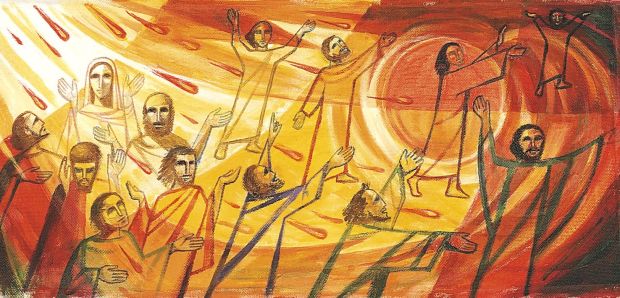
“Come, Holy Spirit,” by Mary Anne Durnin

The Lord was deeply concerned
about his land
    and had pity on his people.
In answer to their prayers
    he said,
“I will give you enough grain,
wine, and olive oil
    to satisfy your needs.
No longer will I let you
    be insulted by the nations.
An army attacked from the north,
but I will chase it
    into a scorching desert.
There it will rot and stink
from the Dead Sea
    to the Mediterranean.”

The Lord works wonders
    and does great things.
So tell the soil to celebrate
and wild animals
    to stop being afraid.
Grasslands are green again;
fruit trees and fig trees
    are loaded with fruit.
Grapevines are covered
    with grapes.

People of Zion,
celebrate in honor
    of the Lord your God!
He is generous and has sent
the autumn and spring rains
    in the proper seasons.
Grain will cover
    your threshing places;
jars will overflow
    with wine and olive oil.

I, the Lord your God,
will make up for the losses
    caused by those swarms
and swarms of locusts
    I sent to attack you.
My people, you will eat
    until you are satisfied.
Then you will praise me
for the wonderful things
    I have done.
Never again will you
    be put to shame.

Israel, you will know
    that I stand at your side.
I am the Lord your God—
    there are no other gods.
Never again will you
    be put to shame.

Later, I will give my Spirit
    to everyone.
Your sons and daughters
    will prophesy.
Your old men
    will have dreams,
and your young men
    will see visions.
In those days I will even give
my Spirit to my servants,
    both men and women. (Contemporary English Version)
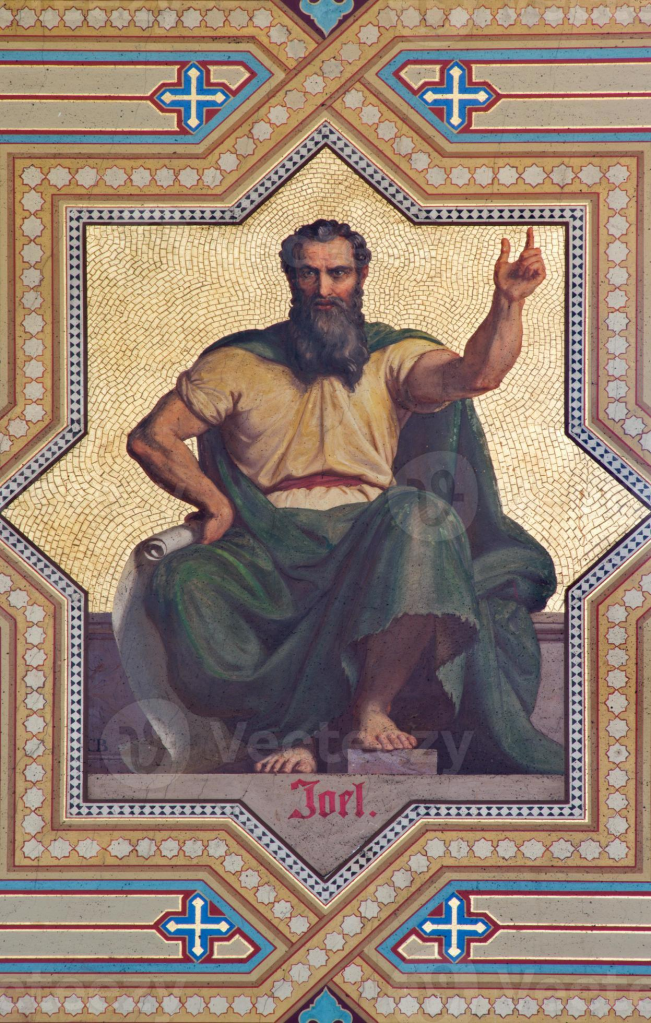
Fresco of the prophet Joel in the Altlerchenfelder Church, Vienna, Austria

We are in the wake of Pentecost Day. But it ought not to have come as a surprise. There were prophetic rumblings of the Spirit’s future tornadic activity, long before the time of Jesus.

The prophet Joel, along with all the Old Testament prophets, had both a message of grace and of judgment. And so, this prophetic book falls naturally into those two parts.

Within the first part of the prophecy, Joel speaks of a terrible locust plague that came over Israel as a judgment from God. The people had strayed from their spiritual and religious ways of covenant with God. The locusts, destroying every plant in their path, reflected the people’s lack of spiritually thriving and growing in grace. They, too, were vulnerable to destruction. They needed to repent and to return to their God.

Yet, the Lord’s anger lasts only a moment, but God’s mercy and blessing endure forever. So, words of grace were offered to the people. There is a time coming, Joel insisted, when God will pour out the divine Spirit far and wide to bless the people and contend with the nations who oppose the covenant community.

Put another way, the first part of the prophecy describes how God fought against God’s own people, to bring them back to their spiritual senses. And the second part of the prophecy describes how the Lord will fight against the nations who fight against God and God’s people.

The people’s affections and allegiance became attached to other things rather than God. So, the Lord sent an army of locusts to oppose them, to challenge their milquetoast and half-hearted attempts at following divine instructions.

Joel foresaw two things coming as the great Day of the Lord approaches: a great outpouring of the Holy Spirit; and a terrible time of divine judgment. 

Let’s take a few things to heart as a response to Joel’s prophecy:

Be aware of God’s purpose in history

From grasshopper swarms to world-wide judgment, to the dissolving of sun and moon—God’s purpose is to reveal divine glory to all the world.

“You will know that I am in the midst of Israel,
        and that I am the Lord your God—no other exists;
        never again will my people be put to shame.” (Joel 2:27, CEB)

“Father, the hour has come; glorify your Son so that the Son may glorify you.” Jesus (John 17:1, NRSV)

Stay close to the Lord

Don’t wander from God. But, if you do, the Lord will spend all kinds of energy in bringing us back and restoring us.

“But even now,” declares the Lord,
“return to me with all your heart—
with fasting, crying, and mourning.” (Joel 2:12, GW)

And the God of all grace, who called you to his eternal glory in Christ, after you have suffered a little while, will himself restore you and make you strong, firm and steadfast. (1 Peter 5:10, NIV)

Change the inside, not the outside

Repentance and faith are to be a way of life, and not simply a one time event. The way we present ourselves on the outside is a projection of what we want others to see. But God sees the heart, so we must go there and focus on the inner person.

Don’t rip your clothes
    to show your sorrow.
Instead, turn back to me
    with broken hearts.
I am merciful, kind, and caring.
I don’t easily lose my temper,
    and I don’t like to punish. (Joel 2:13, CEV)

Endure what you suffer as being a father’s punishment; your suffering shows that God is treating you as his children. Was there ever a child who was not punished by his father? If you are not punished, as all his children are, it means you are not real children, but bastards. In the case of our human fathers, they punished us and we respected them.

How much more, then, should we submit to our spiritual Father and live! Our human fathers punished us for a short time, as it seemed right to them; but God does it for our own good, so that we may share his holiness. When we are punished, it seems to us at the time something to make us sad, not glad. Later, however, those who have been disciplined by such punishment reap the peaceful reward of a righteous life. (Hebrews 12:7-11, GNT)

Earnestly seek the outpouring of the Holy Spirit

On the Day of Pentecost, the Apostle Peter said that the coming of the Holy Spirit was a fulfillment of Joel’s prophecy (Acts 2:16). That was just the beginning of the blessing. The Holy Spirit is still operative and active in the church and the world. The prophecy is far from complete.

In reply to those who were concerned about others prophesying and thereby possibly challenging authority, Moses said:

“Are you concerned what this might do to me? I wish the Lord would give his Spirit to all his people so everyone could be a prophet.” (Numbers 11:29, CEV)

And those who observed and heard the Spirit being poured out, exclaimed with slack jawed amazement:

“Aren’t these all Galileans? How come we’re hearing them talk in our various mother tongues?

Parthians, Medes, and Elamites;
Visitors from Mesopotamia, Judea, and Cappadocia,
    Pontus and Asia, Phrygia and Pamphylia,
    Egypt and the parts of Libya belonging to Cyrene;
Immigrants from Rome, both Jews and proselytes;
Even Cretans and Arabs!

“They’re speaking our languages, describing God’s mighty works!” (Acts 2:7-11, MSG)

The age of the Spirit is here. It hasn’t gone away. So, let’s pursue the spiritual life with all the energy given us, to the glory and praise of God. Amen.

Acts 2:1-21 – The Day of Pentecost

When Pentecost Day arrived, they were all together in one place. Suddenly a sound from heaven like the howling of a fierce wind filled the entire house where they were sitting. They saw what seemed to be individual flames of fire alighting on each one of them. They were all filled with the Holy Spirit and began to speak in other languages as the Spirit enabled them to speak.

There were pious Jews from every nation under heaven living in Jerusalem. When they heard this sound, a crowd gathered. They were mystified because everyone heard them speaking in their native languages. They were surprised and amazed, saying, “Look, aren’t all the people who are speaking Galileans, every one of them? How then can each of us hear them speaking in our native language? Parthians, Medes, and Elamites; as well as residents of Mesopotamia, Judea, and Cappadocia, Pontus and Asia, Phrygia and Pamphylia, Egypt and the regions of Libya bordering Cyrene; and visitors from Rome (both Jews and converts to Judaism), Cretans and Arabs—we hear them declaring the mighty works of God in our own languages!” They were all surprised and bewildered. Some asked each other, “What does this mean?” Others jeered at them, saying, “They’re full of new wine!”

Peter stood with the other eleven apostles. He raised his voice and declared, “Judeans and everyone living in Jerusalem! Know this! Listen carefully to my words! These people aren’t drunk, as you suspect; after all, it’s only nine o’clock in the morning! Rather, this is what was spoken through the prophet Joel:

In the last days, God says,
I will pour out my Spirit on all people.
    Your sons and daughters will prophesy.
    Your young will see visions.
    Your elders will dream dreams.
    Even upon my servants, men and women,
        I will pour out my Spirit in those days,
        and they will prophesy.
I will cause wonders to occur in the heavens above
    and signs on the earth below,
        blood and fire and a cloud of smoke.
The sun will be changed into darkness,
    and the moon will be changed into blood,
        before the great and spectacular day of the Lord comes.
And everyone who calls on the name of the Lord will be saved. (Common English Bible)

The Holy Spirit is the distinguishing mark of the believer in Jesus Christ.

Therefore, since the Spirit is given, the main responsibility of Christians is to receive. 

Christianity is distinctive in this sense – it is primarily a religion of receiving. The Christian life is lived by the power of the Holy Spirit, and not in our own strength. The function of faith is to receive what grace offers. 

We are saved and sanctified by grace alone through faith. God lives in and through us by means of the Spirit. The miraculous and the supernatural cannot, obviously, be done by any human person.  It can, however, be accomplished through the power of the Holy Spirit.

People tend to put a lot of pressure on themselves to be a certain way and to do certain things. The result? Tiredness. Discouragement. Imbalance. Lots of giving. Little receiving.

Christianity is not chiefly about giving but receiving. The Christian life is about putting oneself in a position to receive through prayer and humility. In Christianity, the opposite of receiving is not giving – it’s pride. 

Maybe this kind of talk makes you uncomfortable. I’m not talking about being passive or lazy. I’m highlighting the need of receiving grace from God by means of the Holy Spirit. Then, the Spirit to work in and through us. 

Jesus said we would do greater works than even he himself with the advent of the Spirit! (John 14:12-14)

The question then becomes: Will we let God be God? Will we allow the Spirit to do work in us?

The Spirit is elsewhere described in Holy Scripture as a gentle presence, an encourager, counselor, and comforter. Yet, not here at Pentecost – the Spirit is portrayed like a violent wind and an unusual fire.

The Holy Spirit on the Day of Pentecost was not some gentleman caller entering politely when invited. Instead, the Spirit appears more like a drunken sailor who bursts into the room and causes a big ruckus. There’s nothing subtle about the Spirit at Pentecost. The Spirit is electric, bombastic, and volcanic, causing a huge scene and upheaving the status quo.

Because of Pentecost, Christians are marked and defined by God’s Spirit living within them and being full of the Spirit. God wants to pour out the Spirit on all kinds of people to overflowing so that what comes out of them is “prophecy.” 

The prophet Joel and the Apostle Peter do not intend the word “prophecy” to mean predicting the future. Rather, they are referring to inspired speech coming from a heart overflowing with the Spirit. 

Just as an inebriated person says and does things they would not typically say or do because they are filled with alcohol, so the person filled with God’s Spirit says things and does things they would not typically say or do because their inspiration and courage come as a result of God within them.

Thus, we must cast off the unholy spirits of inebriation and receive the Holy Spirit of God.

Descent of the Holy Spirit at Pentecost mosaic by Anna Wyner

God sobered-up the little band of Christ followers from learners to practitioners, sending them into the world with a mission.

Being on a mission from God is not really about ability; it’s about being filled and sent. 

First time parents may read and learn all they can about parenting before their child is born. Yet, when that little bundle comes into the world, and the hospital puts this kid in your arms and sends you out, you feel inadequate for the task. Parenting becomes a kind of supernatural affair where you pray and learn on the fly, finding out that you need something beyond yourself to get anywhere in raising this screaming, pooping, sleeping person who depends completely on you for everything. 

God sends us into the world to make disciples. And we may feel very inadequate for the task. However, this has more to do with receiving the Spirit. The Spirit comes looking to turn our lives upside-down with new life in Jesus Christ. 

Pentecost means that the Spirit came to shake things up and accomplish among God’s people what they could never do on their own.

Everyone who calls on the name of the Lord will be saved. 

The Church in the New Testament was not a country club for people to simply enjoy the perks of membership.  The community of the redeemed, the Church, is actually more like a place where the people seem drunk because they are all talking with inspired speech from the Holy Spirit. 

Maybe we don’t need to be saved in the sense that we have already called on the name of the Lord concerning forgiveness in Christ. Yet, maybe we need to call on the name of the Lord to be delivered from our misguided attempts to see the Christian life as a pleasant affair.

Perhaps we need deliverance from disordered priorities and misguided loves. We may need to be saved from ourselves so that we are open to the Holy Spirit with palms up receiving from God whatever it is the Spirit wants to do in and through us, rather than telling God how we think things ought to go. 

Prayer, then, is more about receiving the Spirit and God’s purposes for us rather than giving God an earful and expecting the Lord to bless our plans.

Pentecost is the launching pad of the church’s mission – it was explosive because the Spirit is a kind of wild man who fills people up to overflowing so that what comes out of them is inspired speech and missional actions.

If a language barrier cannot stop the Spirit from operating, then how much more can God transform us and use us in the lives of those around us?

Joel’s prophecy, quoted by Peter, is only partially fulfilled. Events have been set in motion by Pentecost for the complete fulfillment of God’s justice. So, there’s some urgency for people to fill their vacuous souls with the grace freely offered to them in Christ.

The outpouring of the Spirit is a sign: The end is near. And the generous giving of the Spirit is inclusive – there is room for all kinds of people. Through the Spirit, God saves all who call on the name of the Lord.

Today is not just another day on the calendar. It is the Day of Pentecost! 

Just as marriages occasionally need a spark and a fire and a fresh wind, so we need the Holy Spirit to breathe on us, comfort us, and inspire us.

May we be filled with the Spirit as we anticipate what our God will do now, and in the years to come.

Spirit of the living God, through the reading and proclamation of the Word, may you refresh our spirits, reshape our desires, recreate our hearts, and reform our ways so that we will shine with your enduring glory, through Jesus Christ, our risen and ascended Lord. Amen. 

Ash Wednesday

Welcome, friends! For Christians all over the world, today begins a 40-day journey to Easter. Click the videos below, and together we will start that journey toward Jesus…

Joel 2:1-2, 12-17 Pastor Tim

Forgive, almighty God, those things we have done which have caused you sadness, and those things we should have done that would have brought you joy. In both we have failed ourselves, and you. Bring us back to that place where our journey began, when we said that we would follow the way that you first trod. Lead us to the Cross and meet us there. Amen.

Joel 2:1-2, 12-17 – Ash Wednesday

Blow the horn in Zion;
    give a shout on my holy mountain!
Let all the people of the land tremble,
    for the day of the Lord is coming.
It is near—
    a day of darkness and no light,
    a day of clouds and thick darkness!
Like blackness spread out upon the mountains,
    a great and powerful army comes,
        unlike any that has ever come before them,
        or will come after them in centuries ahead…

Yet even now, says the Lord,
    return to me with all your hearts,
        with fasting, with weeping, and with sorrow;
tear your hearts
        and not your clothing.
    Return to the Lord your God,
        for he is merciful and compassionate,
        very patient, full of faithful love,
            and ready to forgive.
Who knows whether he will have a change of heart
    and leave a blessing behind him,
    a grain offering and a drink offering
            for the Lord your God?
Blow the horn in Zion;
        demand a fast;
        request a special assembly.
Gather the people;
        prepare a holy meeting;
        assemble the elders;
        gather the children,
            even nursing infants.
Let the groom leave his room
        and the bride her chamber.
Between the porch and the altar
        let the priests, the Lord’s ministers, weep.
    Let them say, “Have mercy, Lord, on your people,
        and don’t make your inheritance a disgrace,
        an example of failure among the nations.
    Why should they say among the peoples,
        ‘Where is their God?’” (CEB)

Imagine you are out for a hike on a beautiful spring day and you come to a creek. You notice that someone has dumped trash into the stream—not a pretty sight. Judging by some of the empty soda cans, the trash has been there awhile. And there is an ugly film on top of the water. You do not want to leave the scene as you found it, because it would bother your conscience.

So, you stoop down and begin gathering the trash. It ends up taking several hours before you can begin to see a difference. It is amazing, you muse, on how much junk is there. You sit back, rest for a moment, and realize you will have to keep coming each day until the site is truly clean. But when you come back the next day, it is as if you did not even do any work at all.  In fact, there is more trash than the day before. It seems the garbage bred overnight. You think about the unlikelihood of someone coming to this very spot to dump their garbage just in the one measly day you were away.

Then, you realize that something smells fishy—so to speak. So, you begin to follow the creek upstream. Sure enough, there is a nasty garbage dump that has been there for years. The waste from it is emptying into the passing creek. Your cleaning job was only a small opening to a world of filth. You could try and clean every day. But if you really want your creek to be free of pollution, this means going directly to the source and dealing with the crud that is there.

Our hearts are the source from which our lives flow. Unfortunately, we spend great amounts of time, money, and energy—even in the church—doing trash removal “downstream.” But real transformation begins when we travel upstream to the source. Our real struggles and sins take place where no one sees them down deep in the heart.

Today is Ash Wednesday, the first day in the season of Lent. Ashes remind us that we live in a polluted world full of garbage. That pollution is fouling up our lives and we must respond to the mess with a humble return to God. Lent is a 40-day cleaning project on the inside of our hearts, instead of trying to keep up dealing with all the scum on the outside of our lives. 

Entrance to confronting the dump of garbage requires fasting, self-examination, prayer, and repentance. The Lord said through the ancient prophet Joel that it is not too late to return to God with our whole hearts. To do so requires grieving and lamenting our stinky sin and turning back around to a merciful God who does not like to be angry and punish people.

We find that at the end of the Lenten journey, Jesus is there. He swallows all the massive tonnage of the world’s garbage on the cross. The refuse is so rotten that it kills him, and there is only darkness. Then, three days later, Christ is risen, having shaken off the filthy stench of death. Jesus Christ is the ultimate fulfillment of the prophet’s words, the merciful one who has taken care of the filthy source of garbage once and for all.

May you find on this day and every day that the spiritual practices of prayer, fasting, and repentance put you in a place to receive Jesus. As you lean into the mess throughout the next six weeks of Lent, may you discover the cleansing and healing agent, Jesus Christ, the Savior who scrubs the heart clean of toxic waste.

Holy God, our lives are laid open before you: rescue us from the chaos of sin and through the death of your Son bring us healing and make us whole in Jesus Christ our Lord. Amen.