Isaiah 25:1-5 – Against Violence

“Violence brings only temporary victories; violence, by creating many more social problems than it solves, never brings permanent peace”. —Martin Luther King, Jr.

AgainstViolence

Lord, you are my God.
I honor you and praise you,
because you have done amazing things.
You have always done what you said you would do;
you have done what you planned long ago.
You have made the city a pile of rocks
and have destroyed her walls.
The city our enemies built with strong walls is gone;
it will never be built again.
People from powerful nations will honor you;
cruel people from strong cities will fear you.
You protect the poor;
you protect the helpless when they are in danger.
You are like a shelter from storms,
like shade that protects them from the heat.
The cruel people attack
like a rainstorm beating against the wall,
like the heat in the desert.
But you, God, stop their violent attack.
As a cloud cools a hot day,
you silence the songs of those who have no mercy. (NCV)

These wonderful words of celebration were uttered not in a time of peace and plenty but in an era of hardship and loss. It seems the Jewish people have always faced a plethora of others who would rather see them wiped off the face of the map than existing with their own customs and religion. It was in one of those times of experiencing problems from Gentiles that this poem was crafted. It is precisely in the adverse times that we need to flee to the open arms of God and enjoy the divine embrace of security. In the sixteenth century, John Calvin reflected on these verses:

“When our minds are perplexed by a variety of uneasy thoughts on account of numerous distresses and afflictions which happen daily, we ought immediately to resort to God, and rely on his providence; for even the smallest calamities will overwhelm us, if we do not betake ourselves to him.”

God Almighty is the One who intervenes on behalf of the poor and helpless. The Lord God is the divine Protector who hears the voice of those overwhelmed with a crushing load of hard circumstances. The great “I AM” is the ultimate refuge and shelter for the vulnerable who possess no resources of their own. There is no bully, whether in the form of a person, an institution, or a government which can stand against the God who bends his ear to listen on behalf of the forgotten and the faint-hearted. Brutality and arrogance might touch our lives, yet it is the Lord to whom all those who exploit others must give an account. The violent, using cruelty and ruthlessness, shall not survive under the shadow of the Almighty God.

The poor and the needy may have no apparent chance against abusive persons and systems of the world. However, no power on earth can take on the Ruler and Sustainer of all creation and expect to have their way. God is the defender of the powerless. He specializes in tearing down the walls of oppression and lifting-up those in need of mercy.

So, then, I shall be explicit about the ancient and almighty God and our present circumstances:

  • Pandemic is a ruthless enemy which knows no pity from both rich and poor, the healthy and unhealthy; and, God is a merciful Deliverer who transcends all disease.
  • Poverty is a cruel master which is never satisfied; and, God is benevolent, bringing both spiritual and material satisfaction to life.
  • Patience is a virtue exemplified and amplified through the divine who desires to see all persons realize new life; and, impatience is a vice of the arrogant who demand their needs be met immediately without any regard to the common good of all.
  • Peace is a harmonious and wholehearted life gifted by God, even despite the surrounding storms of hardship; and, pride is the stance of the privileged who either cannot or will not see those who are underprivileged, and, so, they live in a constant state of unrest and disunity.

Wherever you find people speaking of their individual rights without emphasizing their communal responsibilities, there you will find a situation ripe for God to destroy the walls built by the selfish in order to create a safe place for the afflicted.

The Lord will silence the songs of the unmerciful; and, shall allow the shouts of the ones crying out for mercy to be heard. And he will do it in his own good time and grace.

Lord Jesus Christ, we thank you that through your death on the cross you disarmed the powers of evil. Help us, we pray you, to enter your resurrection victory and to stand in your authority against all evil. Send forth your light and your truth. Bring to light the deeds of darkness and let plans of violence be revealed. Through the power of Holy Spirit, almighty God, disarm every evil power and influence in your good world; and, bring loving connection where there is hatred and cruelty. Amen.

Isaiah 52:13-53:12 – Good Friday

CrossChrist
Depiction of Christ on the Cross at Holy Hill in Hubertus, Wisconsin

The Lord says, “See, my servant will act wisely.
People will greatly honor and respect him.
Many people were shocked when they saw him.
His appearance was so damaged he did not look like a man;
his form was so changed they could barely tell he was human.
But now he will surprise many nations.
Kings will be amazed and shut their mouths.
They will see things they had not been told about him,
and they will understand things they had not heard.”

Who would have believed what we heard?
Who saw the Lord’s power in this?
He grew up like a small plant before the Lord,
like a root growing in a dry land.
He had no special beauty or form to make us notice him;
there was nothing in his appearance to make us desire him.
He was hated and rejected by people.
He had much pain and suffering.
People would not even look at him.
He was hated, and we didn’t even notice him.

But he took our suffering on him
and felt our pain for us.
We saw his suffering
and thought God was punishing him.
But he was wounded for the wrong we did;
he was crushed for the evil we did.
The punishment, which made us well, was given to him,
and we are healed because of his wounds.
We all have wandered away like sheep;
each of us has gone his own way.
But the Lord has put on him the punishment
for all the evil we have done.

He was beaten down and punished,
but he didn’t say a word.
He was like a lamb being led to be killed.
He was quiet, as a sheep is quiet while its wool is being cut;
he never opened his mouth.
Men took him away roughly and unfairly.
He died without children to continue his family.
He was put to death;
he was punished for the sins of my people.
He was buried with wicked men,
and he died with the rich.
He had done nothing wrong,
and he had never lied.

But it was the Lord who decided
to crush him and make him suffer.
The Lord made his life a penalty offering,
but he will still see his descendants and live a long life.
He will complete the things the Lord wants him to do.
“After his soul suffers many things,
he will see life and be satisfied.
My good servant will make many people right with God;
he will carry away their sins.
For this reason I will make him a great man among people,
and he will share in all things with those who are strong.
He willingly gave his life
and was treated like a criminal.
But he carried away the sins of many people
and asked forgiveness for those who sinned.” (NCV)

We all suffer.  In some way, whether a chronic physical condition, emotional or moral distress, mental illness, or spiritual oppression, everyone faces living in a fallen world with its pain and heartache.  Presently, the entire world is suffering the scourge of the COVID-19 virus.  Every person in my neighborhood, city, state, and nation is impacted and affected.  Not only do many suffer because of disease and death itself, all are enduring either lost wages, limitations, loneliness or more.  Suffering that seems to have no reason, the senseless kind, the type where nothing good appears to be going on at all can be very troubling to our souls.

Perhaps it seems ironic, maybe even cruel, that Christians would observe a day called “Good” Friday.  Considering the hard circumstances of so many people, to call today “good” appears awkward, as if Christ’s followers have their heads in the sand.  Even for Christians, at first glance, “Good Friday” might seem a oxymoronic for a day observing the torture and death of an innocent man.  Some would argue that Christ is no longer on the cross and we need to give all our focus on the resurrected Jesus and the victory he achieved.  No need for all this suffering stuff.  Yet, the Resurrection only has meaning because of this very day, Good Friday.  Without the Suffering Servant of Isaiah, there is no King Jesus.  For Christians everywhere, this day is very good in the sense that the crucifixion of Jesus Christ means the redemption of the world.  On this day we remember and commemorate the events that led up to the cross; unpack those events and interpret them with profound meaning and significance; and, worship Jesus with heartfelt gratitude because of his redeeming work of the cross.

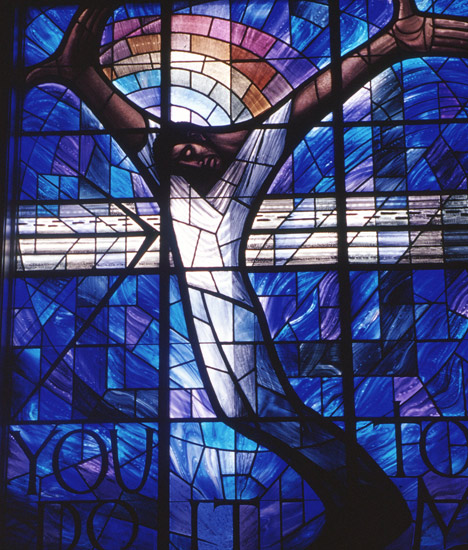
16th St Baptist Church Crucifixion Stained Glass Window
This stained-glass window was donated to the Sixteenth Street Baptist Church of Birmingham, Alabama by the people of Wales after the church was bombed in 1963.

The bulk of the New Testament Gospels of Matthew, Mark, Luke, and John are given over to the final week of Christ’s life, especially leading to the cross.  Good Friday observances often take a somber form due to the brevity of Christ’s experience on the cross.  Christians remember the last words of Christ, and recognize the significant impact his death had on the immediate persons around him.  Believers also contemplate the lasting results of that singular death as an atoning sacrifice; perfect love; reconciliation between God and humanity; victory over evil; and, redeeming all creation.

Sadness, then, is far from the only emotive expression on this day.  It is appropriate to feel wonder, gratitude, and deep satisfaction for the accomplishment of deliverance from the power of sin.  There is the recognition that something profound and meaningful has truly happened in the egregious suffering of Jesus.  Thus, we not only remember the anguish of Christ, but what that horrible torment accomplished.  In fact, the cross of Jesus is so significant that an eternity of considering its import and impact could never plumb the depths of its far-reaching effects.

With all that has been said, one would think that Good Friday is a hugely observed day on the Christian Calendar.  Yet, for a chunk of churches and Christians, it’s not.  The bottom line is that the cross is not popular.  Maybe it’s because neither Christian nor non-Christian wants to ponder something that appears so icky and bloody.

Episcopal priest Fleming Rutledge has adroitly put her finger on the issue: “Religious people want visionary experiences and spiritual uplift; secular people want proofs, arguments, demonstrations, philosophy, and science.  The striking fact is that neither one of these groups wants to hear about the cross.”  Indeed, as the Apostle Paul has said, the cross of Christ is “a stumbling block to Jews and folly to Gentiles” (1 Corinthians 1:23).

A personalized religion which leaves the cross out of the picture (too much blood and violence) might seem appealing yet will only leave us bereft of the communion of the saints both past and present.  Consider the ancient witness of the Church:

“I believe in Jesus Christ, his only Son, our Lord… he suffered under Pontius Pilate, was crucified, died, and was buried; he descended to hell.” –Apostles’ Creed

“For our sake he [Christ] was crucified under Pontius Pilate; he suffered death and was buried.” –Nicene Creed

Christ suffered “in both body and soul – in such a way that when he sensed the horrible punishment required by our sins ‘his sweat became like great drops of blood falling down on the ground.’  He cried, ‘My God, my God, why have you forsaken me?’  And he endured all this for the forgiveness of our sins.  Therefore, we rightly say with the Apostle Paul that we know nothing ‘except Jesus Christ, and him crucified;’ we ‘regard everything as loss because of the surpassing value of knowing Christ Jesus our Lord.’ We find all comforts in his wounds and have no need to seek or invent any other means than this one and only sacrifice, once made, which renders believers perfect forever.” –Belgic Confession, Article 21

And let us consider further the New Testament witness:

“Jesus suffered outside the gate in order to sanctify the people through his own blood.  Therefore, let us go forth to him outside the camp, and bear the abuse he endured.” (Hebrews 13:12-13, NIV)

“May I never boast of anything except the cross of our Lord Jesus Christ, by which the world has been crucified to me, and I to the world.” (Galatians 6:14, NRSV)

6a7f0-thecross

The extent of Good Friday goes far beyond just a day on the calendar; it is the fulcrum upon which all of Christianity hinges.  Because Christ suffered, our suffering has meaning.  Each situation of trauma; every case of disease; all adversity and wholesale hard circumstances make sense, in the Christian tradition, when they are viewed in solidarity with Jesus Christ crucified. So, today, let Christians everywhere contemplate the cross, observe the salvation accomplished through Christ’s death, and offer prayers and petitions for those who need deliverance from the power of evil.  In short, let us worship God in Jesus Christ because of the suffering on the cross.

Along with all believers everywhere we pray:

Jesus, Lamb of God, have mercy on us.

Jesus, Bearer of our sins, have mercy on us.

Jesus, Redeemer of the world, grant us your peace.  Amen.

Click Were You There performed by The Vigil Project as we station ourselves near the cross.

Isaiah 52:13-52:12


             “He had no majestic bearing to catch our eye, no beauty to draw us to him.”  As I was reflecting on this phrase this morning and contemplating the life and death of Jesus on this most holy of days, Good Friday, I began to think about Abraham Lincoln, of all people.  You see, in his ascendancy to the presidency and in his time in office Lincoln was routinely caricatured in political cartoons as an ape or baboon.  Memoirs of people who had seen the president often commented on how extremely normal and homely he appeared.  In fact, Lincoln was quite gangly; he was tall with very long arms and legs.  Indeed, he did look something like an oddity.  Yet, when Lincoln spoke, people listened and were amazed at his intelligence, ability to connect with people, and his grasp of political philosophy.
             Sometimes I wonder if our Lord was actually physically here on earth today if most people would even remotely recognize him.  Perhaps Jesus would be ridiculed and despised, just like he was all those centuries ago.  I think it is safe to say that he would not make it to the cover of GQ, or make commercials selling underwear.  Instead, Jesus came as a humble servant.  He suffered throughout his life, endured a horrible death by torture, and secured for us deliverance from the power of sin.  God has laid on him the iniquity of us all.
             Most people have forgotten that Abraham Lincoln was assassinated on Good Friday in 1865.  Just as the press did not miss a beat to castigate Lincoln while he was alive, they quickly recognized the parallels between him and Christ in their respective deaths.  But while Lincoln was clearly identified with the American people in their baptism of blood with the Civil War, his was not a salvific death.  Only Jesus, in his singular suffering, died as a substitute for us.  Perhaps Jesus had no outward beauty, but his inward beauty has not only drawn me to him, but saved me from an empty life of sin.  Praise be to God!
             Lord Jesus, you were the suffering servant who has pioneered salvation for me.  Thank you for your sacrifice, and I give eternal praise and gratitude for your willingness to endure the cross.  My heart and life is yours; use it as you see fit.  Amen.

Isaiah 43:8-15


            I am an unabashed Calvinist – a Reformed theologian and pastor.  I believe in God’s unconditional election of persons to salvation and new life.  Maybe that means nothing to you, and to others it means everything.  For many, it is just some churchy mumbo-jumbo that is rather irrelevant to the real stuff of the Christian life.  But it is quite important.  The heart of Reformation faith is a focus on God – his sovereignty, majesty, power, and grace.  It is God who justifies, and not any human.  That means there are no “conditions” to which God is beholden to act.  In other words, God works in his world according to his own free will and is not dependent upon anyone or anything to accomplish his good purposes.
             Today’s Old Testament lesson is a soaring view of God in his grace and powerful control.  “Yes, from eternity I am he; there is none who can deliver from my hand; I act and who can cancel it?”  God’s rhetorical question lets us know that nothing can separate us from the love of God.  We might jump from finger to finger in our puny attempts at autonomy, but we are not getting out of God’s hand!  This really ought to be a comfort to every believer.  God’s decrees will be fulfilled, and there is not one thing that any wicked person can do to thwart his plans.  Furthermore, there is absolutely no way we can screw-up God’s purposes.  We simply do not have such power.  Our great task as believers is to rest secure in God’s will and place our trust in Him who knows exactly what he is doing in the world.
             So, take a few minutes, draw a few deep breaths, and think on this wonderful truth that God is sovereign.  To help you, here is the great opening to the Reformed confession, The Heidelberg Catechism, giving us a glimpse into the majesty of God:
What is your only comfort in life and in death?
That I am not my own,
but belong with body and soul,
both in life and in death,
to my faithful Savior Jesus Christ.
He has fully paid for all my sins
with his precious blood,
and has set me free
from all the power of the devil.
He also preserves me in such a way
that without the will of my heavenly Father
not a hair can fall from my head;
indeed, all things must work together
for my salvation.
Therefore, by his Holy Spirit
he also assures me
of eternal life
and makes me wholeheartedly willing and ready
from now on to live for him.