Isaiah 5:1-7 – A Parable of the Vineyard

Let me sing for my loved one
    a love song for his vineyard.
My loved one had a vineyard on a fertile hillside.
He dug it,
    cleared away its stones,
    planted it with excellent vines,
    built a tower inside it,
    and dug out a wine vat in it.
He expected it to grow good grapes—
    but it grew rotten grapes.
So now, you who live in Jerusalem, you people of Judah,
    judge between me and my vineyard:
What more was there to do for my vineyard
    that I haven’t done for it?
When I expected it to grow good grapes,
    why did it grow rotten grapes?
Now let me tell you what I’m doing to my vineyard.
I’m removing its hedge,
    so it will be destroyed.
I’m breaking down its walls,
    so it will be trampled.
I’ll turn it into a ruin;
    it won’t be pruned or hoed,
    and thorns and thistles will grow up.
I will command the clouds not to
The vineyard of the Lord of heavenly forces is the house of Israel,
    and the people of Judah are the plantings in which God delighted.
God expected justice, but there was bloodshed;
    righteousness, but there was a cry of distress! (Common English Bible)

God is the owner of the vineyard. Israel and Judah are the beloved. The Lord graciously chose them, gave them divine promises, and set his steadfast love upon them. God sang over them with affection and took care of them.

The Lord God put time, effort, and love into the relationship. God anticipated good things, looked forward to a bright future, and expected a flowering of justice and righteousness from the people.

It didn’t happen. The relationship went sour. Nothing but rotten grapes.

God builds. God gives. God sustains…. God destructs. God takes away. God ends it.

The Lord didn’t put all that work into the people to have them perpetuate injustice toward the poor and disadvantaged. God didn’t choose Israel so that they would then neglect God’s law by mistreating others and ignoring the right.

The bloodshed of the people was that they squeezed and bled the poor to death. Their cries and anguished responses were ignored. There was no mercy. So, God was not about to idly stand by and let such rotten grapes abuse and ruin the good, the just, and the right.

The relationship between and God and God’s people was an ancient love song that went off key and struck a minor chord. The Lord has extreme love and patience… until he doesn’t. There’s no way the just and right God is going to put up with abusive, ignorant, and bad folks forever.

Defend the rights of the poor and the orphans; be fair to the needy and the helpless.

Psalm 82:3, GNT

Jesus had this allegorical image of Isaiah in mind when he spoke in parables about the impossibility of good fruit coming from bad vines and trees, and the necessity of removing dead branches. (Luke 6:43-45; John 15:1-17)

If the grapes are bad, the vine is bad. If the words are hateful, sarcastic, passive-aggressive, manipulative, conniving, racist, hurtful, mean, foolish, and either subtly or overtly abusive, then the person has a dark heart and is need of redemption, not excuses.

Learn to do good.
    Seek justice.
Help the oppressed.
    Defend the cause of orphans.
    Fight for the rights of widows.

Isaiah 1:17, NLT

Every tree that does not bear good fruit will be cut down and thrown into the fire. The wicked heart will not be able to speak ill of others and act hatefully with impunity forever. They will be called to account for their abusive words and actions, whether overtly violent, or subtly undermining.

The righteous heart, however, shall experience divine pleasure and reward, as if the careful construction of helpful and building up words with loving deeds wins first-prize at the great heavenly fair for their plump juicy grapes.

The good person loves and does not hate. They are so far from harming anyone that they even pray and wish well for their enemies. They pray for blessings on those who curse them. There is an honest striving to speak good words to everyone, regardless of who they are.

The upright heart thinks the best of everyone and holds nothing over someone else’s head. Such a good heart condemns no one, leaving all judgment to God alone. It is patient with the most exasperating of people, praying they might come to their senses and become spiritually healthy.

The righteous are able to use their speech to admonish their neighbor with care and affection. They freely forgive, happily give, liberally encourage, and use their tongue to speak words of life. Indeed, their speech is wise, humble, full of grace, and above all, loving.

The just and right person uses their hands and feet to build good things for others, especially the most vulnerable and needy among us. They willingly meet needs without bitterness or with a begrudging heart.

If there is a problem with words, it will not do to simply change the speech. That’s because it is a heart issue. And the heart must be willing to change and be transformed by sheer mercy.

If there is an issue with actions, it will not do to merely enforce a change in behavior. That’s because it’s a heart problem. And the heart desperately needs to acknowledge sin and repent from evil.

Fortunately, God is the expert on renovating dilapidated hearts and performing effective heart transplants.

Oftentimes something needs to be destroyed for a building to be erected. There always needs to be a death before there can be a resurrection. New life cannot occur without forsaking an old life.

In this Christian season of Lent, believers in Jesus are mindful that our life of faith, hope, and love comes from a death. So, we journey with Jesus along the road of suffering, up Calvary, and are crucified with him so that we might rise with him.

This is the way.

It is the way of repentance, of genuine change, of new habits, of Christianity. So now, let’s go to him outside the camp, bearing his shame. We don’t have a permanent city here, but rather we are looking for the city that is still to come. (Hebrews 13:13-14)

May justice, righteousness, and peace be yours in abundance through him who gave himself for us and for our salvation.

Isaiah 61:1-7 – Better Days Ahead

The Spirit of the Sovereign Lord is on me,
    because the Lord has anointed me
    to proclaim good news to the poor.
He has sent me to bind up the brokenhearted,
    to proclaim freedom for the captives
    and release from darkness for the prisoners,
to proclaim the year of the Lord’s favor
    and the day of vengeance of our God,
to comfort all who mourn,
    and provide for those who grieve in Zion—
to bestow on them a crown of beauty
    instead of ashes,
the oil of joy
    instead of mourning,
and a garment of praise
    instead of a spirit of despair.
They will be called oaks of righteousness,
    a planting of the Lord
    for the display of his splendor.

They will rebuild the ancient ruins
    and restore the places long devastated;
they will renew the ruined cities
    that have been devastated for generations.
Strangers will shepherd your flocks;
    foreigners will work your fields and vineyards.
And you will be called priests of the Lord,
    you will be named ministers of our God.
You will feed on the wealth of nations,
    and in their riches you will boast.

Instead of your shame
    you will receive a double portion,
and instead of disgrace
    you will rejoice in your inheritance.
And so you will inherit a double portion in your land,
    and everlasting joy will be yours. (New International Version)

The message of better days ahead was a breath of fresh air to a beaten down people.

Just today I was speaking with an intensive care nurse who said, “It’s one thing to have a hard day, or know a few weeks will be difficult. It’s altogether another thing when it seems there’s no end to the hard deaths we experience.” Whenever things have gone sideways for so long, we find our lives needing restoration and renewal.

That was the situation for the ancient Israelites. They needed deliverance from their awful predicament. They longed for healing, freedom, and comfort from their grief. After centuries of a downward spiral into disobedience and going their own way, the people found themselves bereft of resources.

After you have suffered for a little while, the God of all grace, the one who called you into his eternal glory in Christ Jesus, will himself restore, empower, strengthen, and establish you.

1 Peter 5:10, CEB

The people needed the year of the Lord’s favor – the year of Jubilee. The Jubilee was supposed to occur every fiftieth year of Israel’s existence in the Promised Land. For forty-nine years there were individuals and families who either incurred debt, indentured themselves into servitude for survival, landed in prison, or ended up laboring in the fields they once owned.

According to the Law, after the forty-nine years, on the fiftieth year, the debts were erased, slaves were freed, fields allowed to rest, and the land restored back to its original owners. God’s deliverance is meant to be not only spiritual, but also very tangible and real.

Salvation is not just otherworldly – it’s also a transformation of the world we inhabit in the here and now.

The need for good news presupposes there’s been some bad news happening. The Lord deliberately gives attention to the oppressed, the brokenhearted, the captives, the prisoners, those who mourn, and the faint of heart. God is concerned for the lowly and the weak. 

It’s significant to note that Israel found themselves in such need not necessarily because they were always victims of adverse situations, but also because they failed to obey the stipulations of their covenant with God. 

We have no actual evidence the Israelites even practiced the Jubilee. After entering the Promised Land, by the time fifty years came down the pike, they had slid so far down the spiritual drain, it was completely off their radar to practice a Jubilee.

It seems no one had any intention of forgiving debts, freeing their indentured servants, giving back the land to original owners, or providing the land itself with a Sabbath rest. 

To not practice the Jubilee was to rob people of their land and practice injustice. But God loves justice and hates robbery. God pays attention to those who are not receiving very real and tangible needs for their lives. So, God speaks words of hope and deliverance for those in circumstances beyond their ability to cope.

The first few verses of today’s Old Testament lesson were the words Jesus read in the synagogue when he began his earthly ministry. Christianity observes that Jesus Christ is the ultimate fulfillment of this promise for deliverance and provision. He came to establish a Jubilee celebration that would never end.

It might be easy for some folks to overlook these verses as pertaining to them. After all, they are blessed, both materially and spiritually. They can always identify people who are in much more need than they are. But we must recognize that the maladies of our hearts are very real. There are specific conditions in our lives that leave us, not just them,in bondage and in need of restoration, renewal, and revitalization, just like the Israelites of old. 

We must name those maladies which are stuffed away in a closet of our heart, such as: the love of things and money; severed relationships; old grudges; hidden addictions; domestic violence; denial of depression; secret affairs; cutting; fear; anger; greed; and hatred. Outward smiles and small talk may hide the truth from others, but they do nothing to hide from a God for whom everything is laid bare.

It’s okay to be a glowstick, sometimes we need to break before we shine.

The good news is not just something for someone else who has “obvious” needs. The gospel must touch our lives and bring us freedom so that we can pass on that very real good news to the legion of social ills that make our world sick. 

There are people all around us who need spiritual, emotional, and material help. Yet, we will not have eyes to see them, or have hearts to help, if we are stuffing our burdens so deep within that we are blind to others.

On the other hand, we may too easily read today’s lesson in a manner it was not meant to be heard, as if we are more in need than we actually are, hearing it something like this: The Spirit of consumer choices is upon me, because the Lord has anointed me to preach good news to the middle-class. He has sent me to bind up the half-hearted, to proclaim more options for the limited, and release from Black Friday for the buyers, to proclaim the year of the Cyber-Monday. 

Perhaps we may not be so crass as to say that out loud, but we might have the tendency to misinterpret Bible passages so as to avoid our own great poverty of heart.

Whichever lens we tend to look at Isaiah’s prophecy, when we become experts at ignoring our needs and emotions, we fail to see the year of Jubilee. The stark reality is that no matter who we are, we need a biblical Jubilee.

Many people are either one paycheck, one prodigal kid, one mental health diagnosis, one serious illness, one drink, one affair, or one bad decision away from being the people we typically identify as in need – the ones that bad things happen to – the ones we do not want as next door neighbors.

We may not yet be vulnerable enough to admit our situation. So, we keep practicing the denial of our spiritual poverty. But everyone knows what a broken heart is. Everybody has a bondage they don’t want to admit. All people need renewal and restoration.

If we believe that tomorrow will be better, we can bear a hardship today.

How, then, shall we live?

Turn from the things which cause us poverty and bondage and turn toward delighting in the Lord your God. Rejoice, because God will make a sprout come up. God will cause us to grow. God will rebuild our ruined souls. God will restore the places of our lives that have been devastated. God will even renew the places that haven’t seen renewal for generations. It begins with you and me allowing the justice of God to work within us.

God can neither bring comfort to those who don’t mourn, nor turn grief into joy unless there is an acknowledgment of a dire situation. If we want to be an oak of righteousness, then there must be a confession of despair and an allowance of God’s justice through Jesus Christ to work its way in us.

Let us envision Jesus coming into our lives and replacing a tattered hat of grief with a crown of beauty. Picture the Lord placing on us a garment of praise to replace those stinky clothes of grumbling. Allow your life to display the grace of God in Christ, since we have been profoundly touched by the justice of God.

Lord Jesus, Carpenter and King, be merciful to the multitudes who today bear the indignities of injustice everywhere. Raise up leaders in every land dedicated to your righteous standards of order, equity, and justice. Grant to us the grace to fulfill our vocation of being loyal to kingdom ethics. Sharpen our intellects to pierce the pettiness of prejudice; to perceive the beauty of human fellowship. Guide our minds to a meaningful understanding of the problems of the poor, the oppressed, the unemployed, and the needy. Incline our hearts toward them, as is your heart, O Lord. May we hunger and thirst after justice always and do it in the power of the Holy Spirit. Amen.

Christmas Day

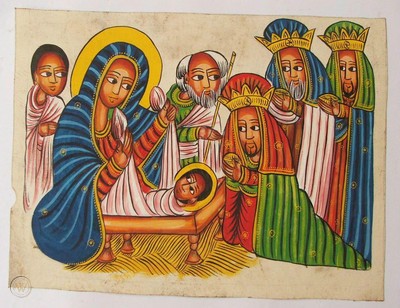
Ethiopian Orthodox Church icon of the Nativity

Merry Christmas! Christ is born! Joy to the world!

On this glorious day for Christians everywhere, the following are the lectionary readings for today. I suggest reading them aloud – with flavor – alongside your family and friends. May you find in the Christ child newfound hope and enduring encouragement.

Old Testament lesson: Isaiah 62:6-12

Upon your walls, Jerusalem,
    I have appointed sentinels.
Continually, all day and all night,
    they won’t keep silent.
You who call on the Lord, don’t rest,
    and don’t allow God to rest
    until he establishes Jerusalem,
    and makes it the praise of the earth.
The Lord has promised
    with raised hand and strong arm:
    I will never again give your grain
    as food for your enemies.
    Foreigners won’t drink your wine
    for which you labored.
Those who harvest will eat it
    and will praise the Lord;
    those who gather will drink it
    in my holy courtyards.

Pass through, pass through the gates;
    prepare the way for the people!
Build, build the road;
    clear away the stones!
    Raise up a signal for the peoples.
This is what the Lord announced
    to the earth’s distant regions:
Say to Daughter Zion, “Look! Your deliverer arrives,
    bringing reward and payment!”
They will be called The Holy People,
    Redeemed By the Lord.
And you will be called Sought After—
    A City That Is Not Abandoned. (Common English Bible)

Psalm lesson: Psalm 97

The Lord rules! Let the earth rejoice!
    Let all the islands celebrate!
Clouds and thick darkness surround God.
    His throne is built on righteousness and justice.
Fire proceeds before him,
    burning up his enemies on every side.
His lightning lights up the world;
    the earth sees it and trembles!
The mountains melt like wax before the Lord,
    before the Lord of the whole world!

Heaven has proclaimed God’s righteousness,
    and all nations have seen his glory.
All those who worship images,
    those who are proud of idols,
    are put to shame.
    All gods bow down to the Lord!
Zion has heard and celebrates,
    the towns of Judah rejoice,
    because of your acts of justice, Lord,
    because you, Lord, are the Most High
        over all the earth,
    because you are so superior to all other gods.

Those of you who love the Lord, hate evil!
    God guards the lives of his faithful ones,
    delivering them from the power of the wicked.
Light is planted like seed for the righteous person;
    joy too for those whose heart is right.
Rejoice in the Lord, righteous ones!
    Give thanks to his holy name! (Common English Bible)

Nativity by Chinese artist He Qi, 1998

New Testament lesson: Titus 3:4-7

God our Savior showed us
    how good and kind he is.
He saved us because
    of his mercy,
and not because
of any good things
    that we have done.

God washed us by the power
    of the Holy Spirit.
He gave us new birth
    and a fresh beginning.
God sent Jesus Christ
our Savior
    to give us his Spirit.

Jesus treated us much better
    than we deserve.
He made us acceptable to God
and gave us the hope
    of eternal life. (Contemporary English Version)

Gospel lesson: Luke 2:8-20

Now there were in the same country shepherds living out in the fields, keeping watch over their flock by night. And behold, an angel of the Lord stood before them, and the glory of the Lord shone around them, and they were greatly afraid. Then the angel said to them, “Do not be afraid, for behold, I bring you good tidings of great joy which will be to all people. For there is born to you this day in the city of David a Savior, who is Christ the Lord. And this will be the sign to you: You will find a Babe wrapped in swaddling cloths, lying in a manger.”

And suddenly there was with the angel a multitude of the heavenly host praising God and saying:

“Glory to God in the highest,
And on earth peace, goodwill toward men!”

So it was, when the angels had gone away from them into heaven, that the shepherds said to one another, “Let us now go to Bethlehem and see this thing that has come to pass, which the Lord has made known to us.” And they came with haste and found Mary and Joseph, and the Babe lying in a manger. Now when they had seen Him, they made widely known the saying which was told them concerning this Child. And all those who heard it marveled at those things which were told them by the shepherds. But Mary kept all these things and pondered them in her heart. Then the shepherds returned, glorifying and praising God for all the things that they had heard and seen, as it was told them. (New King James Version)

May the joy of the angels, the eagerness of the shepherds, the perseverance of the wise, the obedience of Joseph and Mary, and the peace of the Christ child be yours this Christmas. And may the blessing of God almighty – Father, Son, and Spirit – be among you and remain with you always. Amen.

Isaiah 11:1-9 – A Vision of Hope and Peace

The Peaceable Kingdom by Edward Hicks, 1826

A shoot will come up from the stump of Jesse;
    from his roots a Branch will bear fruit.
The Spirit of the Lord will rest on him—
    the Spirit of wisdom and of understanding,
    the Spirit of counsel and of might,
    the Spirit of the knowledge and fear of the Lord—
and he will delight in the fear of the Lord.

He will not judge by what he sees with his eyes,
    or decide by what he hears with his ears;
but with righteousness he will judge the needy,
    with justice he will give decisions for the poor of the earth.
He will strike the earth with the rod of his mouth;
    with the breath of his lips he will slay the wicked.
Righteousness will be his belt
    and faithfulness the sash around his waist.

The wolf will live with the lamb,
    the leopard will lie down with the goat,
the calf and the lion and the yearling together;
    and a little child will lead them.
The cow will feed with the bear,
    their young will lie down together,
    and the lion will eat straw like the ox.
The infant will play near the cobra’s den,
    and the young child will put its hand into the viper’s nest.
They will neither harm nor destroy
    on all my holy mountain,
for the earth will be filled with the knowledge of the Lord
    as the waters cover the sea. (New International Version)

In some quarters of Christianity, the church exists as a mere stump of its former existence. In many Christians’ daily experience the Spirit has been supplanted by individual ingenuity, hard work, and getting ahead through accumulation of more and more. Basic Christian spirituality is a mere shadow of its former influence. If Christians desire the Spirit of the Lord to rest upon them, they will seek Christ as of foremost importance.  

Indeed, it is when we are worn down to a stump and have no ability to grow or sustain life anymore that God enters, specializing in giving hope to the hopeless, justice for the poor, wisdom to the confused, and peace to all who desire a harmonious world.

In the awful feelings of helplessness and hopelessness, a faint sign of life can be seen. A fresh shoot becomes discernible. Could there be possibility amidst impossible circumstances? Can there be life again? Do I dare hope again? Will things really change, and do so for the better?

The answer is “yes.” For where the Spirit of the Lord blows there is the force of resurrection power, spiritual energy, and fresh courage. Where others see only the impossible, the believer has a capacity of faith to see the possible. The Spirit’s force generates possibility where none existed before. When the breath of God whispers to the sprout in the stump, pessimistic despair turns to optimistic hope, even joy.

Christ is the Christian’s hope. In Christ, there is security, well-being, and life. With Jesus, there is a vision of justice in which all persons receive what they need to live, thrive, and flourish in God’s world. Christ works for our benefit without the personal greed and indifference of so many earthly rulers. The weak and vulnerable have a champion in Jesus Christ. Renewal and restoration are possibilities.

I have taken a liking to a show called “The Repair Shop,” a British television series in which family heirlooms with sentimental value are restored by experts for their owners. What captivates me about the show is how a few people can take old broken-down items (and by all appearances now a piece of junk) and restore them to their once glorious newness.

Yet, there is more to my captivation. I am struck by the sheer pleasure the restorers take in handling the old object, enjoying the process. Just by the looks on their faces, I can tell they consider it a privilege to be restoring a precious object of the past.

I am sure this is precisely how God feels with us. Rather than envisioning the Lord as some reluctant deity who feels put out with having to rescue a bunch of dumb and wayward people, God is One who takes delight in taking this old stump of fallen damaged humanity and restoring people to their original luster and beauty.

Transformation is God’s specialty, and the Lord goes about the process of restoration with great care and delight.

The Peaceable Kingdom by Malcah Zeldis

The impossible possibility of God’s new creation is poetically described in Isaiah as the peaceful co-existence of animals who are inconceivably together without fear or violence. There is a time coming when death will be no more, and so, the necessity in this life of hunter and prey will be forever negated. No more snakes terrorizing women and children. No more big fishes eating little ones. No more human fat cats preying upon and striking poison on the small and vulnerable.

The presence of the godly Ruler means the world will be governed rightly, detoxified of its sinful impurities – a place where the poor, the weak, and the little lambs will indeed be safe and secure forever. There will be peace because of the Prince of Peace. All creation will be full of God, and so, free of all malice.

Isaiah envisions a deep, radical, limitless transformation in which there will be no more desire to injure another; no need to dominate another; and no motive for selfish power over others.

The Lord will bring about a metamorphosis of human hearts and institutions, a renovation of the animal kingdom, and a radical change down to every blade of grass in creation. The Apostle Paul had this grand prophetic vision of God in mind when he wrote to the Church at Rome:

I believe that the present suffering is nothing compared to the coming glory that is going to be revealed to us. The whole creation waits breathless with anticipation for the revelation of God’s sons and daughters. Creation was subjected to frustration, not by its own choice—it was the choice of the one who subjected it—but in the hope that the creation itself will be set free from slavery to decay and brought into the glorious freedom of God’s children. We know that the whole creation is groaning together and suffering labor pains up until now. And it’s not only the creation. We ourselves who have the Spirit as the first crop of the harvest also groan inside as we wait to be adopted and for our bodies to be set free. We were saved in hope. If we see what we hope for, that isn’t hope. Who hopes for what they already see? But if we hope for what we don’t see, we wait for it with patience. (Romans 8:18-25, CEB)

The implication for us as humanity was voiced by Paul to the Colossian Church:

Each of you is now a new person. You are becoming more and more like your Creator, and you will understand him better. It doesn’t matter if you are a Greek or a Jew, or if you are circumcised or not. You may even be a barbarian or a Scythian, and you may be a slave or a free person. Yet Christ is all that matters, and he lives in all of us.

God loves you and has chosen you as his own special people. So be gentle, kind, humble, meek, and patient. Put up with each other, and forgive anyone who does you wrong, just as Christ has forgiven you. Love is more important than anything else. It is what ties everything completely together.

Each one of you is part of the body of Christ, and you were chosen to live together in peace. So let the peace that comes from Christ control your thoughts. And be grateful. (Colossians 3:10-15, CEV)

The transformation is all-pervasive, thoroughly public, and intimately personal. It is a gift from God; it is the impossible made possible. And it is this precise thing which we acknowledge, celebrate, and long for in the season of Advent. When the angel came to Mary and communicated that Isaiah’s vision was coming to reality through her womb, Mary astonishingly retorted:

 “How will this be, since I am a virgin?”

The angel, with supreme confidence, answered Mary as a matter of fact:

“The Holy Spirit will come on you, and the power of the Most High will overshadow you. So, the holy one to be born will be called the Son of God…. For no word from God will ever fail.”

Mary’s response gives voice to our own desires and longings for the new order of things:

“I am the Lord’s servant. May your word to me be fulfilled.” (Luke 1:34-38, NIV)

This is our confession, too. We are the Lord’s servants.

May God’s word to us about the coming of Christ be fulfilled, just as Isaiah said. The hopes and fears of all the years are met in Jesus on a starry night so many years ago.

Soli Deo Gloria