

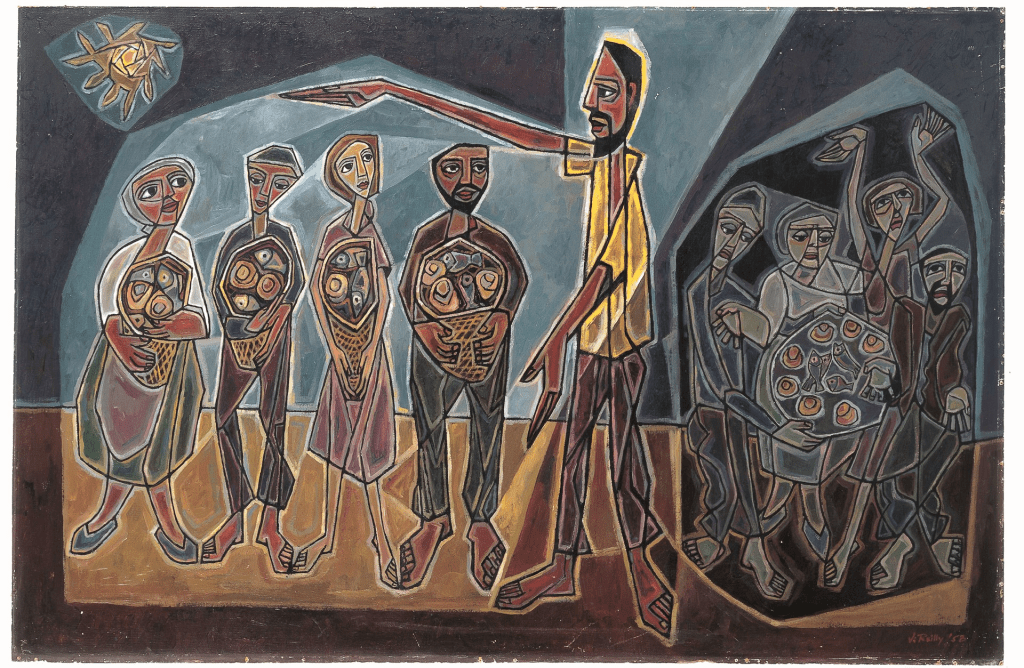
When Jesus heard what had happened, he withdrew by boat privately to a solitary place. Hearing of this, the crowds followed him on foot from the towns. When Jesus landed and saw a large crowd, he had compassion on them and healed their sick.
As evening approached, the disciples came to him and said, “This is a remote place, and it’s already getting late. Send the crowds away, so they can go to the villages and buy themselves some food.”
Jesus replied, “They do not need to go away. You give them something to eat.”
“We have here only five loaves of bread and two fish,” they answered.
“Bring them here to me,” he said. And he directed the people to sit down on the grass. Taking the five loaves and the two fish and looking up to heaven, he gave thanks and broke the loaves. Then he gave them to the disciples, and the disciples gave them to the people. They all ate and were satisfied, and the disciples picked up twelve basketfuls of broken pieces that were left over. The number of those who ate was about five thousand men, besides women and children. (New International Version)
Miracles still happen
I know of a woman who once brought a pan of lasagna to a community meal at her church, thinking that only 25-30 people would be fed. However, 70 people showed up. Her immediate thought was to go buy more, but she didn’t have the time.
So, here is what the dear woman did: She looked up to heaven, gave thanks, and started dishing out the lasagna – until every last person was fed. She confided in me that “every time I put my spatula down there was food to put on it!”
The story of Jesus feeding thousands of people is not just a nice account that happened a long time ago; Jesus is still in the miracle business. Christ can take our meager resources and turn them into something with a large impact on a lot of people.
For this to happen, all we need to do is follow our Lord’s simple instructions: “You give them something to eat,” and, “Bring them here to me.” Jesus, using a simple act of obedience by the disciples, did one of the most famous miracles in history.
The message of the story is simple, but profound: Jesus can multiply whatever little we have, to accomplish his kingdom work, through us. Jesus could do miracles without us, but he wants us to participate in the work. We only need to bring our few loaves and fish to him.
The compassion of Jesus is the motivation for miracles
Jesus withdrew to a solitary place. But the crowd did not leave him alone. Rather than be annoyed by the situation, Jesus looked at the large group of people and his heart went out to them. So, he went about the work of healing the sick. Please know that God does not begrudgingly deal with you, as if you were an interruption to his day; he has compassion.
The desire of Jesus is for us to participate in the miracles
After a full day of healing, Christ’s disciples came to him as if he was unaware of the people’s need for food. They gave a very rational and realistic answer to the problem of hunger: Dismiss them so they can go out to eat. But Jesus said, “They don’t need to go away; you give them something to eat.”
I detect maybe a hint of sarcasm in the tone of the disciples reply: “We have only five loaves of bread and two fish.” But their math was way off because they did not count Jesus. “Bring them here to me,” Christ replied. If we have ears to hear, Jesus is still saying this today: bring them here to me. Through simple prayer and active obedience, we give Jesus what we have, no matter how little or insignificant it seems to us.
Much of what we do in the American church is a reasonable and rational ministry; it has little to do with the impossibility of faith and seeing God work in ways that are incomprehensible to our modern sensibilities.
A Chinese pastor once visited the United States. After seeing our vast resources of money, buildings, and ministries. He said, “This is amazing! It’s incredible what you American Christians can do without God!”
In reality, we need God – who is in the business of taking our simple obedience and humble participation, and doing the miraculous. And it has always been this way. For example….

The wife of a man from the company of the prophets cried out to Elisha, “Your servant my husband is dead, and you know that he revered the Lord. But now his creditor is coming to take my two boys as his slaves.”
Elisha replied to her, “How can I help you? Tell me, what do you have in your house?”
“Your servant has nothing there at all,” she said, “except a small jar of olive oil.”
Elisha said, “Go around and ask all your neighbors for empty jars. Don’t ask for just a few. Then go inside and shut the door behind you and your sons. Pour oil into all the jars, and as each is filled, put it to one side.”
She left him and shut the door behind her and her sons. They brought the jars to her and she kept pouring. When all the jars were full, she said to her son, “Bring me another one.”
But he replied, “There is not a jar left.” Then the oil stopped flowing.
She went and told the man of God, and he said, “Go, sell the oil and pay your debts. You and your sons can live on what is left.” (2 Kings 4:1-7, NIV)
You want me to do what?
What if we were to operate as if God were truly in the business of doing miracles? Would it impact the way we pray, and the way we act? What if we understood just enough of Jesus and what he can and wants to do that we would be bold to say: “This might sound crazy, but what if we….”
- found out everyone who needs food in this community, go love on them, and feed them…
- used our property to create a community garden and seek to help people grow their own food…
- came up with a God-sized plan to reach our community…
- prayed to see a hundred people come to Christ through this church…
Most of our plans don’t require us to do anything impossible, so we simply settle for the possible.
We too often do nothing out of a sense that God either cannot or does not want to use me or what I have. But it just won’t do to stand afar off and expect God to work without us giving what we have – whether that something is time, money, conversation, food, hospitality, or whatever.
Our limitations mean nothing to Jesus, so he doesn’t hear us when we say:
- my home is too small, and it’s not clean enough
- I don’t have enough money,
- I’m not smart enough
- my schedule won’t allow it
- I don’t have enough resources
You don’t need much – only the willingness to be part of the miracle Jesus is doing.
Conclusion
You want me to do what? Feed thousands? Lead someone to Jesus? Pray in front of others? Work for justice?
Sometimes, the greatest miracle is for people to be open, real, and transparent enough to believe that Christ can do a miracle through confessing my sin, participating in a ministry, or having a spiritual conversation with an unbeliever.
The question is never, “Can God use me?” It is, “What miracle does God want to do through me and through this church?”
It is no accident that when Jesus distributed the bread that it sounds a lot like communion. The Lord’s Supper may seem irrelevant, as if it is merely remembering Jesus. However, God’s design is much bigger: The Lord wants to do a miracle.
God wants the practice of our communion together to bring healing and wholeness that the world cannot give. It might be unrealistic to expect that Jesus can use a Table to feed and reach thousands, but we don’t serve a God who is limited to work through rational means.
Blessed are you, O Lord God, King of the Universe, for you give us food to sustain our lives and make our hearts glad. We thank you for your countless blessings, especially for the gift of your Son, for the Church, for our faith, and now for this meal we are about to participate in, through Christ our Lord. Amen.





 Rev. Tim Ehrhardt