Morality Matters (2 Kings 9:14-26)

Then Jehu, Jehoshaphat’s son and Nimshi’s grandson, plotted against Joram. Now Joram along with all of Israel had been guarding Ramoth-Gilead against Aram’s King Hazael, but King Joram had gone back to Jezreel to recover from wounds that the Arameans had given him when he fought Hazael.

So Jehu said, “If this is the way you feel, then don’t let anyone escape from the city to talk about it in Jezreel.” Then Jehu got on a chariot and drove to Jezreel because Joram was resting there. Judah’s King Ahaziah had also come to visit Joram.

The guard standing on the tower at Jezreel saw a crowd of people coming with Jehu. He said, “I see a crowd of people.”

Joram said, “Take a chariot driver. Send him out to meet them to ask, ‘Do you come in peace?’”

So the driver went to meet him and said, “The king asks, ‘Do you come in peace?’”

Jehu replied, “What do you care about peace? Come around and follow me.”

Meanwhile, the tower guard reported, “The messenger met them, but he isn’t returning.”

The king sent a second driver. He came to them and said, “The king asks, ‘Do you come in peace?’”

Jehu said, “What do you care about peace? Come around and follow me.”

The tower guard reported, “The messenger met them, but he isn’t returning. And the style of chariot driving is like Jehu, Nimshi’s son. Jehu drives like a madman.”

Joram said, “Hitch up the chariot!” So they hitched up his chariot. Then Israel’s King Joram and Judah’s King Ahaziah—each in his own chariot—went out to meet Jehu. They happened to meet him at the plot of ground that belonged to Naboth the Jezreelite.

When Joram saw Jehu, he said, “Do you come in peace, Jehu?”

He said, “How can there be peace as long as the immoralities of your mother Jezebel and her many acts of sorcery continue?”

Then Joram turned his chariot around and fled. He shouted to Ahaziah, “It’s a trap, Ahaziah!”

Jehu took his bow and shot Joram in the back. The arrow went through his heart, and he fell down in his chariot. Jehu said to Bidkar his chariot officer, “Pick him up, and throw him on the plot of ground belonging to Naboth the Jezreelite. Remember how you and I were driving chariot teams behind his father Ahab when the Lord spoke this prophecy about him: Yesterday I saw Naboth’s blood and his sons’ blood, declares the Lord. I swear that I will pay you back on this very plot of ground, declares the Lord. Now pick him up, and throw him on that plot of ground, in agreement with the Lord’s word.” (Common English Bible)

Jehu shoots an arrow that strikes Joram in the back, by Jan Luyken, 1712

Ancient storytelling often had a moral to it. Historical writing was typically less concerned for objective details and much more interested to point out, in narrative form, how people morally lived and what happened to them. Rather than commenting on what the moral(s) are, the storyteller lets the story speak for itself.

Today’s Old Testament lesson brings several kings into the story (Jehu, Joram, Ahaziah, and Ahab). We are meant to contrast Jehu’s zeal for justice and living into God’s call with the others kings’ injustice and living for power and wealth. The final end of the kings is designed for us to see the ultimate consequence of injustice.

Elisha the prophet had given a non-descript Israelite military man, Jehu, instructions from the Lord about carrying out divine judgment against the unjust royal house of Omri – and more specifically, against King Ahab and Queen Jezebel.

After Jehu’s prophetic call and anointing, the soldiers under his command immediately acclaimed him as king. Jehu wasted no time in going after the people responsible for years of abusive power.

Rather than simply giving orders to his soldiers and remaining in back of his army, Jehu led his men into the thick of battle. We get the picture of a person with single-minded determination, aggressively going after unjust leaders; and seeking to upend a royal system of power which strayed far from their original mandate of upholding God’s system of law and covenant.

Jehu’s zeal is exemplified in his chariot driving: He was going to speedily get to where he needed to go, and do what he needed to do.

The story emphasizes the increasing drama of messengers sent to enquire of Jehu’s intentions: Are they peaceful? Clearly, no. There was betrayal afoot, as Jehu boldly drove against his own king of Israel, as well as the king of Judah.

The unjust kings had created a situation in their nations of peace for themselves, but not necessarily others. So, Jehu would take that peace from them.

The two kings of Israel and Judah personally went out to Jehu, not realizing what was about to happen. Ironically, it took place on land which Naboth had previously owned, and of which Ahab and Jezebel diabolically stole. It is a powerful depiction of what goes around comes around.

Jehu quickly got to the nub of the issue: There cannot be peace as long as Jezebel’s idolatry and witchcraft abound in the land. Her wicked ways had become thoroughly imbued throughout both Israel and Judah, and was supported by both of the kings.

From the perspective of Jehu, there was no peace that could exist between a follower of Yahweh and a practitioner of the Baal and Asherah cults. Jehu’s intent was to fulfill the prophecy that was announced by Elijah twelve years earlier. And he went about it with violent zeal.

Whenever the Lord begins to exact judgment and ensconce justice, there’s no way anyone is going to stop it. Joram went out to face an enemy that he could not stop. There was no escaping the inexorable force of God.

Divine providence brought the kings together on the very piece of land that was once Naboth’s vineyard – the place where Ahab took sinister control of it. (1 Kings 21). Murderous theft was the inevitable result of spiritual fornication; Ahab and Jezebel had prostituted themselves with the gods Baal and Asherah.

Spiritual adultery never ends well. Because God is a jealous Lover. Peace is not achieved by letting everyone do whatever they want. Instead, it is established through integrity, justice, truth, and ethical morality.

Eternal God, in whose perfect kingdom the sword of righteousness is drawn: Spread abroad your mighty Spirit, so that all peoples may be gathered under the banner of the Prince of Peace, as children of one Father; to whom be dominion and glory, now and forever. Amen.

Yet Another Conflict (Acts 21:27-39)

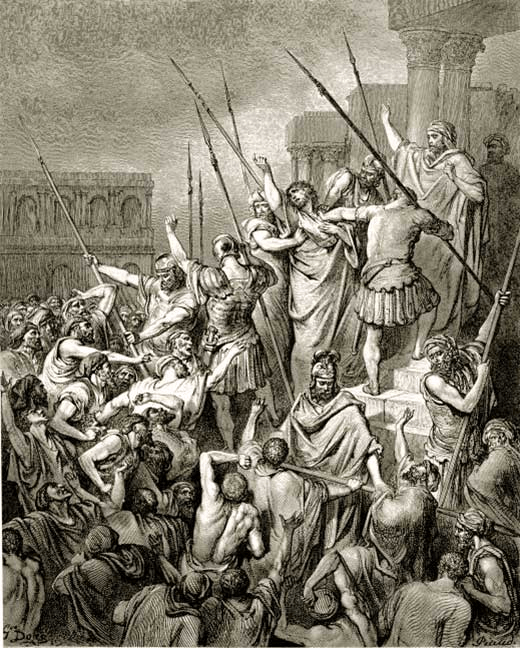
Apostle Paul in Jerusalem, by Gustave Doré, 1878

When the seven days were nearly over, some Jews from the province of Asia saw Paul at the temple. They stirred up the whole crowd and seized him, shouting, “Fellow Israelites, help us! This is the man who teaches everyone everywhere against our people and our law and this place. And besides, he has brought Greeks into the temple and defiled this holy place.” (They had previously seen Trophimus the Ephesian in the city with Paul and assumed that Paul had brought him into the temple.)

The whole city was aroused, and the people came running from all directions. Seizing Paul, they dragged him from the temple, and immediately the gates were shut. While they were trying to kill him, news reached the commander of the Roman troops that the whole city of Jerusalem was in an uproar. He at once took some officers and soldiers and ran down to the crowd. When the rioters saw the commander and his soldiers, they stopped beating Paul.

The commander came up and arrested him and ordered him to be bound with two chains. Then he asked who he was and what he had done. Some in the crowd shouted one thing and some another, and since the commander could not get at the truth because of the uproar, he ordered that Paul be taken into the barracks. When Paul reached the steps, the violence of the mob was so great he had to be carried by the soldiers. The crowd that followed kept shouting, “Get rid of him!”

As the soldiers were about to take Paul into the barracks, he asked the commander, “May I say something to you?”

“Do you speak Greek?” he replied. “Aren’t you the Egyptian who started a revolt and led four thousand terrorists out into the wilderness some time ago?”

Paul answered, “I am a Jew, from Tarsus in Cilicia, a citizen of no ordinary city. Please let me speak to the people.” (New International Version)

The Apostle Paul arrived in Jerusalem, after a sojourn in Greece and the province of Asia. He had been gathering a collection for the believers in need. In his journey, Paul received messages, warnings, and even prophecy that he would be arrested if he went to Jerusalem.

Since the prophecy did not tell Paul to stay away, he kept going, ready not only to be arrested but to also die for his faith, if need be. (Acts 21:10-14)

Iron handcuffs (chains) from the Roman Empire, Archaeological Museum in Durrës, Albania

The first week of being Jerusalem entailed the status quo for Paul: He dealt with yet another church conflict between Jews and Gentiles. Then, the prophecy began to unfold and become reality.

Jews from Asia, who had seen Paul in the Temple and recognized him as a Christian agitator, immediately jumped to the conclusion that Paul was up to no good. It appeared to them that Paul had taken a Gentile into the Temple, thus defiling it, which in fact, he had not.

But when you have a grudge against someone, and an axe to grind, you begin making mental correlations and causations that aren’t really there.

So, the Jews from Asia got the crowd all stirred up by judging Paul as a person who teaches everyone everywhere against the people, the law, and the Temple. In other words, they accused Paul of being anti-Semitic and fomenting violence against the Jews.

Ironically, however, that is just what the Asian Jews did themselves. Without just evidence, they evoked the crowd’s emotions enough to drag Paul from the Temple. And they weren’t inviting him to tea. It seems they had every intention of doing him in, and not by throwing sugar cubes at him.

The only thing that stopped a death that day was the Roman authority getting in between Paul and the crowd. As per the prophecy, Paul was arrested and bound with chains.

The crowd had turned so riotous that the Roman commander could not ascertain Paul’s identity. The mob became violent, so Paul was whisked away by the Roman soldiers. As he left, the shouts of “Away with him!” could be heard throughout the city.

Jesus had a similar experience, but went to his death without any opportunity for a defense speech before an angry crowd.

Paul requested, however, to address the mob. And the Roman commander was aghast to learn that Paul spoke Greek – supposing that he was just another annoying religious nut on the street corner who got up into everyone’s grill a bit too much.

Yet, the commander quickly discovered that he was dealing with a citizen of the Empire who was no kooky preacher. Here we see a turn of events and a flip-flop between two groups of people.

It’s the Roman army who upheld proper justice and protected the interests of the individual; whereas the Jewish crowd became vigilante, ironically violating their own law by trying to put an innocent person to death without justification.

In a twist of history, the Roman arrest of Paul was his deliverance from a Jewish mob. Go figure.

Today’s story opens for me a set of questions that are both genuine, as well as a bit rhetorical:

  • How often do we – as both individuals and churches – accuse others of being unfaithful and/or unbiblical, when it is we ourselves who are going rogue from Holy Scripture?
  • In what ways do we handle false charges, judgmentalism, and unjustified criticism from others who misunderstand and/or misinterpret us?
  • What do we do (and not do) whenever there are differences within the church, family, community, workplace, or nation?
  • Does our manner of approaching conflict include the verbal violence of gossip and slander and/or actual physical violence through passive-aggressive behavior?
  • Am I looking too closely and/or critically under the hood of your soul? What will you do with me, let alone Jesus?

If you can receive this, I recommend taking some time and space today for answering those questions honestly through writing them in a journal and/or talking about them with a trusted friend.

May God have mercy upon our human institutions, societies, and relationships. To God be the glory. Amen.

The Lord’s Will Be Done (Acts 21:1-16)

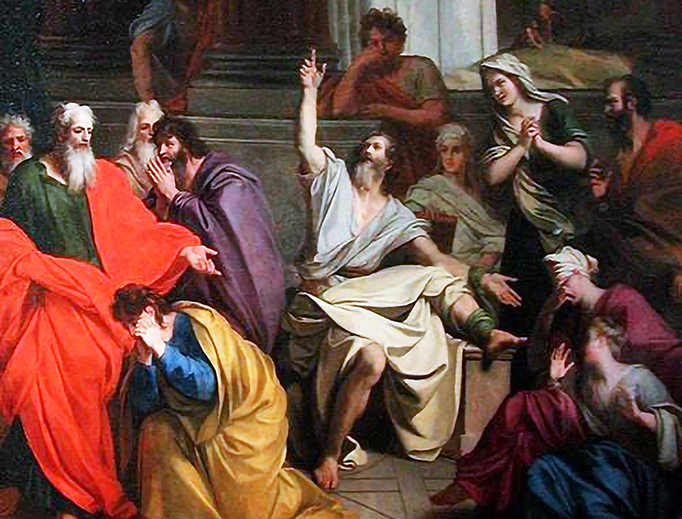
The Prophecy of Agabus, by Louis Chéron, 1687

After we had torn ourselves away from them, we put out to sea and sailed straight to Kos. The next day we went to Rhodes and from there to Patara. We found a ship crossing over to Phoenicia, went on board and set sail. After sighting Cyprus and passing to the south of it, we sailed on to Syria. We landed at Tyre, where our ship was to unload its cargo. 

We sought out the disciples there and stayed with them seven days. Through the Spirit they urged Paul not to go on to Jerusalem. When it was time to leave, we left and continued on our way. All of them, including wives and children, accompanied us out of the city, and there on the beach we knelt to pray. After saying goodbye to each other, we went aboard the ship, and they returned home.

We continued our voyage from Tyre and landed at Ptolemais, where we greeted the brothers and sisters and stayed with them for a day. Leaving the next day, we reached Caesarea and stayed at the house of Philip the evangelist, one of the Seven. He had four unmarried daughters who prophesied.

After we had been there a number of days, a prophet named Agabus came down from Judea. Coming over to us, he took Paul’s belt, tied his own hands and feet with it and said, “The Holy Spirit says, ‘In this way the Jewish leaders in Jerusalem will bind the owner of this belt and will hand him over to the Gentiles.’”

When we heard this, we and the people there pleaded with Paul not to go up to Jerusalem. Then Paul answered, “Why are you weeping and breaking my heart? I am ready not only to be bound, but also to die in Jerusalem for the name of the Lord Jesus.” When he would not be dissuaded, we gave up and said, “The Lord’s will be done.”

After this, we started on our way up to Jerusalem. Some of the disciples from Caesarea accompanied us and brought us to the home of Mnason, where we were to stay. He was a man from Cyprus and one of the early disciples. (New International Version)

The Apostle Paul was on his farewell tour, visiting the believers in churches he planted during his missionary journeys.

The visit to Ephesus was especially heart wrenching; everyone knew this was the last time they would see each other. Paul had spent considerable time in Ephesus establishing the church, and went through a lot with the people. They cared for one another deeply, which is seen in their praying meeting on the beach.

Paul was determined to get back to Jerusalem. Everyone knew that Paul would likely be imprisoned or killed or both by returning there. After the tears were shed, Paul and his coterie of people got on a ship and sailed toward Judea.

Once in Judea, Paul and his companions encountered some characters in the city of Caesarea, including four sisters who had the gift of prophecy, and a man named Agabus who was also a prophet.

The Apostle had been warned several times about going back to Jerusalem. Agabus joined the voices by giving a word by means of the Holy Spirit that Paul would meet persecution if he continued on his journey.

Agabus did some rather dramatic Old Testament prophetic type stuff with Paul. Although others interpreted the message of Agabus as a warning to not go into the lion’s den of inevitable persecution, the prophecy itself is only descriptive of what will happen, and not prescriptive of what should be done.

It’s important to distinguish what the Holy Spirit reveals and commands. We ought only to smush the revelation and the commands together when the Spirit does that. In the case of Agabus and Paul, it was only a revelation. And Paul picked up on that immediately. He knew what he was in for, and was okay with it.

The bottom line for the Apostle Paul was that he felt compelled to head for Jerusalem and face whatever he needed to face there. He was determined to personally bring both spiritual encouragement and economic relief for the people in Judea.

It seems that nobody wanted to see Paul get hurt, arrested, killed, or all three; and that’s more than understandable. Yet, the Apostle himself was convinced of what he should do; and no amount of trying to persuade him otherwise was going to work. So, Paul continued his journey.

The believers came around to saying, “The Lord’s will be done.” And that’s really what we all eventually must come to accept – that participation with what God is doing in the world, in a place, and with us personally, is the thing that counts.

Even Jesus needed to get to that point, so maybe we ought to cut others (and ourselves) some slack when it comes to accepting the situation we are called to be in.

 “Father, if you are willing, take this cup from me; yet not my will, but yours be done.”

Jesus (Luke 22:42, NIV)

No one, especially me, is saying that it’s easy to face adversity and hardship for a certain time and place in your life (or the life of someone you love). In fact, much like Jesus in the garden, it is often agonizing. But moving ahead and doing it we shall, if the Lord’s will is plain to us.

One of the reasons why Paul could be so resolute, and do what he did, was because of the support he continually had around him with his traveling companions.

I often ask people if they are part of a church. Some folks take this as a rebuke and instantly feel guilty that they haven’t attended a worship service for a long while. But the reason I ask is that I’m wondering about their sources of support.

Whenever people are going through hard times, its very helpful to have a faith community who they can rely upon and lean into. Since Paul was rarely alone, he had a consistent supportive presence of people who knew him well, and the circumstance he was enduring.

And I’m hoping that same thing for you – to have a good support system in place for help in following through with the will of God, as you understand it. Because if you are convinced of what you must do, and have people to support you in doing it, no matter what happens, then you can endure a lot, as well as learn a lot.

Lord God almighty, help me grow in discernment and making decisions. Jesus, you know the intensity of our struggle when God’s will conflicts with our desires. Equip and enable me to do your revealed will with a glad and sincere heart. May your will be done, in the power of the Holy Spirit. Amen.

Take the Long View (Genesis 49:1-33)

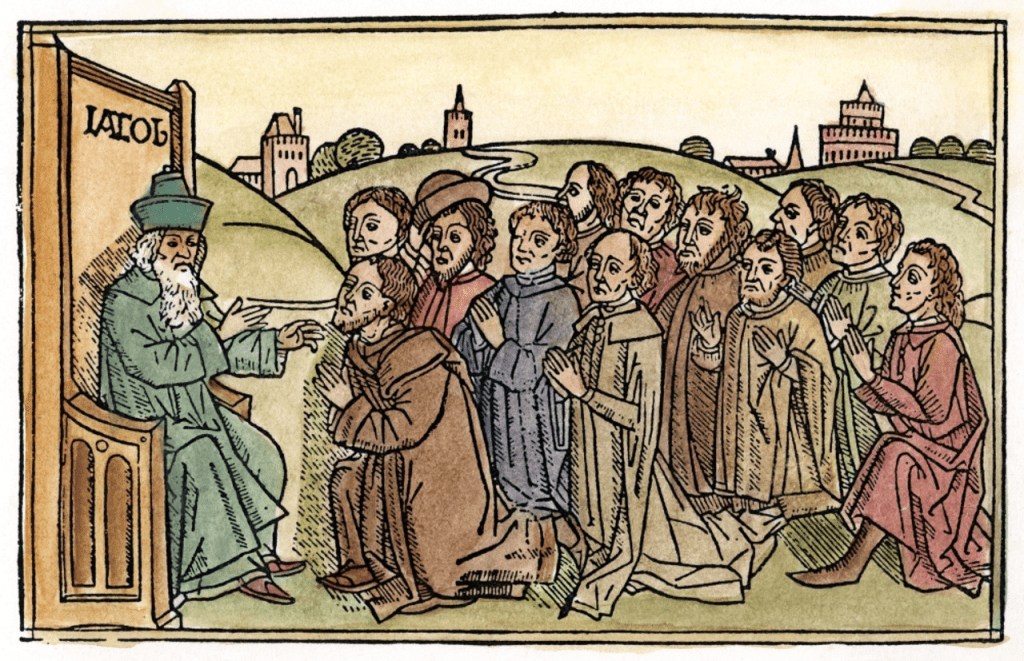
Jacob blesses his twelve sons, a woodcut from the Cologne Bible, c.1479

Then Jacob called together all his sons and said, “Gather around me, and I will tell you what will happen to each of you in the days to come.

“Come and listen, you sons of Jacob;
    listen to Israel, your father.

“Reuben, you are my firstborn, my strength,
    the child of my vigorous youth.
    You are first in rank and first in power.
But you are as unruly as a flood,
    and you will be first no longer.
For you went to bed with my wife;
    you defiled my marriage couch.

“Simeon and Levi are two of a kind;
    their weapons are instruments of violence.
May I never join in their meetings;
    may I never be a party to their plans.
For in their anger they murdered men,
    and they crippled oxen just for sport.
A curse on their anger, for it is fierce;
    a curse on their wrath, for it is cruel.
I will scatter them among the descendants of Jacob;
    I will disperse them throughout Israel.

“Judah, your brothers will praise you.
    You will grasp your enemies by the neck.
    All your relatives will bow before you.
Judah, my son, is a young lion
    that has finished eating its prey.
Like a lion he crouches and lies down;
    like a lioness—who dares to rouse him?
The scepter will not depart from Judah,
    nor the ruler’s staff from his descendants,
until the coming of the one to whom it belongs,
    the one whom all nations will honor.
He ties his foal to a grapevine,
    the colt of his donkey to a choice vine.
He washes his clothes in wine,
    his robes in the blood of grapes.
His eyes are darker than wine,
    and his teeth are whiter than milk.

“Zebulun will settle by the seashore
    and will be a harbor for ships;
    his borders will extend to Sidon.

“Issachar is a sturdy donkey,
    resting between two saddle packs.
When he sees how good the countryside is
    and how pleasant the land,
he will bend his shoulder to the load
    and submit himself to hard labor.

“Dan will govern his people,
    like any other tribe in Israel.
Dan will be a snake beside the road,
    a poisonous viper along the path
that bites the horse’s hooves
    so its rider is thrown off.
I trust in you for salvation, O Lord!

“Gad will be attacked by marauding bands,
    but he will attack them when they retreat.

“Asher will dine on rich foods
    and produce food fit for kings.

“Naphtali is a doe set free
    that bears beautiful fawns.

“Joseph is the foal of a wild donkey,
    the foal of a wild donkey at a spring—
    one of the wild donkeys on the ridge.
Archers attacked him savagely;
    they shot at him and harassed him.
But his bow remained taut,
    and his arms were strengthened
by the hands of the Mighty One of Jacob,
    by the Shepherd, the Rock of Israel.
May the God of your father help you;
    may the Almighty bless you
with the blessings of the heavens above,
    and blessings of the watery depths below,
    and blessings of the breasts and womb.
May my fatherly blessings on you
    surpass the blessings of my ancestors,
    reaching to the heights of the eternal hills.
May these blessings rest on the head of Joseph,
    who is a prince among his brothers.

“Benjamin is a ravenous wolf,
    devouring his enemies in the morning
    and dividing his plunder in the evening.”

These are the twelve tribes of Israel, and this is what their father said as he told his sons good-bye. He blessed each one with an appropriate message.

Then Jacob instructed them, “Soon I will die and join my ancestors. Bury me with my father and grandfather in the cave in the field of Ephron the Hittite. This is the cave in the field of Machpelah, near Mamre in Canaan, that Abraham bought from Ephron the Hittite as a permanent burial site. There Abraham and his wife Sarah are buried. There Isaac and his wife, Rebekah, are buried. And there I buried Leah. It is the plot of land and the cave that my grandfather Abraham bought from the Hittites.”

When Jacob had finished this charge to his sons, he drew his feet into the bed, breathed his last, and joined his ancestors in death. (New Living Translation)

The theme of confidence works its way through the patriarch Jacob’s deathbed prophecies and blessings – a resolute conviction in the promises of God, that he will accomplish what he said he would do.

Jacob expressed the hope and sure belief that God would bring the Israelites out of Egypt and into the land of Canaan as their inheritance – and, ultimately to the City of God, the eternal inheritance.

The Christian will find much in Judah’s blessing as the promise of the coming Christ, Jesus. Mentioning the implements of “staff” and “scepter” are symbols of authority. And, the reference to a donkey communicated a ruler was coming, as donkeys were the preferred mounts of royalty in ancient times.

What’s more, the washing of garments in wine, and eyes darker than wine, are allusions to the future blessing and abundance there will be through the tribe of Judah. In fact, the first miracle of Jesus was turning water into wine – a deliberate attempt by the Apostle John to connect Jesus with Old Testament messianic prophecies of abundance and blessing. (John 2:1-12)

It’s necessary to take a long view of life, keeping in mind that it took eighteen centuries for Jacob’s prophecy of Judah to occur. This long view is what gives us our confidence in life and provides the patience and perseverance we need right now. 

Keeping in mind the big picture of God’s work in this world is important, because if we do not, we will likely become discouraged with the circumstances we face right now.

The reason Jacob makes it into the great Hall of Faith in the New Testament book of Hebrews is not because he was squeaky clean and perfect in how he lived his life, but because he took the long view, the big picture, and saw that God was going to fulfill his promises to Israel:

By an act of faith, Jacob on his deathbed blessed each of Joseph’s sons in turn, blessing them with God’s blessing, not his own—as he bowed worshipfully upon his staff. (Hebrews 11:21, MSG)

Furthermore, when we string the following three verses together across both Testaments, we see the long view of God’s purposes:

It is true that you planned to do something bad to me. But really, God was planning good things. God’s plan was to use me to save the lives of many people. And that is what happened. (Genesis 50:20, ERV)

For I know the plans I have for you,” declares the Lord, “plans to prosper you and not to harm you, plans to give you hope and a future. (Jeremiah 29:11, NIV)       

And we know that all things work together for good to those who love God, to those who are the called according to his purpose. (Romans 8:28, NKJV)

In the Christian faith tradition, all God’s promises come together and are fulfilled in the person and work of Jesus. Christ is our salvation, our inheritance, and our hope. To give our lives to him in complete trust of faith is both our challenge and our privilege.

So, may you and I live by faith, and not by fear.

Be present, O merciful God, and protect us through these anxious times, so that we who are wearied by the changes of this life may rest in your eternal steadiness. Keep watch, dear God, with those who work, or watch, or weep this night, and give your angels charge over those who sleep. Tend the sick, Lord Christ; give rest to the weary, bless the dying, soothe the suffering, pity the afflicted, shield the joyous; and all for your love’s sake. Amen.