Making a Vow (1 Samuel 1:19-27)

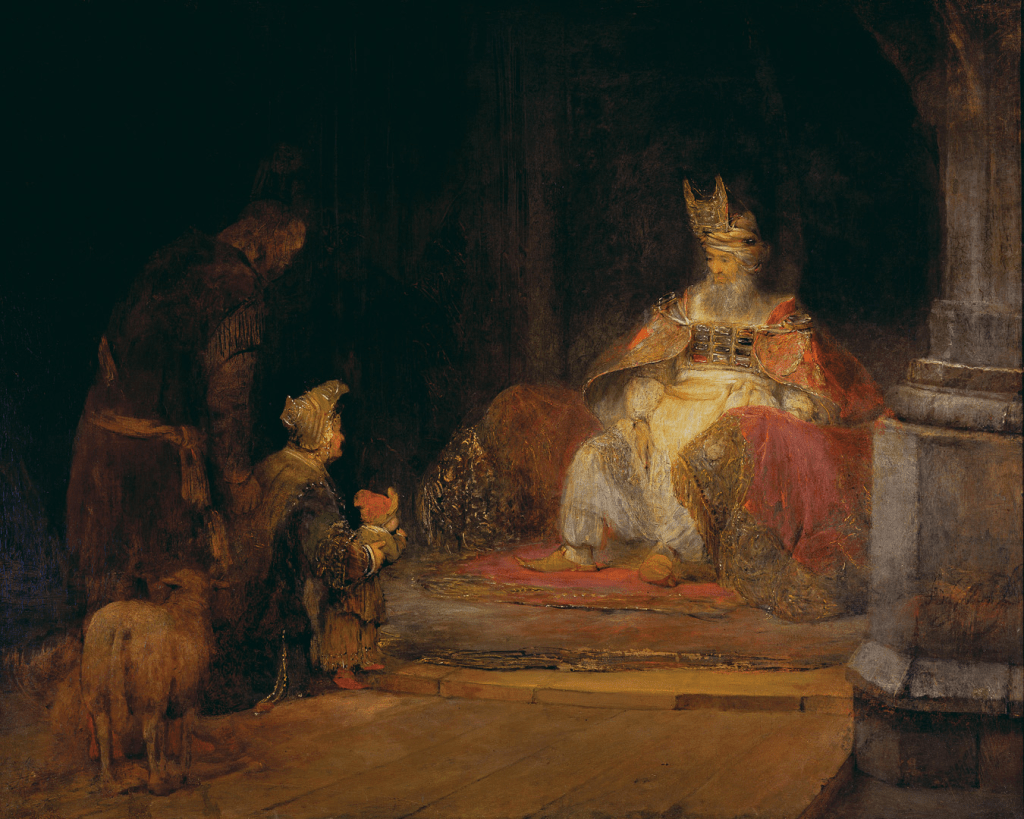
Hannah Presenting Samuel to Eli, by Arent de Gelder, 1710

The entire family got up early the next morning and went to worship the Lord once more. Then they returned home to Ramah. When Elkanah slept with Hannah, the Lord remembered her plea, and in due time she gave birth to a son. She named him Samuel, for she said, “I asked the Lord for him.”

The next year Elkanah and his family went on their annual trip to offer a sacrifice to the Lord and to keep his vow. But Hannah did not go. She told her husband, “Wait until the boy is weaned. Then I will take him to the Tabernacle and leave him there with the Lord permanently.”

“Whatever you think is best,” Elkanah agreed. “Stay here for now, and may the Lord help you keep your promise.” So she stayed home and nursed the boy until he was weaned.

When the child was weaned, Hannah took him to the Tabernacle in Shiloh. They brought along a three-year-old bull for the sacrifice and a basket of flour and some wine. After sacrificing the bull, they brought the boy to Eli. “Sir, do you remember me?” Hannah asked. “I am the very woman who stood here several years ago praying to the Lord. I asked the Lord to give me this boy, and he has granted my request. (New Living Translation)

Hannah had no children. In an era of patriarchy and polygamy, she had to put up with a rival wife verbally attacking her – not to mention a husband who seemed somewhat clueless to what was going on.

The piety of Hannah was unmatched. When worshiping the Lord in the tabernacle at Shiloh, Hannah offered a heartfelt prayer to God. She not only asked for help in her distressing situation, but also promised that if the Lord would give her a son, she would return to the Giver; thus, making the child a double gift to both herself and God.

God listened to Hannah and remembered her. Through her pregnancy and birth of a son, there is even more going on than displaying the Lord’s power over infertility. In taking divine initiative to do what Hannah asked, God demonstrated care and vindication for one of the least valued members of an ancient society that looked askance on infertile women.

Hannah and Samuel in the Temple, by Rembrandt, 1650

In the patriarchal society, Hannah’s husband, Elkanah, could have nullified her vow to the Lord. But he allowed her promise to stand, and even encouraged it. Perhaps this was yet another sort of miracle, to have a husband move the great distance from unaware and aloof to aware and connected.

Hannah and Elkanah went to Shiloh, and back to the old priest Eli, not only making a typical animal sacrifice, but also offering their son, in fulfillment of Hannah’s vow to the Lord. Hannah very much took her vow to God seriously.

As you enter the house of God, keep your ears open and your mouth shut. It is evil to make mindless offerings to God. Don’t make rash promises, and don’t be hasty in bringing matters before God. After all, God is in heaven, and you are here on earth. So let your words be few.

Too much activity gives you restless dreams; too many words make you a fool.

When you make a promise to God, don’t delay in following through, for God takes no pleasure in fools. Keep all the promises you make to him. It is better to say nothing than to make a promise and not keep it. Don’t let your mouth make you sin. And don’t defend yourself by telling the Temple messenger that the promise you made was a mistake. That would make God angry, and he might wipe out everything you have achieved.

Talk is cheap, like daydreams and other useless activities. Fear God instead. (Ecclesiastes 5:1-7, NLT)

Any sort of commitment we express to God, no matter what, is to be taken seriously. Making vows to the Lord isn’t simply a way of helping us feel good about our relationship to God; rather, vows have important implications for our daily life and decisions.

What’s more, vows are not bribes. We don’t make deals with God. That’s because we have nothing to offer in any sort of human understanding of contractual obligations. A vow is a promise, a commitment to follow through with something. And the Lord will hold us accountable to our promises.

Hannah offered her son willingly and gladly to the Lord, and not begrudgingly. In fact, this may have been her thought all along to dedicate a child to God. In other words, giving up her son was not a sorrowful grief but a deep joy. Hannah raised the boy until he was weaned – which was likely, in that day and age, around 3 or 4 years old.

It’s quite possible that Hannah spent those formative years preparing her son for a life of service and doing all she could to help him get a good beginning in the Lord’s Tabernacle.

The biblical character of Hannah has a lot to teach us in our own journey of faith. She was completely devoted to God, found ways to honor and obey God, made a carefully crafted vow to God, persevered and never lost sight of what was important, and did it all with a spirit of obedience, initiative, spunk, gratitude, and gladness.

Hannah was motivated, principled, and sincere. Her good intentions developed into a focused vow, and she organized her life around her promise to God. Hannah did not overpromise or act impulsively; she knew what she was doing. And we have no record of her putting it all in her rival’s face.

God isn’t looking for grand ornate vows from us. The Lord just wants us to live obediently, with a good attitude, and follow through on our expressed commitments. And that’s one of the simplest paths to living a joyful and satisfied life.

Gracious and holy God, who creates, saves, blesses, and sustains us, these things we promise for this day and forevermore:

Never again shall we see another person as an enemy.
Never again shall we place our hope in power.
Never again shall we use violence against another person.
Never again shall we build walls to keep others out.
Never again shall we raise our hand in anger against others.
Never again shall we rob others of their dignity.
Never again shall we treat people differently based on the color of their skin or ethnicity.
Never again shall we take from others what is rightfully theirs.
Never again shall we make judgments about another’s gender identity.
Never again shall we blame another person or group for our own failings.
Never again shall we forget that we are all brothers and sisters.
Never again shall we refuse to listen to one another’s stories.
Never again shall we forget to love others as you love us.
Never again shall we forget that we belong to you.
Never again shall we forget to see ourselves caretakers of your whole creation.
Never again, Creator, shall we forget that you made us as we are, all colors,
shapes and sizes, and said, “Wow! Look at that. Now that is good!” Amen.


2 Chronicles 34:20-33 – Renew Your Faith

He [King Josiah] gave these orders to Hilkiah, Ahikam son of Shaphan, Abdon son of Micah, Shaphan the secretary and Asaiah the king’s attendant:“Go and inquire of the Lord for me and for the remnant in Israel and Judah about what is written in this book that has been found. Great is the Lord’s anger that is poured out on us because those who have gone before us have not kept the word of the Lord; they have not acted in accordance with all that is written in this book.”

Hilkiah and those the king had sent with him went to speak to the prophet Huldah, who was the wife of Shallum son of Tokhath, the son of Hasrah, keeper of the wardrobe. She lived in Jerusalem, in the New Quarter.

She said to them, “This is what the Lord, the God of Israel, says: Tell the man who sent you to me, ‘This is what the Lord says: I am going to bring disaster on this place and its people—all the curses written in the book that has been read in the presence of the king of Judah. Because they have forsaken me and burned incense to other gods and aroused my anger by all that their hands have made, my anger will be poured out on this place and will not be quenched.’ 

Tell the king of Judah, who sent you to inquire of the Lord, ‘This is what the Lord, the God of Israel, says concerning the words you heard: Because your heart was responsive and you humbled yourself before God when you heard what he spoke against this place and its people, and because you humbled yourself before me and tore your robes and wept in my presence, I have heard you, declares the Lord. Now I will gather you to your ancestors, and you will be buried in peace. Your eyes will not see all the disaster I am going to bring on this place and on those who live here.’”

So, they took her answer back to the king.

Then the king called together all the elders of Judah and Jerusalem. He went up to the temple of the Lord with the people of Judah, the inhabitants of Jerusalem, the priests and the Levites—all the people from the least to the greatest. He read in their hearing all the words of the Book of the Covenant, which had been found in the temple of the Lord. The king stood by his pillar and renewed the covenant in the presence of the Lord—to follow the Lord and keep his commands, statutes and decrees with all his heart and all his soul, and to obey the words of the covenant written in this book.

Then he had everyone in Jerusalem and Benjamin pledge themselves to it; the people of Jerusalem did this in accordance with the covenant of God, the God of their ancestors.

Josiah removed all the detestable idols from all the territory belonging to the Israelites, and he had all who were present in Israel serve the Lord their God. As long as he lived, they did not fail to follow the Lord, the God of their ancestors. (New International Version)

Sadness transformed to joy is a beautiful thing. However, joy that turns into an “Uh, oh!” is an altogether different thing.

Today’s Old Testament lesson has both sadness and joy, at the same time. God’s temple was undergoing repairs. And the Book of the Law was found. It’s sad that the Law was even lost, at all. Somewhere along the line a king, a priest, some people, they all just plain forgot about God’s Word to them. 

Yet, what’s joyful is that King Josiah had God’s Word read to him. He and his officials responded with promising to be faithful to what they heard, and to carefully follow God and God’s instructions for them as God’s people. What’s more, Josiah asked the Israelites to make that same promise.

It’s likely that you are reading this because you are a person committed to listening to God’s Word. Also, it’s likely you don’t need to go on an archaeological dig inside your own house, just to find an old dusty Bible to read. 

Maybe, however, you need to take the next step, like Josiah of old, to not only listen and obey yourself, but to ask and invite others to make the same promise.

You and I know that straightforward Bible reading often does not take place within the homes and even the churches of many confessing believers in Jesus. So, take the next step. Invite others to read with you. Ask fellow Christians to read Scripture, make observations about it, apply it to their lives, and base prayers upon it. 

Ask them to make the same promise that you have made to God: To listen to God’s Word, and then, do what it says.

This is how renewal happens.

Patient God, you continue to wait for people to read your Word and obey it. May I not simply attend to your laws in isolation from others, but freely ask others to make the same promise I have: To obey Jesus Christ, my Lord, by living and loving like him, in the power of the Holy Spirit. Amen.

Matthew 5:27-36 – Lusting, Liquidating, and Lying

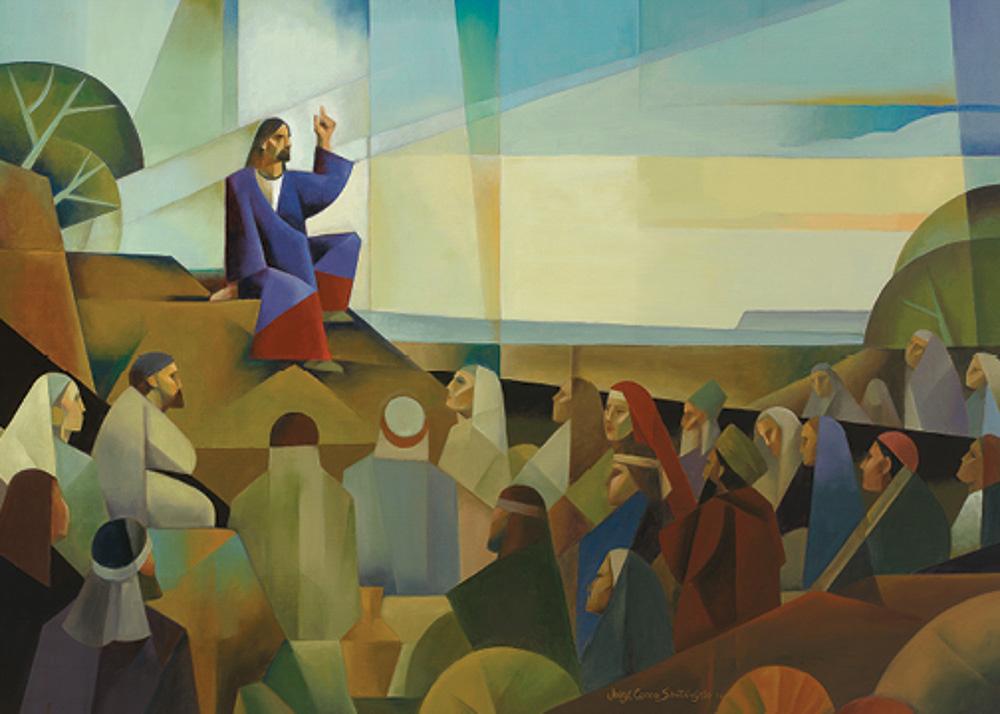
Sermon on the Mount by Argentine artist Jorge Cocco Santángelo

“You have heard that it was said, ‘You shall not commit adultery.’But I tell you that anyone who looks at a woman lustfully has already committed adultery with her in his heart. If your right eye causes you to stumble, gouge it out and throw it away. It is better for you to lose one part of your body than for your whole body to be thrown into hell. And if your right hand causes you to stumble, cut it off and throw it away. It is better for you to lose one part of your body than for your whole body to go into hell.

“It has been said, ‘Anyone who divorces his wife must give her a certificate of divorce. ’But I tell you that anyone who divorces his wife, except for sexual immorality, makes her the victim of adultery, and anyone who marries a divorced woman commits adultery.

“Again, you have heard that it was said to the people long ago, ‘Do not break your oath, but fulfill to the Lord the vows you have made.’ But I tell you, do not swear an oath at all: either by heaven, for it is God’s throne; or by the earth, for it is his footstool; or by Jerusalem, for it is the city of the Great King. And do not swear by your head, for you cannot make even one hair white or black. (New International Version)

Adultery. Divorce. Oaths. Jesus chose these topics from the Ten Commandments (7, 9, and 10) to uphold the ethical law of God.

In Christ’s Sermon on the Mount, Jesus gets to the heart of immorality and unethical behavior. The physical act of adultery arises from mental adultery. Divorce results from hardness of heart. Breaking oaths as a form of lying.

Adultery

Pornography is a 60 billion dollar a year industry, worldwide. It is the church’s problem, as well:

  • 53% of Christian men consume pornography.
  • 51% of pastors say porn is a temptation.
  • 69% of pastors started looking at porn out of curiosity.
  • 37% of pastors say it’s currently a struggle.
  • 35% of men have used pornography in the past month.
  • 4 in 10 of pastors looked at porn today.
  • There are 100,000 websites that offer illegal child pornography.
  • 90% of 8-16 year old’s have viewed porn online (most while doing homework).
  • 20% of men, and 13% of women, admit to viewing pornography at work.
  • 70 percent of all internet porn traffic occurs during the 9-to-5 workday.

Adultery initially occurs when someone feeds on mental sexual activity with another person. As with most of Christ’s solutions, he lays out a radical means of overcoming it.

Jesus is not condemning normal gender attraction, nor sex itself (which is a gift of God). Rather, Jesus condemns the leering upon another with sexual fantasy. All adulterous relationships and inappropriate sexual relations start with the “look.”

“Lust” is to intensely desire and burn for something, to seek mastery over another. The reason people stare, and lust, is not because of the other person’s manner or dress; it’s because they already have an adulterous heart. 

Whenever we are caught in physical or mental adultery, decisive and drastic action is needed. Jesus used hyperbole to drive his point home about the need of dealing with adultery. The approach is not applying a band aid; it is amputation.

The reason many men and women are snared by adultery, and seem unable to stop, is that they deal with it on their own. The radical action needed is accountability; confession must be offered.

Trying to manage lust on our own is like one individual attempting to contain a nuclear meltdown.

Jesus leaves no room to think it is okay to lust in the heart because I am not hurting anybody. Pornography enslaves its users and degrades women.

As powerful and addictive lust is, God’s grace is bigger and more powerful. There’s no need to be burdened with shame and guilt when the cross of Christ has already taken care of it.

There would not be a multi-billion dollar industry if there were not places in our hearts that are black. Now is the time for forgiveness, grace, and healing.

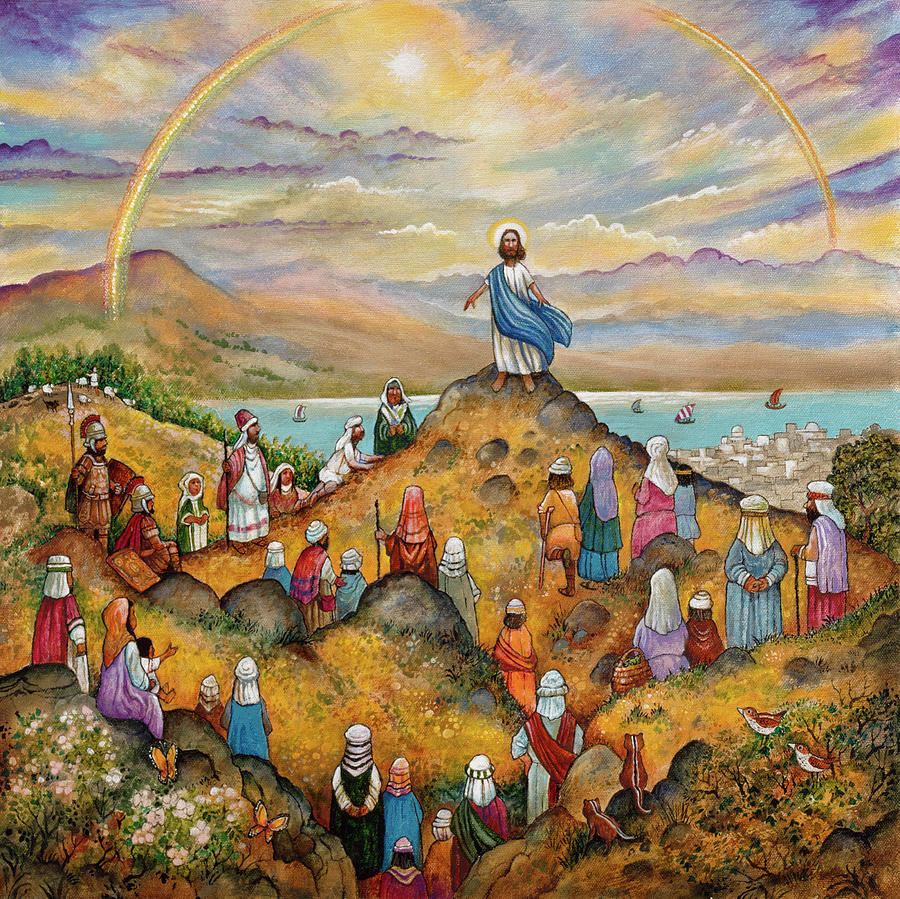
Sermon on the Mount by American artist Bill Bell

Divorce

Today in America more than one-third of all adults have experienced divorce.

Unfortunately, many divorced persons feel their faith community provided rejection rather than support and healing. There is a lot of room for improvement when to help families, and those having experienced divorce.

Please know Jesus condemns the cavalier divorce, and not all divorce. Anybody who doesn’t like their spouse doesn’t have ground for divorce. They entertain the thought of having a better spouse, even though there is no marital unfaithfulness. 

This is yet another form of mental adultery (and idolatry) which believes someone else can better meet my needs. 

Jesus clearly makes provision for divorce to occur in certain circumstances. Yet, he will not bend to liquidating a marriage over unhappiness with what God has joined together.

The intent of Old Testament legislation on divorce is to avoid a casual stance toward marriage (Deuteronomy 24:1-4). Over the centuries, people found creative ways of getting around the law. Although a divorce may be legal, it might not be ethical. Jesus wanted divorce practiced with concern for the woman, so that her rights and needs were considered.

Many took a loose view of divorce and focused solely on “indecency” as grounds for divorce. They did not interpret the term solely as sexual infidelity, as Jesus did, but had a broad understanding of indecency.

For example, if a husband did not like his wife, or, in the words of one rabbi, she continually burns the supper, he may “put her away” (divorce her). Jesus, however, insisted divorce must not happen because of a hard time getting along; or don’t love your spouse anymore; or that your spouse keeps irritating you. 

Being frustrated or unhappy are not biblical grounds for divorce. The answer to most marital problems does not lie in a new spouse, but in the hard work of identifying the idols of our hearts, overthrowing them, and re-connecting. Sin is crouching at the door, but you and I must master it.

Jesus said the ground for divorce is marital unfaithfulness, that is, any sexual activity outside the bounds of the marriage relationship. And, even in this case, divorce need not be an option, if the two people can reconcile.

Christ sought to defend women who are genuine victims. In biblical times, if a wife was given a certificate of divorce, she had four options: 1) Return to her family of origin; 2) Become a beggar; or 3) Become a prostitute to make ends meet; or, 4) Marry again, thus committing adultery if she was divorced because her husband didn’t like her. 

Jesus doesn’t take sides between spouses. Instead, he lifts the original intent of marriage: oneness. Divorce was never meant to be. Separating two people is damaging. However, it obviously occurs. (Matthew 19:1-12)

Divorce exists because of the heart’s hardness in one or both of the marriage partners. Divorce, really, is a legal testimony verifying that a separation has already occurred. It’s a recognition that disunity and non-oneness is already present. Legal divorce affirms that a terrible break already happened, damaging the people involved.

Just as God is one, two marital partners are to be one. Oneness is the primary goal of any marriage relationship. God did not institute marriage for people to live as roommates, but to be a new entity operating as one.

If God found it necessary to divorce his own covenant people, then it is inevitable divorce will occur among people (Jeremiah 3:1-8).  Therefore, let’s be discerning in how we handle each individual situation of marital difficulty.

Sermon on the Mount by Janice Elizabeth Steward

Oaths

“I swear on a stack of Bibles I won’t…” “I will, if I get around to it….” These are a few of the caveats we give when making a promise or oath. Oaths communicate our level or ability of getting it done, or not.

That’s fine. What isn’t fine is making excuses or false promises with no intention of doing what you say you will do. So, Jesus wants all the extraneous language out. Say “yes” or “no” and then follow through. And if you don’t, you’re a liar.

We often lie because we don’t want to do something to begin with. “Yes” and “no” are clear boundary words. Boundaries are needed so there is no oath-breaking.

Boundaries define where I end and someone else begins, leading me to a sense of ownership. Knowing what I am to take and not take responsibility for gives me freedom.

  • Boundaries keep the good in and the bad out. Setting boundaries involves taking responsibility for your choice of “yes” and “no” and living with the consequences.
  • Boundaries protect us from “gaslighting.” Gaslighting is a form of emotional abuse. The abuser manipulates another into doubting their thoughts, feelings, judgments, perceptions, and/or memories.
  • Boundaries hold people accountable for their words and actions. Without boundaries, we can easily feel used and mistreated.

Jesus wants us to clarify our values and live them out; make wise decisions; identify what we will accept and reject; and follow through on what we say we will do.

Conclusion

Adultery, divorce, and oaths are related. Boundaries – making and keeping promises – deals with outside forces trying to compromise our values. Accountability in naming our struggles mitigates covetousness.

Dissolved marriages and broken promises still happen. Yet, Jesus is there offering grace, not judgment. We may become emotionally damaged, however, there is healing available through the mercy of Christ. Amen.

Genesis 12:1-3 – The Blessing

a5487-wisdom2bfrom2babove

The Lord had said to Abram, “Go from your country, your people and your father’s household to the land I will show you.

“I will make you into a great nation,
and I will bless you;
I will make your name great,
and you will be a blessing.
I will bless those who bless you,
and whoever curses you I will curse;
and all peoples on earth
will be blessed through you.” (NIV)

Words are powerful.  They have the power of life and of death, of blessing and cursing. Furthermore, withholding words of blessing and keeping silent is to withhold goodness and love from another.

Speaking words of blessing and backing up those words with an active commitment, is vital to humanity’s spiritual and emotional health.

The question for Abraham, and for us, is not only how we will respond to God’s commands but how we will react to his promise of blessing, and to be a blessing. Abraham left the city of Ur because he believed in the promise God was holding out to him of blessing.  It is the promises of God, not just the commands, which change our lives.  It is the promise, not only the command, which requires a decision and a change.  The world needs promise.  And promise is powered by blessing.

The term “blessing” in Scripture is a powerful communication of God’s presence and approval.  Notice some of the elements of God’s blessing to Abraham. God said that he would show Abraham the Promised Land, that is, he would be with Abraham. Abraham was neither alone nor on his own.  God provided Abraham with a peek into a special future – he would make Abraham into a great nation. What’s more, God would bless everyone else through Abraham. God’s approval was with Abraham – “I will bless you.”  Notice, also, God’s active commitment to Abraham: He would bless those who bless him and curse those who curse him.

This blessing was passed from generation to generation, from Abraham to Isaac, Isaac to Jacob, Jacob to his twelve sons; a blessing of God’s presence, approval; a blessing of a special future, and an active commitment.  The promise of the blessing found its ultimate fulfillment in the person of Jesus, who extended the original promise to the nations. I, as a Gentile believer, have come to faith because of this blessing.

Fathers and mothers everywhere across the world stand in a unique and special position as those who have the power of bestowing a blessing on their children – a blessing of being with them, approving of them, affirming their gifts and abilities, envisioning for them a special future of how God can use them. Those words of blessing have the power to help children navigate the world with assurance and confidence. Armed with blessing, they can filter-out the choices in front of them and walk in the way of God.

Notice in the New Testament Gospels how the God the Father blessed the Son:

As soon as Jesus was baptized, he went up out of the water.  At that moment heaven was opened, and he saw the Spirit of God descending like a dove and lighting on him.  And a voice from heaven said, “This is my Son, whom I love; with him I am well pleased.” (Matthew 3:16-17).

God communicated his constant presence and an active commitment through the Spirit; God spoke words of approval and affirmation; God the Father had a special future for Jesus the Son, which helped Jesus to repel the words of Satan. Since Jesus needed and received a blessing from his Father, how much more do we?

Notice how Jesus passed on the blessing to his disciples with promise and commitment (giving them much more than only the command):

“All authority in heaven and on earth has been given to me. Therefore, go and make disciples of all nations, baptizing them in the name of the Father and of the Son and of the Holy Spirit, and teaching them to obey everything I have commanded you. And surely, I am with you always, to the very end of the age.” (Matthew 28:18-20).

Jesus let his disciples know that his presence would be with them; he communicated an active commitment to give them authority to do the job of disciple-making; he pictured for them a special future of reaching the nations; he affirmed them and approved them. “The Great Commission” is really a re-statement of God’s original blessing to Abraham.

Once we begin to view Holy Scripture through the lens of promise and blessing, we begin to see it everywhere. Perhaps one more illustration of receiving and giving blessing will assist us:

Jesus entered Jericho and was passing through.  A man was there by the name of Zacchaeus; he was a chief tax collector and was wealthy.  He wanted to see who Jesus was, but being a short man, he could not, because of the crowd. So, he ran ahead and climbed a sycamore-fig tree to see him, since Jesus was coming that way.  When Jesus reached the spot, he looked up and said to him, “Zacchaeus, come down immediately.  I must stay at your house today.” So, he came down at once and welcomed him gladly.  All the people saw this and began to mutter, “He has gone to be the guest of a ‘sinner.’” But Zacchaeus stood up and said to the Lord, “Look, Lord!  Here and now I give half of my possessions to the poor, and if I have cheated anybody out of anything, I will pay back four times the amount.”  Jesus said to him, “Today salvation has come to this house, because this man, too, is a son of Abraham.  For the Son of Man came to seek and save what was lost.” (Luke 19:1-10).

Zacchaeus was transformed.  His life changed from one of cursing others through extortion to blessing others through giving. Jesus not once commanded him to do it. Instead, Jesus simply blessed him, and Zacchaeus, in turn, became a blessing. Being invited into someone’s house in the ancient world was in and of itself an act that communicated acceptance, approval, and encouragement.  The presence of Jesus changes people.

God is with us.  He has given us his very great and precious promises in Christ.  He has demonstrated his active commitment to us by giving us the Holy Spirit.  The Holy Spirit has gifted each believer for service so that every individual may be a blessing to both the church and the world.

You and I already possess God’s blessing; there is no need to try and earn it.

We have the privilege and the ability to reverse the world’s curse and turn it into a blessing. Those blessed with money can be a blessing by giving it away. Those blessed by growing up in a loving family can provide love to others who are unloved and need a special blessing. Those blessed with wisdom can mentor and instruct those who need wisdom. Those blessed with the mercy of God can be merciful to others. Those blessed with a wonderful relationship with God can pray people into the kingdom of God.

Parents, it is never too late to bless your children, even if they are adults. Children, it is never too late to bless your parents and your siblings, even if they are prickly and hard. To not bless is to curse. Bless through words that build up, and do not tear down. Use those words to picture a special future of what God can do. Follow through with those words by demonstrating an active commitment to embodying blessing.

I leave you with a blessing, my dear readers:

May God answer you when you are in distress; and, may the name of Jesus protect you. 

May God send you help when you need it and give you support when you cry out to him. 

May the God of heaven remember all your good deeds done in faith and accept you just as you are. 

May God give you the desire of your heart and make all your plans succeed.

When the Almighty answers your prayers and goes out of the way to use you for his glory; then, I will be the first to shout with the loudest shout of joy that there ever was on the earth! 

I know that the Lord is God, and that he has a special future for you beyond what you can even ask or think.  And I will be there on the sidelines, encouraging you all the way. 

Some people trust in the political process, others trust in the strength of the economy; but we trust in the name of the Lord our God. 

May God answer when you call.

May God bless you with an everlasting love. 

May you know Christ, and him crucified, risen, and coming again. 

May God’s presence and power be with you now and forever.  Amen.

Click Blessings by Laura Story to remember that even in difficulty we are blessed.